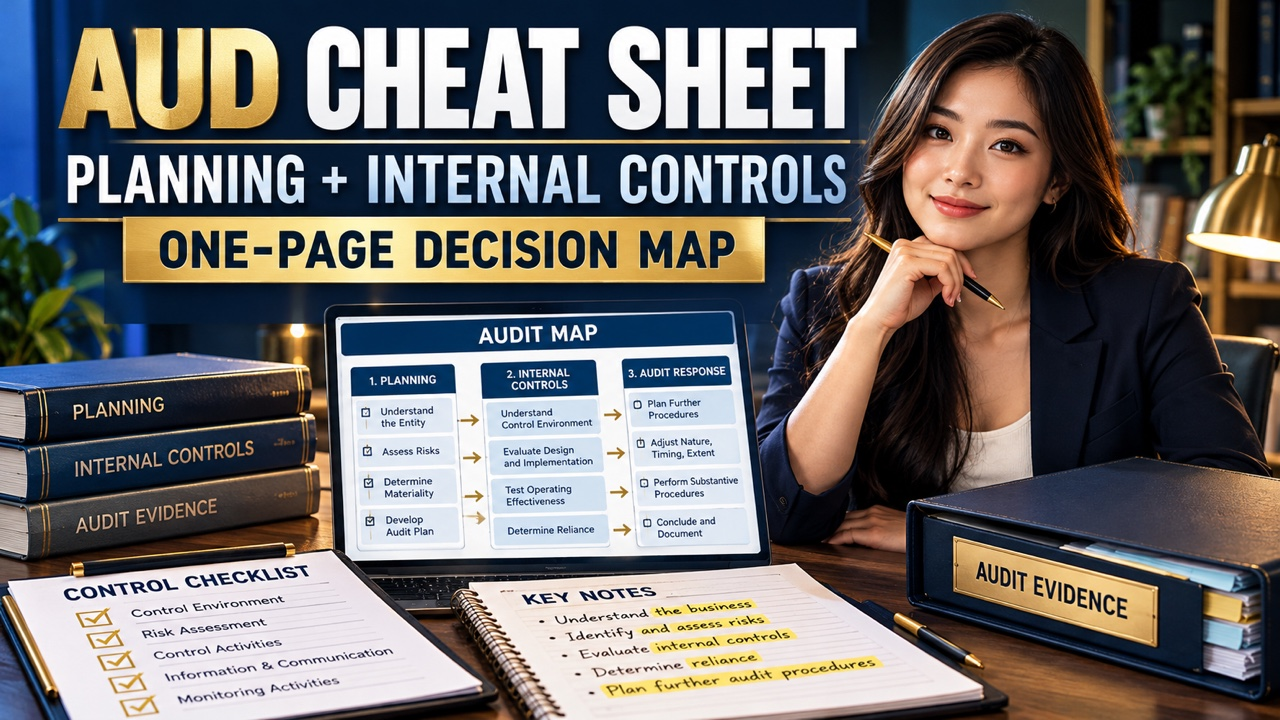

Direct answer: An internal controls cheat sheet works when it records the decision the question asks for. It also records the fact, boundary, and evidence that control that decision. Use the map below to separate planning, control design, implementation, operation, integrated-audit responsibility, and IT dependency. Then choose a response.
This is original study practice for review, not an engagement conclusion. Reopen the AICPA CPA Exam Blueprints for the current tested window. Review the AICPA AUD resources for subject orientation. Use the NASBA CPA Exam FAQ for administrative questions. Simplified facts below isolate a reasoning boundary so you can practice retrieval without treating a shortcut as a professional conclusion.
Use the AUD review hub for orientation. Read the CPA study guide for context and the Blueprint format guide for task boundaries. For recognition, use the topic MCQ page. For an evidence trail, use the TBS practice guide.
Build an internal controls cheat sheet evidence map
Start with the final sentence of the prompt. Write the requested verb in the margin: identify, evaluate, determine, recommend, or explain. An identify question needs the controlling fact. An evaluate question needs a design or operating boundary. A recommend question needs a procedure and its purpose. A familiar control label cannot answer a different verb.
Separate the six fields
Draw six short fields: decision, fact, boundary, proof, owner, and response. First, state the decision you must reach. Next, identify the controlling fact. Then set the boundary: it may be an assertion, process step, period, population, responsibility line, or current Blueprint term. After that, name the proof record or observation that could test the fact. The owner tells you who performed or reviewed the step. Finally, write the response that follows.
Keep system language and evidence language separate. One workflow may show that an approval was routed. A change record may show who tested the new rule. For example, a service report can describe a provider’s controls. The user entity still owns a complementary review. Therefore, this separation keeps an internal controls cheat sheet from treating a noun as proof.
Write the boundary before the explanation
When a prompt mixes risk, control, integrated-audit evidence, and IT dependency, circle the field that limits the answer. If the issue is an access review, an invoice approval story may be context rather than the answer. If the issue is a change in an automated rule, start with the effective date. The affected population may control the response more than the policy title.

Set the internal controls cheat sheet scope
Choose one decision type, one evidence record, and one fact you can change later. A narrow block makes a miss useful. If the block covers every control in a section, a wrong response cannot tell you which boundary to reopen. Record the source checkpoint date and leave a blank line for a current rule or Blueprint note.
Use three timed windows
Give yourself a reading window, a commitment window, and a review window. First, mark the task verb and controlling fact. Next, select a response and write the evidence record you would inspect. Finally, challenge the closest option and state the one fact that would change your response. A late answer that is not logged does not teach you what to repeat.
Choose evidence for the internal controls cheat sheet answer
Prefer a record with a period, population, owner, or assertion when that detail changes the conclusion. Sometimes a report with no scope is relevant but insufficient. A current access list may show the population, while a review sign-off shows operation. Meanwhile, a change ticket may establish implementation. Test evidence then establishes whether the control operated after the change.
Make an internal controls cheat sheet case card
For every item, write a two-line case card. Use “The controlling fact is ___” and “The proof I would seek is ___.” Add the responsibility boundary when a service organization, complementary control, or IT dependency appears. In practice, this keeps the card concrete and stops a broad phrase such as “test the control” from becoming the entire answer.
Run three internal controls cheat sheet cases
Attempt each case before opening the rationale. The choices are original practice written to expose a missing field. Write the task verb, controlling fact, boundary, proof, and closest distractor in your own words.
Reveal the evidence-map reasoning
Attempt the three original cases first. Write the decision, controlling fact, boundary, owner, and evidence record before opening the rationale.
Reveal the answer
Answer: Compare your note with the rationale, name the closest distractor, and change one fact before retrying. Keep the evidence record in words instead of an answer letter.
Compare your process with the reasoning shown above.
Northstar: an automated approval threshold changes
Facts: Northstar Foods moves purchase approvals from a shared mailbox into a rules-based workflow in August. The approval policy still names the same manager. However, the change record does not show who tested the new threshold, which invoices moved, or how exceptions reached a person.
Question: What should you establish before choosing an audit response?
- Accept the old policy description because the manager did not change.
- Conclude that the control failed solely because technology changed.
- Identify the effective date, affected population, rule owner, exception route, and evidence that the new approval operated.
- Test only the last month because it is closest to the reporting date.
Answer and rationale: Choice 3 is strongest. The unchanged label does not prove implementation or operation, and the final month does not define the population affected by the August change. The response should name the rule owner, period split, exception path, and workflow evidence. Choice 1 confuses design wording with proof; choice 2 treats a change as a conclusion; choice 4 may miss the earlier population.
Meridian: a service report meets a user-entity review
Facts: Meridian Health uses a service organization for claims processing and changes the employee who reviews user access exceptions. The file includes a service report. Yet it does not state the report period, the complementary user-entity control, or how the new reviewer followed up exceptions.
Question: Which response preserves the responsibility boundary?
- Accept the service report as a substitute for Meridian’s review.
- Define the report scope, identify Meridian’s owner, and test the changed review record before relying on a conclusion.
- Reject every provider record without reading its control description.
- Draft the conclusion and document the responsibility split afterward.
Answer and rationale: Choice 2 is strongest. A report can be useful evidence, but it does not transfer management’s responsibility or prove the complementary control. Record the report period, scope, Meridian owner, exceptions, and follow-up evidence separately. Choice 1 transfers judgment, choice 3 uses an absolute rule, and choice 4 documents the boundary too late.
Clearview: one IT access exception has three meanings
Facts: Clearview Manufacturing finds an access exception in a privileged role. The note does not distinguish a design gap, an implementation gap, or an operating-effectiveness gap. One changed fact could be the role owner, the affected population, or a missing review record.
Question: What is the best next study action?
- Repeat the item until the answer letter feels familiar.
- Change one material fact, state whether the response changes, and name the effectiveness question that controls it.
- Delete the item because the exception is ambiguous.
- Add a larger mixed set before repairing the missing field.
Answer and rationale: Choice 2 tests transfer. If moving the role owner or population changes the response, the first answer depended on an unstated fact. Write the new fact and the record that would verify it. Choice 1 rewards recall, choice 3 discards a useful signal, and choice 4 adds volume before the proof gap is named.
Read the nearest distractor as a missing field
A distractor can contain a true sentence and still answer the wrong task. Read it as a claim that needs a proof field. If it skips the period, population, assertion, owner, or evidence record, write the missing noun. This makes the explanation portable to a new case.
When a policy label sounds complete
“The policy requires approval” may describe design, but it does not show that a revised workflow was implemented or operated. Ask what changed, who owned the change, which items were affected, and which system record could demonstrate operation. If an option cannot answer those questions, it is a shortcut.
When outsourced evidence is overtrusted
“The provider issued a report” may be relevant, but the report period, scope, complementary control, and exception follow-up still matter. Keep provider evidence and user-entity responsibility in separate fields. The internal controls cheat sheet method treats both as facts to verify rather than as automatic permission or rejection.
When an IT label hides the audit question
“The access list was reviewed” does not reveal who approved access. It also hides the population and relevant review period. Name the reviewer, population, role change, and evidence of follow-up. The right answer may be a scope repair, an implementation test, or an operating test depending on that missing field.
Repair the first internal controls cheat sheet gap
Classify the first missing proof point as scope, fact, rule, evidence, responsibility, or transfer. Choose one bounded repair before another mixed set. Reopen one source or record. Write the boundary in your own words, then retry one case with a single changed fact.
Change one fact only
Move one effective date, switch one access owner, or remove one operating record while leaving the rest of the case fixed. State whether the response changes and why. If it survives, record the evidence that made the transfer possible. If it fails, narrow the case before adding another mixed set.
Route the repair to the right practice mode
Use the topic MCQ page when recognition is slow. Turn to the TBS practice guide when the missing skill is an exhibit or evidence trail. Return to the AUD review hub when the boundary is unclear. A next mode chosen from the missing field is more useful than adding questions by habit.
Reopen current boundaries
Blueprint language and professional guidance can change. Keep a checkpoint date beside any source-based note and reopen the AICPA or NASBA page before reusing it. The cases here train a reasoning path; they do not settle a live engagement or a current administrative rule.
Turn the internal controls cheat sheet into a workpaper
Close every session with a small ledger. Record the task verb, controlling fact, boundary, record checked, response, closest distractor, owner, period, and changed-fact result. The ledger shows whether the gap is recognition, application, evidence selection, responsibility, or transfer. That diagnosis should determine the next practice mode.

Use an internal controls cheat sheet decision-to-evidence line
Write one sentence that connects the response to proof. Use: “Because ___ controls the decision, I would inspect ___ for ___ period and ___ population.” This line makes a vague recommendation testable. If the sentence cannot name a record, the next repair is probably evidence or scope rather than speed.
Keep the response proportionate
A changed control may require a period split, a population check, a change-owner interview, or an operating test. However, do not jump from “technology changed” to “the control failed.” Do not accept “the policy is unchanged” as proof that nothing changed. As a result, the proportional response follows the fact and the boundary.
internal controls cheat sheet checklist
- Copy the task verb and write the requested decision.
- Choose one narrow risk, control, process step, or IT dependency.
- Record the controlling fact and the boundary that gives it meaning.
- Name the record, owner, period, population, or assertion that matters.
- Attempt an original case before reading its rationale.
- Explain why the closest distractor fails and name its missing field.
- Change one fact and state whether the response changes.
- Select MCQ, TBS, or source review from the first missing proof point.
- Reopen a current source before reusing a time-sensitive note.
Overall, a strong internal controls cheat sheet is an evidence habit: state the decision, isolate the fact, verify the boundary, explain the action, and test transfer. In short, let the missing field choose the next review.
internal controls cheat sheet FAQ
Are these authority questions?
No. The cases, choices, and rationales are original editorial practice. Use current AICPA materials for scope and tested language.
What should I write when I miss a case?
Write the controlling fact, the boundary or record to verify, the closest distractor, and one changed-fact retry. If you cannot name the proof, keep the repair at scope or evidence before adding volume.
Should I add more timed questions immediately?
Only after the first missing proof point is repaired. More volume without a repair can preserve the same error, while a bounded retry tells you whether the reasoning transferred.
Does this method promise a passing result?
No. It creates observable study evidence and a focused next action; official rules, preparation, and performance determine the result.