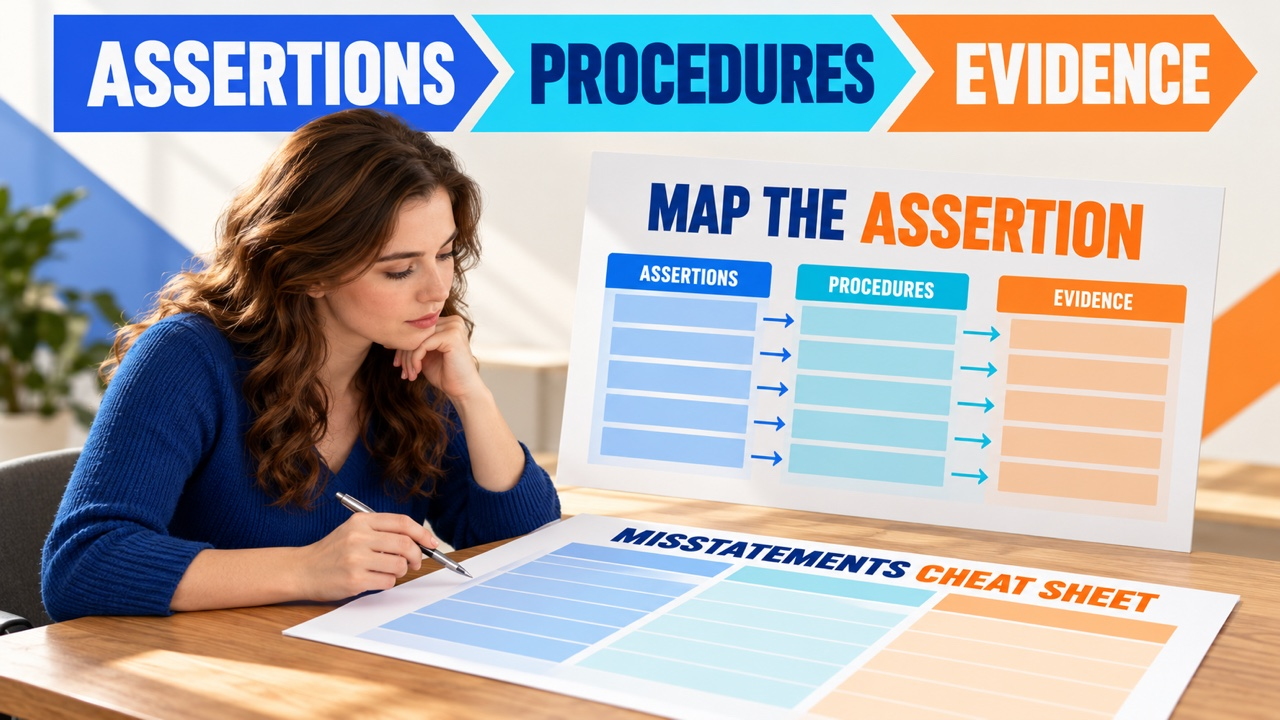

Direct answer: Use assertions procedures evidence as one decision chain: name the assertion, select a procedure that can test it, judge the evidence against the risk, and decide whether the exception is a misstatement. This cheat sheet gives original U.S. CPA AUD practice with a reasoned answer and one next repair action. It does not promise a score or replace current authoritative guidance.
Scope and freshness note: This is original editorial study material, not an exam-authority publication. Reopen the AICPA CPA Exam Blueprints for the testing window, the AICPA AUD resources for current subject boundaries, and the NASBA FAQ for eligibility, scheduling, jurisdiction, or score questions.
Start with the AUD review hub for section orientation. Use the CPA study guide for a broader route, the Blueprint format guide for task boundaries, and the topic MCQ page or TBS practice guide when a different retrieval mode is needed.
For a broader preparation path, continue with our related CPA study resources.
AUD Assertions, Procedures, and Evidence: Misstatements Cheat Sheet
The exam skill is not memorizing a list of procedures. It is matching an assertion to a risk, choosing evidence that can address that risk, and explaining how an exception changes the conclusion. A procedure can be well designed yet answer the wrong assertion. Evidence can exist yet be too limited, too late, or too indirect for the decision. The chain is complete only when the fact, assertion, procedure, evidence, and misstatement conclusion fit together.
Every item below is original practice. These assumptions are simplified study facts. The current Blueprint controls the tested scope, while current professional guidance controls a live engagement. These scenarios are original editorial practice; they are not official, recalled, leaked, or exam-memory questions.
Assertions Procedures Evidence: Difficulty and timing assumptions
Use moderate difficulty first. Give yourself a short reading window, a decision window, and a review window. If you can name a procedure but cannot state the assertion or evidence limitation, stop the clock and record that missing proof point. A clean explanation matters more than a fast answer letter.
Set the assertions procedures evidence boundary
Before attempting a question, write the decision verb. “Identify” asks you to locate the relevant fact. “Evaluate” asks you to judge evidence against a criterion. “Recommend” asks you to select the next action after considering the evidence. The same document can support different conclusions when the task changes.
Then write four short lines: assertion, risk, procedure, evidence. Add a fifth line only when the evidence shows an exception: misstatement or no misstatement, with the reason. This compact note prevents a familiar procedure from becoming an automatic answer. It also makes the next review action visible.
For example, an invoice population may raise completeness, while a signed receiving report may support occurrence or cutoff. A recalculation may test a valuation input, but it does not prove that management owns the underlying estimate. The procedure must fit the claim that the question asks you to evaluate.

Assertions Procedures Evidence: What to record before seeing an answer
Save the task statement, the controlling fact, the relevant boundary, the chosen procedure, and the evidence you would inspect. Predict the strongest distractor before revealing the rationale. If the distractor sounds attractive because it is a familiar audit step, write why it does not answer the stated assertion.
Separate evidence strength from evidence relevance. A document can look persuasive while leaving the key assertion untouched. Conversely, a simple external confirmation can be more relevant than a larger internal file when the risk concerns existence. State what the item can prove, what it cannot prove, and what would close the remaining gap.
Run original assertions procedures evidence practice
Attempt each scenario before opening its rationale. For every item, underline one fact that changes the decision. Then select the answer that links the assertion to a procedure and to evidence that can actually support the conclusion.
Reveal the reasoning
Attempt each original item first. Write the assertion, procedure, evidence check, and likely distractor before opening the explanation.
Reveal the answer
Answer: Compare your note with the rationale, mark the first missing proof point, and change one fact before retrying.
Compare your process with the reasoning shown above.
Scenario 1: existence versus completeness
Fact pattern: Northstar Office Supply reports a large year-end accounts receivable balance. The staff member proposes vouching recorded invoices to shipping documents. A separate note says several customers paid shortly after year-end, but the population contains a few credit memos issued in January.
Question: What is the best first response when the stated risk is that receivables are recorded but did not occur?
- Trace later cash receipts to the ledger and ignore the original invoice population.
- Vouch selected recorded receivables to shipping documents and investigate the January credit memos as possible evidence about the year-end balance.
- Search only for unrecorded liabilities because all year-end cut-off issues are liabilities.
- Accept the balance because post-year-end cash was collected.
Answer and rationale: Choice 2 best links the occurrence assertion to recorded items and source evidence. The shipping document supports whether the sale occurred, while the credit memos may reveal a condition that existed at year-end. Later cash can provide corroboration, but it does not by itself prove every recorded sale occurred. Choice 3 changes the assertion. Collection alone treats post-year-end payment as conclusive when it is only one relevant fact. Save the selected invoices, shipping dates, and credit-memo cause in the evidence note.
Scenario 2: valuation and the limit of a recalculation
Fact pattern: Maple Grove Health estimates a claims reserve. The audit file contains a spreadsheet that recalculates the formula correctly. The historical loss rate, however, was changed after a new state reporting rule and the file does not explain why the rate remains appropriate.
Question: Which response addresses the valuation risk most directly?
- Conclude that valuation is supported because the spreadsheet adds correctly.
- Agree with management because the historical rate was used in prior years.
- Evaluate the changed rule, the data supporting the loss rate, and the reasonableness of the estimate before relying on the recalculation.
- Replace the reserve with the auditor’s preferred number without documenting the evidence.
Answer and rationale: Choice 3 is strongest. A recalculation confirms arithmetic, but valuation also depends on the inputs and the reason those inputs remain suitable. Mathematical accuracy does not validate the estimate inputs. Prior use of the rate is weak support when a reporting rule changed. Replacing the reserve with an unsupported preferred number also moves the judgment without evidence. Record the new rule, the population used for the rate, the sensitivity of the estimate, and any unresolved exception.
Scenario 3: completeness and an unrecorded invoice
Fact pattern: Copperline Energy receives a vendor invoice on January 8 for maintenance completed on December 28. The invoice was not entered until January 12. The controller says the amount is below the normal posting threshold, but the engagement team is testing completeness of year-end expenses.
Question: What should the learner do next?
- Ignore the invoice because it is below the posting threshold.
- Record the item as a confirmed misstatement without considering the threshold, population, or reporting effect.
- Trace the service date and receiving evidence, compare the amount with the applicable threshold and aggregation policy, and assess whether a year-end adjustment or summary of uncorrected misstatements is needed.
- Move the invoice to the next period because it was received after year-end.
Answer and rationale: Choice 3 keeps the completeness assertion, cutoff fact, and reporting effect together. A posting threshold cannot replace the completeness analysis. Recording a misstatement before considering aggregation also skips a material step. Moving the invoice because it arrived after year-end confuses receipt date with service period. Save the service completion date, approval trail, threshold, aggregation, and proposed conclusion in the evidence note.
Assertions Procedures Evidence: Read the rationale and distractor
After an attempt, compare your note with the rationale in the same order. First, identify the assertion that controls the item. Next, name the procedure that can produce relevant evidence. Then ask whether the evidence is sufficient for the risk and whether the exception changes the misstatement conclusion. Finish by stating why the strongest distractor answers a different question.
A common error is to treat any plausible audit step as interchangeable. Vouching from the ledger to source documents generally answers a different direction from searching source documents for items missing from the ledger. A confirmation may support existence, but it does not automatically resolve valuation or cutoff. A recalculation may test arithmetic, but it does not validate a changed assumption. Write the boundary in plain English before you mark the answer.
When a fact is current-sensitive, record its date and reopen the official source before reusing your note. This keeps original practice separate from authoritative scope and prevents a remembered rule from silently becoming a current claim.
Choose the next assertions procedures evidence repair
Classify the first missing proof point as scope, fact, rule, evidence, or transfer. Choose one bounded repair before another mixed set. The repair should change what you do next, not merely add more reading.
For a scope gap, reopen one current Blueprint row and write its decision verb. With a fact gap, mark the date, population, role, or exception that controls the item. An evidence gap calls for the exact document or external source that would close it. If transfer is the gap, change one material fact and state whether the procedure or conclusion changes.

Use the second visual as a decision record: map the assertion, select the procedure, evaluate the evidence, quantify any misstatement, and state the conclusion. It is a study aid, not an official answer key.
Assertions Procedures Evidence: Make the cheat sheet repeatable
Use one evidence note for every session: Blueprint row, decision verb, controlling fact, assertion, procedure, evidence source, distractor rejected, misstatement effect, and changed-fact result. Review the note before the next set. If the same missing line appears twice, narrow the topic instead of increasing volume.
Also separate official scope from original practice. The AICPA pages define the tested boundary. The questions, explanations, visual boards, and repair actions here are independently written. When source exhibits are the problem, move to the TBS practice guide. When rapid recognition is the problem, use the topic MCQ page. The format should follow the skill you need to repair.
assertions procedures evidence checklist
- Write the task statement’s decision verb.
- Name the assertion and the specific risk.
- Select a procedure that can address that risk.
- State what the evidence proves and what it cannot prove.
- Identify the exception, if any, and assess the misstatement effect.
- Reject the strongest distractor in a complete sentence.
- Change one fact and explain whether the response changes.
- Save one focused next review action.
Overall, a strong assertions procedures evidence routine is evidence-based. State the scope, isolate the fact, choose the matching procedure, evaluate the evidence, explain the misstatement effect, and show transfer before adding more volume.
Frequently asked questions
Are these official exam questions?
No. The scenarios and rationales are original editorial practice. Use current AICPA sources for authoritative scope and terminology.
Why does a correct procedure still produce a weak answer?
Because the procedure may address a different assertion, use evidence that is too indirect, or ignore a changed fact. Name the claim and the evidence boundary before relying on the step.
What should I record when I miss an item?
Record the controlling fact, the assertion, the procedure you chose, the evidence you should verify, the distractor you rejected, and one changed-fact retry.
Does this method promise a passing result?
No. It creates observable study evidence and a focused next action; current rules, preparation, and performance determine the actual result.
Sources
- AICPA CPA Exam Blueprints
- AICPA AUD resources
- NASBA CPA Exam FAQ
- AUD review hub
CPA exam questions
Are these official exam questions?
No. The scenarios and rationales are original editorial practice; use current AICPA sources for authoritative scope.
What should I record when I miss an item?
Record the controlling fact, the boundary or exhibit, the rejected distractor, and one changed-fact retry.
Should I keep adding more timed items?
Only after the first missing proof point is repaired; more volume without a repair can preserve the same error.