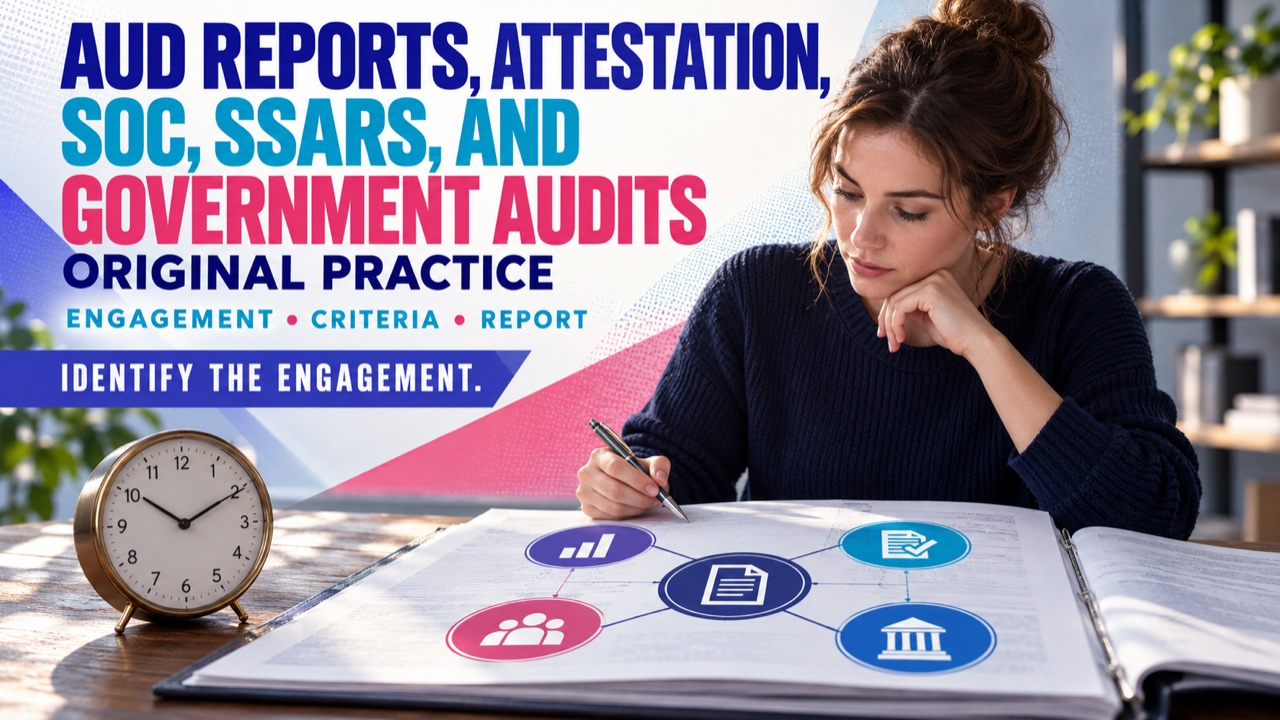

Direct answer: audit reports practice work best when you trace the requested service from engagement to report instead of matching one familiar label. Write the engagement, criteria, responsible party, evidence boundary, and requested communication before choosing an answer. Then change one fact and explain whether the conclusion changes. The drills below use original scenarios so you can practice the reasoning without treating them as exam-authority items.
Scope note: This is independent study material for U.S. CPA AUD candidates. The examples simplify professional situations for practice. Reopen the AICPA CPA Exam Blueprints for the current testing window, the AICPA AUD resources for subject boundaries, and the NASBA CPA Exam FAQ for eligibility, scheduling, jurisdiction, or score questions.
Use the AUD review hub to orient the section. If your gap is retrieval speed, switch to the topic MCQ practice; if the gap is evidence mapping, use the TBS practice guide. Keep this page for the narrower decision: which engagement and report response does the fact pattern actually support?
For a broader preparation path, continue with our related CPA study resources.
AUD audit reports practice: use an engagement-to-report trace
The word “report” is not the answer. First determine who requested the work, who owns the subject matter, which criteria make a conclusion possible, and whether the practitioner obtained the evidence the requested service requires. A SOC description, an attestation engagement, a SSARS service, and a government audit can all contain the word “controls,” yet they do not create the same responsibility or communication.
Use a five-line trace sheet during every attempt:
- Engagement: identify the service and the task verb.
- Criteria: name the framework, requirement, or government criterion used to judge the subject matter.
- Responsibility: record the responsible party and intended users.
- Evidence: mark what was obtained, what is missing, and whether a restriction limits the conclusion.
- Report: choose the communication that matches the first four lines; add a modification only when the changed fact requires it.
This trace stops a common error: selecting a report name from memory and then forcing the facts to fit it. In the drills below, the strongest distractor is usually a true statement that answers a neighboring question. Your job is to say why it does not answer this question.
Set the practice assumptions
Set a 90-second read, a 60-second decision, and a 90-second rationale review for the first round. The goal is a defensible note, not a high raw count. Write the task verb exactly as it appears in the prompt: identify, distinguish, evaluate, or select. If a question asks for report wording, a definition of the service is only an intermediate step.
For this practice set, assume that the facts are complete unless the scenario says a criterion, responsibility, population, or evidence item is missing. Treat every question as original editorial practice. Never infer that an item is drawn from an exam memory. When a current standard or exam boundary matters, pause and reopen the official source before reusing the note.

How to read the first visual: move from the assertion or requested service to the procedure, the evidence obtained, the exception, and the conclusion. The lower labels are a reminder to check engagement, criteria, responsibility, and restriction before you select report wording.
The note that makes a distractor visible
Write two sentences before opening an answer explanation. Sentence one names the controlling fact. Sentence two names the fact that would have to change for the answer to change. For example, “The request is a preparation engagement; management retains responsibility for the statements. If assurance is requested, the service boundary changes.” That pair is more informative than circling option B and moving on.
Also mark the evidence status as shown, missing, or restricted. “Missing” means you need another fact. “Restricted” means the limitation may affect the conclusion or report. Do not treat those labels as synonyms; the next repair differs.
Run the original practice
Attempt each scenario without looking at the rationale. On paper, draw five short lines for the trace sheet. After you commit to a response, write the strongest competing choice and the fact that defeats it. The answer reveal below is deliberately delayed so the act of retrieving the rule remains part of the exercise.
Reveal the reasoning
Attempt the original item first. Write the controlling fact, the boundary or evidence check, and the reason you would save before opening the explanation.
Reveal the answer
Answer: Compare your note with the rationale, mark the first missing proof point, and change one fact before retrying. Do not use a raw answer letter as the study record.
Compare your process with the reasoning shown above.
Scenario 1: a SOC request with an unnamed criterion
Fact pattern: North Harbor Payroll asks for a report on its controls over a hosted payroll platform. The client supplies a control narrative and a list of user entities, but management has not identified the criteria used to evaluate the controls. A sales deck calls the request a “SOC audit.”
Question: What should you establish first?
- Use the sales deck label and select the most familiar SOC report.
- Identify the intended users, the control criteria, and the service requested before choosing a report response.
- Assume the controls are effective because the narrative is detailed.
- Issue a scope limitation immediately without asking what criteria apply.
Answer and rationale: Choice 2 is strongest. Without criteria and intended users, the report objective is not defined. One distractor mistakes a marketing label for an engagement definition. Another shortcut treats a description as evidence of operating effectiveness. The final option jumps to a conclusion before testing whether the missing information can be obtained. Trace note: write “criteria not identified” as the first missing proof point, then list the question you would send to management.
Scenario 2: a SSARS preparation request with assurance language
Fact pattern: Cedar Ridge asks a practitioner to assemble financial statements from a trial balance. The owner wants the cover email to say that the statements are “verified” and asks the practitioner to correct an inventory balance without documenting the source of the correction. Management will distribute the statements to a lender.
Question: Which response protects the engagement boundary?
- Add verification language because the lender will rely on the statements.
- Clarify the preparation scope, keep management responsible for the statements, and request support for any proposed correction.
- Refuse every adjustment even when management supplies reliable support.
- Use an audit opinion because a lender is an intended user.
Answer and rationale: Choice 2 fits the facts. A lender’s reliance does not transform preparation into assurance, and the practitioner should not assume management’s responsibility for unsupported amounts. One distractor creates assurance by wording. Another option turns a documentation issue into an absolute prohibition. The final option confuses an intended user with an audit engagement. Changed fact: if Cedar Ridge later requests limited assurance and supplies defined criteria, rewrite the trace before selecting any communication.
Scenario 3: a government audit with a population restriction
Fact pattern: Metro County receives a federal transit grant. The engagement uses the grant’s compliance requirements as criteria, but the county cannot produce payroll records for one quarter because the vendor archive is unavailable. The missing records cover a material portion of the questioned-cost population.
Question: What should drive the report decision?
- Ignore the missing quarter because the remaining records are complete.
- Describe the restriction, assess its effect on the conclusion, and select wording that matches the resulting limitation.
- Replace the grant criteria with management’s internal budget.
- Call the engagement an ordinary financial-statement audit and continue.
Answer and rationale: Choice 2 is correct because the restriction affects the evidence available for the stated government criteria. One distractor assumes completeness without support. Another option changes the measuring stick. The final option changes the engagement type rather than resolving the limitation. Changed fact: if the archive is restored and the records cover the population, remove the restriction from the trace and reassess the report response.
Audit reports practice: read the rationale as an error map
Do not read the explanation as a paragraph to memorize. Sort it into four lines: controlling fact, evidence or criteria, rejected distractor, and changed-fact test. If the explanation names a responsibility owner, copy that owner into your note. If it names a restriction, write whether the restriction is removable or report-changing.
The most persistent AUD mistake in this cluster is collapsing different forms of communication into one imagined “audit report.” An attestation report depends on the subject matter and criteria. SOC work depends on its intended users and control criteria. SSARS service depends on the level of service and management’s responsibility. Government audit work may carry a compliance criterion and a population restriction that changes the conclusion. Therefore, the labels are clues; the trace sheet is the decision.
When an option sounds familiar, ask one extra question: Which line of the trace does this option actually answer? If it answers only the service name while the prompt asks for report wording, it is a neighboring truth, not the best answer.
Choose the next practice repair
North Harbor needs a criteria and intended-user note before any SOC report comparison. Cedar Ridge needs a clean separation between preparation support and assurance language, plus a management-responsibility note. Metro County needs a model showing how the unavailable population affects evidence and report wording. Consequently, each repair is bounded: one source check, one sentence in your own words, and one changed-fact retry.

Use the second visual as a changed-fact test: start with the fact, identify the assertion and amount, decide whether an adjustment is needed, and then reassess the report response. The conclusion belongs at the end of the trace.
Audit reports practice: make the trace reusable
After a session, keep one compact record: task verb, engagement, criteria, responsible party, intended users, evidence status, report response, rejected distractor, and changed-fact result. Add the date of the source you checked when a blueprint or professional boundary may change. On the next day, cover the report line and reconstruct it from the first four lines.
Use a three-pass rhythm. The first pass is classification: fill the trace without timing pressure. The second pass is transfer: change the criterion, responsibility, or evidence boundary and predict the new response. A final pass is communication: say the conclusion in one sentence that a user could understand. Instead, if transfer fails, return to the line that moved instead of adding a larger question bank.
AUD audit reports practice checklist
Use these audit reports practice as a trace exercise: the next action is the first blank line, not a larger score target.
- Did I copy the task verb before reading the choices?
- Did I name the service rather than rely on a label such as “SOC audit”?
- Did I identify the criteria and intended users?
- Did I keep management or the responsible party in the correct role?
- Did I mark evidence as shown, missing, or restricted?
- Did I explain why the strongest distractor answers a neighboring question?
- Did I change one fact and retest the conclusion?
- Did I write one next source check instead of adding random volume?
AUD audit reports practice FAQ
Are these actual CPA exam questions?
No. They are original editorial practice scenarios. Use the AICPA Blueprints and current professional guidance for scope and terminology.
Why do criteria matter so much?
Criteria provide the measuring stick for the subject matter. Without them, a control description or financial statement claim cannot by itself tell you which conclusion or report response is supported.
What should I do after a wrong answer?
Keep the wrong answer, name the first missing trace line, reopen one source, and retry with one changed fact. The repair record is more useful than immediately starting a larger mixed set.
Audit reports practice sources
- AICPA CPA Exam Blueprints — reopen for the active testing window.
- AICPA auditing and attestation resources — reopen for current subject boundaries.
- NASBA CPA Exam FAQ — use for eligibility, scheduling, jurisdiction, and score questions.