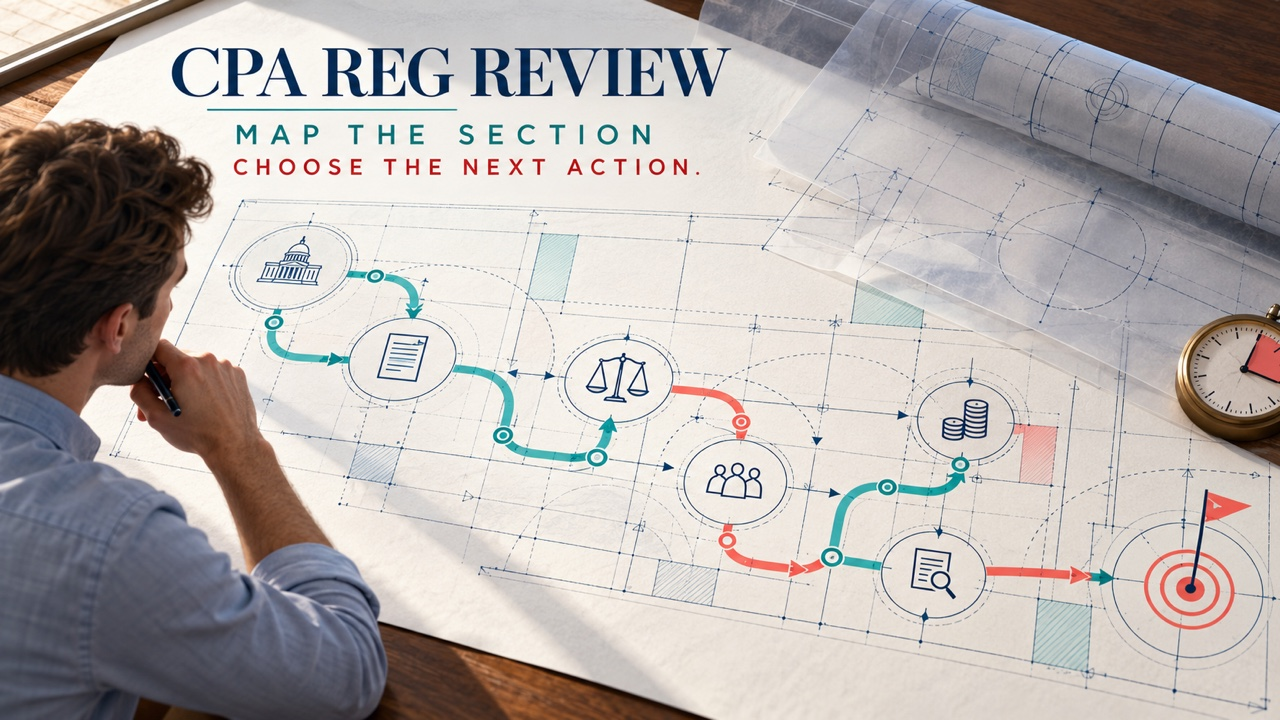

Direct answer: cpa reg prep works better when one study block has a visible job. Pick one current REG Blueprint row, place it on a four-part triage board, and decide what evidence would prove the skill. The board should name the topic, the fact that changes the result, the source that defines the boundary, and the practice output you will produce. That sequence turns a large section into a next action you can finish.
Scope and freshness note: This is original editorial guidance for U.S. CPA candidates. It is not an exam-authority publication, tax advice, a legal conclusion, a licensing decision, or a personal readiness score. Reopen the AICPA CPA Exam Blueprints for the active testing window, the IRS tax resources for current tax material, and the NASBA CPA Exam FAQ for administration questions.
Use the REG review hub when you need the section doorway. Open the Blueprint format guide when a task statement is hard to parse. Choose the topic MCQ page for rule recognition and the TBS practice guide when your missing skill is assembling exhibits, calculations, or a documented response.
For a broader preparation path, continue with our related CPA study resources.
cpa reg prep: build the triage board first
A section label is too broad to guide a study session. Start with a small board, whether it lives in a notebook or a plain text file. Put the Blueprint row at the top, then answer four questions in order:
- What is the task? Copy the task statement and circle its action verb: calculate, classify, determine, evaluate, or explain.
- What can move the answer? Name the controlling fact, such as entity type, ownership percentage, filing date, authority, or procedural trigger.
- Where is the boundary? Record the official source, exhibit, or rule section you would reopen before trusting the note.
- What output will prove transfer? Decide whether you need an MCQ explanation, a TBS-style workpaper, or a short changed-fact comparison.
The board is deliberately small. A crowded list creates the feeling of coverage while hiding the one fact you still cannot use. When the controlling fact is missing, the next action is source reading. If the source is clear but the output is weak, the next action is practice. When the output is correct only under one wording, the next action is a changed-fact retry.
cpa reg prep: turn a Blueprint row into a working card
Read the current row as a work order rather than a chapter heading. Write the section, area, group or topic, task statement, skill level, reference, and item type on one card. Then add a sentence beginning “The answer changes when…” and finish it with the fact you intend to vary. This sentence is a useful guardrail against memorizing a rule without its trigger.
REG questions often feel unrelated because the surface nouns change. The underlying work can still be sorted into four lanes:
- Tax computation lane: identify the taxpayer and transaction, then locate the basis, income, timing, deduction, credit, or limitation fact that controls the calculation.
- Business-law lane: identify the parties, authority, agreement, filing or priority fact, and remedy the prompt asks you to select.
- Ethics and responsibility lane: separate the practitioner’s duty, reliance boundary, disclosure or record obligation, and any deadline that activates the procedure.
- Procedure and application lane: pair the notice or authority with its date and requested response. A deadline without its trigger is an incomplete note.
These lanes are sorting prompts, not a replacement for the current source. If a row crosses lanes, write the crossing explicitly. For example, an entity question may require both a tax classification and a filing consequence. The board should show which fact moves first and which consequence you will test second.
Use the REG topic-to-action route
Once the row is on the board, move it through a five-stop route. Leave one short artifact at every stop so a study partner could reconstruct the decision without guessing what you meant.
- Locate: copy the exact row and mark the task verb. Avoid opening every neighboring topic before this row has a job.
- Trigger: write the fact, date, role, amount, or authority that can change the response. If you cannot name it, mark the row for source work.
- Anchor: reopen the official or technical source and paraphrase only the boundary you need. Save the checkpoint date beside the note when the material can change.
- Demonstrate: choose an item format whose output matches the skill. A recognition gap needs a reasoned MCQ; an assembly gap needs a TBS-style workpaper.
- Vary: change one material fact and state whether the response changes. If it does not change, explain why; if it does, identify the exact handoff that moved.

The section map above is a decision aid, not a scorecard. A good route ends with a concrete handoff such as “reopen the ownership rule, then complete one basis MCQ” or “build a two-field TBS workpaper using the filing date as the changed fact.” A vague instruction such as “review REG more” does not identify the next proof.
Run the REG review route checklist
Use the checklist after one focused block, not as a promise that every topic is finished. Mark an item only when you can explain it from the current row and source. The first unchecked line is the next repair ticket.
Decide between MCQ and TBS with a deliverable test
Choose the format by the output you cannot yet produce. If you can explain the rule after seeing the answer choices but cannot recognize it in a new fact pattern, use a short original MCQ set and write why the strongest distractor fails. Keep the task verb and controlling fact visible beside each explanation.
If you know the rule but lose the response while moving between exhibits, numbers, and roles, use a TBS-style workpaper. List the input, the transformation, the assumption, and the conclusion in separate lines. The workpaper is useful even when it is not graded because it shows where the handoff broke.
Match the practice mode to the proof needed
For a taxpayer-classification question, the proof may be a one-sentence classification plus the fact that activates it. A business-law question may instead need a party-authority-remedy chain. Procedure questions often need a notice-date-trigger-response chain. The practice type follows the proof, so a large mixed set is rarely the first repair.
cpa reg prep: log misses as repair tickets
After every attempt, record five lines: task verb, controlling fact, source or exhibit, strongest wrong turn, and next action. Add a sixth line when the topic is current-sensitive: the source checkpoint you will reopen. This record prevents a correct guess from being mistaken for a transferable skill.
Separate speed from certainty. A fast response is useful when the fact and boundary are clear. If the clock expires while you are still deciding which rule applies, keep the item in repair and shorten the next block. Do not respond to uncertainty by adding a larger mixed set; change one variable and observe the result.
A small repair ticket can read: “Task: determine filing consequence. Trigger: ownership change on day 31. Source: current Blueprint row plus tax reference. Proof: one MCQ explanation. Retry: move the change to day 30.” That format tells you exactly what to reopen and what to compare.
cpa reg prep: close the loop with a 25-minute REG block
Use a repeatable block when the section feels too wide. Begin with five minutes of copying and annotating one Blueprint row. Reserve eight minutes for checking the controlling fact and source boundary. Allocate another eight minutes to the matching MCQ or TBS output. Use the last four minutes to write the changed-fact retry and first unchecked checklist line.
A cpa reg prep block is complete only when the destination is named. At the end, route the next block to one of three destinations: a source refresher, a topic-specific MCQ set, or a TBS workpaper. The destination should be visible in your repair ticket. A study plan that names only hours or pages can look complete while leaving the actual REG decision untested.
CPA REG prep FAQ
Should I study every REG topic in the same order?
No. Use the current Blueprint to choose a row, then let the missing proof line determine the order. The sequence can change when your source boundary or requested output changes.
Is a high practice percentage proof that I am ready?
No. A percentage is one observation. Keep the task, trigger, explanation, and changed-fact result. Those details show whether the answer transfers beyond the wording you just saw.
When should I use MCQ versus TBS practice?
Use an MCQ when rule recognition or distractor discrimination is the gap. Use a TBS-style workpaper when you must assemble exhibits, calculations, roles, or multiple fields into one defensible response.
What should I do after a miss?
Write the first missing board line, reopen one source, and retry with one changed fact. If the same line remains blank, keep the topic narrow before adding volume.
Sources for this REG route
- AICPA CPA Exam Blueprints — reopen for the active testing window, task statements, skills, references, and item types.
- IRS tax resources — use as a current technical refresh path for federal tax topics.
- NASBA CPA Exam FAQ — use for eligibility, scheduling, jurisdiction, and score questions.