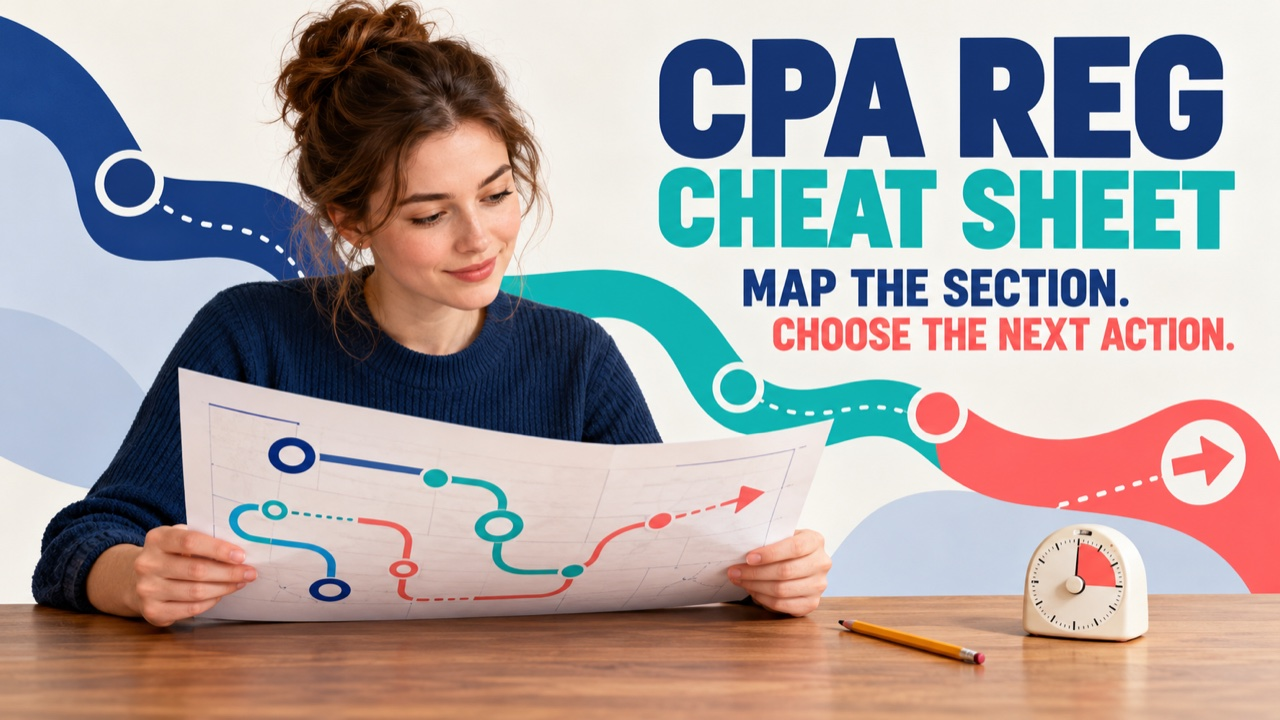

Direct answer: Use cpa reg cheat sheet as a decision record for one REG study block. Write the row you are working on, the verb the row asks you to perform, the fact that could flip the result, the source boundary, and the proof you will produce. Then alter one material fact and log what changed. That sequence turns a sheet into a route instead of another list of rules.
Scope and freshness note: This is original editorial study guidance for the U.S. CPA audience. It does not reproduce official questions, predict a score, set a tax position, give legal advice, or make a licensing decision. Before relying on a live boundary or administration detail, reopen the AICPA CPA Exam Blueprints, IRS tax resources, and NASBA CPA Exam FAQ.
For orientation, use the REG review hub. If a row’s language is vague, consult the Blueprint format guide. If the missing skill is discrimination, use the topic MCQ page; if the missing skill is assembly, use the TBS practice guide.
For a broader preparation path, continue with our related CPA study resources.
cpa reg cheat sheet: draw the decision spine
A REG heading is too wide to be a study instruction. Therefore, give the heading a spine: one row, one requested action, one switching fact, one authoritative checkpoint, and one observable result. Keep those pieces together even when the surrounding section contains several different tax, law, ethics, or procedure ideas.
Imagine handing the note to a study partner. The partner should be able to answer “What are we deciding?”, “Which fact matters?”, and “What will count as proof?” without opening a second page. That is the standard for a useful cpa reg cheat sheet. The sheet should also show where uncertainty remains so a review block can stop at a defined repair.
cpa reg cheat sheet: build a five-field REG review page
Use five fields as a compact diagnostic, not as a memorization formula. First copy the row’s language; afterward, translate it into a task that can be performed.
- Row: record Area or group, topic, task statement, skill level, reference, and item type from the active Blueprint.
- Verb: circle the action the response must show: classify, calculate, evaluate, identify, or recommend.
- Switch: write the role, date, amount, ownership, notice, condition, or classification that would change the result.
- Checkpoint: name the official or technical page, exhibit, or rule boundary that deserves a fresh read before reuse.
- Proof: specify the reason, number, exhibit trail, reconciliation, or response fields an evaluator should be able to inspect.
In addition, add a sixth line called “changed fact.” Alter only one input and predict whether the proof should move. If you cannot make that prediction, the missing line is the next study task.
cpa reg cheat sheet: read the REG lanes as diagnostic questions
Each lane can be phrased as a question. That phrasing keeps a broad section map from turning into four disconnected vocabulary lists.
- Federal taxation: Who is the taxpayer, what is the transaction, and which timing, basis, income, deduction, credit, or limitation fact is decisive?
- Business law: Who has authority, what agreement or default controls, which filing or priority fact matters, and what remedy is requested?
- Ethics and professional responsibility: What duty is active, what reliance boundary applies, and which disclosure, record, or deadline obligation is triggered?
- Tax procedure and application: What notice or authority starts the clock, what date activates the response, and what must the response contain?
For example, a law prompt may look like a rule question while the decisive field is actually a party’s authority. Conversely, a procedure prompt may quote a deadline while the real switch is the notice date. Keep the question and the evidence field side by side so the cpa reg cheat sheet points to the real defect.
Use the REG topic-to-action route
Once the five fields are filled, walk them in a straight line. The aim is to move from scope to a defensible attempt without collecting broad notes that never affect an answer.
- Pin the row. Keep one Blueprint row in view and put neighboring topics aside until the first attempt is complete.
- State the deliverable. Convert the task verb into a sentence that names the result: a classification with its reason, a calculation with inputs, or a response with its fields.
- Mark the hinge. Underline the single fact or input that could send the result in another direction.
- Reopen the boundary. Read the relevant source or exhibit and note the point that needs checking when the fact changes.
- Run the proof. Pick MCQ for recognition or distractor logic; pick TBS-style work for exhibits, calculations, reconciliations, or several fields. Change one fact after the attempt.

The route image makes the handoff visible. In particular, the final arrow is the retry: it is the place where a learner discovers whether the topic was understood or merely recognized.
Run the REG review route checklist
Use the checklist after a single ticket, not after an entire chapter. Mark a line only when you can explain it from the row and its checkpoint. The first unchecked line is a routing signal; it is not an official score or readiness test.
Afterward, obey that first blank. Narrow the row, restate the verb, isolate the hinge, reopen the boundary, choose a different proof format, explain the wrong turn, or run the changed-fact retry.
Select evidence after you name the defect
Next, diagnose before choosing an exercise. If the row itself is unclear, return to the Blueprint. If two rules are colliding, use a short original MCQ set and write why the strongest distractor fails. When the rule is clear but the response requires assembly, use a TBS-style workpaper with the exhibits, inputs, transformation, and conclusion visible together.
MCQ, TBS, or a source reread?
For instance, a classification defect needs a narrow explanation; a calculation defect needs visible inputs and steps; a procedure defect needs notice, trigger, authority, and response in one chain. A source reread is the right move when the checkpoint itself is uncertain. In contrast, a high local percentage without a reason is evidence of one set, not proof of transfer.
cpa reg cheat sheet: keep a repair record that can travel
At the end of the block, capture five short lines: requested verb, hinge fact, source or exhibit, strongest wrong turn, and next action. If the answer is right but the explanation is thin, keep the item open. The record should reveal the earliest broken handoff rather than label the whole section as weak.
Meanwhile, separate speed from certainty. If the clock expires while the boundary is unclear, save the ticket and reduce its scope for the next session. Do not inflate the set just to produce a larger count. A small note with a verified checkpoint is more useful than a long list that cannot explain a miss.
When the topic is current-sensitive, write the date of the checkpoint and the question that still needs verification. Editorial examples can show a reading move, but live authority controls the technical boundary. As a result, the route can stay stable while the source note is refreshed.
Finally, run one mutation. Keep the task verb fixed, change one material fact, and decide whether the answer, calculation, or next destination moves. Explain the trigger either way. That sentence is the part of a cpa reg cheat sheet that earns its place in the next review block.
cpa reg cheat sheet: send the next session to one resource
Use the first unchecked field to pick a single destination. Choose the section hub when the map is missing; choose the Blueprint guide when row language is missing; choose the MCQ page when rule discrimination is missing; and choose the TBS guide when evidence assembly is missing. Opening all four at once only hides the decision.
- REG review hub — find the section boundary and the lane that owns the next question.
- CPA Exam Blueprint format guide — decode the row into task, skill, source, and item-type fields.
- CPA MCQ by topic — test rule recognition, limits, and distractor logic.
- CPA TBS practice — assemble exhibits, calculations, reconciliations, and multi-field responses.
Before ending the session, schedule one action with a row, proof format, fact to change, evidence to keep, and a retry time. Then close the research tabs. A route is complete when the next decision is already named.
cpa reg cheat sheet FAQ
Should I study every REG topic in the same order?
No. Let the current row and the first missing proof field set the order. Keep adjacent topics visible for context, but repair one bounded decision before mixing lanes.
Is a high practice percentage proof that I am ready?
No. A local percentage describes one observation; it is not an official CPA score or readiness determination. Keep the reason, failed distractor, and changed-fact result beside it.
When should I use MCQ versus TBS practice?
Use MCQ when the defect is recognition or rule discrimination. Use TBS-style work when exhibits, calculations, reconciliations, or several response fields must be assembled. Reopen the current Blueprint if the item type is unclear.
What should I do after a miss?
Save the earliest missing field, reopen one relevant checkpoint, explain the hinge in your own words, and retry one new item after changing one material fact.
Sources
- AICPA CPA Exam Blueprints
- IRS tax resources
- NASBA CPA Exam FAQ
- REG review hub