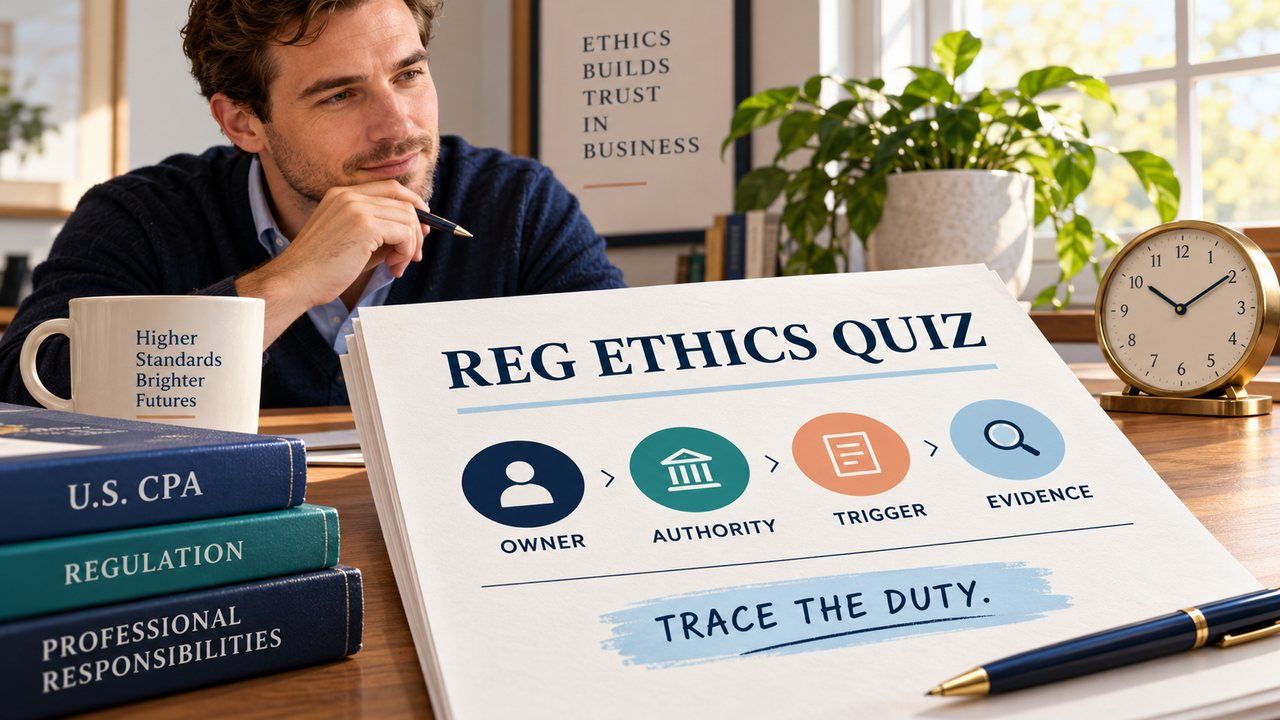

Direct answer: Use a reg ethics quiz as a trace exercise: name the duty owner, anchor the authority, identify the procedural trigger, and save the evidence that would let another reader follow the choice. The exact query, reg ethics professional responsibilities and tax procedures quiz, becomes useful when each answer produces one repairable note instead of another unexplained letter.
Scope and freshness note: This is original U.S. CPA study material, not an exam-authority publication or live tax or legal advice. Reopen the AICPA CPA Exam Blueprints for current tested scope and the NASBA CPA Exam FAQ for administration, eligibility, jurisdiction, or score questions.
Use the REG review hub to choose the lane. The Blueprint format guide helps when the task verb is unclear, the topic MCQ guide helps when recognition is the gap, and the TBS practice guide fits questions that require several exhibits or fields.
For a broader preparation path, continue with our related CPA study resources.
Read a reg ethics quiz as a workpaper request
A REG ethics item may mention a client request, a practitioner, a disclosure, a notice, or a deadline. Those nouns do not identify the controlling fact. Start with the task verb: identify, evaluate, determine, or recommend. Then write the role that owns the action and the fact that activates the next step.
Read the answer choices as competing workpaper instructions. One option may name a duty but assign it to the wrong owner. Another may cite a rule while skipping the event that starts the procedure. A third may sound cautious while refusing to define the question. The strongest answer connects the fact, the authority, the trigger, and the record.
For a reg ethics quiz, mark four lines before choosing an option:
- Owner: who has the responsibility to act, disclose, retain, verify, or communicate?
- Authority: which current source, notice, rule, or exhibit gives that responsibility meaning?
- Trigger: which date, request, role, or missing fact starts the procedure?
- Evidence: what note or workpaper would show why the response fits?
Set the multiple-choice practice assumptions
Before timing a set, choose one Blueprint row and write the requested output. Keep the first block inside one lane: ethics responsibility, professional conduct, or tax procedure. A narrow block makes a changed fact visible; a mixed block can hide whether the miss came from scope, evidence, or timing.
Use a three-window contract. The reading window identifies the task and controlling fact. Next, compare the options during the decision window. The review window checks the authority and records the first missing line. Speed can be measured later, after the reasoning trace is complete.

Build the reg ethics quiz card
Write the owner in the first line, the authority checkpoint in the second, the trigger in the third, and the evidence record in the fourth. If a line is blank, that blank chooses the next review action. Do not fill it with a memorized label just to make the card look complete.
Separate the reg ethics quiz answer from confidence
A correct option with a weak explanation is a review signal, not proof of transfer. Save the reason you rejected the strongest distractor and state what single fact would change your answer. That note makes the next attempt comparable.
Run the original multiple-choice practice
Attempt each original item before opening the feedback. Write the owner, authority, trigger, and evidence in your quiz card. The goal is to expose the first missing proof point, then use the rationale to repair that line.
Reveal the reasoning
Attempt the original case first. Write the owner, authority, trigger, and evidence before opening the explanation.
Reveal the answer
Answer: Compare your card with the rationale, mark the first missing line, and change one fact before retrying.
Compare your process with the reasoning shown above.
Scenario 1: keep the duty with the right owner
Fact pattern: A client asks a practitioner to make a filing position “work.” The file has a transaction summary, but it does not identify who approves the position or what support would justify it.
Question: Which first move creates the strongest study record?
- Accept the requested conclusion because the transaction label is familiar.
- Refuse every discussion before defining the requested output.
- Clarify the decision owner, identify the missing authority and support, and record the disclosure question.
- Draft the conclusion and attach a source after approval.
Answer and rationale: Choice 3 is strongest. It separates a client request from the practitioner’s duty and identifies the evidence needed before a conclusion. Choice 1 treats a label as support, choice 2 skips task definition, and choice 4 reverses the evidence order. Save: the owner, source checkpoint, and missing-support line.
Scenario 2: identify the event that starts the clock
Fact pattern: A notice sits in a client folder. The item supplies a delivery date and a document date but does not say which event controls the response period.
Question: What should the learner test before choosing a deadline?
- Use the earliest date because it is always safer.
- Use the latest date because it gives the client more time.
- Identify the notice type, verify the rule that selects the trigger, and save the source used.
- Choose the option with the most familiar number.
Answer and rationale: Choice 3 is strongest. A procedure depends on the event and authority that govern the clock. Choices 1 and 2 substitute a blanket preference for analysis, while choice 4 rewards recognition without a boundary. Save: the notice type, selected trigger, and authority checkpoint.
Scenario 3: prove transfer with one changed fact
Fact pattern: Your first answer assumes a complete record and a clear responsibility owner. The retry removes a material exhibit and routes the request through a different role.
Question: What is the next study action?
- Repeat the original item until the answer letter feels automatic.
- Change the answer without writing why the new fact matters.
- Re-run the owner-authority-trigger-evidence trace and name the line that changed the response.
- Add a larger mixed set before reviewing the changed case.
Answer and rationale: Choice 3 is strongest because transfer requires a reason for the move. Choice 1 tests familiarity, choice 2 hides the trigger, and choice 4 adds volume before the gap is repaired. Save: the changed fact and the trace line that moved.
Read the reg ethics quiz rationale as a decision trace
Compare your card with the rationale in four passes. First, check whether the task verb matches the option. Next, check the duty owner. Then check the authority or exhibit that gives the fact meaning. Finally, check the evidence you would retain. If the explanation skips a pass, write the missing question before moving on.
A duty is not authority
A practitioner can have a duty to request support, explain a limitation, or preserve a record without having authority to choose a client decision. Treating those roles as interchangeable is a common distractor. Write the owner and the boundary separately.
A procedure needs a trigger
Deadlines, notices, filings, and responses form a chain. A memorized number is weak evidence when the notice or date changes. Name the event that starts the step, then reopen the current source before treating the note as reusable.
Choose the next multiple-choice practice repair
Choose the earliest missing line, then make one bounded repair. Reopen one source checkpoint, write the missing fact or boundary in your own words, and retry one new item with a changed detail. If the retry works, test a neighboring signal. If it fails, narrow the scope before adding volume.

The second visual is a decision record: notice the cue, test the option, reject the unsupported route, keep the evidence line, and name the repair. Use it to explain the next action, not to decorate a score.
Keep a reg ethics quiz ledger
At the end of a block, save five fields beside the item:
- Task: what did the prompt ask you to identify, evaluate, determine, or recommend?
- Owner: who carries the responsibility?
- Boundary: which source, notice, role, or exhibit controls the decision?
- Distractor: which option sounded plausible and what proof did it omit?
- Transfer: which changed fact would prove that the reasoning moves?
This ledger gives the next session a starting point. It also prevents a local hit rate from masquerading as transfer: a score describes one set, while the ledger shows whether the explanation survives a new fact.
Build a reg ethics quiz review loop
Use one bounded lane on the first pass. On the next pass, revisit only cards with a blank boundary or trigger. Later in the week, combine one ethics item with one tax-procedure item while keeping their evidence lines separate. Finish by changing one role or date and explaining the result.
When a boundary is date-sensitive or jurisdiction-specific, write the checkpoint date beside the note and reopen the official source before reuse. The editorial method can remain stable while the authority note is refreshed.
Choose the next resource by the gap. Use the Blueprint page for scope, the MCQ guide for recognition and distractors, the REG hub for lane selection, and the TBS guide when several exhibits must be reconciled. One gap should choose one destination.
reg ethics quiz FAQ
Are these official CPA exam questions?
No. The scenarios, options, rationales, and ledger method are original editorial practice. Use current AICPA material for authoritative scope and terminology.
What should I save after a missed item?
Save the task verb, owner, controlling fact, authority checkpoint, strongest distractor, and one changed-fact retry. Let the first blank line choose the next action.
Should I add more questions when the score is low?
Repair the first missing line before adding volume. More items can repeat the same gap when the evidence and boundary remain unnamed.
Does the quiz promise a passing result?
No. It creates review evidence and a focused next action. Current rules, preparation, and performance determine the actual result.
Sources
- AICPA CPA Exam Blueprints
- NASBA CPA Exam FAQ
- REG review hub