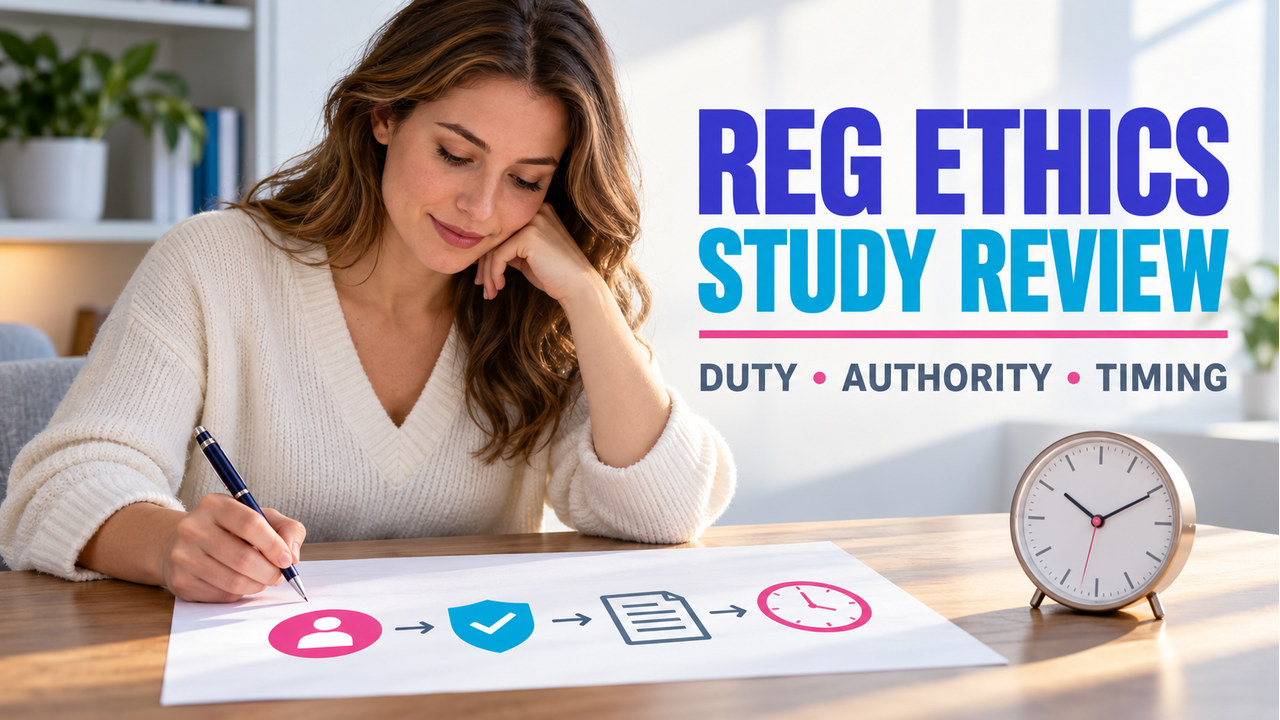

Direct answer: A useful reg ethics study session is a short decision trace. Name the role, the requested action, the controlling fact, and the source that gives that fact meaning. Attempt an original case before reading feedback, then write one changed-fact retry. That sequence turns a vague miss into a study decision.
Scope and freshness note: This is original editorial study material, not a publication from an exam authority. Reopen the AICPA CPA Exam Blueprints for current tested scope and the NASBA CPA Exam FAQ for eligibility, scheduling, jurisdiction, or score questions. Use current professional guidance for any live engagement or tax conclusion.
Use the REG review hub to choose the section lane. The Blueprint format guide helps when the task verb is unclear, the topic MCQ page helps when retrieval is the issue, and the TBS practice guide fits an item with several exhibits.
For a broader preparation path, continue with our related CPA study resources.
Start with a reg ethics study case brief
Before you set a timer, write a four-line brief in the margin of your practice page. Name the role whose responsibility is being tested. State the request in a verb: identify, evaluate, determine, or recommend. Record the fact that could change the response. Finish by naming the authority, notice, exhibit, or procedure you must check. This brief keeps a familiar ethics word from doing all the thinking.
- Role: Who owns the judgment, support, disclosure, or response?
- Request: What must the answer produce?
- Controlling fact: Which detail changes the duty, scope, or timing?
- Source: What current authority or exhibit makes the fact usable?
The method is deliberately small. A learner can finish the brief before the first answer choice becomes attractive. It also creates a visible reason for a miss: a blank role line is different from a blank source line, even when both produce the same wrong letter.
Build a reg ethics study lane before the clock
A REG block becomes noisy when professional responsibility, procedure, and tax terminology are mixed without a boundary. Choose one lane for the first pass: responsibility and support, notice and response timing, or a procedure that depends on a defined role. Save the relevant Blueprint row and its checkpoint date beside the lane. The date is a reminder to reopen current material, not a promise that a number stays fixed.
Set three modest windows: read the task, decide with the brief, and review the evidence. If the reading window ends before the role is clear, mark the gap and continue. If you cannot name the source by the decision window, record “source missing” rather than inventing certainty. The review window is where you explain the strongest distractor and choose the next retry.

Mark reg ethics study evidence that can move the answer
For example, circle only facts that can move the decision. A client preference, a familiar transaction label, or a confident tone may frame the story without controlling it. A missing approval owner, the type of notice, the event that starts a response period, or an exhibit limitation can change the answer. Write the moving fact in plain language, then state what would happen if it changed.
Use a stop rule for uncertain dates
When two dates appear, do not compare their numbers until you have identified the event each date represents. A delivery date, document date, filing date, and response date may belong to different steps. The stop rule is simple: name the event, find the source that selects the trigger, and keep the source in the ledger.
Open the original reg ethics study set
Attempt each case before reading the explanation. On the brief, write the role, request, controlling fact, and source checkpoint. The feedback below shows how a distractor can sound reasonable while missing the task. These cases are original practice for this page; use current authority for the scope around them.
Reveal the reasoning
Attempt the original item first. Write the controlling fact, the boundary or evidence check, and the reason you would save before opening the explanation.
Reveal the answer
Answer: Compare your note with the rationale, mark the first missing proof point, and change one fact before retrying. Do not use a raw answer letter as the study record.
Compare your process with the reasoning shown above.
Scenario 1: incomplete records before a filing deadline
Fact pattern: A practitioner receives a partial set of client records two days before a filing deadline. The client asks for a quick conclusion, but the file does not show who owns the missing records, what support has been received, or which current procedure controls the response.
Question: What should the learner clarify before choosing an action?
- Use the quickest conclusion because the filing label is familiar.
- Assume the practitioner owns every unresolved business judgment.
- Identify the responsibility owner, list the missing support, and verify the procedure that governs the response.
- Ignore the gap and add the case to a later mixed set.
Answer and rationale: Choice 3 is strongest. It keeps the request, responsibility, and evidence separate. The first option treats speed as proof. The second moves a judgment to the wrong owner. By contrast, the fourth preserves an unexplained gap. Save: the missing record, the responsible role, and the source checkpoint.
Scenario 2: a requested position needs a boundary
Fact pattern: A client asks the team to support a tax position and says the disclosure can be handled later. The working file contains the desired result but not the authority, procedural step, or evidence needed to explain who makes the decision.
Question: What is the best first response in a study review?
- Accept the requested position because the client supplied the conclusion.
- Write the authority, identify the decision owner, and define the support and disclosure boundary before drafting.
- Reject all assistance without reading the request.
- Draft the result and add the evidence after the document is used.
Answer and rationale: Choice 2 preserves the reasoning boundary. The first option replaces analysis with preference. The third makes the response absolute when a scoped analysis is needed. By contrast, the fourth postpones the control that the question tests. Save: one sentence that separates support from responsibility.
Scenario 3: the notice contains competing dates
Fact pattern: A tax notice shows a date printed on the document and a later delivery date. The question asks for the next procedural step. A changed version of the case changes the notice type while leaving the two dates in place.
Question: Which study action tests transfer rather than recall?
- Choose the earlier date because it is easier to remember.
- Choose the later date because it gives more time.
- Identify the notice event, check the rule that selects the trigger, and state whether the changed notice changes the response.
- Repeat the original case until the answer letter feels automatic.
Answer and rationale: Choice 3 tests the reasoning. Choices 1 and 2 treat a date as a rule without identifying its event. Choice 4 tests familiarity with the first pattern. Save: the notice type, selected trigger, source, and changed-fact result.
Read the reg ethics study rationale as a proof chain
Review the explanation in four passes. Ask whether the answer responds to the task verb. Check the role that owns the decision. Locate the fact that moves the answer. Then reopen the source or exhibit that makes the fact meaningful. A rationale that names only a rule is incomplete; it should show why the rule attaches to this fact and why the nearest distractor does not.
A label does not settle responsibility
“Ethics” can point to a duty, a conduct limit, a disclosure question, or a split between support and management judgment. Translate the label into the role and requested action. If that translation is missing, the right repair is a narrower scope note, not another page of definitions.
A date is not the trigger until the source says so
When a procedure depends on notice, delivery, filing, or response, write the event beside the date. Check the current source that selects the event. Finish only when you can explain which fact would reverse the decision; a familiar number is not enough.
Choose the next reg ethics study repair
The best repair changes the next attempt. An unclear role calls for a two-sentence owner note before another case. A buried fact calls for an underline and its counterfactual. The missing source calls for the authority and checkpoint date. A failed transfer calls for one changed role, notice type, or exhibit and a new decision.

The second visual is a worked repair, not a score display. Read it from the question to the evidence, then to the changed fact and the next action. Keep the visual beside the ledger while you retry so the repair remains observable.
Keep a reg ethics study ledger
After each timed block, save one row for every miss. The row should fit on a single page and make the next session obvious:
- Lane: responsibility, authority, procedure, or timing.
- Task verb: identify, evaluate, determine, or recommend.
- Moving fact: the detail that could reverse the answer.
- Source checkpoint: the current page, rule, notice, or exhibit to reopen.
- Distractor: the attractive option and the reason it fails.
- Retry: one changed detail and the decision it produces.
The ledger separates a knowledge gap from a reading gap. It also prevents a low score from becoming a vague verdict. A blank source line chooses a source check; a blank moving-fact line chooses a fact-marking drill; a failed retry chooses a narrower lane.
Make the study loop repeatable
Use the same brief for three short sessions, then compare the rows. Start with one responsibility case, add one procedure case, and finish with one changed-fact retry. Keep the cases different enough that the method, rather than a repeated phrase, carries the transfer.
When you need a new resource, choose it from the ledger. Use the Blueprint page for scope, the MCQ guide for retrieval, the TBS guide for exhibits, and the REG hub for lane orientation. Do not add volume until the row tells you what the new volume is meant to test.
reg ethics study checklist
- Choose one narrow REG lane and save the current Blueprint checkpoint.
- Write the role and task verb before the timer starts.
- Mark the fact that can move the decision.
- Identify the event behind every important date.
- Attempt the original case before opening feedback.
- Explain the strongest distractor in a complete sentence.
- Record the source or exhibit you would reopen.
- Change one material fact and state whether the answer moves.
- Let the first blank line choose the next review action.
A strong reg ethics study routine is compact but evidence-led: define the lane, trace the fact, verify the boundary, explain the action, and show transfer before adding volume.
reg ethics study FAQ
Are these exam-authority questions?
No. The scenarios and rationales are original editorial practice. Use current AICPA sources for authoritative scope and terminology.
What should I record after a miss?
Record the role, moving fact, source checkpoint, rejected distractor, and one changed-fact retry.
When should I add more timed items?
Add volume only after you repair the first missing line. More items without a diagnosis can repeat the same gap.
Does this review promise a passing result?
No. It creates study evidence and a next action; current rules, preparation, and performance determine the result.
Sources
- AICPA CPA Exam Blueprints
- NASBA CPA Exam FAQ
- REG review hub
- CPA study guide