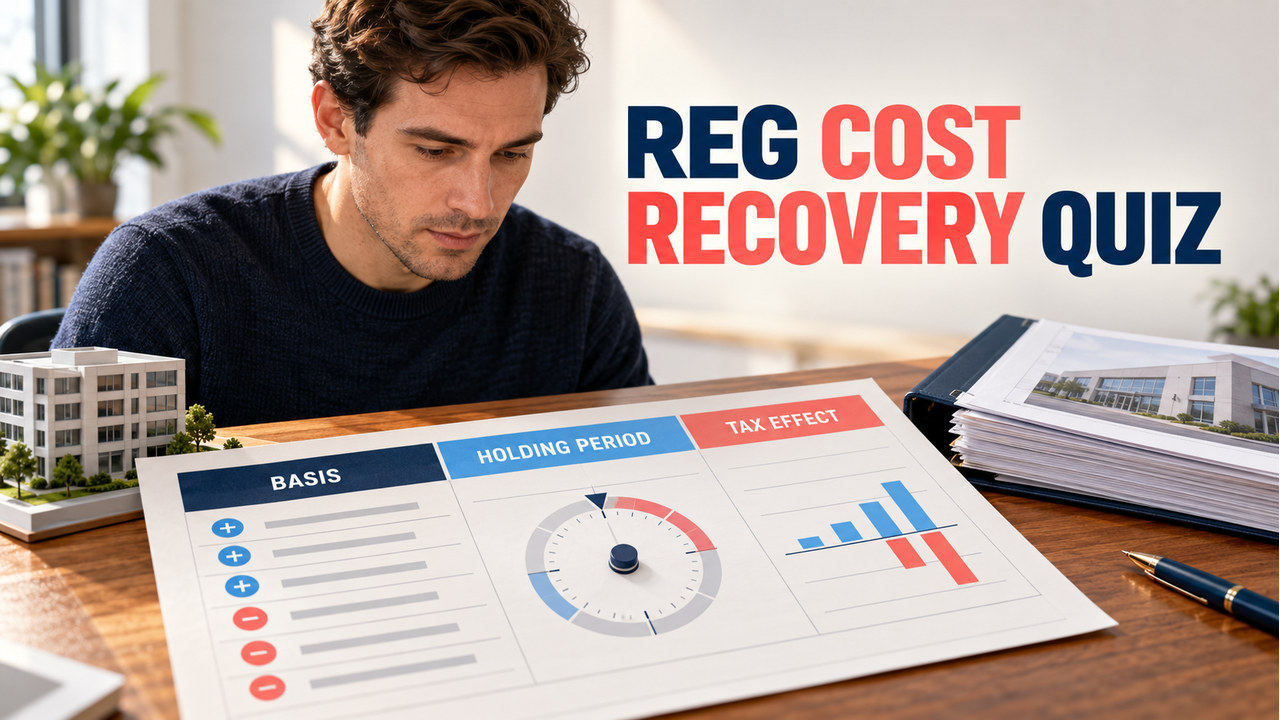

Direct answer: Use reg basis holding period and cost recovery quiz as a short evidence drill: identify the taxpayer and property, build the adjusted-basis ledger, separate holding period from cost recovery, and then answer the tax effect the prompt actually asks for. The three original items below give you numbers to work with, a delayed rationale, and one specific repair action.
Scope and freshness note: These are original editorial study questions, not official, recalled, leaked, or exam-memory items. Reopen the AICPA CPA Exam Blueprints for the current testing window and subject boundaries. Use the NASBA FAQ for jurisdiction, eligibility, scheduling, or score questions.
For orientation, begin with the REG review hub. The CPA study guide gives broader context, while the Blueprint format guide, topic MCQ page, and TBS practice guide help when you need a different retrieval mode.
For a broader preparation path, continue with our related CPA study resources.
REG cost recovery quiz: build the three-line ledger
The tested skill is routing each fact to the right line. Adjusted basis is the first line: starting cost or substituted basis, plus capital additions, less recovery already allowed or assumed. The second line is holding period: the property or transaction facts that control the timing branch. Requested tax effect is the third line: gain, loss, deduction, credit, remaining basis, or the next source check.
That separation matters because a familiar date can be true and still answer the wrong question. A placed-in-service date can anchor cost recovery while a carryover transaction controls holding period. A credit or deduction may affect tax liability without changing the basis ledger. Read the task verb, write the controlling fact, and keep the other facts in view without letting them replace the requested line.
Difficulty and timing assumptions
Use moderate difficulty. Give yourself one minute to mark the facts, two minutes to choose the controlling line, and two minutes to explain the strongest distractor. These are simplified study facts; when a live engagement or current rule is involved, reopen the authoritative source before relying on a conclusion.
Cost recovery quiz: set the ledger assumptions
Before attempting an item, write the taxpayer or entity, the property, the starting amount, the adjustment or recovery fact, the date that controls the timing branch, and the tax result requested. Label any assumption the prompt supplies. Do not import a convention, limitation, or entity rule from a different question just because the vocabulary looks familiar.
For this quiz, use four quick tags: OWNER, BASIS, DATE, and RESULT. OWNER tells you whose property or return is in view. BASIS records what enters and leaves the ledger. DATE keeps acquisition, carryover, placed-in-service, and sale events separate. RESULT tells you whether the item wants a computation, classification, limitation, credit, or review action.

What to write before choosing
Capture the original amount, every stated adjustment, the recovery already taken or assumed, and the date that changes the branch. Then write one sentence naming the evidence you would verify. “Adjusted basis after the stated recovery; sale date controls the disposition branch” is a useful note. “Choice C” is not.
Keep a second note for uncertainty. If the arithmetic is sound but the wrong owner’s basis was used, tag owner. When recovery was subtracted twice, tag basis adjustment. For a deduction question answered with a holding-period rule, tag requested result. Use the tag to choose the next review block.
Run the cost recovery quiz practice
Attempt each original item before opening its rationale. Underline the fact that controls the answer, calculate only from the stated assumptions, and record why the tempting option fails. The purpose is a reproducible reasoning trail rather than a familiar answer letter.
Reveal the reasoning
Attempt the original cost recovery item first. Write the owner, basis line, controlling date, requested tax effect, and the evidence you would reopen before reading the rationale.
Reveal the answer
Answer: Compare your note with the rationale, mark the first missing ledger line, and change one fact before retrying. Do not use a raw answer letter as the study record.
Compare your process with the reasoning shown above.
Scenario 1: improvement and recovery change adjusted basis
Fact pattern: Northstar Delivery buys a van for $42,000 and adds a qualifying $5,500 shelving system. Under the study facts, $9,000 of cost recovery has already been taken. The van is sold after the improvement. The question asks which amount should anchor the next gain-or-loss computation.
Question: What should the learner place on the ledger first?
- Use the $42,000 invoice because it is the largest original number.
- Use the $5,500 improvement because it is the latest event.
- Add the improvement to cost, subtract the stated recovery, and then apply the sale facts.
- Use the one-year holding-period fact as the basis amount.
Answer and rationale: Choice 3 is the correct route under these simplified facts: $42,000 + $5,500 − $9,000 = $38,500 before the sale computation. Choice 1 ignores a capital addition. Choice 2 drops the original cost. A fourth option confuses the timing line with the basis line. Evidence note: save the three ledger inputs and the sale date you would verify.
Scenario 2: carryover timing is separate from cost recovery
Fact pattern: Cedar Ridge receives equipment in a carryover transaction. The prompt supplies a $31,000 carryover basis and tells you to use the stated holding-period assumption. A distractor offers a fresh purchase date, while another uses the date cost recovery began as the holding-period start.
Question: Which response keeps the timing analysis bounded?
- Use the newest invoice date because it is easiest to document.
- Use the cost-recovery start date because both questions involve time.
- Use the carryover and transaction facts supplied by the prompt, and keep the holding-period assumption on its own line.
- Ignore the dates and choose the option with the largest tax effect.
Answer and rationale: Choice 3 preserves the distinction the item is testing. A carryover transaction can supply the relevant holding-period history, while a cost-recovery start date answers a different question. The first distractor invents a new acquisition event. Choice 2 merges two timing systems. A fourth option turns an evidence question into an outcome guess. Evidence note: record the exact transaction fact that would change the timing branch.
Scenario 3: entity tax effect after one changed fact
Fact pattern: Harbor & Pike LLC owns business equipment with a $72,000 starting basis and $18,000 of stated recovery. A changed-fact version sells the equipment before the next recovery period and asks for the best next review action for the entity’s tax result. The prompt supplies the entity type but does not ask you to invent a new election.
Question: What should the learner do next?
- Repeat the same item until the answer letter feels automatic.
- Change one material fact, recompute the remaining basis under the stated convention, and explain whether the requested deduction, gain, loss, or credit consequence changes.
- Add a mixed entity set before checking the original ledger.
- Delete the item because the sale creates another branch.
Answer and rationale: Choice 2 creates a transfer check. It keeps entity classification, remaining basis, recovery, and the requested tax effect visible while one fact changes. Repeating choice 1 tests memory. Choice 3 adds volume before repair. Deleting the item removes the evidence that would show whether the reasoning transfers. Evidence note: state which line changed and why the entity’s requested result did or did not move.
Read the cost recovery quiz rationale
After the attempt, compare your note with the explanation in this order: classify the owner and property, rebuild the basis ledger, isolate the controlling date, apply the stated recovery or limitation, and answer the requested tax effect. If the item mentions a deduction, credit, or entity return, ask whether it changes basis or only changes tax liability.
The common shortcut is to treat basis, holding period, and cost recovery as one time-and-money label. That shortcut makes a distractor plausible because it borrows a true fact from the wrong branch. A strong explanation names the fact, the rule boundary, the rejected option, and the source line you would reopen when the rule is current-sensitive.
Choose the next cost recovery quiz repair
Repair the earliest missing proof point. Reopen one source or worked example. Write the missing basis, date, owner, or requested-result fact in your own words, then retry one item with one changed detail. If the retry works, move to a different branch. If it fails, narrow the property or transaction scope before adding more questions.

Use the second visual as a decision record: classify the error, identify the ledger line, test the changed fact, and choose the next review action. The board should make the distinction between basis, holding period, recovery, and tax effect visible at a glance.
Make the cost recovery quiz repeatable
Use one evidence note for every session. Record the taxpayer or entity, property, starting basis, additions, recovery assumption, controlling date, requested tax effect, rejected distractor, and changed-fact result. The note should let you reproduce the reasoning without reopening the entire question.
Keep official scope separate from original practice. AICPA pages define the tested boundary; the scenarios, calculations, visual boards, and repair actions here are independently authored. When exhibit handling is the weak point, use the TBS practice guide. When retrieval speed is the weak point, use the topic MCQ page after repairing the first open ledger line.
reg basis holding period and cost recovery quiz checklist
- Save the current Blueprint row and checkpoint date.
- Identify the owner, property, entity, and requested result.
- Write starting basis and every stated addition.
- Subtract only the recovery the prompt tells you to use.
- Keep acquisition, carryover, placed-in-service, and sale dates separate.
- Mark whether a deduction or credit changes basis or only tax liability.
- Reject the strongest distractor in a complete sentence.
- Change one fact and recompute the affected line.
- Save the first missing proof point as the next review action.
Overall, a strong reg basis holding period and cost recovery quiz routine is a visible ledger. State the owner and property, build adjusted basis, isolate the holding period, apply the stated recovery path, answer the tax effect requested, and show transfer before adding more volume.
reg basis holding period and cost recovery quiz FAQ
Are these official exam questions?
No. The scenarios and rationales are original editorial practice. Use current AICPA sources for authoritative scope and terminology.
What should I record when I miss an item?
Record the owner, property, basis line, controlling date, rejected distractor, and one changed-fact retry.
Should holding period and cost recovery be combined?
Keep them separate unless the prompt explicitly asks you to connect their consequences. They are different evidence lines even when both involve dates.
Does this method promise a passing result?
No. It creates observable study evidence and a focused next action; current rules, preparation, and performance determine the actual result.
Sources
- AICPA CPA Exam Blueprints
- AICPA CPA Exam resources
- NASBA CPA Exam FAQ
- REG review hub