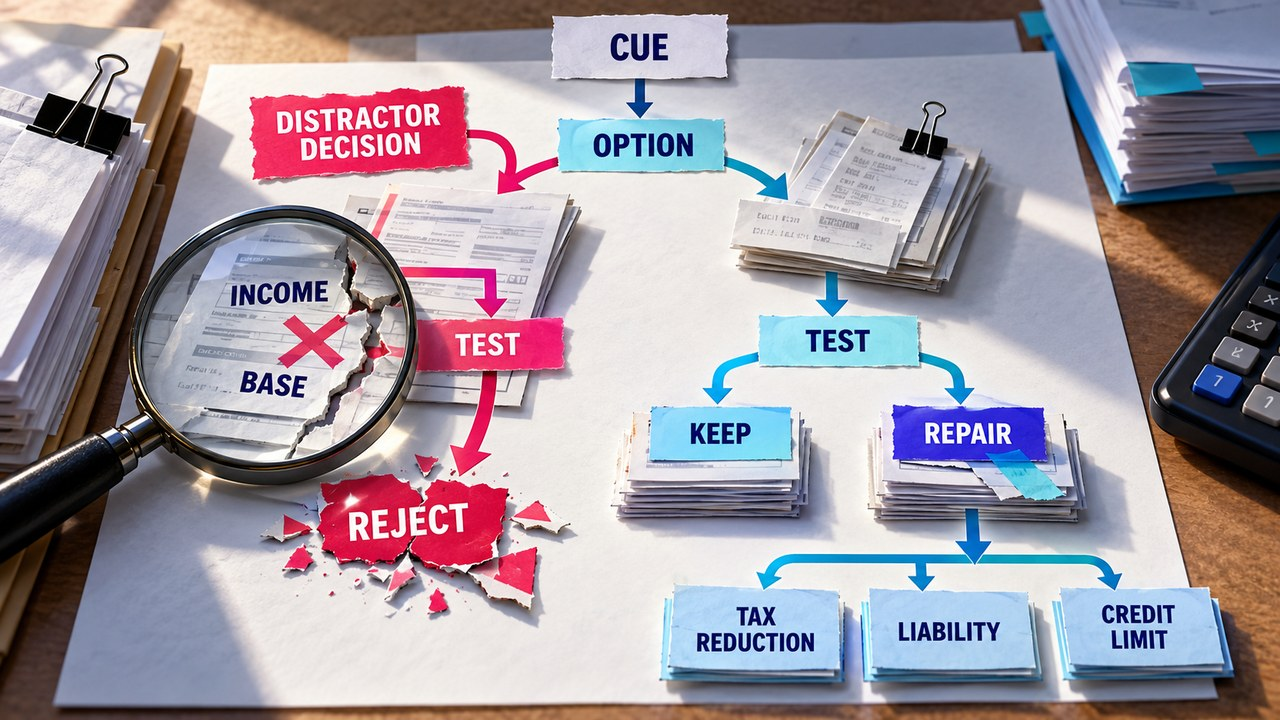

Direct answer: The most useful reg gross income deductions review quiz follows the tax sequence instead of mixing every favorable item together. Mark the requested output, classify what enters gross income, separate an adjustment from a deduction, check the usable credit limit, and record the final liability. Then write the first checkpoint that failed. That short trail tells you what to review next better than an answer letter alone.
Scope and freshness note: This is original editorial study material, not an exam-authority publication. Reopen the AICPA CPA Exam Blueprints for the current testing window and task statements, use the AICPA CPA Exam resources for current subject boundaries, and use the NASBA FAQ for eligibility, scheduling, jurisdiction, or score questions.
Start with the REG review hub for orientation. Keep the CPA study guide for planning context, use the Blueprint format guide when a task boundary is unclear, and move to the topic MCQ page or TBS practice guide when you need a different response mode.
For a broader preparation path, continue with our related CPA study resources.
REG Gross Income Deductions Review Quiz: original items from income to liability
A tax prompt can contain wages, an exclusion, an adjustment, an itemized deduction, and a credit while asking for only one output. Treating every number as if it belongs in the same line is the fastest way to choose a polished distractor. This quiz uses a four-checkpoint trail: income, base, tax reduction, and liability.
The first checkpoint asks what belongs in gross income under the facts supplied. Next, ask how an adjustment changes the base and when to test a deduction route. Then determine whether a credit qualifies and how much the taxpayer can use. Finally, record the liability after the allowed reduction. A later checkpoint cannot repair an earlier classification error.
Four checkpoints for a clean review note
Write the requested output in the first column of your note. Next, copy the controlling fact and its number or label. Then name the rule, supplied assumption, or limitation that gives that fact meaning. At the end, state what you would change on a retry. This simple structure makes a wrong answer inspectable.
Time the decision, not the guess
Use two minutes to read, three minutes to decide, and five minutes to explain. If a prompt leaves a boundary unstated, mark the missing fact instead of inventing one. The goal of the reg gross income deductions review quiz is a repeatable reasoning trail, not a faster unreviewed guess.
Set the reg gross income deductions review assumptions
Before the first item, write four assumptions: the taxpayer profile supplied by the question, the requested output, the simplified rule you are allowed to use, and the point where current authority must be reopened. These are editorial practice facts. I keep the assumptions narrow so you can check the reasoning without turning the page into a standards textbook.
- Mark the output. Is the question asking for gross income, an adjusted base, taxable income, usable credit, or final liability?
- Mark the checkpoint. Which of the four lines controls the answer before you calculate?
- Mark the limit. Is an exclusion assumption, deduction cap, eligibility condition, or credit limitation supplied?
- Mark the repair. What single fact would you change to see whether the explanation transfers?
In a reg gross income deductions review session, do not let the word “credit” pull the computation forward. A credit reduces tentative tax only after you establish the income base, eligibility, and usable amount. Likewise, test a deduction at its proper stage instead of subtracting it from every receipt.

What to save during the attempt
Save the task verb, the controlling fact, the boundary checked, the chosen option, and the rejected distractor. If the question gives a number, keep the number attached to its label. If the question gives an assumption, quote the assumption in your own words. A reviewer should be able to reconstruct the choice without asking what you meant.
Separate speed from certainty. A fast answer with no checkpoint is an unreviewable guess. A slower answer that identifies the missing boundary gives you a repair target. When time expires, record the gap and move to the next item; return later with one changed fact rather than repeating the same stem unchanged.
Run the reg gross income deductions review quiz
Attempt each scenario before opening its rationale. Select one option, name the checkpoint you used, and write why the strongest distractor looked plausible. The facts, answers, and explanations below are original editorial practice, not recalled or official exam questions.
Reveal the four-checkpoint reasoning
Attempt the original item first. Write the requested output, controlling fact, checkpoint, and rejected distractor before opening the explanation.
Reveal the answer
Answer: Compare your note with the rationale, label the first broken checkpoint, and change one fact before retrying.
Compare your process with the reasoning shown above.
Scenario 1: classify the income line first
Facts: Under this simplified exercise, Maya receives $18,000 of wages, a $4,000 personal gift, and $1,200 labeled by the prompt as a reimbursement that meets its supplied exclusion assumption. The question asks which amounts belong on the gross-income line before you apply an adjustment.
Question: Which first move protects the checkpoint?
- Add all three amounts because every cash receipt is income.
- Start with the $18,000 wage amount, then test the gift and the supplied reimbursement assumption separately.
- Apply a credit to the $23,200 total before classifying the receipts.
- Subtract a deduction from wages before deciding what belongs in gross income.
Reveal the reasoning
Attempt the item first. Write the controlling fact, the supplied boundary, and the distractor you would reject before opening the explanation.
Reveal the answer
Answer: Choice 2 preserves the sequence. Wages start the gross-income analysis; test the gift and reimbursement under the facts and supplied assumption. Choices 1, 3, and 4 move arithmetic or a later checkpoint ahead of classification.
Transfer check: Change the reimbursement label so the supplied exclusion assumption no longer applies. Your note should show exactly which amount changes the gross-income line.
Scenario 2: separate an adjustment from a deduction
Facts: The prompt supplies $82,000 of gross income, a $4,000 above-the-line adjustment, and a $7,000 itemized deduction. It also says the taxpayer may use the itemized route only if it is more favorable than the stated alternative. The question asks which value comes first.
Question: Which sequence protects the base checkpoint?
- Subtract the $7,000 deduction from each receipt before identifying the adjustment.
- Apply the $4,000 adjustment to establish the income base, then compare the supplied deduction route under the prompt’s assumption.
- Apply the credit first because credits always reduce taxable income.
- Choose the larger number without checking the supplied alternative.
Answer and rationale: Choice 2 keeps the stages distinct. The adjustment changes the base for the next calculation; test the deduction after the prompt identifies the available route. That choice erases the sequence. Another wrong choice confuses a tax reduction with an income reduction. A final choice replaces the stated comparison with arithmetic size.
Transfer check: Keep the $4,000 adjustment fixed and lower the supplied deduction to $2,000. The route comparison, not the word “deduction,” should determine the next step.
Scenario 3: apply the usable credit after tentative tax
Facts: A simplified computation produces $58,000 of taxable income and $8,600 of tentative tax. The taxpayer qualifies for a $2,000 nonrefundable credit, but the prompt limits the usable amount to $1,250. The prompt supplies no other credit or carryforward.
Question: What final liability belongs in the answer record?
- $6,600, because the full nominal credit is always usable.
- $7,350, because $8,600 minus the $1,250 usable amount equals $7,350.
- $8,350, because the credit is applied before tentative tax is computed.
- $8,600, because credits never affect liability.
Answer and rationale: Choice 2 follows the supplied cap: $8,600 tentative tax minus $1,250 usable credit equals $7,350. That choice ignores the limitation. Another wrong choice reverses the order. A final choice ignores the credit checkpoint.
Transfer check: Change the usable limit to $0 while keeping the nominal credit unchanged. The liability should return to $8,600, and the note should name the limit as the first broken link.
Read the reg gross income deductions review rationale
Review each answer in the same order as the four checkpoints. First, restate the requested output. Next, point to the fact that controls it. Then identify the rule, supplied assumption, or limitation that gives that fact meaning. Only after those steps should you inspect the arithmetic.
The strongest distractor often contains a correct number at the wrong stage. The nominal credit can be real even when the prompt caps the usable amount. A deduction can remain allowable even when you test it after the adjustment. A cash receipt can also be real while the supplied exclusion assumption keeps it outside the exercise’s gross-income line. Explain the stage error in one sentence.
For a reg gross income deductions review, label each miss as scope (you answered another task), fact (you missed the input), rule (you used the wrong boundary), limit (you ignored a cap or eligibility condition), or transfer (you could not predict the changed fact). One label is enough to choose the next repair.
Choose the next reg gross income deductions review repair
Repair the earliest missing proof point before adding another mixed set. If you misclassified a receipt, write a one-sentence classification rule and retry with a changed label. When you mixed an adjustment with a deduction, redraw the base calculation with one number. If a credit limit caused the miss, make a two-line tentative-tax and usable-credit check. Keep the repair narrow enough to verify in one short attempt.

Use the second visual as a decision record: identify the cue, test the checkpoint, reject the tempting path, and keep the supported path. The board is a reminder of the sequence, not a substitute for a current authority check.
Make the reg gross income deductions review repeatable
Use the same evidence note every session: Blueprint row or topic label, decision verb, controlling fact, boundary checked, selected option, rejected distractor, checkpoint label, and changed-fact result. The note should fit in a few lines. Its purpose is to preserve the reasoning path so you can compare a fresh attempt with an earlier one.
Keep official scope separate from original practice. The AICPA pages define the current test boundary; the scenarios, labels, visuals, and review routine here are editorial tools. When a current rule, jurisdiction detail, or eligibility question matters, reopen the authoritative source before relying on a study shortcut.
reg gross income deductions review checklist
- Circle the requested output and decision verb.
- Classify each receipt before applying an adjustment.
- Compute the adjusted base before testing the deduction route.
- Check credit eligibility and the usable limit after tentative tax.
- Write why the strongest distractor fails at its checkpoint.
- Label the first missing proof point as scope, fact, rule, limit, or transfer.
- Change one material fact and predict whether the answer changes.
- Save the next repair before opening another mixed set.
A strong reg gross income deductions review session leaves a short trail from receipt to liability. That trail shows whether the next review should reopen scope, repair classification, verify a limitation, or practice transfer.
reg gross income deductions review FAQ
Are these official exam questions?
No. The scenarios and rationales are original editorial practice. Use current AICPA material for authoritative scope and terminology.
Should every cash receipt enter gross income?
No. Classify the receipt under the facts and supplied assumption in the prompt. Do not treat a practice simplification as live tax advice.
Do I apply a credit before a deduction?
Follow the requested output and supplied sequence. In the third scenario, calculate tentative tax before the prompt limits the usable credit.
Does this method promise a passing result?
No. It creates observable study evidence and a focused next action; it does not predict an exam outcome.
Sources
- AICPA CPA Exam Blueprints
- AICPA CPA Exam resources
- NASBA CPA Exam FAQ
- REG review hub