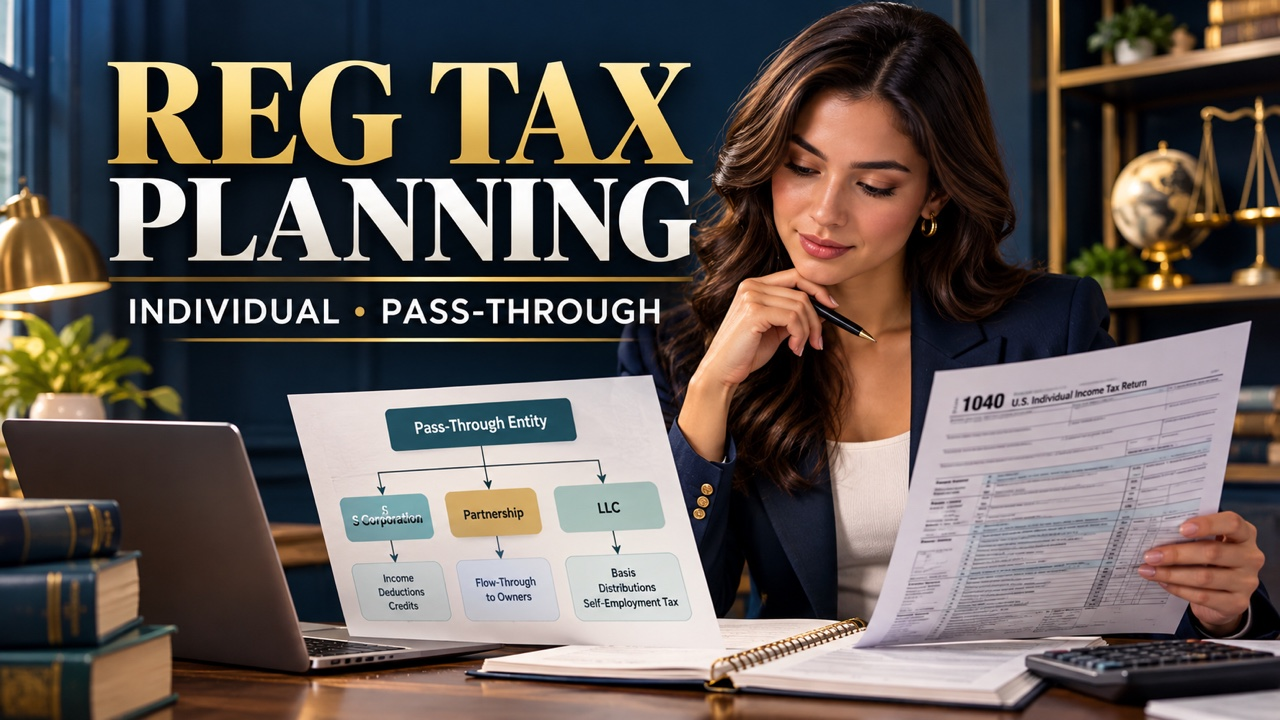

Direct answer: Use a pass-through tax planning mock exam as a four-stop handoff audit. Mark the person who receives the item, translate the item into its owner-level character, test the first limit that is actually stated, and write the evidence for any timing step. The point of this set is to make the first broken handoff visible while the clock is still running.
Scope and freshness note: This is original US CPA REG study material, not an AICPA question, a recalled item, tax advice, or a score promise. Reopen the current AICPA CPA Exam Blueprints for testing-window scope, the AICPA CPA Exam resources for current terminology, and the NASBA FAQ for eligibility, scheduling, jurisdiction, or score questions.
Start with the REG review hub for section orientation. Then use the CPA study guide for sequence, the Blueprint format guide for task boundaries, and the topic MCQ page or TBS practice guide when the next repair needs another retrieval mode.
REG pass-through tax planning mock exam: use the owner-level clock
First, a timed mock creates pressure around familiar words, yet the owner-level handoff still has a fixed order. Start by naming the individual and the requested output. Translate the pass-through item before touching a number. Check the supplied basis or limitation next. Only then connect projected income to a payment action supported by the prompt.
Circle the task verb
For example, circle the verb beside the prompt: classify, determine, evaluate, or plan. That verb sets the proof standard. Classification calls for the item character; limitation calls for an owner gate; planning calls for a bounded action tied to known facts. For a payment prompt, the note must show the comparison you can actually make.
Leave a visible gap marker
Meanwhile, at the buzzer, save the unanswered item and the missing fact rather than guessing a letter. A useful record can say “owner named; character set; basis evidence missing.” That compact marker tells the next session exactly where to resume.
Set the practice test assumptions
Next, before the timer starts, copy one current Blueprint task statement and write the requested output in one line. Each case below is complete only for its stated line. It supplies no hidden filing status, extra basis, at-risk capacity, passive-activity fact, carryforward, withholding change, or current rate. If a needed fact is absent, write source check and keep the boundary open.
Use an owner handoff strip
In practice, draw five small fields: recipient, character, first limit, timing fact, and evidence to reopen. Put one phrase in each field. The strip records a handoff trail without pretending that a raw score proves understanding.
Split the timed pass into three windows
Then, give each item a scan window, a choice window, and a proof window. Spend one minute finding the recipient and verb, two minutes selecting a line, and one minute naming the evidence that would overturn the nearest distractor. If the boundary stays open, carry the gap marker to the next item instead of manufacturing certainty.

Run the original practice test
After that, run each pass-through tax planning mock exam item cold. Before revealing anything, write the recipient, the deciding fact, the first gate, and the evidence you would retain. Afterward, alter one input and predict the first owner-level line that should change.
Reveal the reasoning
Attempt the original item first. Write the controlling fact, the boundary or evidence check, and the reason you would save before opening the explanation.
Reveal the answer
Answer: Compare your note with the rationale, mark the first missing proof point, and change one fact before retrying. Do not use a raw answer letter as the study record.
Compare your process with the reasoning shown above.
Drill A: pass-through tax planning mock exam character handoff
Case card: An individual owner receives a Schedule K-1 showing $28,000 of ordinary business income and $4,200 of separately stated interest income. The prompt asks where the $4,200 belongs on the owner return. No loss or limitation is supplied.
Prompt: Which note follows the stated facts?
- Combine both amounts as ordinary income because one entity issued the K-1.
- Keep the $28,000 ordinary item and $4,200 interest item in their supplied categories before applying an individual-level rule.
- Report the interest as a deduction because it was separately stated.
- Ignore the interest until the owner has a loss.
Why: Choice 2 keeps the two owner lines in the categories supplied. Choice 1 lets the entity label override item character. Choice 3 treats income as a deduction, and choice 4 postpones the item that controls the first report line. On retry, replace interest with a capital item and record the changed category.
Drill B: pass-through tax planning mock exam basis ceiling
Case card: A partner is allocated an $18,500 pass-through loss. The file states that $11,200 of outside basis is available at year-end and provides no additional basis, at-risk, or passive-activity exception. The question asks for the first defensible conclusion.
Prompt: What should the learner record?
- Deduct the full $18,500 because the entity incurred the loss.
- Use $11,200 as the first owner-level gate and flag $7,300 for the stated limitation review.
- Convert the loss into ordinary income for the partner.
- Use the loss as a credit against the next estimated payment.
Why: Therefore, Choice 2 uses the only owner-level ceiling stated in the case. An entity loss is not proof that the owner can use every dollar. Choice 1 skips the basis checkpoint, choice 3 changes the item, and choice 4 moves it to a credit line. On retry, add $8,000 of basis and state which checkpoint moves first.
Drill C: pass-through tax planning mock exam payment comparison
Case card: An owner projects $13,200 of additional pass-through income for the following quarter. The prompt asks for a bounded response to an estimated-tax concern. It gives no withholding change, safe-harbor conclusion, or current-rate assumption.
Prompt: Which action stays inside the supplied facts?
- Promise that the owner will owe exactly $3,100 more.
- Update the projection, reopen current payment guidance, and compare the next estimate with the owner’s actual withholding facts.
- Turn the projected income into a deductible expense.
- Ignore the estimate because pass-through income is never paid by the owner.
Why: Similarly, Choice 2 limits the action to a projection, a current source, and the owner’s actual withholding. Choice 1 invents a number, choice 3 changes income into expense, and choice 4 removes the owner from the payment question. On retry, add a withholding amount and state the new comparison.
Drill D: pass-through tax planning mock exam transfer check
Case card: A revised file keeps the $18,500 loss but increases outside basis from $11,200 to $20,000. It also adds a passive-activity fact that Question 2 did not provide. The question asks what to rebuild first.
Prompt: Which repair shows transfer?
- Carry the old $11,200 ceiling forward because the loss amount is unchanged.
- Rebuild the basis gate with $20,000, then check the new passive-activity fact before recording usability.
- Deduct the loss and the next-quarter income together.
- Delete the basis note because the file changed.
Why: Choice 2 rebuilds the first gate and then checks the new limitation. Choice 1 carries a stale ceiling, choice 3 combines periods, and choice 4 deletes the trail. Keep the changed fact beside the first line that moved.
Audit the tax planning mock exam answer
Next, review the mock in five passes: recipient, character, first limit, timing, and proof to reopen. A merged ordinary and separately stated item is a character miss. A loss used before basis is a gate miss. An exact payment promise without current facts is a timing miss. The label should name the repair, not merely repeat that the option was wrong.
Disarm the tax planning mock exam distractor
A fast distractor often borrows one accurate word and relocates it. Circle that word, write the missing fact beside it, and explain why the line still fails. The same three-part note works when a later mock changes every number.
Log the source boundary separately
In addition, for a current-sensitive boundary, reopen one official page and log its date plus the question it answered. Keep that scope note separate from the scenario rationale; a practice explanation should not read like an authority statement.
Choose the next practice test repair
Finally, choose the earliest missing proof point and make one repair. One character miss calls for a placement drill. A basis miss calls for an owner-level ceiling calculation. For timing, reopen a current payment source and list the facts needed for a comparison.

Use the second visual as a repair log: mark the owner line, test the first gate, record the missing evidence, and write one bounded next move. It explains a decision; it does not decorate a score.
Repeat the mock with one changed fact
Move one input and re-run the handoff
Then, re-run the four cases after moving one input: item character, outside basis, withholding, or a stated passive-activity fact. Predict the first owner line that changes before looking at the options. If several lines move, record their order so the handoff remains traceable.
Preserve the before-and-after record
Finally, keep the original line, changed input, first changed line, rejected distractor, and next action. The second pass matters only when it demonstrates transfer. More volume without a changed input can preserve the same classification or limitation miss.
pass-through tax planning mock exam checklist
- Copy one current Blueprint task statement and its decision verb.
- Name the individual taxpayer and the pass-through item.
- Preserve ordinary, separately stated, capital, or loss character.
- Write outside basis before deciding whether a loss is usable.
- Check any stated at-risk, passive, or other limitation before the final amount.
- Separate projected income from the estimated-payment question.
- Write the nearest distractor and why it fails.
- Record the first missing proof point as character, gate, timing, evidence, or transfer.
- Change one fact and predict the first line that moves.
As a result, a useful pass-through tax planning mock exam record shows the recipient, item, first limit, timing fact, evidence, and repair. Use current authoritative sources for scope, then use these original cases to make the handoff observable.
pass-through tax planning mock exam FAQ
Are these official exam questions?
No. The scenarios, options, rationales, and visuals are original editorial practice. Use current AICPA materials for authoritative scope and terminology.
What should I record when I miss an item?
For example, record the owner, item character, first gate, rejected distractor, source or evidence check, and one changed-fact retry.
Should I keep adding more timed items?
Only after the first missing proof point is repaired. More volume without a repair can preserve the same classification or limitation error.
Does this method promise a passing result?
No. It creates observable study evidence and a focused next action; current rules, preparation, and performance determine the result.
Sources
- AICPA CPA Exam Blueprints
- AICPA CPA Exam resources
- NASBA CPA Exam FAQ
- REG review hub