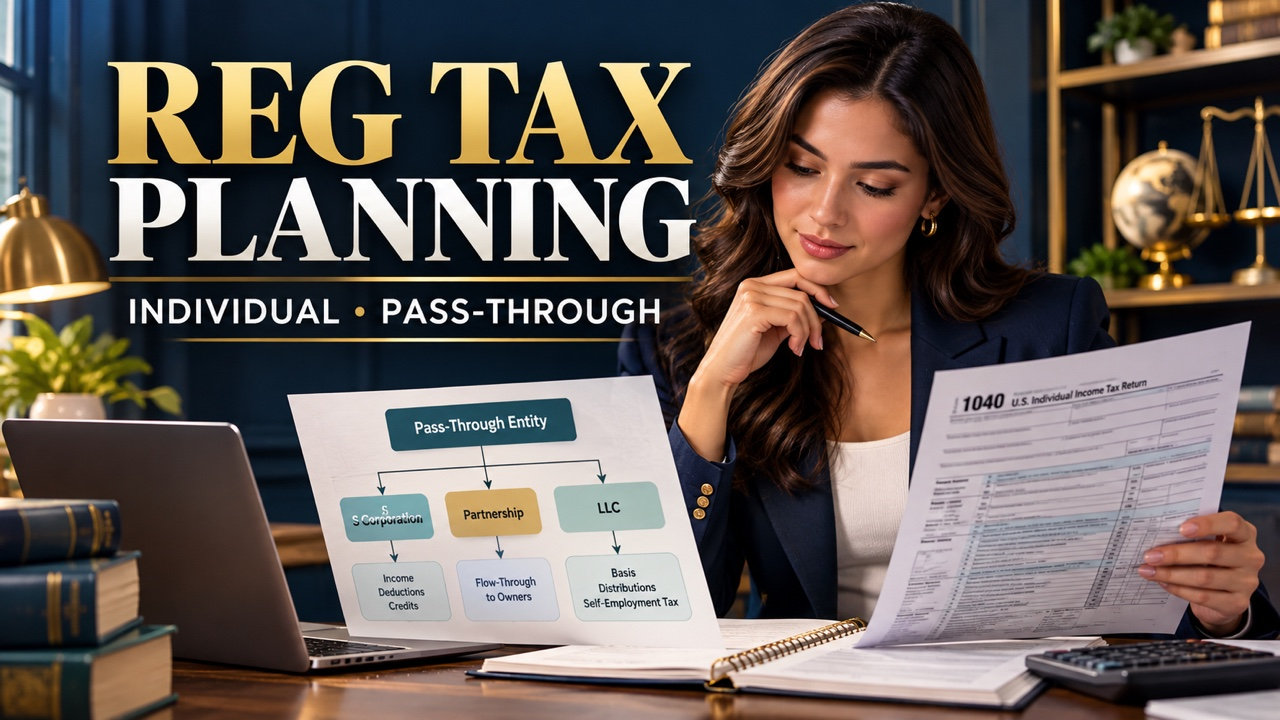

Direct answer: Use free tax planning questions to practice a decision, not to collect answer letters. Name the taxpayer, classify the item, locate the first owner-level gate, and record the evidence you would reopen. Then change one fact and see whether the response moves. This original REG practice set gives you a bounded review loop without claiming to be official, recalled, or live tax advice.
Scope and freshness note: This is original US CPA REG study material, not an AICPA question, recalled item, tax advice, or score promise. Reopen the current AICPA CPA Exam Blueprints for tested scope, the AICPA CPA Exam resources for current terminology, and the NASBA FAQ for eligibility, scheduling, jurisdiction, and score questions.
Begin with the REG review hub for orientation. Then use the CPA study guide for sequencing, the Blueprint format guide for task boundaries, and the topic MCQ page or TBS practice guide when a question exposes an exhibit or retrieval gap.
Tax planning questions: define the skill
Before answering, write the task verb. A question may ask you to classify an item, determine the first limitation, compare a payment choice, or explain why an owner receives a particular result. The same tax phrase can support different tasks. Therefore, the verb belongs above the choices, where it can guide the evidence you save.
Next, name the output in one line. “Classify” calls for an item category. “Determine” calls for a gate and an amount or boundary. “Compare” calls for two fact sets and a current source. “Explain” calls for a reason that connects the fact to the result. A question is useful when the output can be checked without guessing what the writer intended.
Use the five-line answer note
For each prompt, record taxpayer, item, first gate, evidence, and changed fact. An individual taxpayer may be an owner, partner, shareholder, or beneficiary. The item may be ordinary income, separately stated interest, a contribution, a loss, or a projected payment. Next, the gate is the first restriction that can change what reaches the individual. Finally, evidence is the page, exhibit, or current instruction you would reopen.
Finally, state what would change the answer. This last line turns a correct response into a transfer test. It also gives you a repair target when the first attempt is wrong.
Tax planning questions: build a ladder
Use a three-rung ladder for free practice. First, identify the person and item. Rung two names the first gate and the source check. Then, change one fact and predict which line must be rewritten. However, do not skip to a mixed set when the first rung is still uncertain; the later answer will only hide the same gap.
Mark facts that the prompt does not supply. Filing status, debt basis, at-risk facts, passive-activity facts, withholding history, current rates, and jurisdiction can all matter. Write “not supplied” rather than filling the blank from memory. That boundary keeps a simplified study question from becoming an unsupported real-world conclusion.
Keep character separate
Preserve the item as the prompt gives it. Ordinary business income, separately stated amounts, capital items, contributions, and losses are not interchangeable because they came through one pass-through. After the item is classified, test the first owner-level rule. Only then record what remains for a later limitation or payment comparison.
Tax planning questions: trace owner facts
Trace the handoff in plain language: an entity reports or allocates an item, an owner receives information, and an owner-level rule may limit or change what is usable. Put the handoff on the page when a distractor jumps directly from entity reporting to a final individual result. If timing is the tested skill, add the payment date and the current guidance that controls the comparison.
Use a source boundary beside each question. A source boundary says what the current authority can confirm and what the prompt still leaves open. As a result, you can distinguish a recall problem from a scope problem. That distinction matters more than a raw practice total.

Record the controlling fact
Circle the single fact that makes one option stronger. Then write why the other facts do not replace it. For a basis question, the basis figure may control the first usable amount. For a payment question, the owner's actual withholding and payment history may control the comparison. With a character question, the supplied category may control before any limit is applied.
Tax planning questions: time the attempt
Use a short reading window, a decision window, and a review window. During reading, locate the task verb and missing inputs. During the decision, choose the strongest response and write the five-line note. Later, compare your note with the rationale and run one changed-fact retry. Meanwhile, the clock measures retrieval; it does not predict an official score.
When a rule is current-sensitive, pause before reusing the answer. Reopen the relevant AICPA or administrative page, record the date, and separate the source-supported statement from the simplified practice assumption. Later, compare the two. That comparison tells you whether the miss came from a forgotten concept, a missing fact, or an outdated boundary.
Set a stop condition
Stop the timer when you cannot name the first gate in a complete sentence. Write the missing field, the reason it matters, and the evidence you would reopen. Then continue to the next question. This keeps speed from turning uncertainty into a guessed letter.
Tax planning questions: run the set
Attempt each original scenario before opening its explanation. Write the taxpayer, item, first gate, evidence, and changed fact in that order. Afterward, compare your reason with the rationale. The aim is to expose the earliest missing proof point while the decision is still small.
Reveal the reasoning
Attempt the original question first. Write the taxpayer, item, first gate, evidence check, and changed fact before opening the explanation.
Reveal the answer
Answer: Compare your note with the rationale, mark the first missing proof point, and change one fact before retrying. Do not use a raw answer letter as the study record.
Compare your process with the reasoning shown above.
Question 1: preserve item character
Fact pattern: An individual partner receives a K-1 showing $22,500 of ordinary business income and $2,400 of separately stated interest income. The prompt asks where the interest belongs before an owner-level limitation is considered. No loss or basis shortfall is supplied.
Choices:
- Merge both amounts because they came from one partnership.
- Keep the supplied categories, then apply the individual rule that the prompt actually asks about.
- Move the interest to a deduction because it is separately stated.
- Leave the interest out until a loss appears.
Answer and rationale: Choice 2 preserves character before a later gate. Meanwhile, choice 1 removes the category, choice 3 changes income into expense, and choice 4 discards a supplied item. Changed fact: replace the interest with a separately stated capital item and rewrite only the item line.
Question 2: find the first usable loss
Fact pattern: A partner is allocated a $14,200 loss. Outside basis is $9,700 at year-end. The prompt supplies no debt basis, at-risk exception, or passive-activity conclusion and asks what to record first.
Choices:
- Use all $14,200 because the entity reported the loss.
- Record $9,700 as the first basis ceiling and flag $4,500 for the next limitation check.
- Convert the loss to ordinary income for the partner.
- Apply the loss against the next estimated payment.
Answer and rationale: Choice 2 starts with the only owner-level ceiling supplied by the facts. Therefore, the balance is a follow-up field, not an automatic deduction. The other choices skip the gate, change the item, or move it to a payment field. Changed fact: add $2,500 of debt basis and state which evidence must be checked next.
Question 3: keep timing bounded
Fact pattern: An owner projects $17,800 of additional pass-through income for the next quarter and asks whether to change an estimated payment. The prompt has no withholding total, safe-harbor result, prior-payment history, or current rate.
Choices:
- State the exact extra payment the owner will owe.
- Turn the projection into a deductible expense.
- Update the projection, reopen current payment guidance, and compare it with the owner's actual withholding and payment facts.
- Ignore the question because pass-through income cannot affect an individual payment decision.
Answer and rationale: Choice 3 stays within the supplied facts and identifies the source check. In contrast, choice 1 invents certainty, choice 2 changes income into expense, and choice 4 removes the owner from the timing decision. Changed fact: add a withholding amount and rewrite only the comparison line.
Tax planning questions: audit the rationale
Read the explanation in four passes. First, identify the taxpayer. Next, name the item and preserve its character. After that, point to the first gate. Finally, name the evidence that would reopen the question. A correct option with a wrong explanation is still a repair opportunity.
Ask whether the distractor answers the task verb. A statement can be true and still be the wrong answer because it addresses a later limitation, a different taxpayer, or a different item. For that reason, write one sentence explaining why the strongest distractor fails. That sentence teaches the boundary that the answer letter cannot show.
Label the error
Write: “I missed ___ because ___; the changed fact is ___; I will reopen ___.” Fill the first blank with person, item, gate, evidence, timing, or transfer. If the label says only “wrong,” the question has not yet produced a useful next action.
Tax planning questions: repair the miss
Therefore, repair the earliest missing field before adding volume. Reopen one source, rewrite one sentence in your own words, and retry one new question with one changed detail. If the retry works, test a different signal. If it fails, narrow the question and keep the same evidence tag.

Use the second visual as a repair record: mark the signal that failed, point to the boundary, write the changed fact, and choose the next practice action. The record should remain readable when you return to this REG topic later.
Tax planning questions: keep a log
At the end of a session, save the Blueprint task, question version, taxpayer, item character, first gate, rejected distractor, source or exhibit, and changed-fact result. As a result, the next session can begin with the field that is still empty. The log tells you where to work instead of merely showing the number of items attempted.
Additionally, keep official scope separate from original practice. AICPA pages define the tested map. The questions, rationales, visual boards, and repair choices here are independently written. When an exhibit is the bottleneck, move to the TBS practice guide. When recall is the bottleneck, use the topic MCQ page.
Compare first and second notes
Write the first answer in one column and the repaired answer in another. Then add one line explaining why they differ. The comparison exposes an omitted fact, an item-character mistake, a premature limitation, or a timing assumption. It also prevents a second attempt from becoming an unexplained change of mind.
Tax planning questions checklist
- Copy one current Blueprint task statement and checkpoint date.
- Write the decision verb before reading the choices.
- Name the individual taxpayer and entity-to-owner handoff.
- Classify the ordinary, separately stated, capital, contribution, or loss item.
- Write the first owner-level gate.
- Mark material facts the prompt does not supply.
- Attach the source or exhibit you would reopen.
- Explain why the strongest distractor fails.
- Change one fact and state whether the response changes.
- Save the first missing proof point as the next review action.
A strong set of tax planning questions makes the reasoning observable: person, item, gate, evidence, and changed fact. Finally, reopen current sources for scope, then use original practice to make transfer visible.
Tax planning questions FAQ
Are these official exam questions?
No. The scenarios, choices, and rationales are original editorial practice. Use current AICPA materials for authoritative scope.
What should I record after a miss?
Record the taxpayer, item, first gate, evidence to reopen, rejected distractor, and one changed-fact retry.
Should I keep adding more free questions when recall is weak?
Repair the earliest missing field first. More volume without a changed-fact retry can repeat the same error.
Does this method promise a passing result?
No. It creates observable study evidence and a focused next action; current rules, preparation, and performance determine the result.