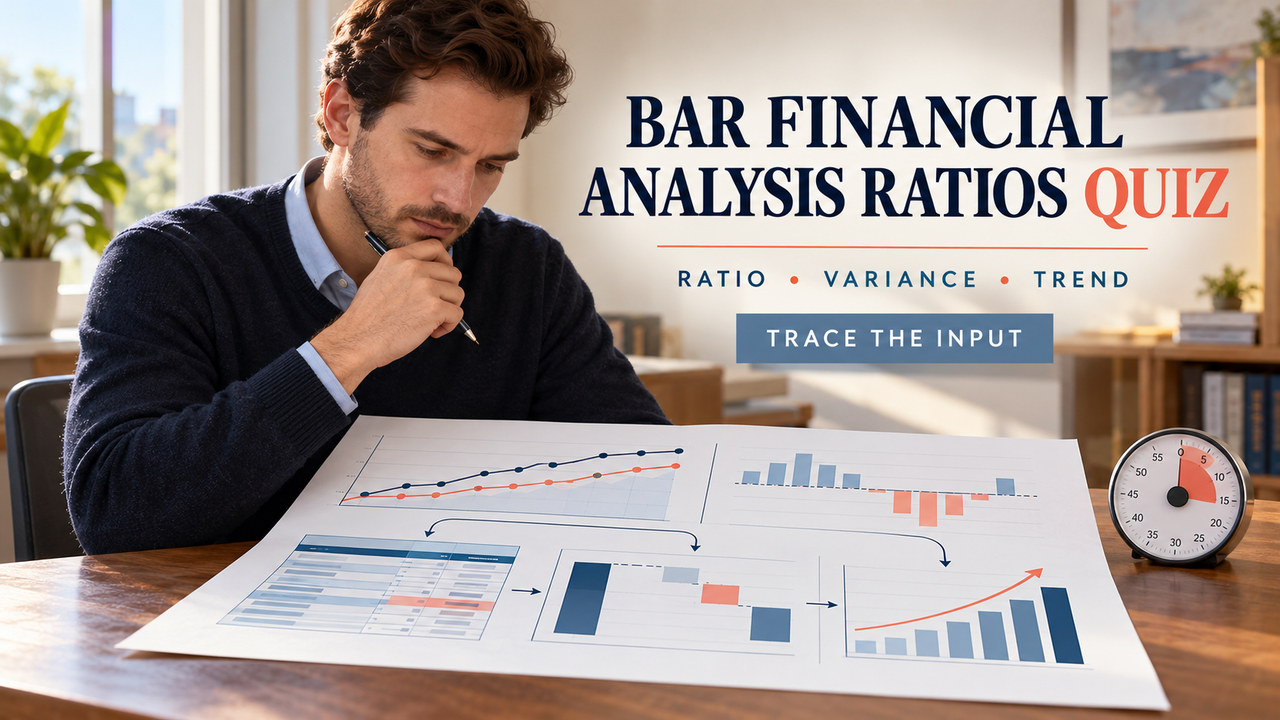

Direct answer: Use bar financial analysis quiz practice as a short evidence drill. Choose one lane, identify the input that controls the result, explain the strongest distractor, and record one changed-fact retry. The goal is a repeatable review action, not a score claim.
Scope and freshness note: These are original editorial practice cases. Reopen the AICPA CPA Exam Blueprints for the current testing boundary and task language, and use the NASBA CPA Exam FAQ for eligibility, scheduling, jurisdiction, and score questions.
Use the BAR review hub for section orientation. Then choose the Blueprint format guide for task boundaries, the CPA MCQ by topic guide for retrieval practice, or the CPA TBS practice guide when the evidence needs a longer exhibit.
For a broader preparation path, continue with our related CPA study resources.
bar financial analysis quiz: choose the evidence lane
This bar financial analysis quiz keeps each case tied to one controlling input and one next review action. Financial analysis questions often share familiar words while testing different work. One ratio may require an asset-quality check. A variance may require a driver decomposition. Elsewhere, a non-GAAP measure may require a reconciliation. A trend can change when the denominator or period changes. Valuation conclusions can turn on risk, timing, or capital structure. Begin with the requested output, then trace the input that can change it.
For each item, write four short labels: input, measure, variance or trend, and decision. Start with the input, the fact you must confirm. Then define the measure, the calculation or comparison. Explain the movement that needs a reason. Finish with the decision you will accept, reject, or test next.
Difficulty and timing
Start with moderate difficulty. Allow two minutes to read, three minutes to choose and justify an option, and two minutes to review the rationale. If the controlling fact is still unclear, mark the item for repair instead of adding speed. A short note that changes the next action is more useful than an answer letter without a reason.
Set the quiz evidence before answering
Before the first question, save the relevant Blueprint row or source boundary. Write the task verb, the output requested, and one fact that could change your answer. Keep reported amounts, adjusted measures, and forecast assumptions separate. This prevents a favorable label from replacing the evidence needed to support it.
Use one evidence note for every item: task, controlling fact, option, rejected distractor, source or exhibit to reopen, and changed fact. For a trend question, name the comparison period. For a variance question, state whether the movement is volume, price, mix, timing, or another driver. When valuation is tested, state the assumption and the sensitivity you would test.

Reveal the reasoning after the attempt
Open the explanation only after you have written your own note. Compare the rationale with your controlling fact. Then name the first missing proof point. The proof point may be a definition, a source boundary, a reconciliation, or a sensitivity check. That label determines what you review next.
Reveal the reasoning
Attempt the original item first. Write the controlling fact, the evidence check, and the strongest distractor you would reject.
Reveal the answer
Answer: Compare your note with the rationale, mark the first missing proof point, and change one fact before retrying.
Compare your process with the reasoning shown above.
bar financial analysis quiz question 1: ratio and trend
Assumptions: A company’s current ratio rises from 1.4 to 1.8. Inventory that has not moved drives most of the increase, while cash is flat. The question asks what a careful analyst should do next. This is an original practice case with simplified facts.
Question: Which response best interprets the trend?
- Conclude immediately that short-term liquidity improved because the ratio is higher.
- Ignore the ratio because a single period never matters.
- Inspect the asset mix and turnover evidence before treating the higher ratio as stronger liquidity.
- Replace the current ratio with a valuation multiple without explaining the change.
Answer and rationale: The third choice is strongest. The changed input is inventory, so the next check is whether that inventory can support near-term obligations in the relevant facts. One distractor treats an output as self-proving. Another discards a useful signal instead of qualifying it. A final distractor changes the task. Save inventory, turnover, and the comparison period in the evidence note.
Changed-fact retry: If receivables, rather than inventory, create the increase, the next check becomes collection timing and aging. If your next action stays the same, reopen the ratio definition and rewrite the controlling-fact line.
bar financial analysis quiz question 2: variance and non-GAAP context
Assumptions: Operating margin looks favorable after a one-time restructuring cost is removed from an adjusted measure. The prompt asks whether the adjusted trend alone supports an operating conclusion. Treat the adjustment as a fact to investigate.
Question: What is the most defensible next step?
- Use the adjusted margin as the only trend because it is higher.
- Compare the reported and adjusted views, identify the adjustment, and ask whether it changes the period-to-period operating story.
- Discard every non-GAAP measure without reading its reconciliation.
- Call the variance favorable and stop the analysis.
Answer and rationale: The second choice is strongest. It keeps the reported result and the adjusted view distinct while testing whether the item is isolated, recurring, or tied to the period. One distractor lets a presentation choice replace analysis. Another is an absolute rule that hides context. A final distractor names a direction but not a driver. Save the reported number, adjustment, adjusted number, and unresolved question.
Changed-fact retry: If the adjustment recurs in two periods, shift the next action toward recurring-driver analysis. If your answer does not change, label the missing proof as trend interpretation and reopen the period comparison.
bar financial analysis quiz question 3: forecast, valuation, and capital structure
Assumptions: A forecast value changes after management replaces a debt assumption with a different financing mix. Forecast cash flows are unchanged. The question asks what the learner should verify before accepting the new conclusion.
Question: Which response best protects the valuation analysis?
- Keep the old conclusion because the forecast cash flows did not change.
- Accept the new conclusion because the capital structure changed.
- Trace the financing assumption, risk or discount effect, timing, and changed sensitivity before comparing conclusions.
- Choose the answer with the largest value because it sounds more favorable.
Answer and rationale: The third choice is strongest. A financing change can alter the risk, discounting, or sensitivity story, so the analyst must show which input moved and how the output responds. One distractor freezes an old assumption. Another treats a changed label as proof. A final distractor substitutes preference for evidence. Save the original assumption, replacement assumption, direction of change, and one sensitivity check.
Changed-fact retry: Keep the financing mix fixed but change the timing of the cash flow. The next check should move toward timing and sensitivity rather than capital structure. That contrast shows whether the note separates inputs instead of repeating the conclusion.
Review the bar financial analysis quiz distractor, not just the answer
After each attempt, restate the task verb. Next, circle the fact that changes the measure or decision. Then explain why the strongest distractor sounds plausible. Finally, write the evidence that would make that distractor correct. This last step turns a rejected option into a boundary check.
When reviewing ratios, inspect the numerator, denominator, asset quality, and timing. For variances, separate volume, price, mix, and timing before calling a movement favorable. With non-GAAP measures, compare the reported result with the reconciliation and ask whether the adjustment recurs. In valuation, connect assumption, timing, risk, and sensitivity to the output.
Keep current sources in view. The cases and rationales here are original editorial practice; current AICPA materials determine the scope and wording to use when you refresh the note.
Choose the next financial analysis repair
Classify the first unresolved line as scope, fact, definition, evidence, or transfer. Choose one bounded repair before another mixed set. Start a scope repair by returning to the Blueprint row. A fact gap means reopening the exhibit or reconciliation. For a definition gap, use the ratio or measure rule. An evidence gap calls for a source check. A transfer gap requires one changed-fact retry.

Run a bar financial analysis quiz 30-minute block
- Minutes 0–4: Select one Blueprint row, evidence lane, and decision verb. Write the assumption that could change the answer.
- Minutes 4–15: Attempt the three original questions. Record input, measure, variance or trend, decision, and strongest distractor.
- Minutes 15–22: Read the rationales. Reopen the source or reconciliation tied to the first unresolved line.
- Minutes 22–27: Change one material fact in the weakest item and state whether the supported option changes.
- Minutes 27–30: Schedule one next action: a ratio calculation, variance decomposition, source check, or transfer item.
Keep the set narrow until the changed-fact retry works. Add a neighboring fact only after the evidence note is visible. More questions are useful after the repair, not before it.
bar financial analysis quiz checklist
- Did I write the task verb and requested output?
- Did I identify the input controlling the ratio, variance, non-GAAP view, trend, forecast, or valuation?
- Did I separate the measure from the story I want it to tell?
- Did I record why the strongest distractor fails?
- Did I save the source, reconciliation, or exhibit I would verify?
- Did I change one fact and explain whether the answer changes?
- Did I turn the first unresolved line into one next review action?
bar financial analysis quiz FAQ
Are these authority-issued questions?
No. The cases and rationales are original editorial practice. Use current AICPA materials for tested scope and current wording.
What should I record when I miss an item?
Record the controlling fact, the boundary or exhibit, the rejected distractor, and one changed-fact retry.
Should I keep adding timed items?
Only after the first missing proof point is repaired. More volume can preserve the same error when the repair is still undefined.
Does this method promise a passing result?
No. It creates observable reasoning evidence and a focused next action.
Sources
- AICPA CPA Exam Blueprints
- NASBA CPA Exam FAQ
- BAR review hub
- CPA MCQ by topic guide
- CPA TBS practice guide