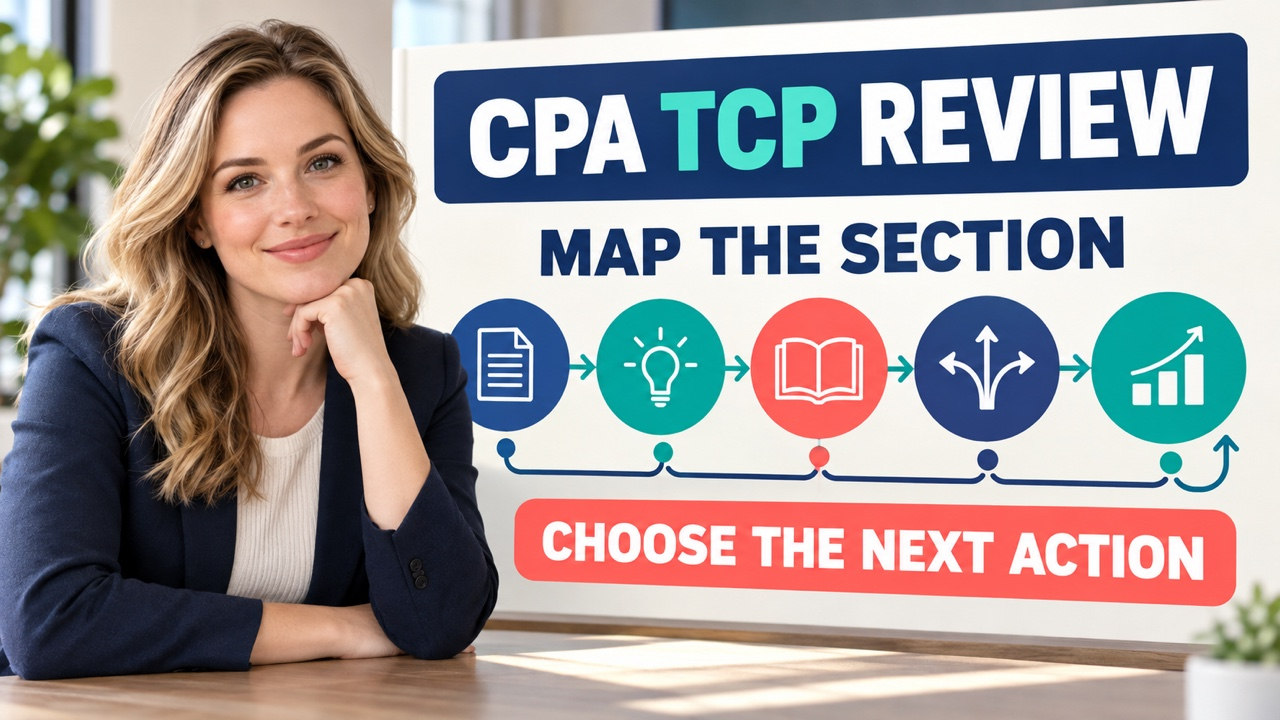

Direct answer: TCP prep guide is most useful as a section route, not as a list of isolated links. Start with the current Blueprint. Map the topic area and requested task. Identify the controlling fact or input. Choose the practice mode that proves the skill, then save the first review gap as one bounded next action.
Scope and freshness note: This is original editorial study guidance for the US CPA audience. It is not an exam-authority publication, tax conclusion, legal conclusion, licensing decision, or professional conclusion. Reopen the AICPA CPA Exam Blueprints, the IRS tax resources, and the NASBA CPA Exam FAQ before relying on a current boundary or administration detail.
Use the TCP review hub for section orientation. Choose the Blueprint format guide when a scope row is unclear. Use the topic MCQ page when recall or rule discrimination is the gap. Use the TBS practice guide when the requested output depends on exhibits, calculations, or multiple evidence fields.
For a broader preparation path, continue with our related CPA study resources.
TCP prep guide: what this section route helps you do
This page is for a candidate who recognizes the broad TCP section but cannot yet turn that recognition into a repeatable study decision. Rather than memorize every label at once, make the next block observable. Name the topic, read the task verb, isolate the controlling fact, open the source, and choose practice that produces the requested output.
Next, treat the current Blueprint as the scope boundary. It does not predict an individual exam form, replace professional literature, or provide a personal score forecast. Practice notes are not official results. Keep those boundaries visible so a correct local answer does not become an unsupported claim about readiness.
Map topics with the TCP prep guide
Begin with one current Blueprint row rather than a broad chapter name. Write the section, Area or topic, task verb, skill level, reference, and item type in one note. Next, circle the fact or input that must change before the response changes. This prevents a familiar term from doing the work of an actual analysis.
- 1. Individual and pass-through taxation: Classify the taxpayer, item, owner, timing, and limitation before comparing the tax effect.
- 2. Entity taxation and compliance: Keep entity type, return, allocation, ownership, and compliance obligation in the same fact record.
- 3. Property and transaction planning: Roll the basis, holding period, ownership, related-party, and disposition facts before choosing an option.
- 4. Trusts, estates, and advanced planning: Compare the planning goal with the taxpayer, transfer, limitation, and reporting consequence.
Across these areas, keep five signals visible: taxpayer, transaction, basis, limitation, planning. They are not a universal formula; they are prompts for deciding what evidence to collect. For example, a REG tax question may turn on taxpayer and timing. A business-law question may turn on party, authority, and remedy. If you mix those lanes too early, a correct-looking memory can hide the wrong rule.
Use the TCP prep guide topic-to-action route
The most reliable route has four handoffs. Each handoff should leave a visible artifact that another person could understand without hearing your internal monologue.
- Locate the topic. Copy the current Blueprint row and mark the Area, Group, Topic, task statement, skill level, and item type. Do not expand into every neighboring row yet.
- Isolate the controlling fact. Rewrite the task as a verb plus output: classify, calculate, evaluate, identify, or recommend. Then write the one fact, date, role, amount, criteria, or assumption that can change the answer.
- Anchor the rule or evidence. Open the appropriate official or technical source. For study purposes, write the boundary in your own words and record which part of the source you would reopen before reuse. Do not turn a short note into a live client conclusion.
- Prove the transfer. Choose MCQ when the gap is recognition or rule discrimination; choose TBS when the gap is assembling evidence, calculations, exhibits, or a multi-step response. Change one material fact and state whether the response changes.

The visual route is intentionally compact. It is a handoff system, not a poster of keywords. If a label does not change the next decision, leave it out. Let the paper object or relationship carry the meaning.
Run the TCP prep guide review route checklist
Use the checklist at the end of a study block or before you add a new topic. Mark only what you can explain from the current row. A blank line is useful evidence: it tells you what to repair next.
Choose practice with the TCP prep guide
Next, if the issue is that you cannot identify the topic or task verb, return to the Blueprint and make a one-row map. If you know the topic but confuse two rules, use a short original MCQ set and explain the strongest distractor in a complete sentence. If you can state the rule but cannot assemble the requested output, use a TBS-style workpaper. Keep the exhibit, calculation, and conclusion visible together.
Match the practice mode to the proof needed
For example, for TCP, the common failure is choosing a planning result before classifying the taxpayer, transaction, ownership, timing, and limitation. Repair it by changing one variable at a time. A REG review block might change the taxpayer or transaction date. An ISC block might change the control owner or system dependency. A FAR block might change the measurement or reporting-model fact. The subject-specific fact matters more than a generic “review harder” instruction.
Record a TCP prep guide review gap
After each attempt, record five lines: the task verb, controlling fact, source or exhibit checked, strongest distractor, and next action. If the answer was correct but the explanation was weak, keep the item in review. Correctness without a defensible reason is not yet transfer evidence.
Meanwhile, separate speed from certainty. A fast response can be useful when it rests on a clear fact and source boundary. If the clock expires while the boundary is unclear, mark the item. Complete the current block, then return with a shorter scope. Do not add a longer mixed set merely to create a larger number.
Therefore, keep a small “why this belongs here” note beside each topic. It should name the task, the fact that activates the rule, and the output you must produce. That note prevents a section landing page from becoming a directory: you are not merely collecting links, you are deciding which link or practice format will answer the gap you actually observed.
When a rule or procedure is current-sensitive, record the source checkpoint and the question that still needs verification. For tax, legal, reporting, audit, or technology claims, a remembered summary is not a substitute for the live authority. The study route can remain stable while the boundary note is refreshed.
That separation also makes review easier to audit later. Someone can see which scope decision was official, which example was editorial, and which practice response still needs another pass.
Finally, run one changed-fact retry. Keep the task verb fixed, change one fact, and decide whether the answer, calculation, report, or next resource changes. If it does not change, explain why. If it does, write the trigger that caused the change. That sentence is often the most valuable part of the session.
Route to the next TCP prep guide resource
Use the section hub for breadth, the Blueprint guide for scope interpretation, the MCQ page for rule discrimination, and the TBS guide for evidence assembly. These pages have different jobs. Opening all of them at once can make a focused gap harder to see. Choose one based on the first unchecked line in the checklist. That is the point of this TCP prep guide: one observed gap should choose one next resource.
- TCP review hub — orient the section and find the main topic lanes.
- CPA Exam Blueprint format guide — translate a current row into task, skill, source, and item-type evidence.
- CPA MCQ by topic — test recognition, rule boundaries, and distractor reasoning.
- CPA TBS practice — rehearse exhibits, calculations, reconciliations, and multi-step outputs.
End the session by scheduling one action, not by opening another tab. A useful next action names the row, item type, fact to change, evidence to save, and the time when you will perform the retry.
TCP prep guide FAQ
Should I study every TCP topic in the same order?
No. Start with the current Blueprint and your evidence gap. Keep adjacent topics visible, but let the requested task and response format choose the next practice block.
Is a high practice percentage proof that I am ready?
No. A local percentage is not an official CPA score or readiness determination. Record why the answer works, what distractor failed, and whether one changed fact changes the response.
When should I use MCQ versus TBS practice?
Use MCQ when the gap is rule recognition or discrimination. Use TBS when the task requires exhibits, calculations, multiple evidence fields, or a constructed response. Reopen the current Blueprint when the item type or skill level is unclear.
What should I do after a miss?
Save the first missing proof point, reopen one relevant source, write the rule or boundary in your own words, and retry one new item after changing one material fact.
Sources
- AICPA CPA Exam Blueprints
- IRS tax resources
- NASBA CPA Exam FAQ
- TCP review hub