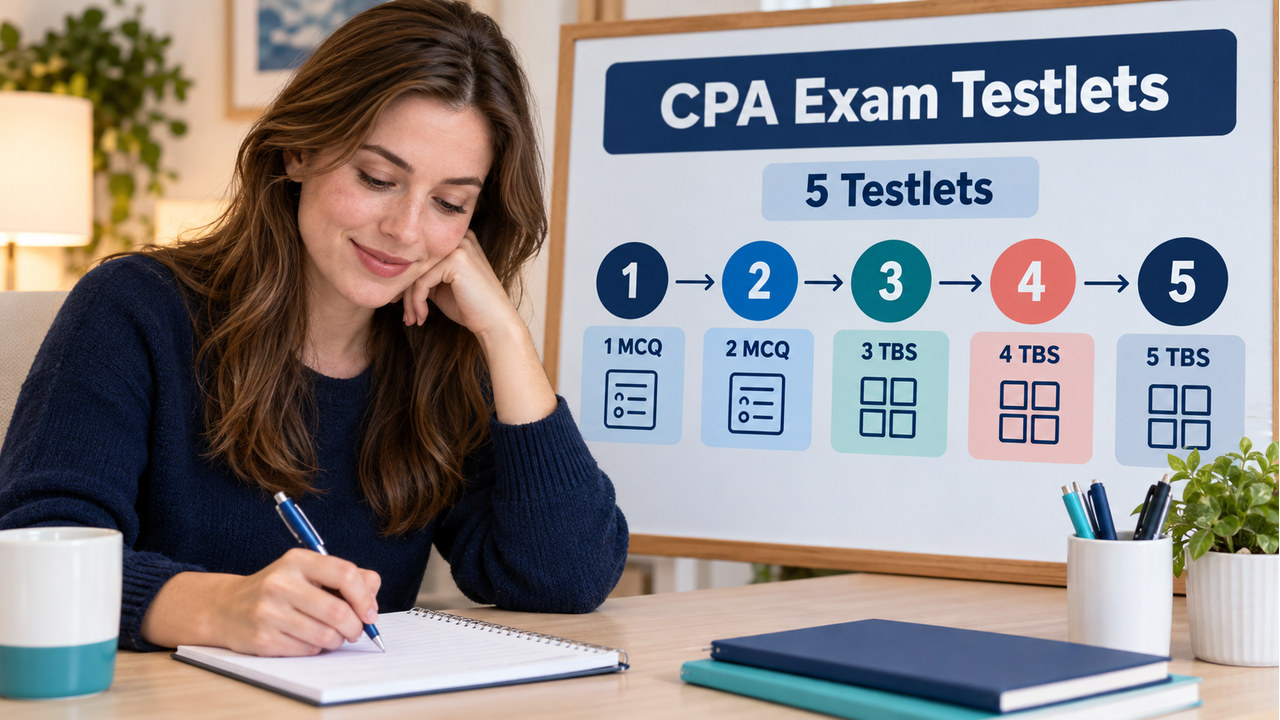

Quick answer: A CPA Exam testlet is a group of questions inside one exam section, not a single question and not a separate exam. The phrase cpa exam testlets usually points to the same practical question: how the five containers work. Under the current AICPA description, one section has two multiple-choice question (MCQ) testlets followed by three task-based simulation (TBS) testlets. Once you submit a testlet, you cannot reopen it, so practice should include a short review pause before you commit it.
That definition turns a vague format word into a behavior. You can orient yourself before a testlet, work through its questions, flag uncertainty, review while the container is open, submit when ready, and record what the attempt actually proved. The AICPA Blueprint remains the source for current section tasks and detailed item context; this page supplies a way to use that structure in study.
For a broader preparation path, continue with our CPA Exam Study Guide.
What Is a CPA Exam Testlet?
A CPA Exam testlet is a container of questions presented as one part of a section. Think of it as an operating layer between the full section and the individual MCQ or TBS. It gives you a defined group of work to complete, review, and submit. It is not a topic label, a score category, or a fourth type of question.
The testlet layer matters because it creates both a visible sequence and a decision point. Review has to happen before submission because the submitted container is no longer available for reopening. Instead of tracking only questions completed, ask what the testlet showed about the action that needs another attempt.
When you study, use the testlet as a small unit of format, control, and evidence: identify MCQ or TBS work, review what is still open, and record the rule, output, or process your performance did or did not demonstrate. That makes the container something you can plan, inspect, and repeat.

How Are CPA Exam Testlets Ordered?
The current sequence is two MCQ testlets followed by three TBS testlets. The first pair asks you to select responses. The final three ask you to perform tasks that can involve exhibits, calculations, research, organization, or a specified entry. The five containers sit inside one section; they are not five separate exams.
The sequence creates a useful mental transition. In the first phase, you are often identifying the controlling fact or rule quickly enough to choose the best response. In the second phase, you translate the prompt into a requested output and manage the information needed to produce it. That is why a strong MCQ result is encouraging evidence but not proof that your TBS process is ready. The modes overlap in knowledge, but they do not ask you to demonstrate it in the same way.
Do not turn the sequence into an unsupported promise about difficulty or a fixed study ratio. Use the current Blueprint for the selected section and choose practice that matches its task statements.
Also separate a testlet from an individual question. If one MCQ exposes a knowledge gap, you can review that item. If a TBS reveals that you misread an exhibit or failed to organize a calculation, the better unit of review is the action across the task. The testlet is the container that helps you notice that difference.
What Can You Do Before You Submit a Testlet?
Before submission, perform a deliberate review pass on flagged work and on the prompt’s requested output. You do not need a dramatic ritual. You need a short repeatable check that catches avoidable omissions while the testlet is still open.
- Confirm the task. Restate what the question or simulation asks you to select, calculate, explain, or enter.
- Review flagged items. Revisit uncertainty with the prompt and exhibits in view. Change an answer only when your reasoning improves, not because the clock made you anxious.
- Check the container. Make sure you have moved through the available items and have not left an exhibit, schedule, or requested field untouched.
- Check the evidence. In an MCQ, name the controlling rule or concept. In a TBS, verify that the output follows the requested format and the key calculation or exhibit step.
- Submit intentionally. Once you commit the testlet, treat the review window as closed and move to the next permitted part of the section.
This is a process safeguard, not a score guarantee. It can help you separate a knowledge miss from a rushed or incomplete response, which makes the result more useful for study. In a practice environment, write down whether the error was visible before submission and whether you noticed it in time to fix it. That is more actionable than simply marking the answer wrong.
Keep the check short enough to repeat; if it replaces the practice you meant to evaluate, shorten it and refine it after you see which omissions recur.
How Should You Practice CPA Exam Testlets?
Practice the testlet control loop: orient, work, flag, review, submit, and log the next retry. Start with one current Blueprint task statement for the section you are studying. Pick a fresh MCQ set or a TBS that tests the same action. Complete it without notes, use the pause-before-submit check, and then review the evidence instead of treating the percentage as the whole lesson.
For a 60-minute block, you might spend 8 minutes translating the task statement into your own words, 30 minutes completing a matched practice set, 12 minutes reviewing the reasoning and the submission check, and 10 minutes scheduling the next attempt. That is a flexible example, not an official time ratio. A TBS may deserve the whole block if the skill is organizing exhibits or producing a multi-step output; do not force a fixed question count just to make the session look productive.
Use a two-line log after every testlet. On the first line, write the layer that failed: knowledge, reading, calculation, organization, output format, or timing. On the second line, write the next same-action retry, such as “recalculate the requested amount from the exhibit and enter the answer in the requested unit.” The retry should test the broken action, not merely repeat the same question from memory.
CPA Exam Testlet Preflight
What do I do before I submit?
Review flagged items, confirm the prompt's requested output, and make sure you have not skipped an exhibit or calculation step.
What do I record after an MCQ miss?
Record the controlling rule or concept, the strongest distractor, and the reason your choice failed.
What do I record after a TBS miss?
Record the requested output, the exhibit or calculation step that controlled it, the error class, and the next same-action retry.
The method also makes progress comparable across days. A repeated MCQ rule miss calls for a new context; an exhibit-organization miss calls for an evidence map; a timing problem calls for observing where the loop slows. These need different interventions even when the percentages look similar.
How Do Testlet Mistakes Differ Between MCQs and TBSs?
MCQ and TBS misses need different review evidence because the response actions are different. Use the table as a recording aid, not as a claim that one mode is more important than the other.
| Response mode | What you are demonstrating | What to record after a miss | Next same-action retry |
|---|---|---|---|
| MCQ | Identify the controlling fact, rule, or distinction and choose the best response. | The rule or concept, the strongest distractor, and the reasoning step that broke. | Answer a new item testing the same distinction without memorizing the old choices. |
| TBS | Read the task, organize information, calculate or research, and produce the requested output. | The requested output, controlling exhibit or step, error class, and format omission. | Repeat the same process on a fresh task with a short evidence map before working. |
| Testlet control | Review flagged work before the container is submitted. | Whether the error was visible before submission and whether the review caught it. | Run the pause-before-submit check on the next matched practice block. |
For example, a similar-sounding MCQ error calls for a new contrast question and a one-sentence rule. A TBS error from the wrong exhibit column calls for locating and labeling evidence before calculating. The testlet framework locates the failure; the log chooses the next action.
Which CPA Exam Testlet Details Need Rechecking?
Use the AICPA Blueprint and current AICPA FAQ for the exam facts in this article: the testlet terminology, the two-MCQ-then-three-TBS sequence, section-specific content, and the submitted-testlet boundary. The Blueprint can change the details that matter for a particular section, so record its effective date when you build a dated study plan.
Use NASBA or the selected jurisdiction for candidate-record, eligibility, and licensure questions. Use Prometric and your current appointment notice for the testing center, identity documents, arrival instructions, and scheduling rules. Those are different owners. A testlet explainer can be accurate about exam structure while still being the wrong place to answer whether your application is eligible or what you must bring to a particular center.
Practice software may use different labels or reset behavior. Use it to build skills, but recheck current official resources before relying on an exam-day assumption.
CPA Exam Testlets FAQ
How many testlets are in one CPA Exam section?
One current section uses five testlets: two MCQ testlets followed by three TBS testlets under the AICPA description checked for this article.
Can you go back to a submitted testlet?
No. Once a testlet is submitted, treat it as closed and unavailable for reopening. Complete your review of flagged items and requested outputs before submission.
Are testlets the same as individual questions?
No. A testlet is a group or container of questions. Individual MCQs or TBSs are the work inside that container.
Why should MCQ and TBS review be different?
Because the response actions differ. MCQ review should explain the controlling rule and distractor; TBS review should explain the requested output, evidence, calculation, organization, or format step.
Does the testlet order tell me how to divide all study time?
No. It tells you the order of response modes. Use the current Blueprint and your error log to decide which action needs more practice; do not treat a universal time ratio as an official rule.
Key Takeaway
The current CPA Exam testlets model is easiest to use as a control loop: orient to the task, work the questions, flag uncertainty, review while the container is open, submit deliberately, and log the next same-action retry. Start with the AICPA Blueprint for your selected section, practice one matched action, and make the pause-before-submit check part of the block before you count the session complete.
CPA exam testlet questions
How many testlets are in one CPA Exam section?
Five: two MCQ testlets followed by three TBS testlets under the current AICPA description.
Can you go back to a submitted testlet?
No. Review flagged work and requested outputs before submitting.
Are testlets individual questions?
No. A testlet is a group or container that holds individual questions.