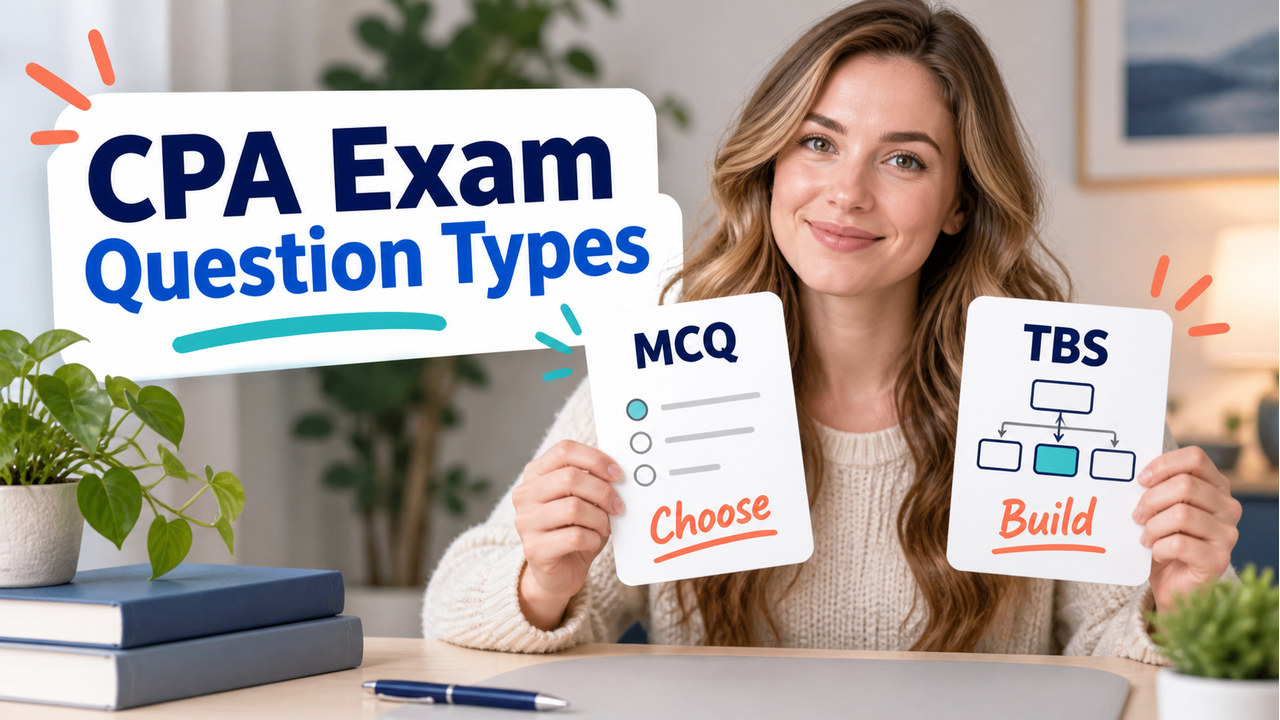

Quick answer: The current cpa exam question types are multiple-choice questions (MCQs) and task-based simulations (TBSs). An MCQ asks you to select the best response from the choices provided. A TBS asks you to work through a task, use the supplied information, and produce the requested output. They test related accounting knowledge, but they require different response habits. The current AICPA Blueprint for your section controls the tested topics and task statements; this page explains how to recognize and practice the two modes.
A learner can understand a rule and still miss a TBS by misreading an exhibit, or miss an MCQ by choosing a familiar answer before identifying the controlling fact. After practice, ask which response action broke, what evidence should have supported it, and what fresh action you will try next.
CPA Exam Question Types: What They Ask You to Do
There are two broad current CPA Exam question types: MCQs and TBSs. MCQs are selected-response items. You read a prompt, identify the relevant fact or rule, compare the choices, and choose the best answer. TBSs are constructed-response tasks presented through a simulation environment. You interpret instructions and exhibits, organize information, calculate or research when the task calls for it, and enter or produce the requested result.
The terms describe the response format, not a complete map of every subject tested. The same section can ask about several content areas while using both formats. The AICPA Blueprint is the right place to check task statements for AUD, FAR, REG, BAR, ISC, or TCP. Do not infer a section’s exact item count, weighting, or difficulty from a generic description or a provider dashboard.
You may also see testlet. A testlet is a group or container of work; MCQ and TBS are the response types inside the current structure. Keeping those levels separate prevents treating a group of items as a third question type.
Are MCQs and TBSs the Same Kind of Question?
No. MCQs ask you to choose; TBSs ask you to execute a task and submit an output. Both can require technical knowledge, careful reading, and judgment, but the visible evidence of a good response is different. In an MCQ, the evidence is a defensible choice supported by the controlling distinction. In a TBS, the evidence is a completed process: the right instruction, source exhibit, calculation or research step, and output format.
That difference changes review. An MCQ miss becomes useful when you can state why the correct choice wins and why the strongest distractor loses. A TBS miss needs a process note: perhaps you selected the wrong exhibit, carried a number into the wrong schedule, used the wrong unit, or stopped before producing the requested field. Calling all of those errors a knowledge gap makes the next session less precise.
What Does an MCQ Ask You to Do?
An MCQ asks you to identify the controlling fact or rule and select the best available answer. A choice may be generally true but still fail to answer the question asked, use the wrong measurement basis, or ignore a fact that changes the result.
Use a four-step reading pass. State the requested output in a few words: classification, amount, treatment, assertion, or conclusion. Name the fact that controls the result. Predict the rule before the choices pull your attention. Then compare the strongest two choices and write one sentence explaining the difference. This is a practice method, not an exam-day promise, so adapt it when the prompt requires another approach.
Consider an original practice illustration. A prompt gives two facts that sound similar and asks which one changes the accounting treatment. Your first note should name the controlling distinction. If you choose a familiar rule without explaining why the second fact matters, the miss is not merely memory. Retry with a new item testing the same contrast, plus one sentence for the rule and one for the strongest distractor. Keep examples in your own words and never present generated or provider questions as live exam items or as an endorsement.
What Does a TBS Ask You to Do?
A TBS asks you to translate the task, organize the evidence, perform the required work, and submit the requested output. The task may involve exhibits, calculations, research, journal entries, a classification, or another structured response. Exact content depends on the section’s current Blueprint, so process habits are more durable than memorized screen labels.
Rewrite the instruction as an output statement: what must be entered, calculated, selected, or explained? Build a small evidence map. Mark the exhibit or data field that controls the answer, note the expected unit or format, and separate relevant facts from facts that are merely present. Complete the reasoning, then run a final format check before submission.
Here is an original practice illustration. Imagine a simulation that asks for an amount based on a schedule and an attached note. If you calculate from the first number you see, the failure may be evidence selection rather than arithmetic. Your next retry should label the controlling schedule and requested unit before calculating. That tests the broken action instead of repeating familiar numbers.

For a broader preparation route, continue with our CPA Exam Study Guide. Use the current AICPA Blueprint for the section-specific task, not a generic TBS promise.
How Should You Practice CPA Exam Question Types?
Practice MCQs and TBSs as separate response loops, then connect them through the same error log. For an MCQ block, choose one Blueprint task statement, answer a fresh set without notes, and record the controlling rule, strongest distractor, and reason your choice failed. For a TBS block, translate the requested output, map the evidence, complete the process, and record the step or format that broke.
Use a conditional switch rule rather than a universal study ratio. If MCQ misses are mostly rule or distinction errors, stay with short contrast sets until the rule is explainable in a new context. If MCQs are accurate but TBS work stalls at exhibits, organization, or output format, move the next block to a smaller TBS process drill. If both formats fail on the same content task, return to the Blueprint concept before increasing speed.
A 60-minute example might include 10 minutes translating one task statement, 30 minutes on matched practice, 10 minutes reviewing evidence, and 10 minutes scheduling a fresh retry. It is a flexible study example, not an official timing rule. A complex TBS may deserve the whole block; a short MCQ contrast set may be enough when the goal is to repair one distinction.
Question-Type Triage Card
I missed an MCQ because two choices sounded right. What should I record?
Record the controlling distinction, the strongest distractor, and the sentence that explains why the correct choice fits the prompt better. Retry with a new contrast question.
I knew the TBS topic but used the wrong exhibit. What should I do next?
Label the requested output and the controlling exhibit before calculating. Retry the evidence-selection process on a fresh task instead of repeating the same numbers.
My process was correct but I ran out of time. Is that a knowledge miss?
Not necessarily. Record where the process slowed, then shorten the next matched block or rehearse that step separately before increasing speed.
How Do You Diagnose CPA Exam Question Types?
Diagnose the failed response action before choosing the next question. This table is a study-recording tool, not an official readiness score or a claim that one format matters more.
| Format | What you demonstrate | What to record after a miss | Next same-action retry |
|---|---|---|---|
| MCQ | Identify the controlling fact or rule and choose the best response. | Rule or distinction, strongest distractor, and the reasoning step that failed. | Answer a fresh contrast question without memorizing the old choices. |
| TBS | Translate instructions, organize evidence, complete the work, and produce the requested output. | Controlling exhibit or step, error class, unit, and format omission. | Repeat the process on a new task with an evidence map before calculating. |
| Either | Read the requested output before committing to a response. | Whether the error was visible from the prompt and whether a final check could have caught it. | Run the same pre-response check on the next matched block. |
Use five labels in the log: knowledge, reading, calculation, organization, and output format. Timing can be a sixth label when the process was correct but too slow. A knowledge error calls for concept review; a reading error calls for a prompt-rewrite drill; a calculation error calls for a worked step; an organization error calls for an evidence map; and a format error calls for a final-output checklist. The label should change the next action.
Is Written Communication Still a Current CPA Exam Question Type?
Historical advice about the former BEC section should not be treated as a current separate written-communication question type. That former section belonged to the pre-CPA Evolution structure, so older study pages may use that label. Verify the present response modes and task statements for your selected section in the current AICPA Blueprint instead of copying an old plan.
Communication still matters for understanding instructions and producing a clear response, but that does not make an old exam-format claim current. Check the date of a provider page, forum answer, or PDF before changing your study method.
Which Question-Type Details Should You Verify?
Verify current tested content and task statements in the AICPA Blueprint for your selected section. AICPA sample-test resources can help you become familiar with the general response experience, but a sample or generated item is not evidence that the same question will appear on your exam.
Route candidate-record, eligibility, education, experience, credit windows, and licensure questions to NASBA or the selected jurisdiction. Route testing-center, identity, arrival, accommodation, and appointment details to Prometric and your current appointment notice. Before a dated plan, record the Blueprint edition or effective date you checked and recheck it when the policy or section changes.
CPA Exam Question Types FAQ
Are there two main CPA Exam question types? Yes. The current broad response types are MCQs, where you select the best answer, and TBSs, where you work through a task and submit the requested output. Section-specific content comes from the current Blueprint.
Do MCQs and TBSs require the same study method? No. Use contrast and distractor reasoning for MCQs; use instruction translation, evidence organization, process completion, and output checks for TBSs. Connect both through an error log that chooses the next same-action retry.
What should I do next? Open the current Blueprint for your section, choose one task statement, complete one matched MCQ or TBS block, and record the response action that needs another attempt. That creates useful evidence without turning a percentage into a pass prediction.
Key Takeaway
The practical answer to cpa exam question types is not only MCQ versus TBS. It is choose versus execute, with a different kind of evidence and a different review action. Name the requested output, identify what supports it, record the failed layer, and retry that action in a fresh context. Then confirm current section details in the AICPA Blueprint before older labels or generic ratios shape your plan.