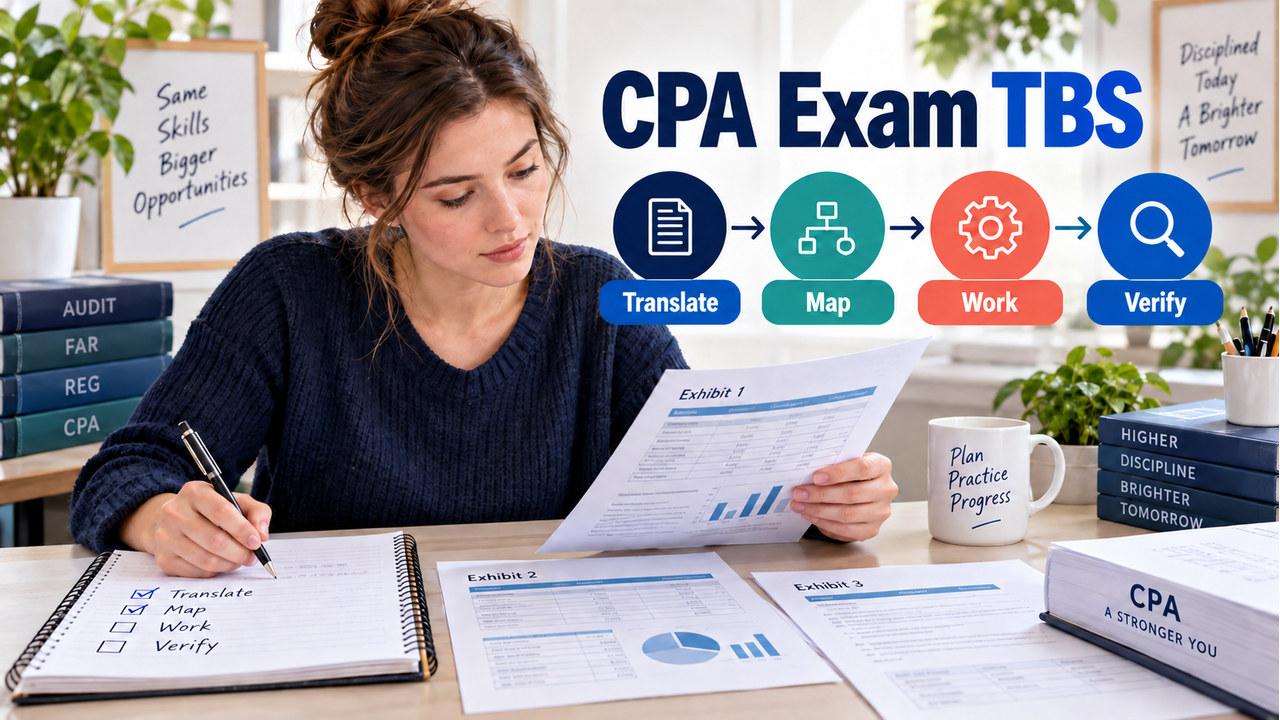

Quick answer: cpa exam task based simulations are completed by following the task’s requested output, locating the evidence that controls it, doing the required work, and checking the final entry before submission. Treat the process as a sequence, not as a long multiple-choice question: translate, map, work, verify, and review. The current AICPA Blueprint for your selected section controls the tested content and task statements, so this page teaches a reusable method rather than promising a universal item count, score weight, or screen layout.
A TBS combines reading, evidence selection, technical work, and field-by-field submission. Separating those jobs gives useful feedback instead of a simple wrong mark.
What Are CPA Exam Task Based Simulations?
A task-based simulation is a constructed-response exam task that asks you to apply knowledge to supplied information and produce the requested result. The task may involve exhibits, calculations, research, journal entries, classifications, reconciliations, or another structured response. Exact task statements and content depend on the section and current AICPA Blueprint; a generic TBS article cannot replace that source.
A TBS has more than a final number: an instruction, possible evidence, an operation or judgment, and an output format. A correct calculation in the wrong field can be incomplete; an irrelevant exhibit can support a polished wrong answer. Review the path, not only the result.
Think of the task as a small workpaper. Before touching the calculator, write what the prompt asks you to deliver, which unit or accounts are involved, and what condition changes the treatment. That pause makes the task easier to audit.
What Should You Read Before You Start a TBS?
Read the requested output and completion conditions before reading every exhibit in detail. Ask: What must I enter or explain? In what unit or format? For what date or population? What facts could change the result? These questions turn a broad scenario into a defined work product.
Mark the verbs in the instruction. “Select” may require one choice, “calculate” an amount, “prepare” multiple fields, and “explain” a short rationale. Do not assume every visible tab or attachment must be used; one exhibit may provide context while another supplies the controlling fact.
Make a stop condition: “I am finished when the requested amount is entered, the debit and credit fields are populated, the unit is correct, and the final check agrees with the instruction.” This prevents manipulating numbers after the task is answered.
How Do You Build a TBS Evidence Map?
Build an evidence map by connecting each requested output to the exhibit, fact, operation, and unit that support it. A simple four-column note is enough:
- Output: the field, conclusion, entry, or amount the task requests.
- Evidence: the exhibit, date, policy, or data point that controls that output.
- Work: the calculation, research step, classification rule, or comparison you will perform.
- Check: the unit, sign, account, format, or condition you will verify before submitting.
Label the exhibits instead of copying them: “policy note,” “transaction schedule,” and “answer template” are more useful than unfiltered notes. If two exhibits seem to conflict, identify whether they describe different dates, populations, or purposes. A contradiction is a reading signal, not an invitation to average numbers.
Keep irrelevant information visible but crossed out. That records a deliberate choice and makes a later miss easier to diagnose. The goal is to make controlling evidence obvious before the calculation begins.
How Do You Work Through CPA Exam Task Based Simulations?
Work through a TBS in four passes: translate the request, map the evidence, complete the operation, and verify the output. The following fictional practice illustration shows the passes. It is an original study example, not a live exam item.
Fictional scenario: Orchard Lane LLC pays $12,000 on October 1 for a 12-month service period. A policy exhibit says the cost is recognized evenly over the service period. At November 30, the task asks you to enter the expense recognized to date and the remaining prepaid balance in a journal-entry template. The template requests dollars and names the debit and credit fields.
Pass 1—translate. The output is not “explain the payment.” It is two dollar amounts plus the accounts or fields required by the template. The dates matter: two months of service have elapsed. The unit is dollars, and the answer must fit the requested journal-entry structure.
Pass 2—map. The payment record supplies the $12,000 amount and October 1 start date. The policy note supplies the even-recognition rule. The template supplies the output fields. An exhibit about a vendor contact or unrelated invoice is not controlling evidence for this task.
Pass 3—work. Divide $12,000 by 12 months to get $1,000 per month. Two months recognized means $2,000 of expense, leaving $10,000 prepaid. The journal-entry logic is a debit to service expense and a credit to prepaid service for the amount recognized, subject to the fictional template. Write the operation so a reviewer can see why the answer is $2,000.
Pass 4—verify. Check the elapsed period, arithmetic, dollar unit, remaining balance, debit-credit direction, and every required field. The recognized amount plus remaining prepaid should equal the original payment. If the number is right but the field is wrong, record an output-format failure rather than a conceptual failure.
On the real exam, replace this fictional policy with the task’s actual instructions and current section Blueprint. The illustration’s value is the workflow: identify the output, select controlling evidence, show the operation, and reconcile the response.

For broader preparation context, continue to our CPA Exam Study Guide. Use current AICPA sample-test resources to learn the general response experience, but do not assume an original practice illustration predicts a live item.
How Do You Check CPA Exam Task Based Simulations Before Submitting?
Run a final check against the instruction, evidence, work, and output—not only against the calculator. Use this short sequence:
- Read the requested output again and confirm every field or explanation is present.
- Confirm the controlling date, population, unit, sign, and account or category.
- Reperform the key operation from the evidence you marked, not a number remembered from another exhibit.
- Check that the response format matches the template: amount, selection, entry, schedule, or explanation.
- Ask whether a final condition changes the result or requires a separate field.
Match the check to the task. A calculation-heavy task deserves arithmetic and reconciliation; a research or classification task deserves a source, condition, and conclusion check. The purpose is to catch an avoidable submission error while the evidence map is fresh.
How Should You Review a TBS Miss?
Review the failed response layer before choosing the next practice task. A useful log says what broke and what fresh action will test that layer:
TBS Miss Triage Card
I started calculating before I read the requested output. How do I recover?
Stop and rewrite the deliverable, unit, date, and completion condition. Keep the calculation only if it answers that deliverable; otherwise reset your evidence map and start from the controlling exhibit.
I used the wrong exhibit even though my arithmetic was correct. What should I do next?
Record the exhibit you used, the exhibit that controlled the answer, and the clue that separated them. Retry on a new task by labeling each exhibit's purpose before performing any operation.
My reasoning was right but the answer field was incomplete. Is that a knowledge miss?
Not necessarily. Label it as an output-format or instruction-compliance miss, then practice a new task with a final field-by-field check before submission.
| Failed layer | What it looks like | Record after the attempt | Next retry |
|---|---|---|---|
| Reading | You answered a different question from the one asked. | The missing verb, date, condition, or requested field. | Rewrite the output statement before opening the exhibits. |
| Evidence | You used a plausible but non-controlling exhibit. | The controlling exhibit and the distracting exhibit. | Label evidence first on a new task before calculating. |
| Calculation | The right inputs were selected but the operation failed. | The exact step, sign, unit, or reconciliation that broke. | Work one fresh operation with written units. |
| Organization | You lost track of tabs, dates, fields, or intermediate results. | Where the evidence trail became unclear. | Use a smaller evidence map and a visible stop condition. |
| Output format | The reasoning was sound but the answer did not satisfy the template. | The missing field, account, label, or format requirement. | Practice a new task with a final-output checklist. |
Knowledge can be part of any miss, but do not assume it is the cause before checking the path. If the same rule fails after reading and evidence steps are correct, review the concept. If the rule is correct but the output field is wrong, more flashcards may not solve the problem.
Which TBS Details Should You Verify in the Current Blueprint?
Verify section-specific task statements and tested content in the current AICPA Blueprint before building a dated plan. A commercial review page or old screenshot may describe a different release.
Use AICPA sample-test resources for general familiarity, but do not present generated or provider questions as live exam material. Route candidate records, eligibility, education, experience, credit windows, and licensure to NASBA or the selected jurisdiction. Route testing-center, identity, arrival, accommodation, and appointment details to Prometric and the current appointment notice.
CPA Exam Task Based Simulations FAQ
Are TBSs only calculation questions? No. A task can require research, classification, journal-entry work, evidence selection, or another structured response. Read the requested output before choosing a method.
Should I open every exhibit? No. Scan the available material, label each exhibit’s purpose, and identify the evidence that controls the requested output. Do not force irrelevant material into the answer.
What is the best way to practice TBSs? Use fresh, legally obtained practice material and apply the same translate-map-work-verify sequence. After each attempt, record the failed layer and complete a new task that tests that action. Exact section content and current exam details still belong to the applicable AICPA Blueprint.
Key Takeaway
The practical method for cpa exam task based simulations is simple to state: translate the requested output, map the controlling evidence, complete the work with visible units, verify the required fields, and review the failed layer. A good TBS log changes what you do next. It does not copy exam questions, rely on old BEC advice, or turn one practice result into a promise about the exam.
Sources
- AICPA CPA Exam toolkit
- AICPA CPA Exam Blueprints
- AICPA CPA Exam sample tests
- NASBA CPA Exam resources
- Prometric CPA Exam