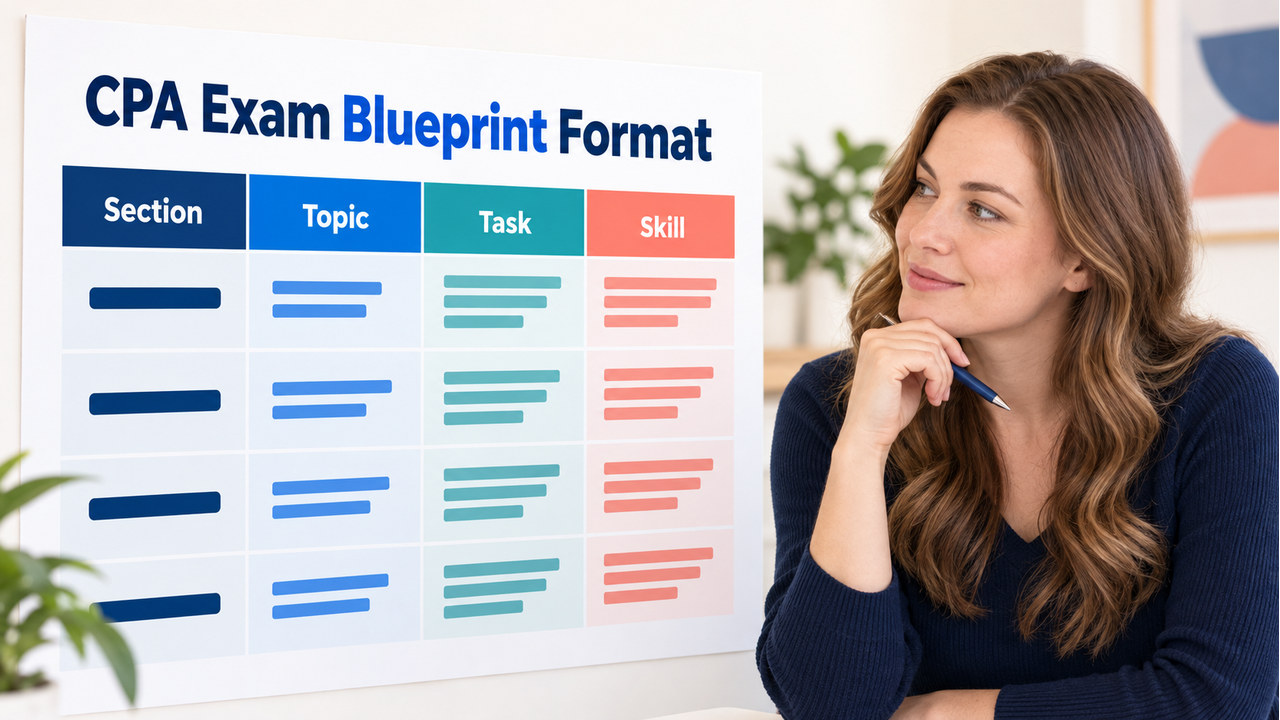

Quick answer: The cpa exam blueprint format is the AICPA’s versioned map of the knowledge and skills tested in a section. It is not the same thing as the delivery format, such as testlets, timing, or the order in which questions appear. To use a Blueprint well, read from section to topic, inspect the representative task statement and skill level, note the weighting and effective date, and then choose practice that matches the task demand.
This distinction matters because a candidate can memorize an exam-format summary and still study the wrong depth. The Blueprint tells you what the section is designed to assess; the current exam instructions tell you how you will encounter the assessment. Use both, but do not make one document answer the other’s question.
For a broader preparation path, continue with our CPA Exam Study Guide.
What Is the CPA Exam Blueprint Format?
The CPA Exam Blueprint is an official content-and-skills map, not a promise of exact questions. AICPA materials use the Blueprints to show the areas, groups, topics, and representative tasks that define the scope of an initial-licensure section. Because the files are versioned, the effective date is part of the information you should save, not a footnote to ignore.
The word “format” creates a common trap. In ordinary study conversations, it can mean the four-hour section, testlets, multiple-choice questions, task-based simulations, navigation rules, or the distribution of items. Those are delivery and scoring questions. A Blueprint-format question usually needs a different answer: how the tested content is organized, what a task statement asks you to do, and how the published scope should change your study activity.
How Is the CPA Exam Blueprint Format Organized?
Read the hierarchy from broad scope to observable work: section, area, group, topic, representative task statement, skill level, weighting or item-type context, and effective date. The labels may be presented differently across section files, but the reading habit is stable. Start with the section you plan to sit, then move downward until you can describe the task in your own words.
A task statement is more useful than a topic label alone because it points toward an action. “Revenue” is a subject; “analyze a revenue arrangement under the applicable guidance” implies a different practice session. That sentence is an interpretation for study design, not a quotation or guaranteed exam prompt. The Blueprint remains the authority for the published scope and terminology.

Use the visual as a reading path, not as a substitute for the current AICPA file. When the page you are using has a different hierarchy, preserve the same question: what is the scope, what must the candidate do, how deeply must the candidate do it, and when was this version effective?
What Does Each Part of the Blueprint Tell You?
The following grid turns each common label into a practical question. It is a study tool built from the official hierarchy; it does not replace the wording or tables in the current Blueprint.
| Blueprint field | What it answers | Study action |
|---|---|---|
| Section | Which exam section and current scope are you reading? | Save the exact section name and file date. |
| Area / group / topic | Where does the concept sit in the content map? | Tag notes so weak areas can be found later. |
| Task statement | What observable work may be assessed? | Write one practice output using the task verb. |
| Skill level | How much reasoning or judgment does the work require? | Progress from recall to explanation, analysis, or judgment. |
| Weight / item context | How does the section file frame emphasis or item type? | Use it to prioritize, never to predict an exact score. |
| Effective date | Which version did you actually read? | Recheck before the study calendar or exam appointment. |
Area, group, and topic
These labels locate the knowledge. The area is a broad content family; groups and topics narrow it. Do not treat every label as a separate article opportunity or a separate memorization pile. Use the hierarchy to connect a rule to its application and to find the exact place where an error belongs.
Representative task statements
These statements describe work, not a hidden question bank. Circle the verb: identify, calculate, prepare, analyze, evaluate, or another action. Then decide what a correct answer would look like: a short explanation, a calculation, a conclusion supported by evidence, or a completed simulation workflow.
Skill levels
Skill levels describe cognitive demand, not a guaranteed number of items. A recognition task may require accurate recall and identification. Application asks you to use a rule in a situation. Analysis requires connections among facts or alternatives. Evaluation asks for a supported judgment. Your practice should show the same kind of thinking instead of stopping at flashcard recognition.
Weighting and item context
Use weighting as a prioritization signal, not a promise. Section files can show how content and item types are framed, but a candidate should not reverse-engineer a guaranteed score from one percentage. Combine the Blueprint emphasis with your error log, available time, and the section-specific format guidance.
How Do Skill Levels Change the CPA Exam Blueprint Format?
Skill level changes what “knowing the topic” must look like in practice. If the task is recognition, a clean definition and correct classification may be enough. If it is analysis, practice should include a fact pattern, competing treatments, and a reasoned conclusion. If it is evaluation, add judgment, support, and a clear explanation of why one answer is stronger.
That does not mean every higher-level statement becomes a task-based simulation or that every lower-level statement appears as a multiple-choice question. The Blueprint shows the intended skill demand; the section’s current format and item mix show how the assessment is delivered. Keep those claims separate in your notes.
How Should You Turn the CPA Exam Blueprint Format Into a Study Plan?
Use a five-step read-one-row method: copy the section and version date; mark the area, group, and topic; underline the task verb; name the skill level; and assign one practice output. For example, suppose a current row concerns a financial-reporting topic and uses the verb “analyze.” An original study translation would be: compare two fact patterns, identify the governing issue, calculate or classify the relevant result, and write a two-sentence justification. That is a practice design based on the row; it is not an official task statement or a prediction of the next exam.
After the first attempt, record the evidence rather than a vague feeling. Did you miss the rule, misread the facts, choose the wrong calculation, or fail to explain the conclusion? Repeat the same task at a slightly different difficulty, then return to the topic label and update the error tag. This loop turns the Blueprint into a feedback system instead of a static PDF.
Keep the schedule flexible. A heavily weighted area may deserve earlier attention, but a low score on a smaller area can still be the best next action. Choose the next session where the Blueprint demand and your error evidence intersect.
Blueprint Source-Owner Preflight
Which source controls tested content?
Use the current AICPA Blueprint for tested areas, task statements, skill-level framing, counts, and weighting. Use a provider for explanation, but check its date against the official file.
Which source controls eligibility or licensure?
Use the relevant jurisdiction and official candidate resources. The Blueprint maps exam content; it does not decide education, application, credit, or licensure requirements.
What should I save in my study log?
Save the section, Blueprint effective date, date checked, task verb, skill level, error type, and the next practice output. This makes a later version refresh easier to audit.
What Is the 2026 Blueprint Effective Date?
The current snapshot used for this guide is the AICPA CPA Exam Blueprints effective January 1, 2026. Save that date next to your notes and check the official Blueprint hub again before locking a long study calendar. A revised file, new pronouncement window, or updated law eligibility can change what belongs in a current plan.
A simple refresh line is enough: “Section — Blueprint effective date — checked date — next review trigger.” This keeps an evergreen article or spreadsheet honest without pretending that a page checked once will remain current forever.
What If a Study Provider and the Blueprint Disagree?
Use the official source that owns the question. For tested scope, task statements, section counts, and weighting, start with the current AICPA Blueprint. For broad delivery and testlet behavior, use the AICPA exam FAQ. For eligibility or licensure, check your jurisdiction. For candidate-account and score resources, check NASBA. A provider can explain or organize the material, but an undated summary should not silently override a newer official file.
CPA Exam Blueprint Format FAQ
Is the Blueprint the same as the CPA Exam format?
No. The Blueprint maps tested knowledge and skills. Exam format describes delivery details such as section timing, testlets, item types, and navigation. A good study plan reads the Blueprint first and then uses the current format guidance to choose practice conditions.
Does the Blueprint list every question I will see?
No. It defines scope and representative work; it is not a guaranteed question list. Use task statements to design original practice and use official updates to confirm the boundaries.
Does a skill level tell me the exact number of simulations?
No. Skill level communicates cognitive demand. It does not independently determine the exact MCQ or simulation count. Check the current section-specific format and item information for delivery details.
Which Blueprint version should I study?
Use the version that is current for your planned testing window, then confirm it with the official AICPA hub. Record the effective date and the date you checked it. If your provider shows a different date, ask which official change it has incorporated.
Can the Blueprint replace my jurisdiction’s CPA requirements?
No. The Blueprint addresses exam content and skills. Education, application, credit, and licensure rules belong to the relevant jurisdiction and official candidate resources.
Key Takeaway
The useful way to read the cpa exam blueprint format is to move from scope to action: identify the hierarchy, read the task verb, match the skill level, note the weight and effective date, and produce one practice output. Check the official AICPA file again when your testing window or the published version changes.
Official references: AICPA Blueprint guide, AICPA CPA Exam FAQ, AICPA CPA Exam toolkit, AICPA Professional Insights, and NASBA CPA Exam resources.