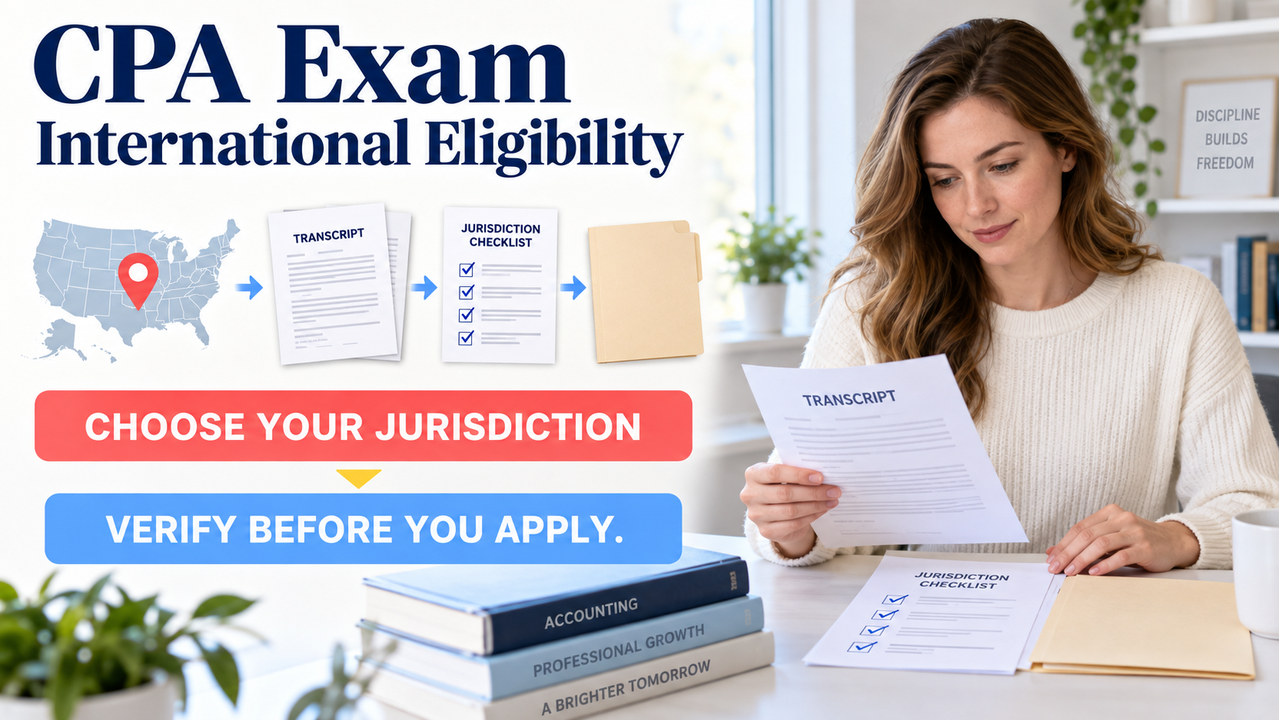

Quick answer: If you are researching cpa exam international eligibility, an international background does not automatically prevent you from pursuing the U.S. CPA Exam. The key condition is that a participating U.S. jurisdiction must declare you eligible under its current education and application rules. The test is offered in English, and an international testing location is a scheduling option after eligibility—not a substitute for it. As of September 14, 2026, the safest route is to choose the jurisdiction, verify your education evidence, follow any accepted evaluation path, obtain the Notice to Schedule, and then confirm international administration details. This guide explains who owns each decision; it does not make an individual eligibility or license determination.
For a broader preparation path, continue with our CPA Exam Study Guide.
CPA Exam International Eligibility: The Short Answer
International candidates follow the same basic CPA Exam path as U.S. candidates: identify a jurisdiction, submit the required application and records, receive an eligibility decision and any required Notice to Schedule, schedule an approved appointment, take the exam, and receive a score. What changes is the evidence and routing. A foreign transcript may need translation or evaluation, the chosen board may require a specific service, and a candidate testing outside the U.S. may need an additional international-administration step.
AICPA explains the common exam map as three Core sections—AUD, FAR, and REG—and one Discipline section chosen from BAR, ISC, or TCP. That common examination does not create a single national education rule. NASBA’s current Candidate Guide says the 55 U.S. jurisdictions set their own education, examination, and experience requirements. In practice, the board or authorized service that owns your chosen jurisdiction answers whether your record qualifies to sit.
Keep four questions separate: Can this jurisdiction review my education? Can I apply through this board or service? Can I schedule at an international location? and What else will I need for a CPA license? A yes at one stage does not silently become a yes at the next stage.
| Decision | Primary owner | Evidence or handoff |
|---|---|---|
| Exam content and blueprint | AICPA | Current blueprint and section choice |
| Eligibility to sit | Chosen Board of Accountancy or authorized service | Current rule, transcript, evaluation, and application |
| International education evaluation | Provider accepted by the chosen jurisdiction | Report plus official documents in the requested format |
| International appointment | NASBA and Prometric | NTS, administration step, identity, fee, and seat |
| CPA license | Chosen jurisdiction | Exam plus the board’s education, experience, ethics, and application rules |
What CPA Exam International Eligibility Actually Includes
The phrase international eligibility sounds like one status, but it is a bundle of decisions. Start by naming the stage you are trying to clear. A candidate with a foreign bachelor’s degree may be asking whether the credential is recognized, whether the transcript has enough relevant credit, whether a particular evaluator is required, whether the application can be filed, or whether an overseas appointment is available. Those are different questions with different owners.
Education evidence is the first common source of confusion. A diploma may show the credential and award date, while the transcript shows course titles, credit values, and sometimes course level. The board may also need official delivery, translation, or an evaluation. Do not replace missing evidence with a general statement such as foreign degree accepted.
Jurisdiction eligibility is the board’s decision about whether you may apply for one or more exam sections under its current rule. It is not the same as a country of residence, a test-center location, or a future license application. You may live outside the United States and still need a U.S. jurisdiction to own the eligibility decision.
International administration is a later logistics layer. NASBA’s international page says a candidate must first select a participating U.S. jurisdiction and establish eligibility. After receiving the NTS, the candidate follows the international-registration and fee instructions before scheduling through Prometric. The participating list and the instructions are live information, so they need a fresh check.
Licensure is a separate endpoint. Passing sections is an important exam milestone, but the jurisdiction can require additional education, experience, ethics, documents, or an application before issuing a license. A useful article should make that boundary visible because it prevents an expensive misunderstanding.
The Six-Gate International Eligibility Route Map
Use this original route map as a stop-and-check system. At each gate, write the owner, the evidence you have, the exact page or message that supports it, and the event that should trigger a recheck. If a gate is unsupported, pause there instead of moving forward because a later document cannot repair an earlier ownership mistake.
- Choose the jurisdiction. Identify the U.S. state or territory whose board will review your application. A test country does not choose your eligibility.
- Verify education. Compare your credential, total credit, subject content, course level, and document format with the current board rule.
- Confirm evaluation. If the board requires an international education evaluation, use the provider and submission route it accepts. An evaluation supports review; it is not universal approval.
- Apply through the owner. Follow the board or authorized service’s application, fee, identity, and record instructions. Do not copy another jurisdiction’s form.
- Read the NTS. Check the approved sections, name, identity details, and expiration before scheduling. The NTS is the scheduling handoff, not the license.
- Confirm international administration. Verify the current location, administration fee, passport or national-ID requirement, waiting period, and Prometric appointment details.
The route is intentionally not a promise of approval. It tells you which question to answer next and where to stop when the evidence is incomplete. That makes it useful for both a first-time international candidate and a U.S.-based candidate whose education was completed abroad.

Gate 1: Choose the U.S. Jurisdiction That Owns Your Review
Begin with the regulator, not the test center. NASBA’s state-board directory helps you locate the official board and its contact details. Then open the board’s current page for exam eligibility, education, foreign education, application method, and any designated evaluation service. A directory is a routing map; it is not the final interpretation of your transcript.
Choose a jurisdiction for a reason you can document. That reason might be where you expect to work, where a board’s current education path fits your record, or where the application route is available to your circumstances. It should not be a claim that a state is easiest unless the official board has answered your actual facts. Do not choose only because an article lists a country, a credit number, or a low fee.
Gate 2: CPA Exam International Eligibility and Foreign Education Evidence
CPA Exam International Eligibility: What to Verify in a Foreign Education Record
Foreign education is not a single checkbox. Prepare a document map before you ask whether you are eligible. Record the credential name, institution, country, award date, official transcript route, language or translation requirement, total credit, accounting and business subjects, and any course-level information. Add a note for credits that were transferred, repeated, awarded by examination, or completed after the degree if the board asks you to distinguish them.
Imagine Mia, a fictional candidate with a three-year foreign bachelor’s degree and an evaluation report. Mia has a clear credential, but her report does not make the level of two accounting courses obvious and the board’s page uses a course-category term that her transcript does not use. The correct conclusion is not eligible or ineligible. The correct next step is a narrow question: which document or course description does the board need to decide whether those courses satisfy the named category for exam eligibility?
That example shows why a total-credit number is not enough. The board may care about the relationship between the credential, credit conversion, course content, institution, level, and effective date. If the current rule is not clear, mark the field verify. A visible gap is safer than a confident but unsupported conversion.
| Evidence field | Record | Stop condition |
|---|---|---|
| Credential | Award, institution, country, date, and recognition details requested by the board | The credential or institution is not accepted or is not documented |
| Official record | Transcript delivery, translation, seal, and course descriptions if requested | The board cannot verify the record’s source or completeness |
| Credit and content | Total credit plus named accounting, business, and other categories | A similar-sounding course cannot be mapped to the current wording |
| Level and date | Course level, rule effective date, and record version | The rule changed or the level is not stated |
Keep copies of the public source and your own evidence log. Never send original or irreplaceable documents through an unverified channel. Follow the board’s current secure-submission instructions and confirm whether the evaluator sends the report directly.

Gate 3: Understand NIES and Credential Evaluation
When a jurisdiction requires an international education evaluation, the evaluator is part of the route—not the authority for every route. NASBA International Evaluation Services presents a current flow for candidates who have completed an international evaluation report and links its requirements, services and fees, deficient-education resources, FAQ, and policy pages. The service page also identifies the jurisdictions it serves and flags a special approval condition for North Carolina.
Read the NIES page together with the chosen board’s instructions. Confirm whether the evaluation is for exam eligibility, licensure, or both; which records must be official; whether translations are required; how documents must be delivered; what the deadline is; and whether the report can be used for the jurisdiction you selected. The current NIES page says supporting materials must be received within 90 days of applying and warns that incomplete documentation can lead to denial of the evaluation application and forfeiture of its fee. Because this is time-sensitive, verify the live instruction before paying.
An evaluation report can make a foreign record easier for a board to review, but it does not erase the board’s rule. If the report says a credential is comparable, that does not automatically answer whether a specific accounting course or course level satisfies the jurisdiction’s current exam requirement. Treat the report as evidence in the board’s file, not as a universal approval badge.
Gate 4: Apply Through the Correct Board or Service
The July 16, 2026 NASBA Candidate Guide says international applicants follow the same basic steps as U.S. applicants and that the application is filed with the selected Board of Accountancy or CPA Examination Services, depending on the jurisdiction. Follow the instructions attached to your route. Some candidates submit an education evaluation first; others must submit a particular application, transcript, identity record, and fee sequence.
Use the exact name that will appear on your passport or other accepted identification. If your document has an unusual name format, read the current Candidate Guide and the board’s instructions before submitting. A correct eligibility decision can still be wasted if the application, NTS, and identification do not match at check-in.
Gate 5: Read the NTS Before Scheduling
After the application is processed, the Notice to Schedule tells you which section or sections you are approved to take and enables the scheduling step. Treat it as a controlled handoff. Check your name, approved sections, identification details, and expiration date as soon as it is available. The Candidate Guide warns that a candidate may not be admitted without the correct NTS and matching identification, and that an expired NTS can mean reapplication and new fees.
Do not schedule internationally just because you have an account or an evaluation report. First confirm that the NTS is valid for the section, that the location is available through the current international-administration route, and that your identity document meets the registration requirement. If a field is wrong, contact the board or service that owns the field before creating an appointment.
Gate 6: Add International Administration and Test-Center Checks
NASBA’s international-administration page says qualified candidates must first establish eligibility through a participating jurisdiction. After receiving the NTS, the candidate registers for an international location and pays the additional administration fee for each section through the NASBA Candidate Account, following any questionnaire or attestation. For practical details, the July 16, 2026 guide says to use the current international-administration option, keep candidate information matched, and have a valid passport or national ID available.
The guide says that after the international registration is complete for a section, the candidate must wait at least 24 hours before scheduling the appointment through Prometric. The current page also says the candidate may attend only the selected location and that the list of locations is subject to change. Confirm the live location list, the fee, the waiting period, and the appointment confirmation before traveling.
Write down the section, location, local date and time, confirmation number, NTS expiration, identity document, and cancellation rules. International travel adds a real cost to a scheduling mistake, so check the appointment email rather than relying on a calendar note. Accommodations also have location-specific limits; if you need them, obtain board approval first and confirm what is available at the selected international center.

What Exam Eligibility Does Not Prove About Licensure
Passing the CPA Exam is not the same as holding a CPA license. The AICPA overview and NASBA Candidate Guide both describe education, examination, and experience as parts of the broader path, while the chosen jurisdiction controls its own requirements. A candidate can be eligible to sit for an exam section and still need additional education, verified experience, ethics work, or a separate license application later.
| Stage | Question | What remains separate |
|---|---|---|
| Education review | Can the jurisdiction evaluate this credential and record? | Course categories, experience, ethics, and license application |
| Exam eligibility | May the candidate apply for the requested section? | International appointment and later licensure |
| International administration | Can this eligible section be scheduled at the selected listed location? | Seat availability, travel, and the jurisdiction’s license rule |
| Licensure | Has the board received every requirement for a license? | Exam location does not replace board approval |
Your CPA Exam International Eligibility Verification Record and Change Log
Before you apply, create a record that another person could audit without opening your browser history. Use four fields: Owner, Current source, Evidence received, and Recheck trigger. For example: Owner—selected Board of Accountancy; Current source—education page accessed September 14, 2026; Evidence received—official transcript and the evaluation route named by the board; Recheck trigger—new rule effective date, new jurisdiction, or a change to the transcript.
Add a short change log with the current date, the page owner, and the decision it supports. At minimum, recheck before sending a new application, paying an evaluation or international-administration fee, accepting an NTS, booking travel, or relying on a rule after its stated effective date. This habit is especially valuable for international candidates because a location list, document deadline, or service scope can change independently of the exam blueprint.
Choose your first international eligibility check
Which starting point best matches your record right now? Choose one route, then complete the evidence check shown below it before applying or paying.
- I have a foreign or non-U.S. degree and an academic record.
- I have not chosen a U.S. jurisdiction yet.
- I have an evaluation report but do not know whether it is accepted for my route.
- I have eligibility or an NTS and need to schedule internationally.
Check your reasoning
Answer: Choose the first gate you cannot support with a current document. If the jurisdiction is unknown, use NASBA's board directory and the current international-administration page. If education is unclear, follow the chosen board's accepted evaluation route. If you already have an NTS, confirm international administration, identity, fee, wait-period, and location requirements before scheduling.
A foreign degree, evaluation report, or test appointment is evidence for one stage only. It does not replace the selected board's eligibility decision or prove that the eventual CPA license requirements are complete.
When the record is complete, take one narrow action: open the board page and highlight the first line you cannot map to your evidence. Ask that exact question through the official channel, save the response, and record the date. A precise question such as whether a named course satisfies the exam-stage accounting category is more useful than asking whether an entire foreign degree is good.
Common CPA Exam International Eligibility Mistakes
- Starting with a country instead of a jurisdiction. Where you live or want to test does not necessarily own the eligibility decision.
- Assuming an evaluation report equals approval. The evaluation supports a board review; the board still applies its own rule.
- Using a general credit conversion as a final answer. Total credit can hide subject, level, institution, or document requirements.
- Mixing exam eligibility and licensure. A valid NTS and a passing score do not silently complete experience, ethics, or license-application requirements.
- Using a stale location or fee list. Check NASBA and Prometric immediately before international registration and travel.
- Ignoring the identity match. The application, NTS, passport or national ID, and appointment record must follow the current instructions.
- Sending incomplete documents. Follow the current evaluator or board channel, deadline, translation, and official-delivery requirements.
- Choosing a jurisdiction from a ranking. A commercial list cannot decide how your actual record fits a current board rule.
CPA Exam International Eligibility FAQ
Can a non-U.S. citizen meet CPA Exam International Eligibility requirements?
Yes, an international candidate can pursue the exam, but the selected participating U.S. jurisdiction must establish eligibility. The current board rule—not citizenship alone—controls the education and application decision.
Do I need a U.S. accounting degree?
Not automatically. A foreign credential can be reviewed through the evaluation and document route accepted by the selected jurisdiction. The board decides how the credential, credit, course content, and level fit its rule.
Can I take the CPA Exam outside the United States?
NASBA lists international administration locations, but an eligible candidate must complete the NTS and international-administration steps before scheduling. Check the live NASBA and Prometric instructions because locations and fees can change.
Does an international evaluation guarantee a license?
No. An evaluation report supports education review. The board still controls exam eligibility and the separate licensure requirements for education, experience, ethics, documents, and application.
What should I do if two official pages seem to conflict?
Stop at the conflicting gate, identify the page owner and effective date, and ask the board or authorized service for a written clarification. Do not average two pages or choose the answer that is cheapest until the current owner resolves the conflict.
Key Takeaway
International candidates can pursue the U.S. CPA Exam, but the path is jurisdiction-led and evidence-based. Choose the U.S. board first, map your foreign education, use only the evaluation route it accepts, apply through the named owner, verify the NTS, and then complete the current international-administration and scheduling checks. Record the source date and recheck trigger at every handoff. That is the practical meaning of cpa exam international eligibility: not a permanent country label, but a current, documented answer from the authority that owns your next decision.