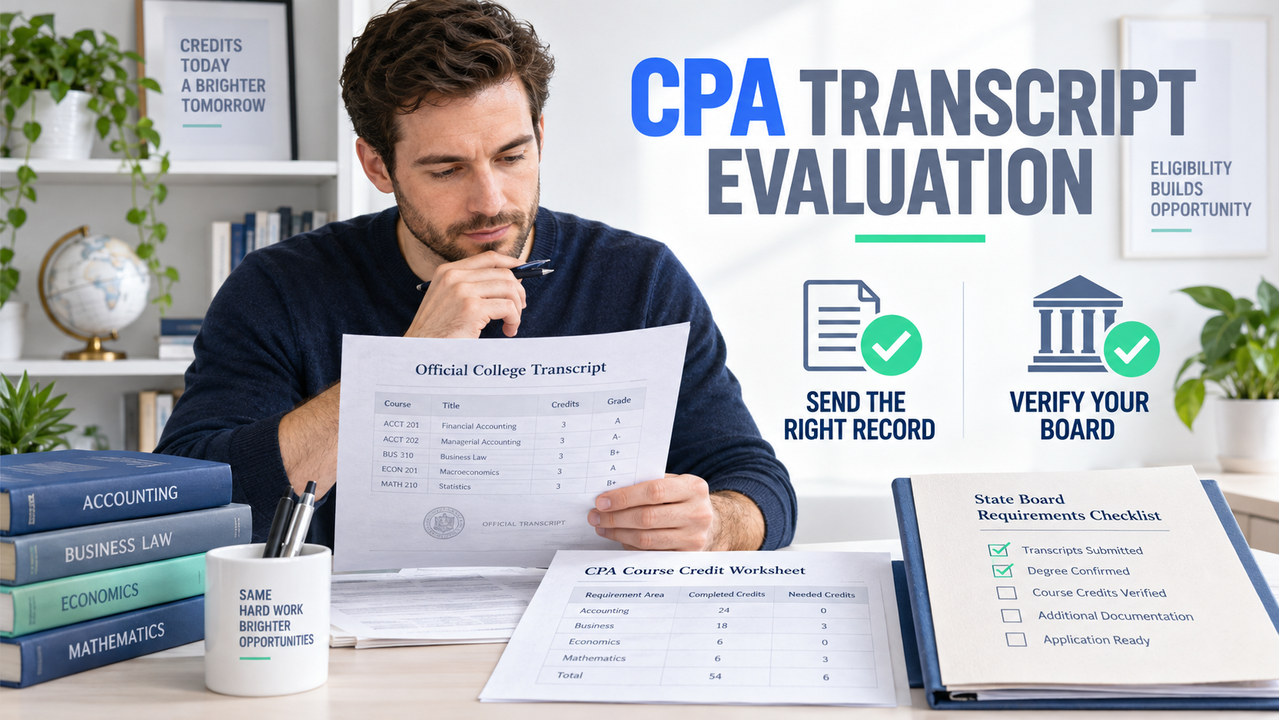

Quick answer: A cpa exam transcript evaluation helps the jurisdiction or its designated service compare your education record with the rules for the CPA Exam. It is not automatically the same as an eligibility decision. The exact recipient, document format, evaluation provider, course detail, credit conversion, and timing depend on the U.S. jurisdiction and on whether you are applying to sit for the Exam, pursuing licensure, transferring records, or documenting international education. Before you send a transcript or pay for a report, write down those five variables and verify them on the current board or NASBA instruction.
This guide gives you a practical evidence map. It explains what to collect, how to prove delivery, how to interpret an evaluation without overreading it, and how to ask one precise question when your record does not fit a simple checklist. For a broader preparation route, continue with our CPA Exam Study Guide.
CPA Exam Transcript Evaluation: The Short Answer
Think of the process as two linked decisions, not one report. First, an evaluator or board describes the education shown by your records: institutions, degrees, courses, credits, and sometimes U.S. equivalency. Second, the jurisdiction that owns your application decides whether that description satisfies its current education rule for the selected stage. NASBA’s CPA Exam FAQ makes the boundary explicit for international reports: an evaluation converts education into a format the board can review, but the report itself does not determine CPA Exam eligibility.
Use this sequence throughout the article: Classify the purpose and stage, Collect the complete record set, Deliver it through the accepted channel, Confirm receipt and the board’s determination, then Recheck when the rule or your plan changes.
What Is a CPA Exam Transcript Evaluation?
A transcript is the academic record issued by a college or university. It can show courses, grades, credits, degree conferral, and the institution that issued it. A transcript evaluation or education evaluation is a review of that record against a purpose. A credential evaluation for education completed outside the United States may add country, degree, equivalency, course-by-course, and credit analysis. A board determination is the decision about whether your record satisfies the requirements for the jurisdiction and stage you selected.
These terms overlap in casual conversation, which is why the search phrase is confusing. A board may ask for official transcripts from every institution. A service may prepare an international report before the board or its coordinator checks the report against local rules. A licensing office may review education again after the Exam. None of those steps should be treated as a universal replacement for the others.
Four questions that prevent the biggest misunderstanding
- What is the purpose? Are you proving eligibility to sit, applying for a license, transferring credit, or translating international education?
- Who owns the decision? Is it the state board, a board-designated CPA examination service, an approved evaluator, or a school accepting transfer credit?
- What stage are you in? Exam application, post-exam licensure, reciprocal licensing, or renewal can have different documents and dates.
- What proof must survive the handoff? You may need an official transcript sent directly, an original evaluation report, course syllabi, a degree conferral date, or a receipt in a portal.

Start With Purpose, Owner, and Stage
Before opening a transcript portal, make a three-line header for your file: Purpose, Jurisdiction, and Stage. For example: “CPA Exam eligibility; New York; first application under the current exam-stage pathway.” That header prevents a common error: sending a licensure document to an exam service, or ordering an international evaluation for a state that requires a different provider.
| Use case | Primary owner | What the record should answer | Do not assume |
|---|---|---|---|
| Exam eligibility | Selected board or designated exam service | Does this education record meet the current requirements to apply for a section? | Passing the Exam or having 150 credits automatically answers it. |
| Initial licensure | Selected state board | Does the record satisfy the license pathway after education, exam, experience, and any other gate? | An earlier exam evaluation is the final license determination. |
| International education | Approved evaluator plus the selected board | How do the foreign institution, degree, courses, and credits compare with the requested U.S. record? | The report itself grants eligibility or works for every jurisdiction. |
| Transfer or quarter-hour record | Board, school, or designated reviewer | Which institution’s credit and course content will be recognized, and how is it converted? | A consolidated transcript erases the need to verify each original institution. |
NASBA’s Candidate Guide describes a broad sequence from education evaluation and eligibility through section application, scheduling, testing, and score reporting, while also stating that each jurisdiction sets its own education, examination, and experience requirements. Use that guide for orientation, then move to the specific board page for the rule that controls your file.
Which Documents Are Official and How Should You Send Them?
“I have a PDF of my transcript” is not the same as “the board has received an official transcript.” Official status usually depends on who issued the record and how it was delivered. The safe default is to request a transcript from the registrar of every college or university whose coursework may be counted, then follow the exact electronic or sealed-mail route on the selected board’s page. Do not email a personal scan unless the instruction explicitly accepts it.
| Evidence item | Check before sending | Proof to keep |
|---|---|---|
| Transcript from each institution | Institution name, courses, credits, grades, and degree conferral are visible where required. | Request date, institution receipt confirmation, and the exact recipient. |
| Electronic transcript | The board lists the provider or direct registrar delivery as acceptable. | Delivery confirmation and the email or portal recipient shown in the instruction. |
| Sealed paper transcript | It remains sealed and is sent from the registrar or other approved source. | Tracking number and a scan of the envelope exterior, not an opened unofficial copy. |
| International evaluation | The provider, report purpose, course-by-course detail, equivalency, translation, and supporting documents match the jurisdiction’s instruction. | Application number, evaluation date, report copy, and evidence that the report went to the board or portal. |
| Course or degree follow-up | The board requests syllabi, degree proof, transfer letters, or additional records. | File name, upload date, and a saved copy of the board’s request. |
New York’s current instructions illustrate why this level of detail matters: they call for official records from each school, direct delivery, and original evaluation material for international education. California’s Board of Accountancy similarly describes limits on acceptable electronic providers and asks that foreign evaluations contain course-by-course accounting, business, and general education information, an overall U.S. equivalency statement, and supporting documentation. These are examples, not a national checklist.
How the Evaluation Process Works
Use the following five-step process as a working file. Each step produces evidence for the next one. If you cannot support a step, stop there rather than trying to compensate with a second paid report.
1. Choose the jurisdiction that will review the application
Start with the board that owns the application, not the evaluator that appears first in a search result. Compare the board’s current education page, application instructions, and any international-credential page. Note whether the board uses NASBA CPAES, its own portal, or a named provider. If you are deciding among jurisdictions, write a separate header for each one; never combine requirements into a fictional national rule.
2. Name the stage and the evidence question
Write the question in a form a reviewer can answer: “Does my education record satisfy the CPA Exam eligibility rule for [jurisdiction] as of [date]?” That is different from “Do I have enough hours for licensure?” If the page requires named subjects, course level, degree type, or a specific evaluation, list those fields now. A total-credit count is only one field.
3. Build the complete institution list
List every institution that issued original coursework, including community college work, transfer coursework, study abroad, dual enrollment, and graduate work if the board may count it. For international study, gather the original academic records, translations if required, degree evidence, and any course descriptions. Keep the institution list stable; adding a forgotten school later can restart the review clock.
4. Send through the accepted route
Order the transcript or evaluation for the stated purpose. Use the recipient name and address exactly as the board writes them. A transcript delivered to you and forwarded by you may be treated differently from one sent directly by the registrar. If you use an evaluation service, verify whether it must send the original report directly and whether the report is jurisdiction-specific. Save confirmations instead of relying on memory.
5. Confirm receipt, then ask about deficiencies
Check the portal or contact the designated office only after the expected delivery window in the current instruction. NASBA’s CPA Portal guidance tells candidates where to see received transcripts and notes that an education evaluation can take time after the last transcript is uploaded. Treat any estimate as an operational guide, not a promise. If a course or document is missing, ask which exact record or content field is unresolved.
6. Save the determination and its effective date
Keep the result, deficiency notice, eligibility email, and board response together. Record the date, the stage, and whether the response applies only to the jurisdiction named in your application. When your course plan, jurisdiction, pathway, or application date changes, recheck the rule. A report that was useful for one application does not automatically travel to another.
How to Read an Evaluation Result
Read the report in layers. First, confirm identity: name, institutions, degree, and dates. Second, inspect the education description: total credits, semester or quarter units, course-by-course listing, accounting and business categories, level, and any conversion or translation assumptions. Third, compare those fields with the board’s rule. Only after that should you use words such as eligible, deficient, or complete, and only when the responsible board uses them for your stage.
U.S. Transcripts, International Evaluations, and Transfer Credits
The document route changes with the record’s origin and the requested purpose. U.S. candidates often work directly with registrars and a board portal. International candidates may need translation and a jurisdiction-approved evaluation before the board can compare the record. Transfer or quarter-hour records may require the original institution’s transcript and a conversion or acceptance check. The common rule is to identify the evidence owner before choosing the delivery channel.
| Record situation | Likely evidence focus | Question to verify |
|---|---|---|
| U.S. institution, no transfer complexity | Official transcript, degree date, course list, credit units, direct delivery | Does the board accept this registrar or electronic provider route? |
| International institution | Original record, translation, institution and degree analysis, course-by-course detail, approved evaluator | Which evaluator and recipient are accepted for this jurisdiction and stage? |
| Transfer coursework | Transcript from the institution that awarded the original credit and any transfer-credit explanation | Will the board count the original course, the receiving institution’s notation, or both? |
| Quarter-hour record | Unit conversion, total credits, and named course categories | What conversion and subject-course rules does the selected board use? |
| Mixed or incomplete record | Missing institution, degree conferral, syllabus, or delivery proof | What exact deficiency must be resolved before the application is reviewed? |
NASBA’s international evaluation guidance is especially important here: the report is prepared for a stated purpose and jurisdiction, and the board still performs the eligibility comparison. Do not order a generic report first and hope it will be accepted everywhere. The cheapest-looking route can become the slowest if the recipient, provider, or purpose is wrong.
How State Instructions Change the Answer
State examples are useful when they show why a universal answer would be unsafe. They are not a reason to publish one static list and call it current. Check the selected board immediately before ordering records or paying an evaluator.
| Bounded example | What the official page illustrates | Reader lesson |
|---|---|---|
| New York | Official transcripts from each institution, direct delivery, and original international evaluation material with credit analysis can matter. The page also shows detailed education conditions for its exam-stage pathways. | Course content, institution-by-institution records, and application stage matter alongside total credits. |
| California | First-time applicants are encouraged to send records before applying. Foreign evaluations need CPA-purpose detail, course-by-course accounting, business and general education information, equivalency, and supporting documents; electronic delivery is provider-specific. | “Electronic” is not a universal permission. The board controls the channel and report contents. |
| Virginia | The board gives an example of accepting official electronic transcripts sent directly by the institution or its transcript provider and publishes its own application conditions. | Direct registrar delivery may be accepted, but the exact recipient and current instruction still control. |

Build a Transcript-to-Rule Card
Here is the original method to use before you submit an application. Create one card per possible jurisdiction, then fill every field with either a document, a source link, or a written board response. A blank field is not a failure; it is the next question you need to resolve.
| Card field | Example entry | Pass condition before payment or application |
|---|---|---|
| 1. Purpose | CPA Exam eligibility, not initial licensure | The question matches the stage named by the application. |
| 2. Jurisdiction | Selected board and its current education page | The recipient and evaluator route are taken from that board’s instruction. |
| 3. Record set | Three institutions, degree transcript, graduate coursework, transfer record | Every institution that may contribute credit is listed. |
| 4. Rule fields | Total credits, named accounting/business courses, degree, level, conversion | The record is mapped to the exact fields, not just a total-hour number. |
| 5. Delivery proof | Registrar confirmation, portal receipt, report number, date | You can show who sent what, to whom, and when. |
| 6. Determination and recheck | Board response saved with access date and next trigger | You know the next action and the event that requires a fresh check. |
Fictional example: why the total is not the whole answer
Imagine Jordan has a bachelor’s transcript showing 120 semester hours, a second college transcript with 12 transferred hours, and a graduate transcript with 18 hours. The arithmetic suggests 150. But the card still has open fields: Which institution awarded the transferred credit? Does the selected board accept the graduate subjects for the required categories? Is the degree conferral visible? Were all three transcripts sent directly? Does the application stage require a particular evaluation provider?
Jordan should not solve those questions by buying a random 30-credit package. The next defensible action is to download the current board checklist, match each course to the named category, request official delivery from each institution, and ask the board to confirm the unresolved category in writing. If the board says the record is short in a specific subject, then choose coursework that fixes that documented gap. This keeps the education plan connected to evidence instead of guesswork.
Use a precise board question
“For the [exam or license] stage in [jurisdiction], I have official records from [institutions]. My record shows [degree, total credits, and relevant course categories]. The records will be sent by [approved channel]. Does the current rule require [specific missing field], and if so, which document or course description should I provide?” This format is short enough for an office to answer and specific enough to preserve in your card.
Choose Your Next Transcript Check
Use the decision flow below as a self-check. Choose the statement that is closest to your current record, then follow the evidence action rather than a generic “apply now” recommendation.
Choose your next transcript check
- I have U.S. transcripts but do not know if they are official.
- My records are international or translated.
- I have transfer or quarter-hour credits.
- I already received a report but the board has not confirmed eligibility.
Check your reasoning
Answer: Start with the first field you cannot prove: purpose, jurisdiction, stage, complete record set, accepted delivery, report detail, or board confirmation. Save one dated question for the responsible board or designated service before paying or applying.
The correct next step changes with the evidence gap. A transcript packet problem needs document routing; an international record may need an approved evaluation; a report without board confirmation still needs the jurisdiction's eligibility decision.

Common CPA Transcript Evaluation Mistakes
Counting hours without mapping subjects
Total credits do not prove that every named accounting, business, ethics, or upper-level category is complete. Build the course map first and identify the exact gap.
Assuming the evaluator makes the final decision
The evaluator describes or converts the record. The selected jurisdiction decides whether it satisfies the current rule. Save the board’s determination rather than relying on a report label.
Ignoring the last-received date
When several schools send records, the review clock or application completeness may depend on the last item. Record every delivery and check the portal for missing documents before assuming the file is under review.
Using an old page for a new application
Provider lists, portal steps, pathways, fees, and effective dates change. Save the access date in your card and set a recheck trigger for a new jurisdiction, new stage, new degree, or a rule update.
CPA Exam Transcript Evaluation FAQ
Does an international evaluation report mean I am eligible to take the CPA Exam?
No. NASBA explains that an international report converts education into a U.S.-equivalency format, while the jurisdiction or its coordinator compares that information with the eligibility requirements. Follow the board’s current education-evaluation step and wait for its determination.
Key Takeaway
A strong cpa exam transcript evaluation process is an evidence handoff: choose the jurisdiction and stage, list every institution, use the accepted direct-delivery or evaluation route, confirm receipt, and save the board’s dated determination. An equivalency report can make education easier to review, but it does not become universal eligibility by itself. If one field is unresolved, ask one narrow current-rule question before you enroll, pay, or submit.
Sources
- NASBA CPA Exam hub — exam process, CPAES services, and jurisdiction routing.
- NASBA CPA Exam FAQ — jurisdiction variation and the international-report eligibility boundary.
- NASBA CPA Portal guidance — transcript receipt and education-evaluation tracking.
- NASBA International Evaluation Services — international document and provider instructions.
- AICPA & CIMA tested-content resource — current Blueprint reference.
- NASBA CPA Exam Candidate Guide — broad candidate sequence and jurisdiction responsibility.
- NASBA New York requirements — bounded official transcript and evaluation example.
- California Board of Accountancy transcript delivery — bounded foreign-evaluation and delivery example.
- Virginia Board of Accountancy application page — bounded electronic-transcript example.
Verified September 14, 2026. State rules, provider lists, fees, deadlines, processing times, and accepted delivery channels can change; verify the selected board’s current instruction before acting.