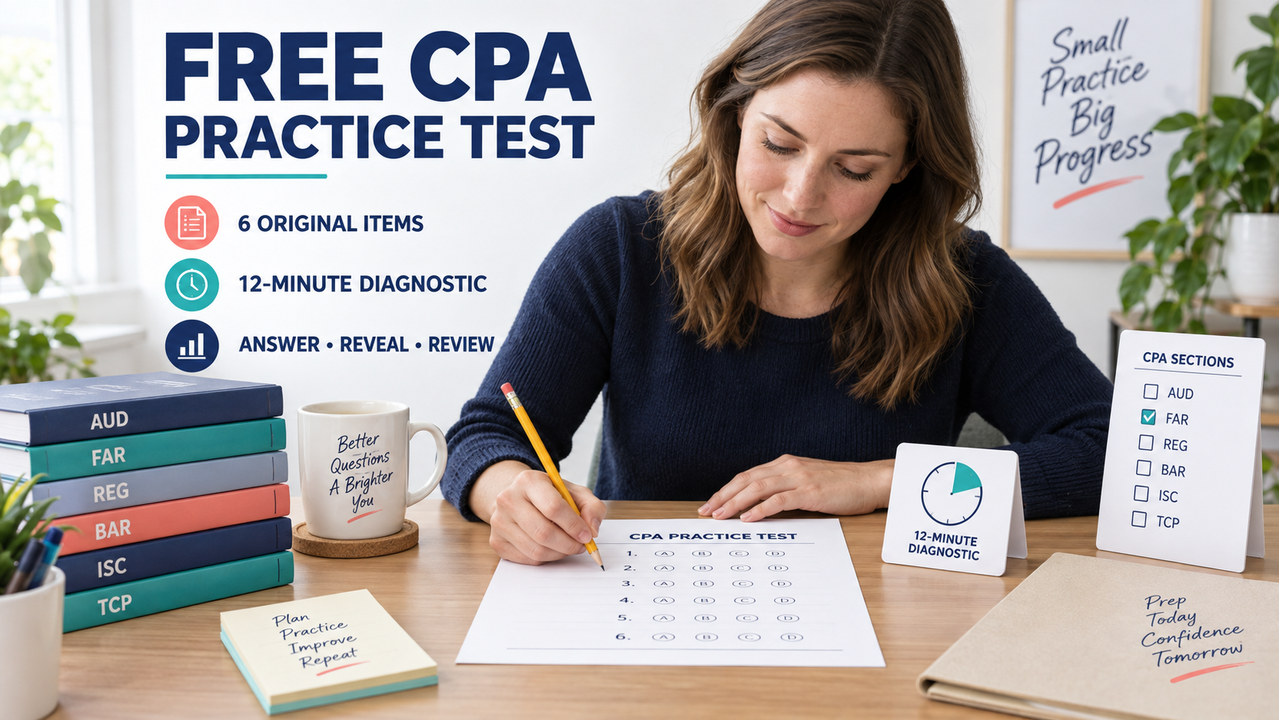

Quick answer: in short, yes—this free cpa practice test gives you six original CPA-style questions across AUD, FAR, REG, BAR, ISC, and TCP. Set a 12-minute timer, answer without notes, and open each explanation only after you commit. The result is a study signal, not an official score or readiness prediction.
First, before you begin, every item shows the skill, assumptions, and difficulty. Afterward, the answer reveal explains the governing fact, rule, or variable, names the main distractor, and gives a next review action. Moreover, the set is independently authored for CPA Exam Prep, not an AICPA sample-test item or a NASBA assessment. For software familiarization, use the current AICPA sample-test page.
Free CPA Practice Test: How to Take It
First, close your notes and choose a quiet 12-minute block—about two minutes per item. Then, write answers on paper or in a private note, but do not search while the timer runs. In contrast, this is a short decision drill, not a reproduction of the full exam.

More importantly, the habit is: identify the controlling fact, name the rule or variable, then compare choices. Next, for calculations, label the numbers first; for rules, state the boundary first. Also, a correct answer after opening a reveal is not a first-pass correct answer, so the score can select a useful next action.
Before You Start: One Skill, Six Assumptions for a Free CPA Practice Test
First, the defined skill is decision accuracy: isolate the governing fact, rule, or variable before selecting an answer. Meanwhile, the current AICPA Blueprints set scope; they do not turn this independent practice set into an official exam. As a result, the map shows what each item exercises.
| Item | Section | Defined skill | Difficulty |
|---|---|---|---|
| 1 | AUD | Evaluate evidence for existence | Foundational |
| 2 | FAR | Separate book-side and bank-side items | Foundational calculation |
| 3 | REG | Apply wash-sale timing and basis | Foundational application |
| 4 | BAR | Calculate break-even units | Foundational calculation |
| 5 | ISC | Apply least-privilege access | Foundational application |
| 6 | TCP | Compare after-tax cash flow | Foundational judgment |
In addition, assumptions are visible, scenarios use U.S. exam terminology, and no jurisdiction-specific licensure rule is tested. Likewise, mark any assumption that needs current-source verification. For now, refresh the REG item against current IRS guidance if the tax rule changes.
Six Original Questions for This Free CPA Practice Test
Next, each item is an Original practice item. Then, try it first; the native details element keeps the explanation closed until you reveal it.
1. AUD — Free CPA Practice Test Item: Evidence for Existence
For the first item, the tested skill is to distinguish evidence that most directly supports an account balance assertion. Assumptions: the customer receives a positive confirmation and returns it directly to the auditor with the balance agreed; there are no unusual exceptions. Difficulty: foundational.
Original practice item: Which evidence most directly supports the existence of a customer’s accounts-receivable balance?
- A positive confirmation returned directly to the auditor by the customer
- The company’s internally prepared aging report
- A management representation that the balance is collectible
- A recomputation of the allowance percentage
Reveal the AUD answer and reasoning
Answer: A positive confirmation returned directly to the auditor by the customer.
Reasoning: Therefore, the external customer directly confirms the balance, so the evidence addresses existence. The controlling fact is independent confirmation.
Distractor: By contrast, an aging report or allowance recomputation helps valuation or collectibility; management representation is weaker because it comes from management.
Next action: Make a four-assertion card and add one evidence example for existence, completeness, valuation, and rights.
2. FAR — Free CPA Practice Test Item: Bank-Reconciliation Calculation
For the second item, the tested skill is to separate book-side adjustments from bank-side timing items. Assumptions: the book cash balance is $18,400; the bank service fee is $75; an NSF customer check is $300; the deposit in transit is $1,500; outstanding checks are $2,100; no other items exist. Difficulty: foundational calculation.
Original practice item: What is the adjusted cash balance after the bank reconciliation?
- $17,800
- $18,025
- $18,700
- $20,125
Reveal the FAR answer and reasoning
Answer: $18,025.
Reasoning: Adjust the book balance for items not yet recorded: $18,400 − $75 − $300 = $18,025. Therefore, the deposit in transit and outstanding checks belong on the bank side.
Distractor: By contrast, adding or subtracting the timing items from the book balance mixes the two reconciliation sides.
Next action: Redo it in two columns labeled bank and books, explaining each placement.
3. REG — Free CPA Practice Test Item: Wash-Sale Timing and Basis
For the third item, the tested skill is to apply a timing rule before deciding whether a loss is currently deductible. Assumptions: an individual sells stock at a loss, buys substantially identical stock 10 days later, is not acting as a dealer, and the replacement purchase is not an IRA acquisition. Difficulty: foundational application. Also, tax rules can change; verify current IRS guidance when studying.
Original practice item: Under these assumptions, what is the most likely federal tax consequence of the sale?
- The loss is currently deductible with no adjustment
- The loss is permanently forgiven and the replacement basis is unchanged
- The loss is disallowed for now and generally added to the basis of the replacement stock
- The sale is automatically treated as a short-term gain
Reveal the REG answer and reasoning
Answer: The loss is disallowed for now and generally added to the replacement stock’s basis.
Reasoning: As a result, buying substantially identical stock within 30 days after a loss sale can trigger the wash-sale rule. The loss deduction is postponed and generally increases replacement basis.
Distractor: By contrast, “currently deductible” ignores timing; “permanently forgiven” ignores the basis adjustment. Other facts can require separate analysis, which is why the assumptions are stated.
Next action: Draw a 61-day line and place the replacement purchase on it before writing the basis consequence.
4. BAR — Break-even units
For the fourth item, the tested skill is to identify contribution margin before dividing fixed cost. Assumptions: selling price is $60 per unit, variable cost is $36 per unit, fixed costs are $120,000, and there are no mixed costs or multiple products. Difficulty: foundational calculation.
Original practice item: How many units must the company sell to break even?
- 2,000 units
- 3,333 units
- 5,000 units
- 7,500 units
Reveal the BAR answer and reasoning
Answer: 5,000 units.
Reasoning: Contribution margin is $60 − $36 = $24. Thus, break-even units are $120,000 ÷ $24 = 5,000.
Distractor: By contrast, dividing by the $60 selling price ignores the variable cost; contribution margin is the decision variable.
Next action: Write the formula in three lines and redo it after changing one input.
5. ISC — Least-privilege access
For the fifth item, the tested skill is to match access rights to the user’s job need. Assumptions: a reporting analyst needs to read approved data and export a scheduled report, but does not administer users, change production code, or approve transactions. Difficulty: foundational application.
Original practice item: Which access design best applies least privilege?
- Give the analyst administrator rights so troubleshooting is faster
- Give read and scheduled-export rights only, with separate approval for exceptional access
- Give the analyst the same role as the system owner to avoid delays
- Use one shared account so the team can cover absences
Reveal the ISC answer and reasoning
Answer: Give read and scheduled-export rights only, with separate approval for exceptional access.
Reasoning: Therefore, least privilege grants only the permissions needed for reporting, without administration, code deployment, or transaction approval.
Distractor: By contrast, administrator, owner, and shared-account options add unnecessary capability or weaken accountability.
Next action: For one role, list the task, minimum permission, prohibited permission, and review owner.
6. TCP — Compare after-tax cash flow
For the sixth item, the tested skill is to choose the correct decision variable in a tax-planning comparison. Assumptions: two alternatives produce the same pre-tax cash proceeds, but one creates taxable income now and the other defers tax; the taxpayer, tax year, rates, basis, and timing assumptions must be stated before a final recommendation. Difficulty: foundational judgment.
Original practice item: What should the analysis compare first?
- Pre-tax cash only, because taxes are outside the business decision
- The number of transactions, because more transactions are always less efficient
- After-tax cash flow and the timing of tax under the stated taxpayer and basis assumptions
- The option with the largest headline deduction, without considering timing
Reveal the TCP answer and reasoning
Answer: After-tax cash flow and tax timing under the stated taxpayer and basis assumptions.
Reasoning: Equal pre-tax proceeds cannot separate the choices. Thus, compare cash after tax, including taxpayer status, basis, tax year, and timing.
Distractor: By contrast, a headline deduction or transaction count is not enough; timing and future basis can change the result.
Next action: Build two columns for cash, tax now, tax deferred, basis effect, and decision date; mark unknowns “verify.”
Score Your Free CPA Practice Test
After the attempt, count only answers chosen before the reveals. However, six items cannot predict an exam outcome, but the result can choose a next action when paired with the error type.
| First-pass result | Next action |
|---|---|
| 5–6 | Complete a longer mixed set and keep an error log. |
| 3–4 | Review misses, then redo similar items without notes. |
| 0–2 | Refresh concepts before taking another short set. |
However, these bands are a local study rule, not a conversion to a CPA Exam scaled score. Instead, the value is in the decision that follows: continue, target, or refresh.
Turn Wrong Answers Into a Review Plan
Instead of writing “study more” beside a miss, classify the error as a fact, rule, calculation, or reading. Then write the controlling fact, your answer, the correct answer, and one sentence about the distractor.

Next, use the first missed item as your sample and schedule the smallest repair: underline a fact pattern, write a rule card, redo a calculation, or restate the question. As a result, the next attempt tests a repaired process.
Afterward, redo the item from a blank page, then try a new fact pattern. Thus, recognition of the old sentence is not transfer.
When to Use the Official AICPA Sample Test
Meanwhile, this page is a 12-minute paper-based reasoning diagnostic. By contrast, the AICPA resource is a shorter software-familiarization version of the exam experience; it shows answers, can take up to two hours, and is not scored or a readiness determination. Its page says the content was current as of July 1, 2023 and may not operate exactly like CPA Exam Driver, so check the live boundary.
Therefore, use this page to locate a weak decision habit, the AICPA resource to practice navigation, and the current Blueprint to check scope. Therefore, keep those jobs separate.
Your Next 15-Minute Free CPA Practice Test Review Block
Finally, choose one action now: sort AUD evidence by assertion; redo a FAR or BAR formula with labeled variables; write the REG or TCP timing assumption; or map an ISC role to minimum permission and review owner. Then, spend 15 minutes, and answer two new items from the same skill without notes. Moreover, for the broader sequence, continue with our CPA Exam Study Guide.
FAQ: Free CPA Practice Test
Are these AICPA exam questions?
In short, no. They are original practice items written for this page, not copied from the AICPA sample test and not presented as AICPA, NASBA, or Board material.
Does the result predict whether I will pass?
However, six items are a small learning sample. Consequently, the result only selects a local next action: a mixed set, targeted review, or foundation refresh.
Why are the answers hidden?
That is because the learning value depends on an actual first attempt. Open each native answer reveal after you commit, then compare your reasoning with the explanation and distractor path.
Why are six CPA sections represented?
In practice, the six items provide a broad diagnostic across current section names. Your exam path still depends on the Core/Discipline structure and jurisdiction; this page does not choose a section for you.
Sources and Originality Note
Checked September 15, 2026. AICPA provides scope and sample-test context, NASBA the process boundary, and IRS Publication 550 the wash-sale concept in item 3. In addition, the stems, numbers, choices, explanations, and score-to-action method are original. Volume, KD, and Intent are not fabricated; Finally, refresh Semrush US row 101 before a human publish decision.
- AICPA CPA Exam Blueprints — current scope, skill, item-type, and section reference.
- AICPA official sample tests — software familiarization and unscored-sample boundary.
- NASBA CPA Exam — process and jurisdiction boundary.
- IRS Publication 550 — wash-sale timing and basis concept.
Update owner: CPA Exam Prep content team. Refresh when an official source changes, a tax assumption changes, or an item is corrected.