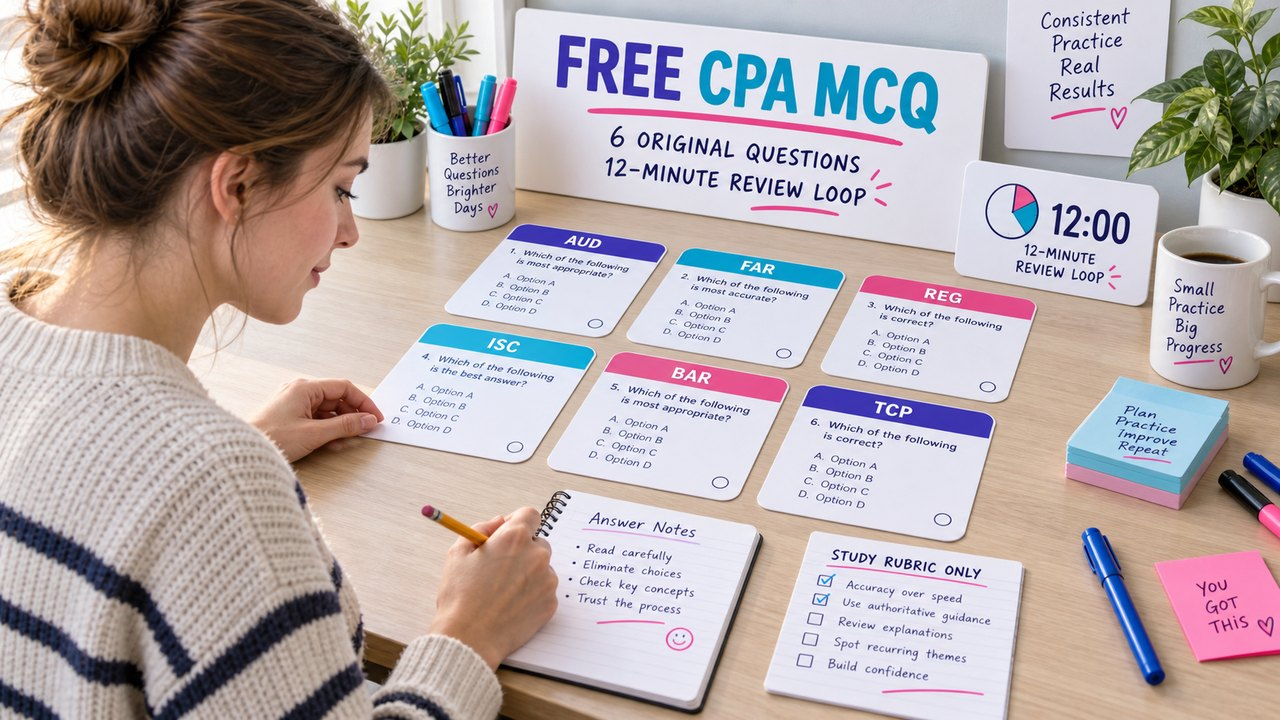

Quick answer: this free cpa mcq page gives you six original multiple-choice questions across AUD, FAR, REG, BAR, ISC, and TCP, followed by rationales and a review action. It is editorial practice, not official AICPA content, an official score, or a readiness prediction.
First, keep the source boundary clear. Meanwhile, AICPA’s sample test is a shorter software-familiarization version of the Exam; it helps candidates practice the interface, shows correct answers, and is not scored or a readiness determination. In contrast, this page is an original content-and-reasoning check.
Meanwhile, the current AICPA Blueprints organize content by Area, Group, and Topic and describe item types and weighting. The page offers Blueprints effective January 1, 2026. Use that resource for Exam scope; use this free MCQ set to notice how you read, calculate, and review. Checked September 16, 2026.
For a broader preparation path, continue with our CPA Exam Study Guide.
Free CPA MCQ: What You Get
In short, you get six original questions, one for each current section label. Each states its skill, assumptions, and difficulty before the stem. Then, answers stay inside a reveal block for a genuine attempt first. Next, the explanation identifies the key calculation, control, evidence, or planning move, names the distractor, and gives you a next action.
Just as important, the page is free because its value is the method, not access to a vendor question bank. Record the answer, confidence, and error type; that tells you whether the problem was knowledge, process, reading, or time control.
- Six original items: one short fact pattern for AUD, FAR, REG, BAR, ISC, and TCP.
- Attempt-first format: answer before opening the rationale.
- Study-only feedback: compare the reasoning, not just the answer letter.
- Next-action loop: turn the first miss into one targeted review and a new retry.
How to Use This Free CPA MCQ in 12 Minutes
To begin, set a 12-minute timer and allow about two minutes per item. Keep a blank note with four fields: question number, answer, confidence, and error label. During the attempt, do not search for a definition or peek at a reveal. Therefore, observe your decision process under a small amount of pressure.
- Read the task: identify what the stem actually asks before calculating or choosing a control.
- Mark the facts: write only the numbers, qualifiers, dates, or roles that drive the answer.
- Commit: choose one option and mark high, medium, or low confidence.
- Reveal: open the explanation after your attempt, then compare the reasoning and distractor.
- Repair: label the miss and schedule one action with a different fact pattern.
For comparison, the AICPA sample test allows up to two hours and familiarizes candidates with Exam software. This 12-minute block is an editorial study method, not an official section time limit.

Free CPA MCQ: Six Original Questions
For clarity, these are original practice items, not AICPA questions or vendor material. The section labels are used as a scope cue because the current Blueprint includes AUD, FAR, REG, ISC, BAR, and TCP. First attempt each item. Then open the reveal and use the next action instead of copying the answer key.
1. AUD: Match Evidence to the Assertion
First, tested skill: select evidence that directly addresses an assertion. Assumptions: the auditor is testing the existence of year-end accounts receivable, and a customer paid part of the balance shortly after year-end. Difficulty: foundational application.
Original practice question: Which evidence is most directly responsive to the existence assertion?
- Inspect the subsequent cash receipt and trace it to the recorded receivable.
- Compare the sales budget with management’s forecast.
- Ask the controller whether the balance seems reasonable.
- Review the depreciation schedule for the reporting period.
Reveal answer and reasoning
Answer: 1. A subsequent cash receipt tied to the recorded balance provides direct evidence that the receivable existed at year-end. However, distractor 3 is weaker: inquiry may help, but it is less persuasive than inspecting corroborating evidence. Next action: write the assertion beside one new fact pattern and name the evidence that would address it.
2. FAR: Adjust Operating Cash Flow
Next, tested skill: use the indirect method to adjust net income. Assumptions: net income is $70,000, depreciation expense is $8,000, accounts receivable increased by $5,000, and accounts payable increased by $3,000; ignore every other item. Difficulty: foundational calculation.
Original practice question: What is cash provided by operating activities under these assumptions?
- $68,000
- $76,000
- $86,000
- $70,000
Reveal answer and reasoning
Answer: 2. Start with $70,000, add back $8,000 of noncash depreciation, subtract the $5,000 increase in receivables, and add the $3,000 increase in payables: $70,000 + $8,000 − $5,000 + $3,000 = $76,000. In contrast, distractor 4 stops at net income and ignores every adjustment. Next action: write a plus or minus sign beside each adjustment before solving a new indirect-method set.
3. REG: Compute Adjusted Basis
Similarly, tested skill: distinguish original basis from an allowed recovery adjustment. Assumptions: equipment has an initial basis of $30,000, and the only stated adjustment is $6,000 of depreciation; ignore all other tax facts. Difficulty: foundational calculation.
Original practice question: What adjusted basis remains immediately after the stated depreciation adjustment?
- $6,000
- $24,000
- $30,000
- $36,000
Reveal answer and reasoning
Answer: 2. Therefore, adjusted basis is $30,000 − $6,000 = $24,000. However, distractor 1 reports the adjustment itself rather than the remaining basis. Next action: label each number as original basis, adjustment, or adjusted basis before working the next basis question.
4. BAR: Calculate the Current Ratio
Meanwhile, tested skill: calculate a liquidity ratio with the requested numerator and denominator. Assumptions: current assets are $180,000 and current liabilities are $120,000; use current assets divided by current liabilities. Difficulty: foundational calculation.
Original practice question: What current ratio follows from these amounts?
- 0.67
- 1.50
- 2.00
- $300,000
Reveal answer and reasoning
Answer: 2. Next, divide $180,000 by $120,000 to get 1.50. However, distractor 1 reverses the amounts and produces approximately 0.67. Next action: write the ratio in words before inserting amounts, then say what a higher or lower result would mean in the stated context.
5. ISC: Apply Least Privilege
In addition, tested skill: choose an access design that matches a limited business need. Assumptions: an analyst needs to view one report for two days and does not need administrator rights. Difficulty: foundational application.
Original practice question: Which response best applies least privilege?
- Grant permanent administrator access so the analyst is never blocked.
- Share a coworker’s password for the two-day task.
- Approve a view-only role for two days and log the grant and removal.
- Disable access logging to reduce administrative work.
Reveal answer and reasoning
Answer: 3. Thus, a role limited to the resource and duration receives approval and leaves an auditable record. The key distractor is 1, which solves a temporary need by creating excessive, persistent privilege. Next action: describe one access request with the user, resource, duration, approval, and log.
6. TCP: Gather Facts Before Planning
Finally, tested skill: separate fact gathering from a tax recommendation. Assumptions: a client asks which of two strategies will produce the lowest tax, but filing status, timing, basis, and governing authority have not been confirmed. Difficulty: foundational application.
Original practice question: What is the strongest first response?
- Promise the lowest tax result so the client can decide quickly.
- Gather the missing facts, state assumptions, and verify current authority before comparing options.
- Choose the strategy with the shorter name.
- Use a prior-year answer without checking the tax year.
Reveal answer and reasoning
Answer: 2. Therefore, a defensible planning comparison begins with the facts, explicit assumptions, and current authority. The key distractor is 1, because an incomplete prompt cannot support a guaranteed outcome. Next action: write three missing facts and one official source or authority you would verify.
Score the Free CPA MCQ Without a Fake Pass Line
After the attempt, give yourself one point per correct answer and then inspect confidence. However, a high-confidence miss needs a different repair from a low-confidence guess. Meanwhile, the bands below are original study rules for this page only. They are not a scaled score, passing standard, official result, or readiness determination.
| Correct out of 6 | Study reading | Next action |
|---|---|---|
| 0–2 | Rebuild the tested rules and decision process. | Review the two lowest-confidence misses, then retry a smaller set untimed. |
| 3–4 | The method is partly working; identify the error pattern. | Repair one category and repeat two related items with a short timer. |
| 5–6 | Keep the reasoning fresh and test transfer. | Review the fastest guess or one miss, then use a new fact pattern. |
Free CPA MCQ Review Queue: Fix the Cause of a Miss
Before another mixed set, classify the first miss. First, a concept miss means the rule or definition was missing. Next, a process/calculation miss means you knew the idea but used the wrong formula, sign, or order. Meanwhile, a reading/qualifier miss means you overlooked a word that changed the answer. Finally, a time-control miss means the clock changed your decision.
For example, the FAR item belongs in process review if you know what depreciation and working-capital changes do but use the wrong sign. In contrast, the AUD item may be a reading error if you miss the word “existence” and choose evidence for a different assertion. As a result, the next action should repair the cause rather than repeat the same six questions.

Then write one sentence that would prevent the error: “For existence, inspect evidence that shows the balance was real at the reporting date.” Finally, choose a new fact pattern that tests the same skill with different numbers, roles, or qualifiers. This gives the free MCQ result a useful second step.
Free CPA MCQ vs. the AICPA Sample Test
In practice, these two resources can sit in the same plan, but they answer different questions. Meanwhile, the AICPA sample test is for software familiarity and test-center-style functionality. Additionally, AICPA says it is a shorter version, covers AUD, FAR, REG, ISC, BAR, and TCP, allows up to two hours, shows correct answers, and is not scored or a readiness determination.
By comparison, this free CPA MCQ page is a small content-and-reasoning check. Its six items, 12-minute timer, confidence notes, study bands, and error queue are editorial choices. They help you decide what to review next; they do not reproduce AICPA questions, imitate official scoring, or replace the current Blueprint.
Meanwhile, a commercial QBank may offer a larger inventory, analytics, timed testlets, or a free trial. Therefore, check those features on the provider’s current page. Keep eligibility, application, score reporting, and jurisdiction rules with NASBA, the applicable state board, and the relevant official AICPA resource.
What to Do After This Free CPA MCQ
After the review, schedule one purposeful block rather than reacting to the percentage alone. For conceptual misses, read the relevant Blueprint topic and complete two untimed questions. For process-based misses, write the formula, evidence chain, or control sequence and use new facts. When you were accurate but slow, repeat three different questions with a modest timer.
- 0–2 correct: shrink the next set and rebuild the rule before adding time pressure.
- 3–4 correct: repair one error category, then test a new fact pattern.
- 5–6 correct: test transfer, confidence, and pacing; do not call the result official readiness.
In other words, a useful free MCQ session ends with a better next question. Record the date, timer result, confidence, error category, source reviewed, and retry date. Also, use the current AICPA Blueprints when you need to verify scope.
FAQ: Free CPA MCQ
Did AICPA write these questions?
No. These are original practice questions written for this page. Instead, AICPA’s sample test is the official software-familiarization resource, but this page does not reproduce its questions or imply access to confidential or restricted items.
Is the free CPA MCQ score an official score?
No. Instead, the correct count is a study-only signal for choosing a next action. It is not a scaled score, passing standard, credential, or readiness prediction. Official score questions belong with the relevant official owner.
How long should I spend on the six questions?
Use 12 minutes for the first attempt, or roughly two minutes per item. That timer is an editorial practice method. Change it only after you record whether the problem was knowledge, process, reading, or time control.
Where can I verify current CPA Exam scope?
Finally, use the current AICPA CPA Exam Blueprints for tested areas, task statements, skills, item types, and weighting. Use NASBA and the applicable jurisdiction for eligibility, application, and score-reporting questions.
Sources and Originality Note
Checked September 16, 2026. AICPA and NASBA sources establish the official boundaries described on this page. By contrast, the six questions, choices, calculations, explanations, distractor notes, study bands, error taxonomy, timer, and review queue are independently authored editorial practice material.
- AICPA: Practice for the CPA Exam with Sample Tests
- AICPA: CPA Exam FAQ
- AICPA: Learn what to study for the CPA Exam and current Blueprints
- NASBA: CPA Exam process and candidate resources
Semrush US volume, difficulty, and intent were not individually refreshed. Keep this page in draft; refresh row-level data and official links before publication.