
Quick answer: the best free cpa study materials stack is small and task-based. Use a current official scope source, an official sample test for software familiarity, original practice, an explanation source, and an official process page. Then record what each source proved. Free access does not automatically mean complete coverage, current terminology, detailed feedback, or an official readiness signal.
However, a long bookmark list is not a study plan. Moreover, a free trial, a public page, an open question, and a downloadable checklist each solve a different problem. This guide helps you match the source to the question, attempt five original material-choice drills, and leave with a seven-day next step.
For a broader preparation path, continue with our CPA Exam Study Guide.
Free CPA Study Materials: What Counts as Free?
First, define “free” before comparing resources. A public official page may answer one narrow question. An open practice set may provide an attempt but limited feedback. A trial may unlock a preview for a limited time or after account creation. A personal spreadsheet or printed planner may cost nothing and still be valuable because it records your work.
Therefore, classify each resource by four facts: access, coverage, feedback, and follow-through. Access tells you whether you can open and reuse it. Coverage tells you which topic, task, or step it actually addresses. Feedback tells you whether you can see why an answer works. Follow-through tells you what you can do next. If one of these is unknown, label it “verify” instead of assuming that the source is complete.
- Public official source: useful for current scope, terminology, or process ownership. It may not be a full practice course.
- Free sample or open drill: useful for a low-friction attempt. Check whether the explanation is deep enough to repair a miss.
- Trial access: useful for testing workflow and feedback. Record the end date, account requirement, and what remains unavailable.
- Personal study tool: useful for turning links and attempts into a visible plan. It does not replace current source verification.
Free CPA Study Materials: Build a Source Stack
The AICPA Blueprints page should anchor your scope check. It provides current section and Blueprint context, including task statements, skill levels, references, item types, and weighting. Use the live page before labeling a topic as current. Next, keep the AICPA sample-test resource in a separate lane. AICPA describes it as a way to become familiar with exam format and software functionality, not as a personal score or readiness determination.
For process questions, use NASBA and the applicable jurisdiction. In contrast, an original practice set answers a different need: it helps you attempt a bounded scenario, explain a choice, and expose a gap. A commercial preview or trial can be useful when you need to judge interface, feedback, or tracking. Still, record the exact access boundary instead of treating a preview as the whole course.
- SCOPE: What is tested, and which terminology is current? Start with the live AICPA Blueprint page.
- SOFTWARE: What does the official testing interface feel like? Use the AICPA sample-test resource.
- PRACTICE: Can you apply one rule or decision without notes? Use an original drill and write one reason.
- FEEDBACK: Why is the answer right, and why is the tempting answer wrong? Open the explanation only after attempting.
- PROCESS: Who owns an eligibility or application answer? Use NASBA and the applicable board, not a generic study list.
As a result, your stack is the fewest sources that close the current gap. If a source cannot answer your written question, move it to a later list.
Free CPA Study Materials: Turn a Free Resource into a Study Session
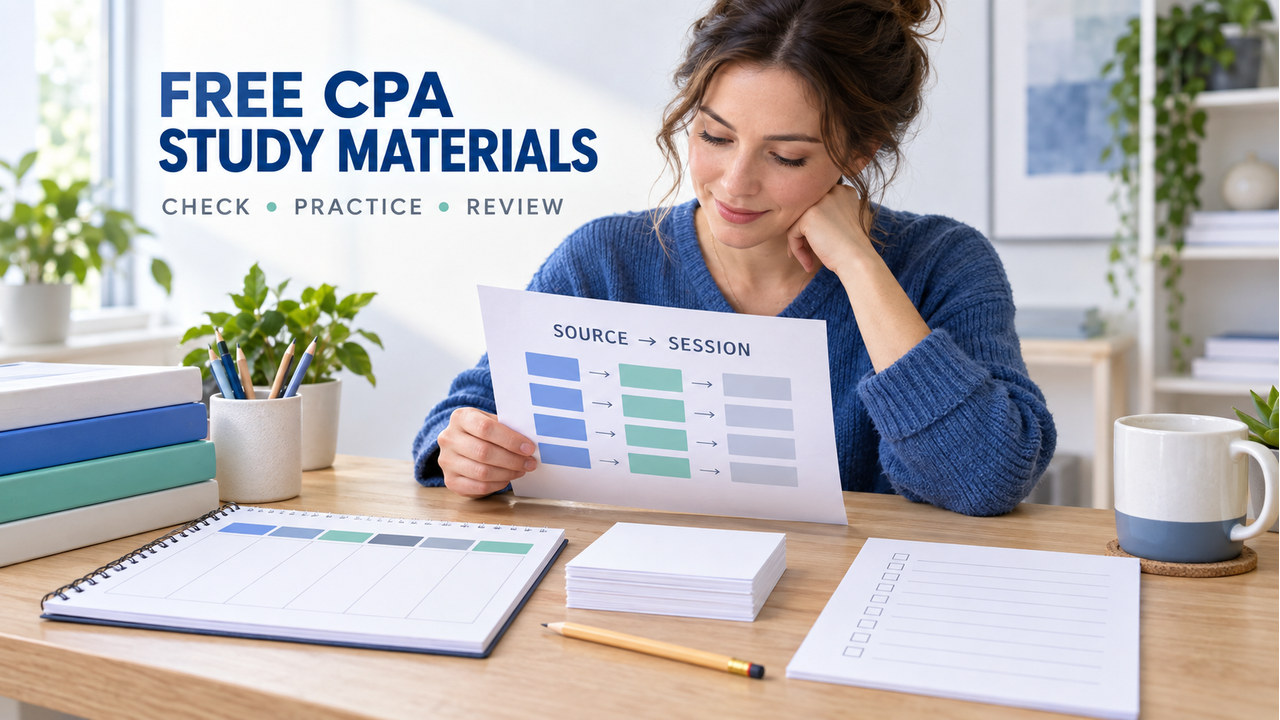
Next, run the source-to-session test. Write one question before opening the resource. For example, “Which AUD topic should I review next?” needs a scope source. “Can I navigate the sample interface?” needs a software source. “Can I explain why this answer is correct?” needs a practice-and-feedback source. This small distinction prevents passive reading.
- Write the question: name the decision, not just the topic.
- Choose one source: label it scope, software, practice, feedback, or process.
- Produce one output: a marked Blueprint topic, a completed software step, a reasoned answer, or a repair sentence.
- Record the gap: note what the source did not answer, such as missing explanation or unclear freshness.
- Book the next action: change one fact, source, date, or error category and try again.
For a seven-day loop, use day one for scope and a baseline attempt, day two for the software sample if needed, days three and four for original practice, day five for repair, day six for a changed-fact retry, and day seven to refresh the source record.

Five Original Free-Material Choice Drills
Now practice the selection skill. These are original editorial scenarios, not official exam content. Before each item, read the tested skill, assumptions, and difficulty. Write your choice and confidence first. Then open the reveal and record the distractor.
1. Which Source Controls a Scope Question?
Tested skill: match a current-scope question to the source that owns it. Assumptions: you are deciding whether a topic belongs in your next study block, and you have a live official Blueprint page plus a commercial blog post. Ignore the blog’s freshness and detail. Difficulty: foundational classification.
Original practice item: which source should you check first, and what output should you save?
Reveal the answer and reasoning
Answer: check the live AICPA Blueprint page first and save the topic, source URL, checked date, and the exact question that remains. Scope ownership is the key issue. A commercial article may help with orientation, but it should not replace the current source of scope. Distractor: choosing the most detailed-looking page confuses length with authority. Next action: turn the verified topic into one original drill.
2. What Does a Sample Test Prove?
Tested skill: separate software familiarity from content readiness. Assumptions: you finish an official sample test and can navigate its screens, but you have not reviewed a content explanation. Treat the sample test’s stated purpose as the boundary. Difficulty: foundational judgment.
Original practice item: what is the strongest conclusion you may record?
Reveal the answer and reasoning
Answer: record that you practiced format and software functionality. Do not record an official score, passing probability, or readiness conclusion. Distractor: treating smooth navigation as content mastery changes a tool-familiarity result into a claim it cannot support. Next action: pair the software session with one independent content drill.
3. How Do You Evaluate a Free Trial?
Tested skill: evaluate trial value by study output rather than access alone. Assumptions: a trial lets you open a small practice set and its explanations for a stated period; you do not yet know whether the coverage matches your gap. Ignore price and brand reputation. Difficulty: foundational comparison.
Original practice item: which three facts should you record before deciding whether the trial helped?
Reveal the answer and reasoning
Answer: record the topic or skill covered, the quality of the explanation after an attempt, and the next action you can take before access ends. Also note the end date and any login boundary. Distractor: counting unlocked questions alone measures access, not learning value. Next action: repeat one changed-fact item while the feedback path is still available.
4. What Should Follow an Unexplained Miss?
Tested skill: turn a practice miss into a source-to-action repair. Assumptions: you chose an answer, saw that it was wrong, and received no useful reason. You can return to the Blueprint and choose another explanation source. Difficulty: foundational application.
Original practice item: what is the next best action?
Reveal the answer and reasoning
Answer: label the missing feedback, write the exact question you could not explain, check the relevant scope topic, and choose one source that supplies a worked reason before retrying. Distractor: immediately doing a larger mixed set adds volume while preserving the same unknown. Next action: retry the same skill with one changed fact and one written reason.
5. What Belongs in a First-Week Stack?
Tested skill: build a balanced first-week material stack. Assumptions: you have seven short study blocks, no selected section yet, and access to a current scope page, a software sample, an original drill, an explanation source, and an official process page. Ignore long-term course selection. Difficulty: foundational planning.
Original practice item: what should the stack contain, and what should it avoid?
Reveal the answer and reasoning
Answer: include one source for scope, one for software familiarity if needed, one original practice path, one feedback path, and one process owner. Avoid adding more links until the current source produces an output or a clearly recorded gap. Distractor: choosing five similar sample pages creates apparent breadth but little diagnostic information. Next action: schedule a scope check, baseline attempt, explanation review, changed-fact retry, and weekly source refresh.
Record Your Free CPA Study Materials Session
Therefore, record evidence instead of collecting URLs. For each session, write the source name, access boundary, question, output, confidence, first gap, and next action. A source is useful when it changes what you do next. It is not useful merely because it is free, popular, or visually polished.
Use a study-only count if you want a quick check: count a source as “used” only when you opened it, attempted the intended task, and saved an output. Do not convert that count into a passing standard. The AICPA Blueprint, AICPA sample-test resource, and NASBA process page each have different jobs, so a number without a job label would mislead you.
Free Resources vs. Paid CPA Review
In contrast, a paid review course may bundle coverage, explanations, tracking, scheduling, and support. That convenience can matter when you lose time deciding what to open next. However, a price tag is not proof that every feature fits your gap. Compare the missing job: scope, practice volume, feedback, tracking, accountability, or process clarity.
Free material can support orientation, targeted review, and a realistic routine. Paid access may add value when you need wider practice, deeper explanations, or one progress record. The honest comparison is: “Which gap remains, and what is the lowest-friction way to close it?”
For a practical next step, use the CPA exam practice online guide for an independent attempt-first set. Keep the current official pages open beside it when the question is about scope, software, eligibility, or application ownership.
Classify the First Gap and Choose the Next Source
Instead of downloading another checklist, classify the first gap. A scope gap means you do not know whether the topic is current or where it sits in the Blueprint. An access gap means you cannot open, save, or revisit the source. Practice gaps mean you have not attempted a bounded task. Feedback gaps mean you cannot explain why the answer works. Follow-through gaps mean you know the next step but have not booked it.
- Rewrite the question you were trying to answer.
- Choose one gap label and one source or action that can close it.
- Write one repair sentence, such as “I need a current scope check before I choose a drill.”
- Schedule a changed-fact retry within two study blocks.
As a result, the next source is selected by evidence, not by volume. When the gap is feedback, more unanswered questions will not fix it. If the gap is scope, a random explanation may send you to the wrong topic. For a follow-through gap, another comparison page is probably avoidance. Finally, revisit the live official pages when a date, label, process, or access rule may have changed.

FAQ: Free CPA Study Materials
Are free CPA study materials enough to pass?
No single free source can establish that. Free resources can support orientation, scope checks, software familiarity, targeted practice, and a review routine. Coverage, feedback, freshness, and follow-through still need to be checked. Do not turn a completed checklist or small practice set into a personal readiness claim.
Which free source should I open first?
First, choose the source that owns your immediate question. Next, check AICPA’s Blueprint page for scope and terminology. Then, use AICPA’s sample-test resource for format and software familiarity. For candidate-process questions, use NASBA or the applicable jurisdiction. Finally, use original practice and explanations for content work.
Do I need a laptop for these materials?
No. The method works with printed source cards, a notebook, and a timer. Save the question, output, gap, and next action.
How should I treat a free trial?
Treat it as a time-bounded evaluation. Record the access end date, the topic coverage, the explanation quality, and the next action it enables. A trial can help you evaluate workflow, but it does not automatically represent the full product.
How often should I refresh the official sources?
Refresh them whenever the page shows a new effective date, section label, Blueprint, sample-test description, process instruction, or jurisdiction link. Keep the checked date in your source record. Before publishing this article or reusing its claims, revisit the live AICPA and NASBA pages.
Sources and Refresh Note
Official scope: AICPA CPA Exam Blueprints. Software familiarity: AICPA sample tests. FAQ: AICPA CPA Exam FAQ. Process: NASBA CPA Exam. Checked September 16, 2026. The five drills, source map, evidence record, and retry method are original editorial study content, not official questions. Recheck live pages and refresh Semrush row data before publication.