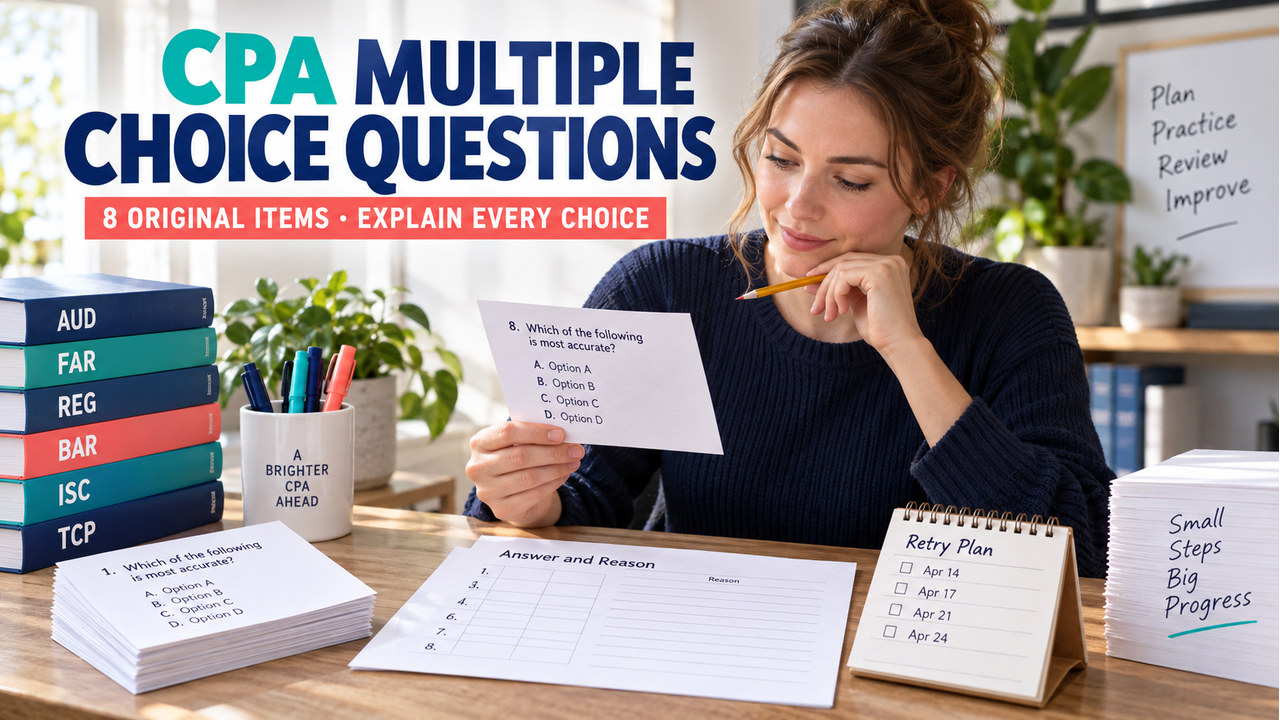

Quick answer: this page gives you eight original cpa multiple choice questions with an attempt-first reveal. Before each item, name the skill and assumptions. Then choose an answer, explain why it wins, identify the tempting distractor, and write the next review action. The set is designed to improve reasoning; it is not an official question bank or a readiness score.
In practice, a small set should make every item produce evidence. Check the current skill boundary, commit before opening the reveal, and record the first gap. As a result, one missed item can become a focused study block instead of a reason to collect another hundred links.
CPA Multiple Choice Questions: How to Use This Set
First, treat each question as a compact experiment. Instead, the goal is not merely to see whether a letter matches. Instead, you want to know whether the miss came from scope, knowledge, reading, calculation, or transfer. That distinction determines what you do next.
- Name the skill: write the topic or decision the item tests.
- State the assumptions: note the facts that control the answer and ignore facts that are not supplied.
- Commit first: choose an answer and write one short reason before opening the reveal.
- Read the distractor: ask which tempting path the wrong option represents.
- Book the repair: choose one next source, calculation, wording check, or changed-fact retry.
However, these are original practice items. They are not published exam content and are not endorsed by an exam authority. Use the AICPA Blueprints for current scope and the AICPA sample test for format and software familiarity; keep those jobs separate from this practice set.
What CPA Multiple Choice Questions Should Measure
However, AICPA materials describe tested content through Blueprints, sample task statements, skill levels, references, item types, and weighting. Therefore, the resource lists two MCQ testlets followed by three TBS testlets for each section. Therefore, MCQs matter, but a multiple-choice practice result does not represent every task you may meet.
Meanwhile, the official sample test has a different job. It is a shorter way to become familiar with the format and testing software, and the AICPA says it is not scored or a readiness determination. Its visible page also states that its sample-test content is current as of July 1, 2023. Use that date as a refresh boundary, not as proof that every current topic is covered.
In practice, work from the skill named in your study plan. However, a mixed set can be useful, but it is harder to diagnose. In contrast, a small set with a known skill lets you compare your reason, your distractor, and your next action.
Build a CPA Multiple Choice Questions Session
Initially, before opening the first answer, write a session contract: “I will attempt eight original questions, preserve my first choice, and leave with one error label and one booked review block.” You can use a 25- or 35-minute time box, but the time box should serve the skill. It should not turn a tiny sample into a prediction.
- Scope: confirm the section and skill against your current plan or official Blueprint.
- Predict: underline the fact or question word that controls the decision.
- Choose: record the option and a one-sentence reason before revealing anything.
- Explain: compare the answer, rationale, and strongest distractor; correct your own explanation.
- Retry: keep the skill constant, change one fact, and schedule the retry in a later block.
In addition, save the session output. For example, a record includes the skill, source, number attempted, number correct, confidence, first gap, and next action. If you cannot name the reason after a miss, do not solve the problem by immediately increasing the question count.

8 Original CPA Multiple Choice Questions
Importantly, these items are original practice. For each one, read the tested skill, assumptions, and difficulty. Then answer before opening the reveal. Moreover, the rationales address the most tempting distractor so that the review changes your next decision.
1. Where Do the Multiple-Choice Testlets Appear?
Tested skill: First, read current exam-format boundary. Assumptions: the question asks about the sequence described in the current AICPA material, not about a personal practice platform. Difficulty: foundational recall.
Original practice item: Which sequence matches the AICPA description of a CPA Exam section?
Reveal the answer and reasoning
Answer: the first two testlets contain MCQs and the next three contain TBSs. Reasoning: that is the structure stated in the current AICPA Blueprint resource. Distractor: “all five testlets are MCQs” confuses a practice format with the full section. Next action: therefore, pair MCQ practice with a separate TBS plan instead of treating an MCQ percentage as whole-section evidence.
2. Which Assertion Fits a Shipment Recorded Too Early?
Tested skill: connect a timing fact to an audit assertion. Assumptions: a sale is recorded on December 31, but the goods are not shipped until January 3; the question asks for the primary assertion risk. Difficulty: foundational application.
Original practice item: Which assertion should receive the closest attention?
Reveal the answer and reasoning
Answer: cutoff. Reasoning: the issue is whether the transaction was recorded in the correct accounting period. Distractor: existence sounds attractive because a sale is in the ledger, but the supplied fact focuses on timing, not whether a transaction occurred. Next action: review one more cutoff example and write the date that controls the entry.
3. What Entry Records Earned but Unbilled Revenue?
Tested skill: select a basic accrual adjustment. Assumptions: a company completed $4,000 of services by year-end, has not invoiced the customer, and no revenue or receivable has been recorded. Difficulty: foundational calculation.
Original practice item: Which adjusting entry is most appropriate?
Reveal the answer and reasoning
Answer: debit accounts receivable $4,000 and credit service revenue $4,000. Reasoning: the performance creates earned revenue and a right to collect even though billing has not occurred. Distractor: debiting cash assumes collection, which the facts do not support. Next action: rework the item with a different amount while keeping the earned-but-unbilled fact pattern constant.
4. Which Control Best Limits a Stolen Password?
Tested skill: match a security control to its purpose. Assumptions: a user password may be exposed, and the goal is to reduce the chance that the password alone grants access. Difficulty: foundational application.
Original practice item: Which control most directly addresses the stated risk?
Reveal the answer and reasoning
Answer: multi-factor authentication. Reasoning: it requires another factor beyond the stolen password. Distractor: a longer password may improve resistance to guessing, but it does not directly solve a password that has already been exposed. Next action: compare one preventive control and one detective control in your notes, then retry with a different authentication fact.
5. What Is the Current Ratio?
Tested skill: calculate a ratio from stated amounts. Assumptions: current assets are $90,000 and current liabilities are $60,000; no other adjustment is requested. Difficulty: foundational calculation.
Original practice item: What is the current ratio?
Reveal the answer and reasoning
Answer: 1.5 to 1. Reasoning: divide current assets by current liabilities: 90,000 ÷ 60,000 = 1.5. Distractor: 0.67 reverses the numerator and denominator. Next action: write the formula before calculating a changed set of amounts; if your miss was a reversal, label it calculation rather than knowledge.
6. What Is the Starting Basis Under the Stated Assumption?
Tested skill: apply a simple basis assumption. Assumptions: an investor buys stock for $8,000, pays no separate transaction fee, and the question asks for the starting basis. Difficulty: foundational application.
Original practice item: What amount is the starting basis?
Reveal the answer and reasoning
Answer: $8,000. Reasoning: under the stated facts, the purchase amount is the starting basis. Distractor: $0 ignores the investment, while $11,000 would import an unstated sale price or later value. Next action: retry with a stated fee or later sale, changing only one fact so you can see which amount affects basis and which affects gain.
7. What Prepaid Insurance Balance Remains?
Tested skill: calculate a prepaid balance across time. Assumptions: a company pays $12,000 on October 1 for twelve months of insurance, and the question asks for the prepaid balance on December 31 using straight-line expense. Difficulty: foundational calculation.
Original practice item: What balance remains prepaid at December 31?
Reveal the answer and reasoning
Answer: $9,000. Reasoning: three months have expired, so $3,000 is expense and nine months, or $9,000, remains prepaid. Distractor: $12,000 ignores elapsed coverage; $3,000 is the expense recognized, not the remaining asset. Next action: draw a twelve-month line and retry with a different start date before changing the method.
8. Which Retry Gives the Clearest Evidence?
Tested skill: design a transfer check. Assumptions: you missed an original item because you are unsure whether the rule transfers when one material fact changes. The skill and output requirement can remain constant. Difficulty: foundational planning.
Original practice item: Which retry design is most diagnostic?
Reveal the answer and reasoning
Answer: keep the same skill and explanation requirement, change one material fact, and schedule a later attempt. Reasoning: one changed variable makes the result easier to interpret. Distractor: changing the skill, source, time box, and question format at once creates a new experiment rather than a transfer check. Next action: book the retry within two study blocks and compare your written reason, not just the letter or percentage.
CPA Multiple Choice Questions: Review Loop
Then, after eight items, record more than correct or incorrect. Write the section and skill, your first choice, the correct choice, confidence from 1 to 5 if useful, the first gap, and the next action. The confidence number is a planning signal; it is not a score conversion.
For example: “FAR accrual; earned but unbilled; chose B; correct C; confidence 2; gap: calculation; next action: rework one changed amount and explain why receivable increases.” As a result, this entry lets you see whether the problem was a rule, number, reading cue, or transfer failure.
Ultimately, count the session as complete only when it leaves an output and a booked next step. If you only copied the answer, the session produced exposure, not proof of reasoning. Meanwhile, a correct answer with no explanation may still deserve review because the next unfamiliar distractor could expose the gap.
CPA Multiple Choice Questions: Next Action
Specifically, use five labels for the first observable gap:
- Scope: you did not know which topic or task the question tested. Verify the current Blueprint or study-plan boundary.
- Knowledge: you recognized the topic but could not state the rule. Review one authoritative explanation and restate it.
- Reading: you missed a qualifier, date, exception, or question word. Reread the stem and underline the controlling fact.
- Calculation: you knew the rule but reversed, skipped, or misapplied a step. Write the formula or timeline and rework it.
- Transfer: you could explain the original item but could not adapt when one material fact changed. Schedule a changed-fact retry.
First, point to the earliest evidence, not the most embarrassing mistake. Next, choose one repair. Then, write a sentence such as “I need to name the elapsed months before choosing the prepaid balance.” Finally, book a retry that changes one fact while preserving the tested skill.
Consequently, that sequence helps when you compare free and paid options. A free source may be enough for one narrow gap if it gives a clear explanation and a repeatable item. A paid product may add breadth, tracking, or scheduling; however, the decision should still start with the gap you can name.

FAQ: CPA Multiple Choice Questions
Are these official CPA multiple-choice questions?
No. They are original editorial practice items. Use the AICPA Blueprints for current tested-content scope and never treat a practice answer or online claim as an official question.
How many questions should I do in one session?
Next, use the smallest set that lets you diagnose a skill. Eight items can be enough for a focused block when you preserve the answer, reason, distractor, and next action. Increase the set only after the review evidence is useful.
Should I reveal the answer immediately?
No. Instead, make a choice and write a reason before opening the reveal. Otherwise, recognition can feel like understanding, and the distractor analysis becomes much less informative.
Can a high practice percentage predict a pass?
No. Instead, a small set tests only its stated skills and conditions. Use the result to choose a next block, and keep it separate from official scoring or readiness evidence.
Where should I check current exam format or candidate rules?
Therefore, use current AICPA Blueprint and sample-test pages for scope and software orientation. For eligibility, application, fees, jurisdictions, and candidate-process questions, use NASBA and the applicable board. Those facts can change independently of a question set.
Sources and Refresh Note
Current scope and item types: AICPA CPA Exam Blueprints. Format and software familiarity: AICPA sample tests. General FAQ: AICPA CPA Exam FAQ. Candidate process: NASBA CPA Exam. Checked September 16, 2026. The eight questions, rationales, error labels, review record, and retry method are original editorial study content. Reopen the live official pages and refresh the workbook’s Semrush US fields before publication. For a broader preparation route, continue with our CPA Exam Study Guide.