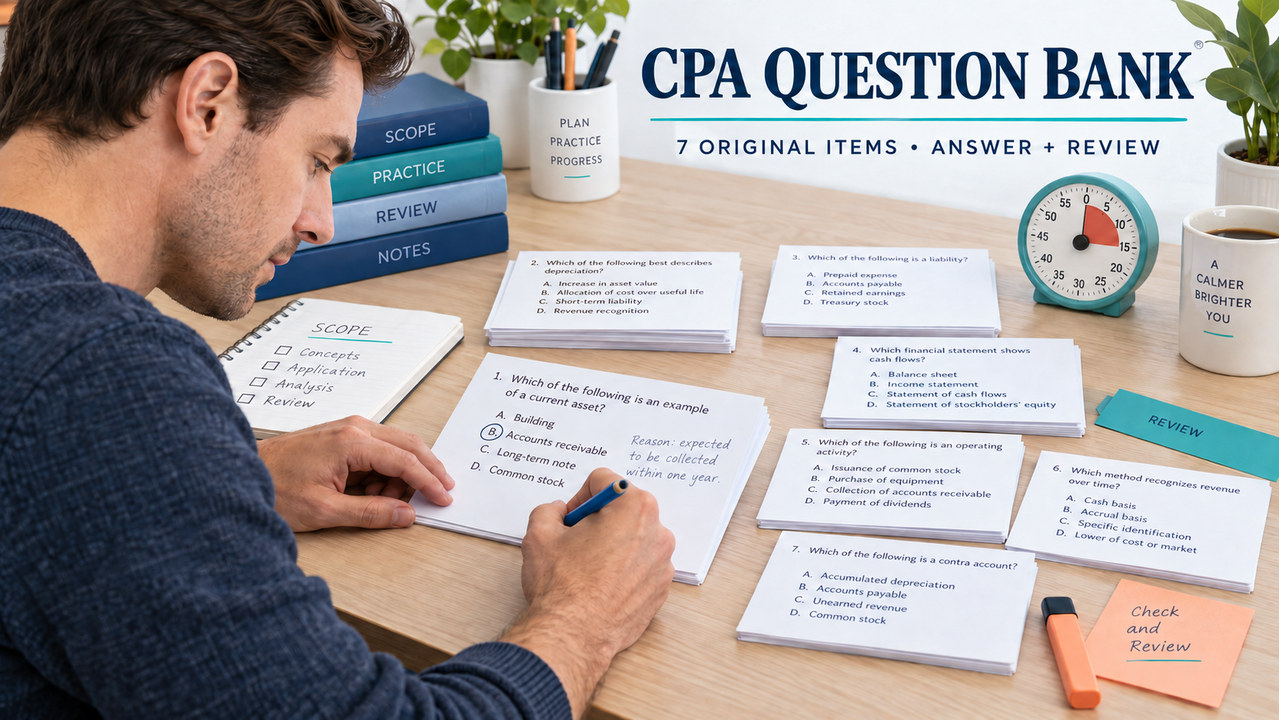

Quick answer: a cpa question bank is useful when each question produces evidence you can act on. First, start with the scope boundary, name the skill and assumptions, choose an answer with a reason, and reveal the explanation only after the attempt. Then preserve the strongest distractor, record time, confidence, tag the first miss, and book one focused repair. Importantly, the record is a study aid, not a released item set, official score, or readiness determination.
In practice, these seven items cover scope, calculation, evidence, control judgment, and review design so you can inspect the method behind a choice.
cpa question bank: What It Should Do
In practice, banks should help you answer three questions after every attempt: What skill was being tested? Which fact controlled the decision? What should I do next? A letter-only answer key cannot answer those questions. Moreover, a useful item states its assumptions, names its difficulty, delays the reveal, and explains the correct path and the strongest distractor.
First, use current AICPA Blueprints to frame official tested-content boundaries. Meanwhile, Blueprints organize content by Area, Group, and Topic and include task statements, skill levels, references, item types, and weighting. However, provider topic lists can help you practice, but they do not replace that scope reference.
In contrast, the AICPA sample test has one job. In addition, it helps candidates rehearse format and software, shows correct answers, and is not scored or a readiness determination. However, this is an original editorial practice set. It does not reproduce or imply released examination content. For eligibility, fees, applications, jurisdictions, or licensing, use NASBA or the applicable board.
How to Use a cpa question bank
First, run the bank as a sealed attempt. Before each question, read the skill and assumptions. Underline the amount, date, qualifier, authority, or condition that controls the result. Next, choose one option and write a one-sentence reason. Meanwhile, keep the clock moving when you meet an unfamiliar term; mark the uncertainty and return during review.
- Check scope: write the Blueprint Area, Group, or Topic that frames the item.
- Set the skill: state whether you are calculating, applying, identifying evidence, or planning a repair.
- Attempt first: commit to one choice and preserve the reason before opening the answer.
- Reveal and explain: compare your reason with the rule, then name why the strongest distractor loses.
- Log the repair: tag the first miss and schedule one same-skill retry with a bounded change.
As a result, this sequence protects its meaning. Next, search after committing, and record the path behind a miss instead of only a percentage. Therefore, the bank should end with a study decision, not another arbitrary batch of questions.

7 Original Questions for This cpa question bank
Next, all seven items are original. First, read the skill, assumptions, and difficulty. Then attempt the item before opening the delayed reveal. In addition, the explanations are written to show the rule, the strongest distractor, and one next action. None of the items should be mistaken for distributed exam content or endorsement.
1. Which Source Should Set the Question-Bank Boundary?
Tested skill: separate a current scope source from a provider topic list. Assumptions: you are deciding whether a topic belongs in a current section plan. Difficulty: foundational judgment.
Original practice item: For example, a provider’s question bank lists a topic, but you are not sure whether it belongs in current section. What should you check first?
- The provider’s largest inventory
- The current AICPA Blueprint for the relevant section
- A social-media study schedule
- A prior candidate’s memory of test day
Reveal the answer and reasoning
Answer: B, the current AICPA Blueprint. Reasoning: therefore, the Blueprint is the scope reference for tested content and describes task statements, skill levels, references, item types, and weighting. Distractor: however, provider inventories may support practice, but their size does not establish the governing boundary. Next action: write the exact Blueprint Area, Group, or Topic beside the next bank session.
2. What Is the Adjusted Book Cash Balance?
Tested skill: update book cash for reconciling items that were not recorded. Assumptions: the book balance is $8,740; the bank charged an unrecorded $40 service fee; and the bank collected $500 for the company, also unrecorded. However, ignore deposits in transit and outstanding checks because the question asks for the adjusted book side. Difficulty: foundational calculation.
Original practice item: What is the adjusted book cash balance?
- $8,200
- $8,740
- $9,200
- $9,280
Reveal the answer and reasoning
Answer: C, $9,200. Reasoning: first, start with $8,740, subtract $40, and add the $500 collection: $8,740 − $40 + $500 = $9,200. Distractor: instead, D adds items and misses that the service fee reduces cash. Next action: write “book side” before solving a new reconciliation with an interest amount.
3. Which Evidence Tests a Control Throughout the Period?
Tested skill: match a control-testing objective to period-wide evidence. Assumptions: the auditor wants evidence that an approval control operated during the year, not just at one date. Difficulty: foundational application.
Original practice item: Which procedure best responds to that objective?
- Ask the control owner whether the control worked
- Select items from across the period and inspect evidence of the required approval
- Confirm one year-end receivable balance
- Recalculate the allowance estimate
Reveal the answer and reasoning
Answer: B, select items across the period and inspect the approval evidence. Reasoning: because the objective concerns operation over time, the sample should cover the period and show the control’s required performance. Distractor: however, inquiry alone may explain the process, but it does not provide the same evidence that the control operated on selected items. Next action: change the objective to year-end existence and name the evidence question that would then control the procedure.
4. What Is the Starting Cost Under the Stated Basis Assumption?
Tested skill: compute an acquisition cost when the question states which outlay is included. Assumptions: equipment has a purchase price of $18,000 and a nonrefundable $1,200 sales tax that is required to acquire it; under this item’s assumption, include that acquisition cost in starting basis. Difficulty: foundational calculation.
Original practice item: What amount should the question-bank record use as the starting cost under the stated assumption?
- $16,800
- $18,000
- $19,200
- $21,600
Reveal the answer and reasoning
Answer: C, $19,200. Reasoning: next, add the purchase price and the stated included acquisition cost: $18,000 + $1,200 = $19,200. Distractor: B repeats the sticker price and ignores the assumption that the required nonrefundable cost is included. Next action: rewrite the item with a refundable tax and identify which assumption must be reconsidered before calculating.
5. Does the Discounted Annuity Recover the Initial Investment?
Tested skill: compare a discounted three-year cash-flow stream with its initial cost. Assumptions: an investment costs $5,000 now and returns $2,000 at the end of each of the next three years; use a 10% annual discount rate, no taxes, and no other cash flows. The three-year annuity factor at 10% is approximately 2.4869. Difficulty: foundational calculation.
Original practice item: What is the approximate net present value?
- -$2,000.00
- -$26.30
- $26.30
- $4,973.80
Reveal the answer and reasoning
Answer: B, approximately -$26.30. Reasoning: first, inflows have a present value of $2,000 × 2.4869 = $4,973.80. Then subtract $5,000 initial cost to get about -$26.20, which rounds to the displayed choice. Distractor: D is the present value of the inflows, not the net value after the initial investment. Next action: label “PV inflows” and “initial outflow” as separate lines on the next calculation.
6. What Is the First Response to an Active Terminated Account?
Tested skill: respond to termination evidence in an access-control review. Assumptions: a user is listed as terminated, but the review shows the account is still active; the reviewer has authority to request an immediate suspension and investigation. Difficulty: foundational application.
Original practice item: Which action best addresses the immediate risk?
- Grant the account a broader role so the activity is easier to track
- Wait for the annual access review
- Suspend the account, preserve the evidence, and investigate the access
- Delete the account and its logs immediately
Reveal the answer and reasoning
Answer: C, suspend the account, preserve the evidence, and investigate. Reasoning: therefore, an active terminated account creates an immediate access risk; containment and evidence preservation come before a final root-cause conclusion. Distractor: deleting the account and logs may remove evidence needed to understand what occurred. Next action: change the fact to an active account with a valid job change and identify which approval evidence should be reviewed.
7. Which Record Makes a Question-Bank Result Useful?
Tested skill: choose a review record that preserves the path behind an answer. Assumptions: you want the next block to distinguish timing, scope, knowledge, reading, calculation, and transfer problems. Difficulty: foundational planning.
Original practice item: Which record is most useful after a missed question?
- A percentage with no explanation
- A count of every question opened
- The first choice, reason, time, confidence, distractor, error tag, and repair
- A comparison with another learner’s pace
Reveal the answer and reasoning
Answer: C, the evidence-rich record. Reasoning: in turn, it shows the decision path and links the observed problem to one defined action. Distractor: a percentage or question count cannot reveal whether the problem was reading, knowledge, calculation, timing, or transfer. Next action: change one material fact in a same-skill retry and compare the written reasons.
How to Review a cpa question bank
After the final reveal, do not turn every signal into one verdict. Start with the first error. For example, missed qualifiers suggest reading. When a known method runs slowly, timing is likely. However, a correct letter with a weak reason suggests that the knowledge or transfer path is not stable yet.
First, inspect accuracy as a prompt, not as a readiness claim. Next, ask whether the method was efficient or whether the item deserved a deliberate calculation. Finally, use confidence to find calibration problems: high confidence plus a weak reason calls for a careful reread, while low confidence plus a sound reason may call for retrieval practice.
Also, preserve the strongest distractor as it records the path that felt plausible. For example, a distractor that ignores an assumption calls for better framing. If the distractor reports present value instead of net value, label the outflow. When it deletes access logs, check that the evidence is preserved.
Choose the Next Study Block
Instead, choose one repair, not a new resource library. Next, use these tags to make the decision explicit:
- Timing: you knew the method but used the block inefficiently. Rework one item with a written time budget.
- Scope: you could not identify the current topic boundary. Check the relevant Blueprint Area, Group, or Topic.
- Knowledge: you recognized the topic but could not state the rule. Restate one trusted explanation and retrieve it without notes.
- Reading: you missed an amount, date, qualifier, or authority. Mark the controlling words before solving again.
- Calculation: you knew the rule but skipped or reversed a step. Write the formula and label inflows, outflows, or periods.
- Transfer: the original item made sense, but one changed fact broke the method. Retry with exactly one material fact changed.
Then write the repair as a sentence: “I need to separate present value from net present value before choosing an option.” Afterward, schedule a same-skill retry within the next two study blocks. Then compare the new reason with the old one. If the reason changes in the intended direction, you have stronger evidence than a larger unexplained question count.

FAQ: cpa question bank
Are these released examination questions?
No. They are original editorial practice items. Instead, use current AICPA Blueprints for scope, and do not treat any answer on this page as released or endorsed content.
How many questions should a question bank session include?
In a session, use the smallest block that lets you explain the result. Moreover, seven items preserve a reason, distractor, time observation, confidence note, and next action for each item.
Should I judge my preparation by a percentage?
You may record accuracy as one study signal. However, do not convert seven original items into a passing prediction. Therefore, preserve the reasoning and error tag so the number has context.
What if a provider topic list conflicts with my study plan?
Instead, pause the topic decision and check current AICPA Blueprint for the relevant section. Then use provider list as a practice-navigation aid, not as the authority for tested-content scope.
Where should I check current exam scope and candidate rules?
Finally, use the AICPA Blueprints for scope and the AICPA sample test for software orientation. Also use NASBA or the applicable board for eligibility, applications, fees, jurisdictions, and licensing.
Sources and Refresh Note
Current scope and item types: AICPA CPA Exam Blueprints. Format and software familiarity: AICPA sample tests. General administration: AICPA CPA Exam FAQ and NASBA CPA Exam. Checked September 16, 2026. The seven questions, rationales, distractors, study record, error tags, and retry method are original editorial content. Reopen the live official pages and refresh the workbook’s Semrush US fields before publication. For a broader plan, continue with our CPA Exam Study Guide.