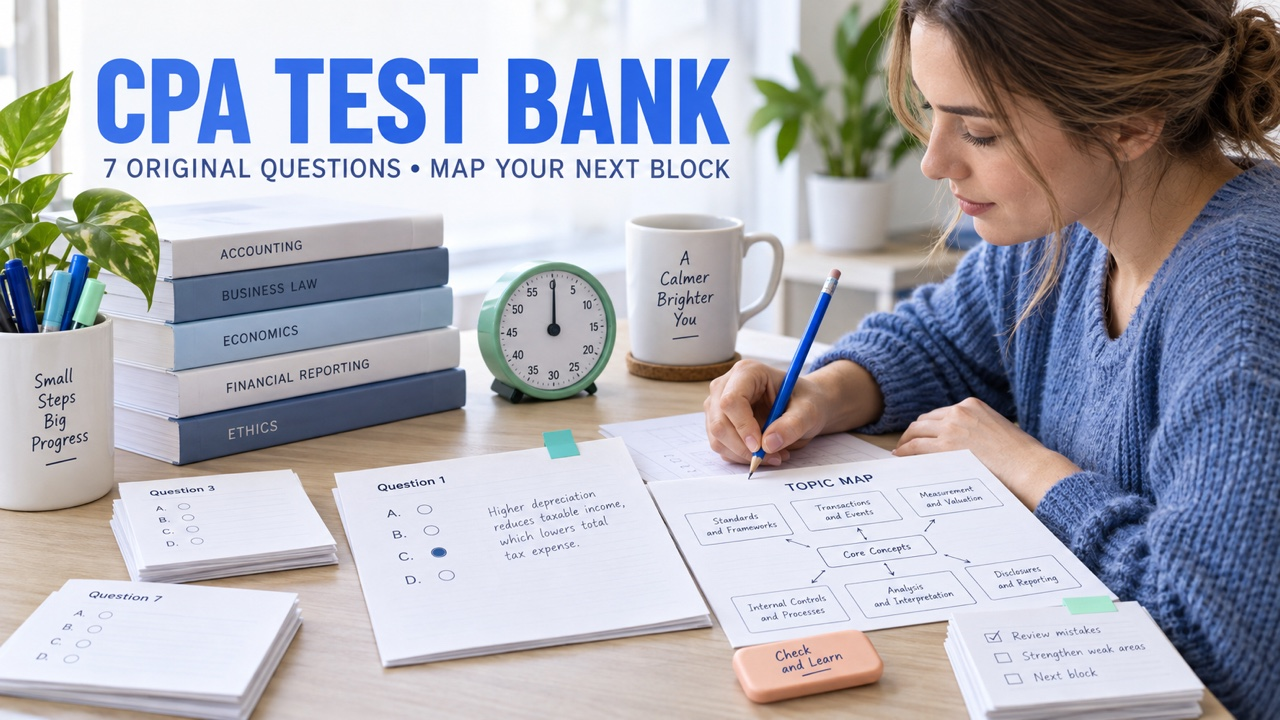

Quick answer: a cpa test bank becomes useful when every question is tied to one topic, one tested skill, and one review decision. First, before you answer, check the current scope source, write the assumptions, and note the difficulty. Then commit to a choice and a reason before opening the delayed reveal. Afterward, inspect the strongest distractor, record time and confidence, tag the first miss, and book one focused retry. This is a study method, not an official score or readiness test.
In practice, this page gives you seven original questions and a record for each one. The goal is to make the path behind a choice visible enough that your next study block has a job.
cpa test bank: What It Should Produce
A useful test bank should produce more than an answer letter. After each attempt, name the topic, tested skill, controlling fact, and reason the strongest distractor lost. Without those notes, a percentage can hide whether the issue was reading, timing, knowledge, or calculation.
Next, start with the current AICPA CPA Exam Blueprints for the official scope boundary. AICPA organizes them by Area, Group, and Topic and includes task statements, skill levels, references, item types, and weighting. The current page links a Blueprint effective January 1, 2026. A provider topic list can guide practice, but it does not replace that source.
However, keep the AICPA sample test in its proper lane: it prepares you for testing-software format and functionality, lets you see correct answers, and is not scored or a readiness determination. These seven questions are original editorial practice, not an official sample or reconstructed exam set. For applications, eligibility, fees, jurisdictions, accommodations, or licensing, use NASBA and the applicable board; NASBA says it does not develop or score the exam.
Finally, as of September 16, 2026, the AICPA scope page describes two MCQ testlets followed by three TBS testlets in each section. Treat this as a point-in-time note and reopen the live Blueprint before locking a study map.
How to Use a cpa test bank
Run the bank as a sealed attempt. Before each item, read the topic, skill, assumptions, and difficulty. Underline the amount, date, qualifier, authority, or condition that controls the result. Choose one option and write a one-sentence reason. If a term is unfamiliar, mark it and search during review.
- Map the topic: write the Blueprint Area, Group, or Topic that frames the item.
- Name the skill: state whether you are calculating, applying, selecting evidence, or planning a review action.
- Attempt first: commit to one answer and preserve the reason before opening the reveal.
- Reveal and explain: compare your reason with the rule, then name why the strongest distractor is tempting but wrong.
- Book the repair: tag the first miss and schedule one same-skill retry with one material fact changed.
Therefore, that sequence keeps the result interpretable and prevents answer checking from becoming passive recognition. You are recording the route from topic to decision, not just collecting letters.

7 Original Questions for This cpa test bank
Moreover, all seven items below are original practice. Read the skill, assumptions, and difficulty first, then attempt the question before opening its delayed reveal. Each explanation names the correct path and the strongest distractor.
1. Which Source Should Map the Tested Topic?
Tested skill: separate current official scope from a provider topic list. Assumptions: you are deciding whether a topic belongs in your study map, and the provider list and current AICPA resource use different labels. Difficulty: foundational judgment.
Original practice item: Which source should control the initial scope decision?
- A current AICPA CPA Exam Blueprint
- A provider’s largest advertised question count
- A forum post that remembers a prior exam
- A screenshot with no section or effective date
Reveal the answer and reasoning
Answer: A, the current AICPA CPA Exam Blueprint. Reasoning: Therefore, the Blueprint is the scope reference that organizes content and describes task statements, skill levels, item types, and weighting. Provider lists can help with navigation, but they are practice aids. Distractor: D looks specific because it is an image, but without a section and effective date it cannot establish current scope. Next action: add the Blueprint Area, Group, or Topic to your record before opening a provider item.
2. What Revenue Belongs in December?
Tested skill: recognize revenue timing from a stated service period. Assumptions: a company receives $12,000 on December 1 for three equal months of service beginning immediately; ignore taxes, refunds, and other adjustments. Difficulty: foundational calculation.
Original practice item: How much revenue should the company recognize for December under the stated facts?
- $0
- $4,000
- $8,000
- $12,000
Reveal the answer and reasoning
Answer: B, $4,000. Reasoning: Thus, the cash receipt is $12,000, but the stated service is delivered evenly over three months. One month is one-third of the obligation, so $12,000 ÷ 3 = $4,000 for December. Distractor: D treats cash received as if the full service had already been delivered. Next action: on the next timing item, write both the cash date and the service-delivery period before calculating.
3. Which Evidence Addresses Receivable Existence?
Tested skill: select audit evidence that addresses existence. Assumptions: the assertion is whether recorded year-end receivables are real, the customer addresses are available, and the auditor can send positive confirmations. Difficulty: foundational application.
Original practice item: Which procedure most directly addresses the stated assertion?
- Trace shipping documents forward into the sales journal
- Send positive confirmations to selected customers
- Recalculate the allowance percentage
- Compare the gross margin with the prior year
Reveal the answer and reasoning
Answer: B, send positive confirmations. Reasoning: In particular, confirmation asks the external customer to support whether the recorded balance exists. Distractor: A starts with shipping documents and traces into the journal, which is more naturally a completeness path because it asks whether recorded sales were omitted. It is not the most direct procedure for the stated assertion. Next action: label the assertion before choosing evidence, then write “existence” or “completeness” beside the direction of the test.
4. What Is the Present Value of One Future Cash Flow?
Tested skill: discount one future cash flow using the correct number of periods. Assumptions: receive $10,000 exactly two years from today, the annual discount rate is 8%, compounding is annual, and there are no interim cash flows. Difficulty: foundational calculation.
Original practice item: What is the approximate present value?
- $8,573
- $9,259
- $10,800
- $11,664
Reveal the answer and reasoning
Answer: A, approximately $8,573. Reasoning: Therefore, use $10,000 ÷ (1.08)2. The two-year period count is part of the fact pattern, so the result is about $8,573. Distractor: B discounts for only one year and therefore leaves too much value in today’s amount. Next action: write the cash-flow date, valuation date, and exponent on separate lines before entering a calculator.
5. What Is the First Response to an Active Terminated Account?
Tested skill: contain an access risk while preserving evidence. Assumptions: an employee is listed as terminated, the account remains active, unusual activity is visible, and the reviewer can request immediate suspension and investigation. Difficulty: foundational application.
Original practice item: Which response best addresses the immediate risk?
- Grant a broader role so the activity is easier to track
- Wait for the annual access review
- Suspend the account, preserve the logs, and investigate
- Delete the account and all logs immediately
Reveal the answer and reasoning
Answer: C, suspend the account, preserve the logs, and investigate. Reasoning: Meanwhile, containment addresses the active risk while preserving evidence for the investigation. Distractor: D may remove the very records needed to determine what occurred, while A increases access and B leaves an immediate exposure in place. Next action: change one fact in a retry—for example, make the account active after a documented role change—and identify the approval evidence you would inspect.
6. Which Fact Should You Verify Before a Current Tax Conclusion?
Tested skill: identify the date and entity facts needed before applying a current tax rule. Assumptions: a practice prompt asks about a federal tax treatment, the payment was made in a named tax year, and the taxpayer’s entity classification is not yet confirmed. Difficulty: foundational judgment.
Original practice item: What should you verify first?
- The answer that appears most often in a discussion thread
- The tax year, effective date, and taxpayer classification in a current authoritative source
- Whether another learner selected the same choice
- The provider’s total number of tax questions
Reveal the answer and reasoning
Answer: B, verify the tax year, effective date, and taxpayer classification. Reasoning: Because a date-sensitive tax conclusion can change when a rule becomes effective, and entity facts can change the applicable treatment. The missing facts must be resolved before choosing a rule. Distractor: A supplies confidence without authority or a date boundary. Next action: tag a miss here as “scope” or “reading” only after you write the exact missing fact and the authoritative source you will check.
7. Which Record Makes a Test-Bank Result Useful?
Tested skill: interpret practice evidence and choose a bounded retry. Assumptions: the next block should distinguish timing, scope, knowledge, reading, calculation, and transfer problems. Difficulty: foundational planning.
Original practice item: Which record is most useful after a missed item?
- A percentage with no explanation
- A count of every question opened
- The topic, first choice, reason, time, confidence, distractor, error tag, and repair
- A comparison with another learner’s pace
Reveal the answer and reasoning
Answer: C, the evidence-rich record. Reasoning: Thus, it preserves the decision path and connects the observed problem to one defined action. Distractor: a percentage or question count shows quantity but not whether the problem was timing, scope, knowledge, reading, calculation, or transfer. Next action: change one material fact in a same-skill retry and compare the new written reason with the old one.
How to Review a cpa test bank
Instead, after the final reveal, start with the first error instead of treating every signal as one verdict. A missed qualifier may be reading; a known method that runs slowly may be timing; a correct answer with a weak reason may show unstable knowledge or transfer.
Moreover, accuracy is a prompt, not a readiness claim. Ask whether the method was efficient, then use confidence to find calibration problems: high confidence plus a weak reason calls for a reread, while low confidence plus a sound reason may call for retrieval practice.
Furthermore, the strongest distractor records the plausible wrong path. A one-period present-value distractor calls for an explicit date line; an access-control distractor that deletes logs calls for evidence-preservation review.
Choose the Next Study Block
Instead, choose one repair, not a resource library. Use the first-miss tag to make the decision explicit:
- Timing: you knew the method but used the block inefficiently. Rework one item with a written time budget.
- Scope: you could not identify the current topic boundary. Check the relevant Blueprint Area, Group, or Topic.
- Knowledge: you recognized the topic but could not state the rule. Restate one trusted explanation and retrieve it without notes.
- Reading: you missed an amount, date, qualifier, or authority. Mark the controlling words before solving again.
- Calculation: you knew the rule but skipped or reversed a step. Write the formula and label inflows, outflows, or periods.
- Transfer: the original item made sense, but one changed fact broke the method. Retry with exactly one material fact changed.
Then write the repair as a sentence: “I need to count the service period before treating cash received as revenue.” Schedule a same-skill retry within the next two study blocks and compare the new reason with the old one. That is stronger evidence than a larger unexplained question count.

FAQ: cpa test bank
Are these official or released examination questions?
No. They are original editorial practice items. Use current AICPA Blueprints for scope, and do not treat any answer on this page as distributed or endorsed content.
How many questions should a test-bank session include?
For example, the smallest block that lets you explain the result is enough. Seven items can preserve a topic, reason, distractor, time note, confidence note, and next action.
Should I judge preparation by a percentage?
Thus, accuracy is one study signal, but do not turn seven original items into a passing prediction. Preserve the reasoning and error tag.
What if a provider topic list conflicts with my plan?
Also, pause the topic decision and check the current AICPA Blueprint for the relevant section. Use a provider list as a practice-navigation aid, not as the authority for tested-content scope.
Where should I check current candidate rules?
Therefore, use AICPA Blueprints for scope and the AICPA sample test for software orientation. Use NASBA or applicable board for eligibility, applications, fees, jurisdictions, accommodations, and licensing.
Sources and Refresh Note
Current scope, task statements, and item types: AICPA CPA Exam Blueprints. Format and software familiarity: AICPA sample tests. General administration: AICPA CPA Exam FAQ and NASBA CPA Exam. Checked September 16, 2026. The seven questions, rationales, distractors, study record, error tags, and retry method are original editorial content. Reopen the live official pages and refresh the workbook’s Semrush US fields before publication. For a broader plan, continue with our CPA Exam Study Guide.