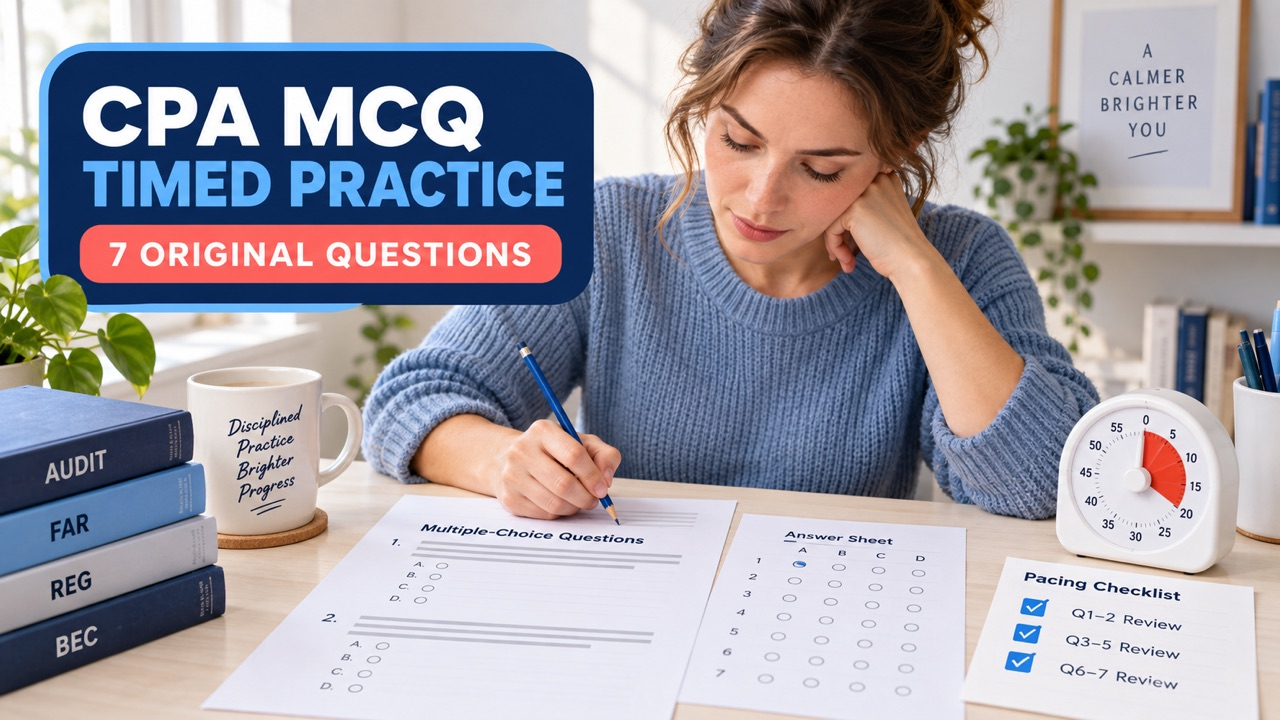

Quick answer: A useful cpa mcq timed practice session is a controlled experiment, not a race. Set a time box, mark the controlling fact, commit once, and flag uncertainty for review. Then use the rationale to classify the gap. These seven items are original practice, not exam content and not a score report.
For a broader preparation path, continue with our CPA Exam Study Guide.
cpa mcq timed practice: Use a Time Box, Not a Race
Time pressure changes what an MCQ reveals. A slow correct answer may show an unfamiliar calculation, while a fast wrong answer may show that you skipped the ask or reversed an evidence direction. Therefore, the goal is not to finish as quickly as possible. The goal is to make your decision process visible enough to improve it.
First, use a soft first-pass limit and reserve a review window. These are study controls, not official CPA timing rules. Check the AICPA sample-test resource for current software and format guidance; this page supplies the method.
Set a Time Box Before You Start
First, write the total block length and the job before opening a question. A short block may train reading and commitment. A longer block may train calculation, explanation, review. Keep one skill visible so that speed data does not get mixed with every possible source of error.
- Set: choose the number of original questions and the total study window.
- Read: find the ask, the unit, the date, the assertion, or the taxpayer fact.
- Mark: circle the one fact that controls the first decision.
- Decide: choose once and write a short reason before checking the reveal.
- Flag: note uncertainty with one word instead of rereading the entire stem.
- Move: finish the set, then review flagged items and classify the first gap.

Compare first-pass and reviewed choices. Many changes suggest reading or confidence; few changes with wrong answers suggest the rule or calculation.
How to Run a cpa mcq timed practice Set
Next, start with four to seven items, a timer, and one written reason per first choice. Keep the time box fixed so changes reflect the skill, not a new rule.
Then flag uncertainty, move on, and review after the set. Compare time, first choice, and reviewed choice; then read the rationale and strongest distractor. This makes cpa mcq timed practice a feedback loop.
7 cpa mcq timed practice Questions with Worked Explanations
Each item is original editorial practice. Read the tested skill, assumptions, difficulty, and pacing cue before attempting it. Hide the explanation until you have selected an answer and written one reason.
1. Time-Box Setup: What Should You Write First?
Tested skill: define a repeatable timed study block. Assumptions: you have a 24-minute block, six original questions, and a separate review window; no official exam timing is being inferred. Difficulty: foundational planning. Pacing cue: plan the block before starting the first item.
Original practice item: Which setup creates the clearest study signal?
- Start immediately and decide the time limit after the first miss
- Write the total block, a soft first-pass limit, and a review window
- Give every question unlimited time so accuracy is the only signal
- Use a different time limit for every question without recording it
Reveal the answer and explanation
Answer: B, write the total block, a soft first-pass limit, and a review window. Explanation: a visible plan makes the result comparable across sessions. It also separates first-pass decisions from later review. In contrast, unlimited time hides the cost of a difficult item, while unrecorded limits provide no useful pacing evidence. Distractor: A gives the first miss too much control over the study design. Next action: write your next block length, first-pass limit, and review window before opening a question.
2. AUD Evidence: Which Choice Fits the Clock and Assertion?
Tested skill: match evidence direction to an assertion. Assumptions: recorded year-end receivables are being tested for existence, customer addresses are available, and positive confirmations can be sent. Difficulty: foundational application. Pacing cue: identify the assertion before comparing procedures.
Original practice item: Which procedure most directly addresses the stated assertion?
- Trace shipping documents forward into the sales journal
- Send positive confirmations to selected customers
- Recalculate the allowance percentage
- Compare gross margin with the prior year
Reveal the answer and explanation
Answer: B, send positive confirmations. Explanation: an external customer can support whether the recorded receivable exists. Specifically, the procedure matches the stated existence assertion. In contrast, tracing shipping documents forward into the sales journal more naturally tests completeness because it asks whether items that occurred were recorded. Distractor: A may look efficient, but its direction does not fit the assertion named in the stem. Next action: in the next timed AUD item, write the assertion and evidence direction before reading all four choices.
3. FAR Revenue Timing: What Belongs in December?
Tested skill: separate cash receipt from service delivery. Assumptions: a company receives $18,000 on December 1 for three equal months of service beginning immediately; ignore taxes, refunds, and other adjustments. Difficulty: foundational calculation. Pacing cue: write the period count before touching the answer choices.
Original practice item: How much revenue should be recognized for December?
- $0
- $6,000
- $12,000
- $18,000
Reveal the answer and explanation
Answer: B, $6,000. Explanation: the service is delivered evenly across three months. Therefore, December represents one-third of $18,000, or $6,000. Timing follows the service period rather than the cash date. Distractor: D treats the receipt as if the full obligation had already been performed. Next action: when the clock is running, write cash date, service period, and period count on separate lines before calculating.
4. REG Tax Facts: Which Fact Must Be Checked First?
Tested skill: identify facts that control a current tax conclusion. Assumptions: a practice prompt asks about a federal tax treatment, the payment belongs to a named tax year, and the taxpayer’s entity classification is not confirmed. Difficulty: foundational judgment. Pacing cue: scan for year, effective date, and entity before applying a remembered rule.
Original practice item: What should you verify before applying the rule?
- The answer most often repeated in a discussion thread
- The tax year, effective date, and taxpayer classification in a current authoritative source
- Whether another learner selected the same choice
- The provider’s total number of tax questions
Reveal the answer and explanation
Answer: B, verify the tax year, effective date, and taxpayer classification. Explanation: a date-sensitive rule can change when it becomes effective, and entity facts can change the treatment. As a result, those facts belong before the conclusion. Distractor: A feels fast but substitutes repetition for current authority. Next action: if you miss a timed REG item this way, record “fact check” rather than “too slow.”
5. BAR Analysis: What Keeps a Fast Comparison Valid?
Tested skill: connect a metric to a stated decision. Assumptions: management is comparing two projects, the question gives expected cash inflow and investment for each, and the task is to compare a simple return measure. Difficulty: foundational analysis. Pacing cue: name the decision and denominator before comparing percentages.
Original practice item: What must you identify before comparing the two percentages?
- The decision the metric is meant to inform
- The project with the more attractive name
- The largest raw inflow without its investment base
- A ranking copied from an older example
Reveal the answer and explanation
Answer: A, identify the decision the metric is meant to inform. Explanation: a percentage has meaning only after you name its numerator, denominator, period, and decision use. In practice, compare both projects with the same formula and assumptions. Distractor: C ignores the investment base, so a larger inflow may simply reflect a larger project. Next action: if the answer felt slow, practice writing formula, units, period, and decision in one line.
6. ISC Access Control: What Comes First Under Time Pressure?
Tested skill: contain an active access risk while preserving evidence. Assumptions: an employee is listed as terminated, the account remains active, unusual activity is visible, and the reviewer can request immediate suspension and investigation. Difficulty: foundational application. Pacing cue: distinguish containment from later analysis.
Original practice item: Which response best addresses the immediate risk?
- Grant a broader role so activity is easier to track
- Wait for the annual access review
- Suspend the account, preserve the logs, and investigate
- Delete the account and all logs immediately
Reveal the answer and explanation
Answer: C, suspend the account, preserve the logs, and investigate. Explanation: containment reduces active exposure while preservation keeps evidence available for a later conclusion. In contrast, deleting the logs may destroy the record needed to understand the incident. Distractor: B postpones the response even though the risk is active. Next action: use “contain, preserve, investigate” as a three-word recall cue in the next timed ISC question.
7. TCP Planning: Which Missing Fact Changes the Comparison?
Tested skill: identify a missing fact before comparing planning alternatives. Assumptions: a prompt compares two choices for a taxpayer, but the taxpayer type and tax year are not stated; no numerical conclusion is requested yet. Difficulty: foundational planning. Pacing cue: stop after spotting a missing controlling fact; do not calculate around it.
Original practice item: What should you do first?
- Choose the option with the higher advertised savings
- Confirm the taxpayer type, tax year, and governing rule
- Use a prior-year example without checking its assumptions
- Compare the number of practice questions in each topic
Reveal the answer and explanation
Answer: B, confirm the taxpayer type, tax year, and governing rule. Explanation: planning comparisons are fact dependent. Specifically, the same option can produce a different result when the taxpayer, year, or effective rule changes. Distractor: A treats an unverified savings claim as if it were a conclusion. Next action: record the missing facts, flag the item, and return during review instead of spending the first-pass clock on an unsupported calculation.
Review the Timed Set
After the seven reveals, record more than correct or incorrect. Note the time box, elapsed signal, first choice, reason, reviewed choice, strongest distractor, and first gap. A correct answer that changed during review is different from a correct answer chosen confidently on the first pass.
Next, review four distinctions:
- Fast and wrong: check whether you skipped the ask or controlling fact.
- Slow and wrong: check knowledge, formula, source boundary, or evidence direction.
- Slow and right: keep the reasoning, then shorten only the expensive step.
- Changed on review: inspect second-guessing, not just subject knowledge.
Do not use a small practice result to predict readiness or an official score. Use it to choose the next condition. For example, repeat one FAR calculation under the same time box with one changed number, or repeat one AUD evidence decision with a changed assertion.
Repair the First Timing Gap
Start with the earliest gap that made the item expensive. Next, choose one repair and keep the tested skill stable. Changing the skill, the time box, and the question format at once makes the result hard to interpret.
- Rushed reading: circle the ask and one qualifier before looking at choices.
- Slow calculation: write the formula, units, variables, and period count.
- Second-guessing: commit once, record the reason, and flag uncertainty for review.
- Lost time: use a stop rule and move to the next item after the soft limit.
- Knowledge gap: check one trusted rule, then close the source and retrieve it.
- Transfer gap: keep the skill and change exactly one material fact.
For instance, if the FAR item failed because you used the cash date, your repair is not “do more FAR.” Write “identify the service period,” check one explanation, and retry with a different number of months inside the same time box. If the AUD item failed because you reversed existence and completeness, write the assertion direction on a fresh fact pattern. Consequently, the next attempt has a clear job.

FAQ: cpa mcq timed practice
How long should a cpa mcq timed practice block be?
For consistency, choose a block. A short block trains reading; a longer block can include calculation and review. Treat the number as a study control, not an official limit.
Should I review every question immediately?
No. Instead, keep the first pass intact, flag uncertainty, move on, and review after the set. Immediate checking changes the timing signal.
What if I am slow but usually correct?
Therefore, keep the reasoning that protects accuracy and shorten one expensive step. Use a compact formula template or name the assertion before comparing procedures. Do not remove a necessary fact check.
Does a timed practice score predict readiness?
No. However, a small original set is a study signal, not an official score or readiness determination. Preserve the first gap and review change for the next block.
When should I repeat cpa mcq timed practice?
Finally, repeat after one focused repair, keeping the skill and time-box rule stable while changing one material fact.
Sources and Refresh Note for cpa mcq timed practice
Current scope and item types: AICPA CPA Exam Blueprints. Format and software familiarity: AICPA sample tests. General administration: AICPA CPA Exam FAQ. Candidate process: NASBA CPA Exam. Checked September 16, 2026. The time-box loop, seven questions, choices, rationales, distractor analysis, gap labels, and retry method are original editorial study content. Reopen live official pages and refresh the workbook’s Semrush US fields before publication.