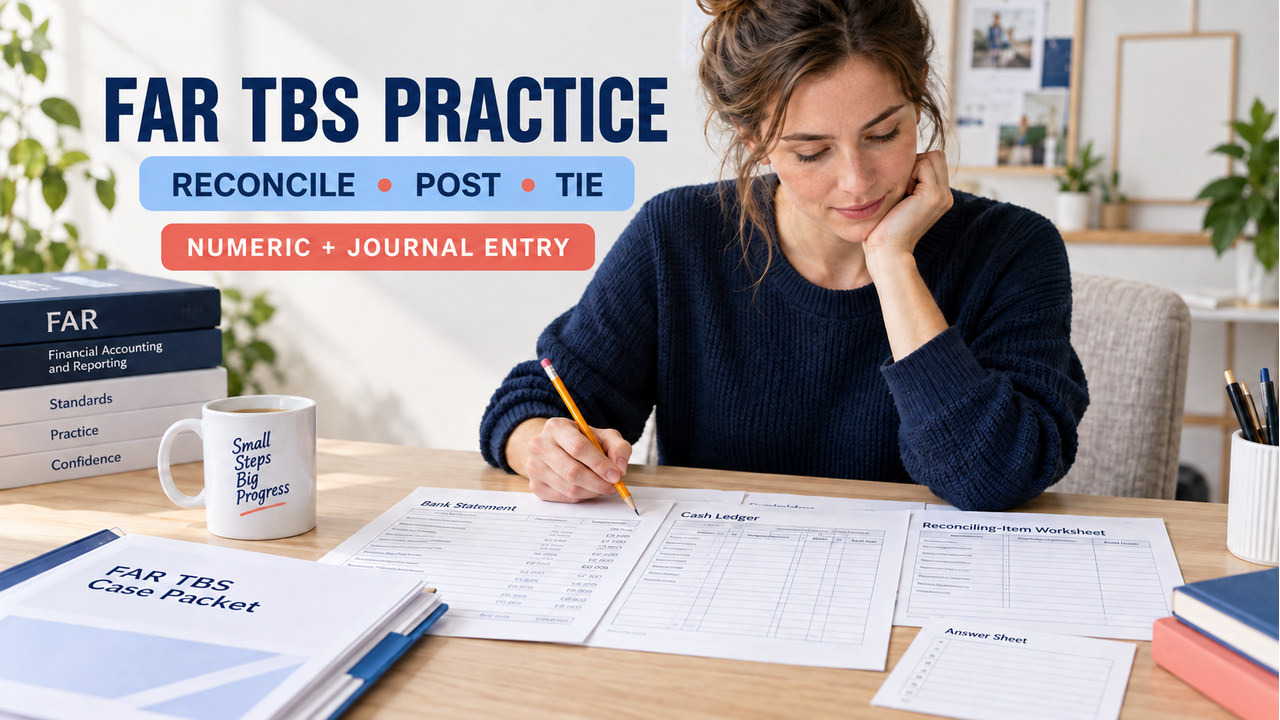

Quick answer: The most useful cpa tbs practice starts with the deliverable, not the arithmetic. Read what the answer cell asks, classify each fact as bank-side or book-side, calculate one side at a time, post only the book-side differences, and then prove that both adjusted balances tie. The original FAR case below gives you five answer cells, delayed reveals, and a changed-fact retry. It is editorial practice, not released exam content.
Current boundary: the AICPA Blueprint says each section has five testlets: the first two are multiple-choice and the next three contain TBSs. FAR is listed as 2/3/2 across TBS testlets 3, 4, and 5. The AICPA scoring page reports a 0–99 scaled score, not a percentage; a home total is not an official score. Use the CPA Exam Study Guide for broader planning.
What cpa tbs practice Should Train
In practice, a TBS is a chain of decisions. You must identify the requested output, locate the fact that controls it, apply the supplied rule or assumption, and enter the response in the required form. Therefore, a correct final number is useful only when you can explain where it came from and which exhibit supports it. For example, the same total can be right for the wrong reason.
Start with the cpa tbs practice answer form
First, name the deliverable: an adjusted balance, journal entry, selected treatment, edit, or citation. Next, note whether the cell wants a positive or negative number, debit or credit, option, or “no change” selection. This pause prevents a correct calculation from landing in the wrong column.
Separate cpa tbs practice facts from decoration
Then, label each exhibit by what it can prove. A bank statement establishes what the bank recorded by the cutoff; a ledger establishes what the company recorded. A memo can explain an item without changing its amount. As a result, ignore realistic detail that does not answer the cell.
Make the first cpa tbs practice divergence visible
Finally, review classification, formula, amount, account, side, and completion in that order. If the tie-out fails, find the first line where your work left the exhibit or instruction. That line usually tells you what to review next.
The Four-Pass cpa tbs practice Method
1. READ: define the output
First, read the stem and answer cells before opening every exhibit. Write the cutoff date, requested balance, and response format. Here, the output is a March 31 bank reconciliation plus the book-side entries. However, timing matters because a later transaction may be a reconciling item, not a book adjustment.
2. RECONCILE: sort the evidence
Next, put bank-side items in one column and book-side items in another. Deposits in transit and outstanding checks explain a difference even when the books are correct. Moreover, fees, direct collections, NSF items, and book errors usually need entries when the company omitted them. Do not let the word “bank” decide the side; ask which record is missing the fact.
3. POST: update only the books
Afterward, calculate the net book-side change and translate each omitted item into an entry. However, bank-side posting is not repeated because it appears on the statement. For a check error, compare recorded and cleared amounts, then post only the difference. Keep the account and debit-credit direction tied to the facts.
4. CHECK: tie and explain
Finally, calculate adjusted bank and book balances independently. They should agree under the case assumptions. If they do not, check signs, cutoff, duplicate adjustments, and book-entry classification. Therefore, incomplete work remains until every required cell has a response.

Original FAR cpa tbs practice Simulation
Next, try the case without looking at the reveals. Classify, calculate, post, then tie.
Case file: Harbor & Pine Services
Tested skill: reconcile a bank statement to the company ledger and identify the book-side entry. Assumptions: Harbor & Pine is preparing its March 31 close; all listed amounts are in dollars; the company records outstanding checks and deposits in transit when it issues or deposits them; the question asks for the amount or entry supported by the listed exhibits. Difficulty: foundational FAR numeric and journal-entry practice.
Exhibit A — March 31 bank statement
First, the statement shows an ending balance of $48,760. It does not yet show the March 31 deposit of $4,200. Checks #118 for $1,050 and #121 for $2,400 were issued by the company but had not cleared by the statement date.
Exhibit B — Cash ledger
Next, the ledger shows $48,995. It does not include a bank service charge of $35 or a direct customer collection of $1,100. In addition, a customer check for $460 was returned NSF after the company had recorded the receipt. Also, check #119 was recorded as a $780 Office Expense, but the bank cleared it for $870.
Exhibit C — Close instructions
Finally, use the March 31 cutoff. Do not add a deposit in transit to the books a second time. Reinstate the customer receivable for the NSF item. Correct the $90 difference on check #119. The final reconciliation should use whole dollars and should show why the two adjusted balances agree.
Answer cell 1: Which items belong on the bank side?
Original practice item: Select the pair that adjusts the bank statement balance rather than the book balance.
- The $35 bank fee and the $1,100 direct collection
- The $4,200 deposit in transit and the $3,450 of outstanding checks
- The $460 NSF item and the $90 check error
- The $780 Office Expense and the $48,995 ledger balance
Reveal the answer and explanation
Answer: B. The deposit in transit and outstanding checks explain transactions the company recorded but the bank had not reflected at the cutoff. Therefore, they adjust the statement side. In contrast, the fee, collection, NSF item, and $90 check difference are book-side items because the ledger needs an update. Next action: before calculating any reconciliation, write “bank statement missing this” or “books missing this” beside each line.
Answer cell 2: What is the adjusted bank balance?
Original practice item: Compute the March 31 adjusted bank balance after the bank-side reconciling items.
- $45,310
- $48,760
- $49,510
- $52,210
Reveal the answer and explanation
Answer: C. Start with $48,760, add the $4,200 deposit in transit, and subtract $1,050 plus $2,400 of outstanding checks: $48,760 + $4,200 − $3,450 = $49,510. Option A subtracts the deposit; B ignores the reconciling items; D adds the outstanding checks instead of subtracting them. Next action: write the bank-side formula on its own line before touching the ledger-side items.
Answer cell 3: What is the net book-side adjustment?
Original practice item: Using Exhibit B and the close instructions, calculate the net change needed to bring the books to the adjusted balance.
- Increase cash by $515
- Decrease cash by $515
- Increase cash by $3,450
- Make no book adjustment
Reveal the answer and explanation
Answer: A. The book-side net is +$1,100 − $35 − $460 − $90 = +$515. The direct collection increases cash; the fee, NSF return, and check correction reduce cash. Therefore, $48,995 + $515 = $49,510. Option C incorrectly moves the outstanding checks to the books, and D ignores four stated book-side facts. Next action: label every book-side amount with a plus or minus before you sum it.
Answer cell 4: Which entry records the bank service charge?
Original practice item: Choose the entry for the unrecorded $35 bank service charge.
- Debit Cash $35; credit Bank Fee Expense $35
- Debit Bank Fee Expense $35; credit Cash $35
- Debit Accounts Receivable $35; credit Cash $35
- Debit Outstanding Checks $35; credit Cash $35
Reveal the answer and explanation
Answer: B. The fee is an expense that reduces cash, so debit Bank Fee Expense and credit Cash. The bank statement is evidence of the charge, but the entry belongs in the books because the ledger omitted it. Option A reverses the effect; C uses an unrelated receivable; D treats a reconciling label as an account. Next action: for each journal-entry cell, name the economic event first, then choose the account and side.
Answer cell 5: Which conclusion is supported?
Original practice item: After the listed book-side entries and bank-side adjustments, which statement is supported?
- The bank statement proves that every cash control operated all year
- The March 31 balances tie at $49,510 under the supplied facts, with no remaining difference in this reconciliation
- The deposit in transit must be posted to cash again because it is not on the statement
- The $460 NSF item should remain a permanent reduction of Accounts Receivable
Reveal the answer and explanation
Answer: B. The bank side and book side both reach $49,510 under the case assumptions. However, that tie-out supports this reconciliation only; it does not prove every cash control operated all year. The deposit is already in the ledger, and an NSF return restores the customer receivable rather than permanently reducing it. Next action: state the period, balance, and assumptions before using a broad conclusion.

Review cpa tbs practice by Error Type
After the reveals, record the first place your work diverged. However, one wrong total is not enough information. Instead, classify the error as task when you misread the deliverable, classification when you put a fact on the wrong side, calculation when the sign or formula failed, posting when the account or debit-credit side failed, or completion when a cell or instruction was left unfinished.
Review cpa tbs practice classification errors
Therefore, revisit the two-record question: what did the bank omit, and what did the books omit? Re-sort the facts without doing arithmetic. Then explain why a deposit in transit is not a second cash receipt and why a bank fee is not an outstanding check.
If the error was calculation
Next, record starting balance, each signed adjustment, and the ending balance on separate lines. Check the cutoff date and the units. For Harbor & Pine, the two independent equations are $48,760 + $4,200 − $1,050 − $2,400 and $48,995 + $1,100 − $35 − $460 − $90.
If the error was posting or completion
Finally, verify each answer cell and the account, debit-credit column, amount, and required selection. A correct net adjustment can still fail if the NSF item is posted as an expense or if the bank-side deposit is entered again. Finally, leave a one-line note naming the instruction that prevented the mistake.
Transfer cpa tbs practice to a Changed Fact
Transfer is where practice becomes useful. Keep the skill fixed and change one fact. For example, suppose Exhibit A now says check #121 cleared before March 31. It is no longer outstanding at the cutoff. Before recalculating, confirm that the revised statement balance reflects the clearing; otherwise you could subtract the check twice.
Use a cpa tbs practice changed-fact repair
First, name the changed fact. Next, identify the affected exhibit and cells. Then, revise only that formula line and explain whether an entry changes. Finally, recompute both sides and state the narrow conclusion. Change one variable at a time so you know what drove the answer.
FAQ for cpa tbs practice
What is cpa tbs practice?
It is deliberate practice with case-based task-based simulations: read a requirement, use exhibits, calculate or select a response, and review the reasoning. A useful session records the first divergent step, not only a final percentage.
How should I start a cpa tbs practice question?
First, start with the deliverable and answer form. In addition, write the cutoff date, the requested output, and the evidence type that can prove it. Only then scan the exhibits and sort each fact into the record it changes.
How many TBSs are in a CPA Exam section?
Currently, the AICPA Blueprint lists FAR as 2/3/2 TBSs across testlets 3, 4, and 5. It lists different distributions for the other sections, so reopen the live Blueprint for your testing window instead of relying on a static practice page.
Should I treat a practice total as my CPA score?
No. The AICPA reports scores on a 0–99 scale and says the reported total is not a percentage correct. Therefore, use this page’s count and confidence fields to choose a review action, not to predict a scaled result.
Where do I check software and administration details?
Finally, use the AICPA sample-test page for software familiarity and use NASBA or the applicable state Board for eligibility, applications, fees, accommodations, and licensing. Those details can change independently of this original study case.
Sources and Refresh Note for cpa tbs practice
Current TBS structure and FAR testlet counts: AICPA CPA Exam Blueprints. Software-familiarity boundary: AICPA sample tests. Score boundary: AICPA scoring and pass rates. Candidate FAQ: AICPA CPA Exam FAQ. Candidate process: NASBA CPA Exam. Checked September 17, 2026. The four-pass method, Harbor & Pine facts, three exhibits, five answer cells, calculations, entries, explanations, and changed-fact retry are original editorial study content. Reopen official pages and refresh the workbook’s Semrush US fields before any human publication decision.