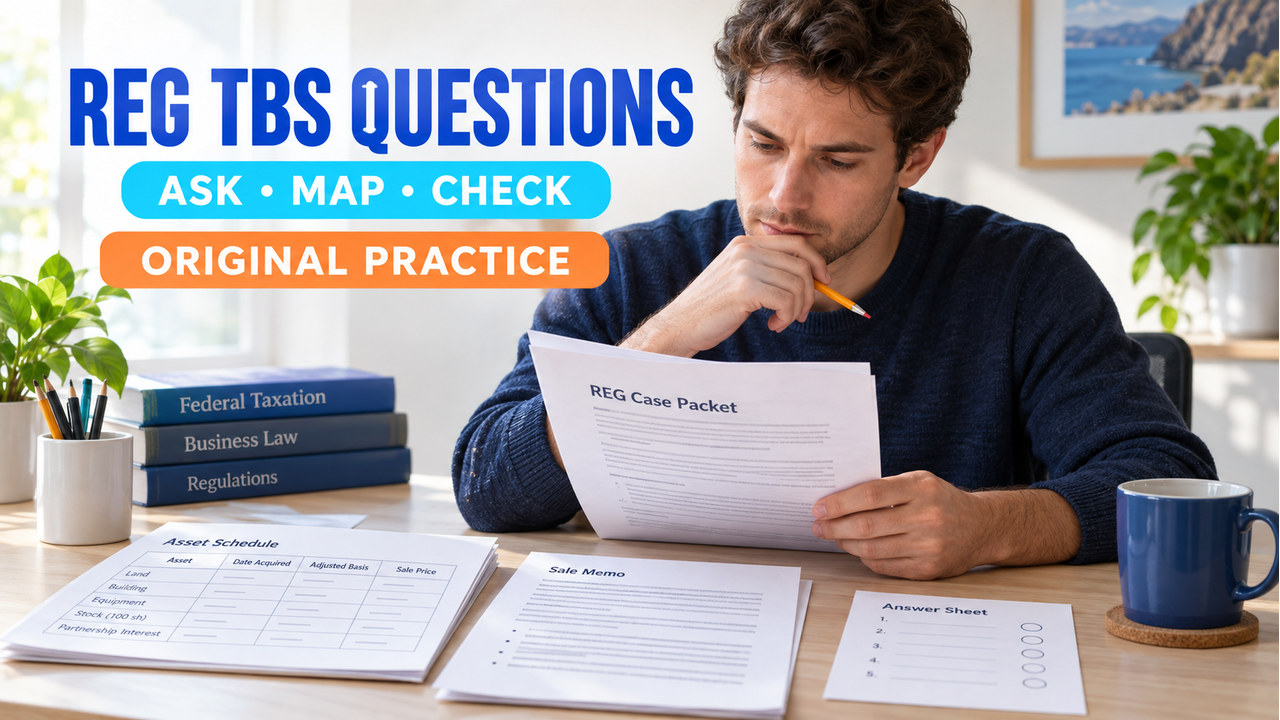

Quick answer: The best cpa tbs questions practice starts with the answer cell. Ask what the cell requests, map the exhibit that can prove it, calculate only from the supplied assumptions, choose the narrow response, and check the result against the case. The original REG case below gives five delayed-reveal cells and a changed-fact retry. It is original editorial practice, not an exam-content release.
Currently, the AICPA Blueprint describes five testlets for each section: the first two are multiple-choice and the next three contain TBSs. Its current page lists section-level TBS distributions, including REG. Those labels can change, so reopen the live Blueprint for your testing window. Also, the AICPA reports a 0–99 scaled score rather than a percentage-correct result; the five-cell record is only a study aid.
For a broader preparation path, continue with our CPA Exam Study Guide.
Why cpa tbs questions Need a Question-First Method
First, a task-based simulation can contain a prompt, exhibits, calculations, and multiple response fields. Instead, shrink the task to one deliverable at a time. A number, selection, journal entry, or short conclusion should each have a controlling fact.
Read the requested cpa tbs questions output before the exhibits
First, name the response form: dollar amount, option, account treatment, or conclusion. Also, write the cutoff, unit, sign, or rounding instruction. Consequently, a correct formula can land in the wrong answer box. As a result, you can open each exhibit instead of reading every line equally.
Map cpa tbs questions evidence instead of guessing from realistic detail
Next, assign each exhibit a job. An asset schedule may control recorded basis and depreciation in a bounded case; a sale memo may control proceeds and selling costs; close instructions may limit which outside assumptions are allowed. However, a realistic name or extra narrative does not change the requested calculation. Keep a short evidence map: cell, controlling exhibit, fact, and operation.
Freeze cpa tbs questions assumptions before you calculate
Therefore, separate case assumptions from outside rules. In this case, the exercise supplies the amounts and tells you to use only those facts. Do not add a current-law classification, form treatment, or holding-period conclusion that the question did not request. As a result, the practice measures evidence control and calculation discipline, not memory of an unstated rule.
The Five-Step cpa tbs questions Method
1. ASK: what must this cell return?
First, define the deliverable. For example, “adjusted basis in whole dollars” is narrower than “explain the tax result.” Note whether the answer is a positive amount, decrease, choice, or supported conclusion. Therefore, this line controls scope.
2. MAP: which exhibit can prove it?
Specifically, find the facts that control the cell, and record their exhibit names. In case documents conflict, pause before calculating and reread instructions. Distinguish an evidence source from a calculation step: the memo may supply the proceeds, while your worksheet derives the amount realized.
3. CALCULATE: use only the supplied inputs
Next, show the formula with signs before entering the result. Next, keep basis, proceeds, costs, and the final comparison on separate lines. Above all, do not invent a fact merely to make the case look complete. For this reason, an explicit, clean narrow calculation is better than an unsupported broad answer.
4. CHOOSE: match the result to the response field
Then, compare your result with every option, not only the option that feels familiar. For example, a distractor may use gross proceeds instead of amount realized, subtract depreciation in the wrong direction, or apply a second adjustment that the case already included. Explain the wrong path in one sentence before moving on.
5. CHECK: verify the conclusion and the unit
Finally, re-read the cell, assumptions, signs, and units. Then state the narrow conclusion supported by the case. If the answer changes when one fact changes, identify the formula line that moved; if it does not change, say why. This gives your review log a useful error location.

Original REG cpa tbs questions Simulation
First, attempt each cell before opening its reveal. In practice, this original editorial exercise tests evidence mapping and arithmetic. It does not reproduce an AICPA item and does not predict readiness.
Tested skill, assumptions, and difficulty for cpa tbs questions
Tested skill: connect supplied asset, improvement, depreciation, sale, and closing facts to adjusted basis, amount realized, and gain. Assumptions: all amounts are whole dollars; use only the facts below; the case treats the $4,000 improvement as an addition to basis and the $12,000 depreciation amount as a reduction already specified for this drill; treat selling costs as reducing amount realized; do not add a separate holding-period, character, form, or current-law conclusion. Difficulty: foundational REG evidence mapping and numeric calculation.
Exhibit A — Asset schedule
Redwood & Pine Design LLC acquired the asset with an original tax basis of $36,000. The schedule lists $12,000 of depreciation allowed in this exercise. No other basis adjustment is listed in Exhibit A.
Exhibit B — Improvement memo
A memo dated before the sale lists one capital improvement of $4,000. The close instructions say to add this supplied amount to basis for the exercise. Do not infer any other improvement from the memo’s narrative.
Exhibit C — Sale memo
The sale memo lists gross proceeds of $31,500 and selling costs of $1,500. The case asks you to calculate the amount realized from these supplied figures.
Exhibit D — Close instructions
In short, use stated facts only, show whole dollars, and answer the cells in order. The question asks for a narrow calculation and conclusion under the case assumptions. It does not ask you to supply an external tax classification.
Answer cell 1: Which evidence controls adjusted basis?
Original practice item: Select the pair that controls the basis calculation under the supplied facts.
- Exhibit A asset schedule and Exhibit B improvement memo
- Exhibit C sale memo and a buyer’s unstated valuation
- Exhibit D close instructions and an outside holding-period rule
- Exhibit C sale memo and the AICPA Blueprint
Reveal the answer and reasoning
Answer: A. Exhibit A supplies the original basis and depreciation amount, while Exhibit B supplies the improvement. Exhibit D limits how to use those facts, but it does not add a new dollar amount. The other choices introduce an unstated valuation, an outside rule, or a source that does not control the case calculation. Next action: write “cell → exhibit → fact” for the next four cells before doing arithmetic.
Answer cell 2: What is adjusted basis?
Original practice item: Calculate the adjusted basis using the exact amounts supplied in Exhibits A and B.
- $24,000
- $28,000
- $32,000
- $40,000
Reveal the answer and reasoning
Answer: B. Start with $36,000, add the $4,000 improvement, and subtract the stated $12,000 depreciation: $36,000 + $4,000 − $12,000 = $28,000. Option A subtracts the improvement instead of adding it; C omits depreciation; D adds depreciation rather than treating it as a reduction. Next action: rewrite the basis formula with a sign beside every input, then compare it with Exhibit A and B.
Answer cell 3: What is the amount realized?
Original practice item: Calculate the amount realized from the gross proceeds and selling costs in Exhibit C.
- $29,000
- $30,000
- $31,500
- $33,000
Reveal the answer and reasoning
Answer: B. Under the case instruction, subtract selling costs from gross proceeds: $31,500 − $1,500 = $30,000. Option C uses gross proceeds without the supplied cost; A subtracts the cost twice; D adds it. Next action: circle the formula line affected by each cost before you review any gain option.
Answer cell 4: What gain is supported?
Original practice item: Compare amount realized with adjusted basis under the stated assumptions.
- $1,000
- $2,000
- $3,500
- $58,000
Reveal the answer and reasoning
Answer: B. The case result is $30,000 − $28,000 = $2,000. Option A uses the altered selling-cost fact from the later retry; C compares gross proceeds with adjusted basis; D adds the two results instead of comparing them. Next action: check that the gain cell uses the result of cells 2 and 3, not a raw exhibit amount.
Answer cell 5: Which cpa tbs questions conclusion is supported?
Original practice item: Select the narrow conclusion that follows from the case file.
- Under the supplied assumptions, adjusted basis is $28,000, amount realized is $30,000, and the resulting gain is $2,000.
- The case proves the taxpayer’s complete current-law tax treatment.
- Because the sale memo lists $31,500, selling costs never affect amount realized.
- The improvement must be subtracted because it occurred before the sale.
Reveal the answer and reasoning
Answer: A. It states the three values and keeps the conclusion inside the supplied assumptions. The other options overclaim beyond the question or reverse the stated operations. Therefore, a tied calculation is evidence that this case was solved consistently, not a general tax opinion. Next action: write the scope phrase “under the supplied assumptions” beside your final review note.

Review cpa tbs questions by Error Type
Afterward, record the first place your work diverged. A wrong final gain can come from a task-reading error, an evidence error, a sign error, or a conclusion that went beyond the prompt. Classify the earliest gap as task when you misread the deliverable, evidence when you chose the wrong exhibit, calculation when the operation or sign failed, choice when you selected a distractor despite a correct result, or completion when you left a cell or assumption unchecked.
If the error was evidence mapping
Reopen the four exhibits without recomputing. For each answer cell, name the controlling document, the fact it supplies, and the operation you will perform. In this case, the asset schedule and improvement memo control basis, while the sale memo controls proceeds and selling costs. Therefore, a wrong map will not be repaired by more arithmetic.
If the error was calculation or choice
First, write the three lines separately: $36,000 + $4,000 − $12,000 = $28,000; $31,500 − $1,500 = $30,000; and $30,000 − $28,000 = $2,000. Then explain which distractor used a raw exhibit amount, a reversed sign, or a changed fact. This turns “I got it wrong” into one reviewable operation.
If the error was scope or completion
Underline the assumptions and reread the requested conclusion. Do not add a current-law claim that the case did not ask for. Finally, verify that every answer cell has a response and that every reveal was opened only after your attempt. The goal is a reliable process, not a decorative percentage.
Transfer cpa tbs questions to a Changed Fact
Meanwhile, keep the skill fixed and change one fact. Suppose Exhibit C changes the selling costs from $1,500 to $2,500, while original basis, improvement, depreciation, and gross proceeds remain unchanged. Adjusted basis stays at $28,000 because no basis input changed. Amount realized becomes $31,500 − $2,500 = $29,000, and the gain becomes $29,000 − $28,000 = $1,000.
Repair the cpa tbs questions changed-fact path
First, name the changed exhibit and formula line. Next, keep cells 1 and 2 fixed because their evidence and amounts did not change. Then revise cell 3, carry its new result into cell 4, and restate the narrow conclusion in cell 5. The distractor to avoid is changing adjusted basis merely because the sale cost changed. Therefore, your review action is a fresh amount-realized and gain calculation, not a full restart of the basis schedule.
FAQ for cpa tbs questions
What are cpa tbs questions?
In practice, case-based task questions ask you to use a requirement, exhibits, calculations, selections, or written reasoning. Useful practice makes the requested cell and the controlling evidence explicit.
How should I start a cpa tbs questions practice set?
First, define the deliverable, response format, cutoff or unit, and supplied assumptions. Then map each exhibit to the cell it can prove before you calculate.
Are these questions from the AICPA?
No. The Redwood & Pine case, facts, amounts, choices, explanations, and changed-fact retry are original editorial practice. No official item is reproduced; instead, use AICPA materials for sample-test and Blueprint information.
Should my five-cell result be treated as a CPA score?
No. The AICPA describes a reported scaled score on a 0–99 scale rather than a percentage correct. Use the result to identify the next review action, not to predict readiness.
Where should I check administration or eligibility details?
Use the AICPA FAQ and NASBA, or the applicable state Board, for current eligibility, applications, fees, accommodations, scheduling, and licensing. Those process details are separate from this original REG calculation drill.
Sources and Refresh Note for cpa tbs questions
Blueprint and current TBS structure: AICPA CPA Exam Blueprints. Software-familiarity boundary: AICPA sample tests. Score boundary: AICPA scoring and pass rates. Candidate FAQ: AICPA CPA Exam FAQ. Candidate process: NASBA CPA Exam. Checked September 17, 2026. The ASK → MAP → CALCULATE → CHOOSE → CHECK method, Redwood & Pine case, exhibits, values, answer cells, rationales, and changed-cost retry are original editorial study content. Reopen official pages and refresh the workbook’s Semrush US fields before any human publication decision.