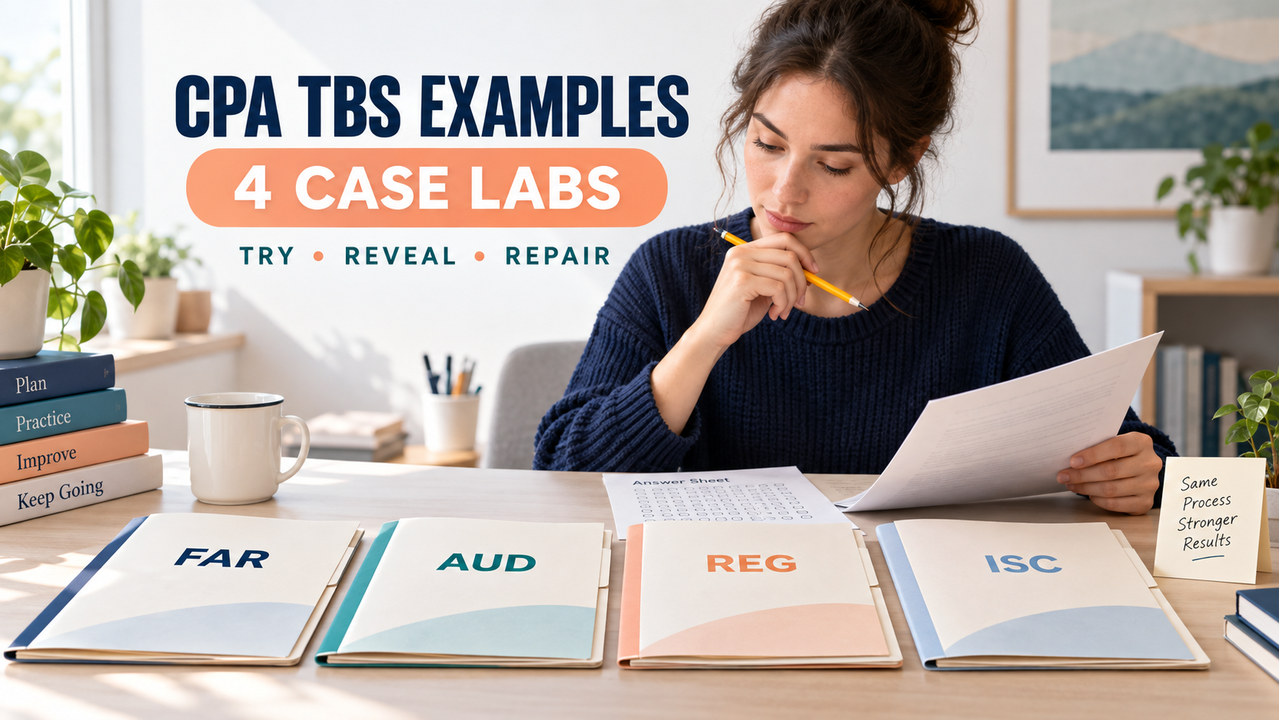

Quick answer: Useful cpa tbs examples do more than show a final choice. They name the deliverable, point to the controlling exhibit or system record, make the answer path visible, explain the closest distractor, and give you a next retry. The four original case labs below cover FAR, AUD, REG, and ISC without presenting any item as released exam content.
Currently, the AICPA Blueprint and sample-test resources are the right places to confirm current section scope, task statements, item types, and interface behavior. In addition, use this page for original editorial practice. Then, keep the attempt record separate from the AICPA’s reported scaled score; in other words, four correct cells are useful feedback, not a percentage or readiness claim.
For a broader preparation path, continue with our CPA Exam Study Guide.
Why cpa tbs examples Need an Evidence Path
First, a TBS can feel like one large packet even when each response field asks for a narrow decision. Therefore, start by shrinking the case to one deliverable. Is the cell asking for a classification, a number, evidence of a control, or a short conclusion? For that reason, the requested output determines which facts deserve your attention.
Read the requested cpa tbs examples output first
Next, copy the response form in your own words. For example, “current principal due within twelve months” is narrower than “classify the note.” Likewise, “evidence that access was removed on time” is different from “prove the system is secure.” As a result, a precise output line prevents a plausible but unsupported answer.
Separate a controlling fact from realistic background
However, realistic names, dates, and extra descriptions can pull your attention away from the controlling fact. For this reason, map each exhibit to one job: supply a number, establish a date, document an approval, or show a system event. At the same time, ignore detail that cannot change the requested response.
Keep the four cpa tbs examples original and bounded
These case labs are original editorial exercises with stated assumptions. They are not a substitute for the current AICPA Blueprint, official sample software, or jurisdiction-specific process guidance. Instead, use them to rehearse the decision path, and reopen the official pages whenever section labels or exam instructions change.
The anatomy of cpa tbs examples
Before you open a reveal, run the LAB loop: Locate the deliverable, Anchor it to evidence, Build the narrow answer, and Label the first gap. This simple sequence keeps the worked explanation useful because you can compare your first path with the controlling path.
1. Locate the deliverable
First, underline the requested output and unit. A dollar amount, a current portion, a control test, and a conclusion each require different evidence. In addition, note whether the case supplies a special assumption before you calculate or choose. If the prompt says to use only the listed facts, do not import an unstated rule to make the story feel complete.
2. Anchor the answer to evidence
Next, name the exhibit or record that can prove the response. For example, a general ledger may supply a balance, while a repayment schedule supplies timing. Similarly, a count sheet may support what was observed, while a receiving log may explain cutoff. Meanwhile, an access ticket and a system log together can test whether a removal happened within the stated window.
3. Build the smallest defensible answer
Then, write the formula, comparison, or evidence conclusion before you select an option. After that, show signs and units for calculations. For control questions, state the population, event, timestamp, and expected condition. As a result, your answer remains reviewable even when a distractor uses a true but non-controlling fact.
4. Label the first gap
Finally, classify the earliest divergence as scope, evidence, calculation, choice, or transfer. Do not wait until the final answer to diagnose the miss. For example, if you chose the wrong exhibit, more arithmetic will not fix the attempt; if you mapped the evidence correctly but reversed a sign, a targeted calculation retry is enough.

Four original cpa tbs examples to attempt
First, set aside notes and attempt each case before opening its reveal. Before you begin, remember that every case below states the tested skill, assumptions, and difficulty. In addition, use the rationale to learn a method rather than memorize the result; the numbers and facts are original editorial practice.
Example 1 — FAR: classify the note without losing the time horizon
Tested skill: separate the principal due within the next twelve months from the remaining balance. Assumptions: the note has a total principal of $80,000; the repayment schedule shows $18,000 due in the next twelve months; no refinancing or unusual covenant fact is supplied. Difficulty: foundational classification.
Prompt: Which amount belongs in the current portion for this original FAR practice case?
- A. $18,000
- B. $62,000
- C. $80,000
- D. $98,000
Reveal the answer and reasoning
Answer: A, $18,000. The requested output is the principal due within the next twelve months, so the repayment schedule controls the answer. The remaining $62,000 is the supplied long-term balance for this bounded exercise. The closest distractor is $80,000 because it is the total note, but total principal does not answer a current-portion question. Next action: write “time horizon first” beside the case and retry with a different payment schedule.
Example 2 — AUD: choose evidence that supports inventory existence
Tested skill: match the assertion to evidence that can show goods were physically present at the count date. Assumptions: the original count sheet lists 420 units; the perpetual record lists 500; a receiving log shows 80 units arrived after the count. The case asks which evidence best supports existence at the count date. Difficulty: foundational evidence mapping.
Prompt: Which evidence should anchor the existence conclusion?
- A. The observed count sheet tied to the floor-to-sheet item records
- B. A vendor invoice created after the count
- C. The perpetual record without investigating the timing difference
- D. A manager’s statement that inventory is complete
Reveal the answer and reasoning
Answer: A. The observed count sheet is closest to the requested assertion because it records what was present and counted at the relevant date. The receiving log helps explain why the perpetual record is 80 units higher, but it does not replace the observation. The distractors are either later, uncorroborated, or incomplete. Next action: label the count sheet as the primary evidence, then trace the 80-unit timing difference as a separate cutoff question.
Example 3 — REG: calculate a narrow gain from supplied facts
Tested skill: calculate gain using supplied proceeds, selling costs, and adjusted basis. Assumptions: gross proceeds are $55,000; selling costs are $2,000; the case supplies an adjusted basis of $42,000; use only these figures and report whole dollars. Difficulty: foundational calculation.
Prompt: What gain is supported by this original REG practice case?
- A. $11,000
- B. $13,000
- C. $15,000
- D. $97,000
Reveal the answer and reasoning
Answer: A, $11,000. First calculate amount realized: $55,000 − $2,000 = $53,000. Next compare it with the supplied basis: $53,000 − $42,000 = $11,000. The $13,000 distractor subtracts basis from gross proceeds and ignores selling costs; $15,000 reverses the cost direction; $97,000 adds the inputs. Next action: write the two-line calculation before selecting an answer on the next gain case.
Example 4 — ISC: test timely logical-access removal
Tested skill: select evidence that can test whether access was removed within the required window. Assumptions: the control requires termination access to be disabled within one hour of an approved ticket; the ticket was approved at 10:00 a.m.; the system access log records disablement at 10:42 a.m.; the manager’s email only says “handled.” Difficulty: foundational control testing.
Prompt: Which evidence pair best supports a conclusion about timely removal?
- A. The approved termination ticket and the timestamped system access log
- B. The manager’s email and the employee directory
- C. A policy document without a user event
- D. A later access review with no termination timestamp
Reveal the answer and reasoning
Answer: A. The ticket establishes the starting event and approval time; the system log supplies the actual disablement time. Together they permit a 42-minute comparison with the one-hour requirement. The other choices may provide context, but none proves both the expected event and the actual timestamp. Next action: practice stating control tests as “expected condition + event evidence + time comparison.”

Review your four cpa tbs examples
Afterward, record more than right or wrong. For each case, save your first answer, confidence before the reveal, controlling evidence, closest distractor, and earliest gap. For this reason, a correct answer with weak evidence deserves a different review block from an incorrect answer caused by a sign error. In addition, note whether the gap appeared before or after the reveal.
Use the first gap to choose the next block
With a scope gap, rewrite the requested output in one line. For an evidence gap, remap the exhibit or system record without recalculating. When the gap is calculation, show signs, units, and intermediate values. If the gap is choice, explain why the nearest distractor fails. Finally, for a transfer gap, change one fact and rerun the same reasoning path.
Transfer cpa tbs examples to a changed fact
Meanwhile, choose the case that exposed your earliest gap and change exactly one material input. For the FAR case, change the next-twelve-month principal from $18,000 to $24,000 while keeping total principal at $80,000. Therefore, the current portion becomes $24,000 and the remaining balance becomes $56,000; the time-horizon method stays fixed.
Keep the evidence path stable while one answer moves
Next, choose a changed fact that should move one answer line. For AUD, you could change the receiving-log timing and ask whether the same count sheet still anchors existence. With REG, changing selling costs from $2,000 to $3,500 changes amount realized to $51,500 and gain to $9,500, while supplied basis remains $42,000. For ISC, move the disablement timestamp past the one-hour window and state that the evidence now indicates an exception to investigate.
The purpose is not to create a larger story. Rather, explain which exhibit, formula line, or control comparison moved and which facts stayed fixed. As a result, you can recognize transfer skill instead of remembering four isolated answers.
FAQ for cpa tbs examples
What makes a useful CPA TBS example?
A useful example states the skill, assumptions, difficulty, requested output, controlling evidence, answer logic, closest distractor, and next action. A final choice without that path is not enough for targeted review. For example, record the controlling evidence before judging whether the answer was right.
Are these four case labs official exam items?
No. The FAR, AUD, REG, and ISC facts, choices, explanations, and changed-fact paths are original editorial practice. Use the current AICPA Blueprint for official scope and the AICPA sample tests for interface familiarity.
Should I treat four correct answers as a CPA score?
No. The attempt record is a study signal. It helps you choose a review action, but it does not convert to the AICPA’s reported scaled score or establish readiness.
Where should I verify current section and process details?
Use the current AICPA Blueprint for scope and task statements, the AICPA FAQ for general candidate questions, and NASBA or the applicable state Board for eligibility, applications, accommodations, scheduling, and licensing. Reopen those pages when the testing window or jurisdiction changes.
Sources and Refresh Note for cpa tbs examples
Current scope and task statements: AICPA CPA Exam Blueprints. Interface familiarity: AICPA sample tests. Score boundary: AICPA scoring and pass rates. Candidate FAQ: AICPA CPA Exam FAQ. Candidate process: NASBA CPA Exam. Checked September 17, 2026. The LAB loop, four case labs, facts, choices, rationales, distractor notes, and changed-fact retry are original editorial study content. Reopen live official pages and refresh the workbook’s Semrush US fields before publication.