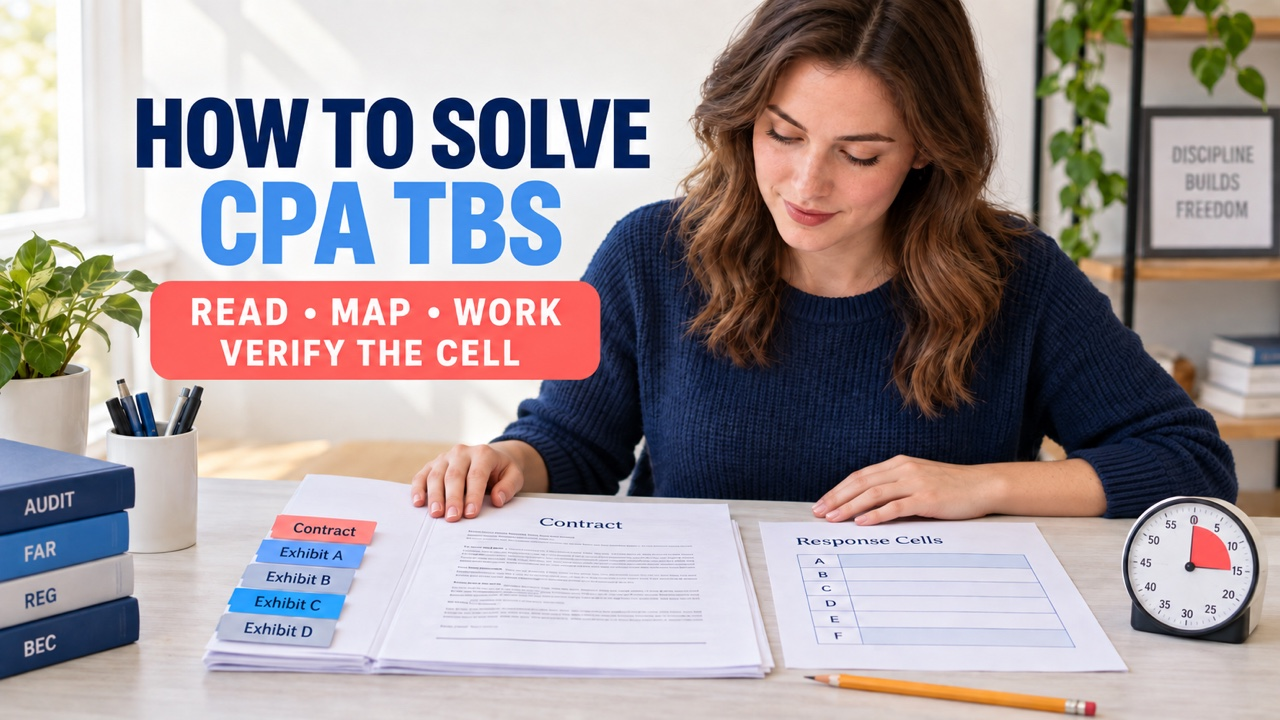

Quick answer: To learn how to solve cpa tbs questions, do not begin by hunting for a familiar keyword in the exhibits. Begin with the requested response cell. Then map each record to its job, mark the facts that actually control the answer, write the smallest defensible calculation or decision, and verify the unit before reviewing the first gap. This method keeps a long packet from becoming a memory test.
A TBS can feel difficult because the page gives you more context than the response cell needs. The solution is not to ignore the exhibits or read every line with equal weight. Instead, create a short evidence path that another learner could audit. The original Cedar Ridge case below uses a service contract, invoice, service log, and cutoff instructions; every amount and assumption is stated inside the case.
For broader planning, continue with our CPA Exam Study Guide. Use the current AICPA Blueprint for live section labels and task statements, and keep this page’s practice facts separate from official candidate administration.
How to solve cpa tbs when tasks look long
A solvable task has three layers. First, the response cell tells you the output: a number, selection, classification, entry, or short explanation. Next, the exhibits supply evidence, but each exhibit may serve a different purpose. Finally, the instructions define the assumptions, date, unit, or scope. Your first job is to keep those layers separate.
How to solve cpa tbs
How to solve cpa tbs: read the cell
First, underline the action word and the unit. “Compute monthly revenue” is not the same as “identify the controlling document.” Likewise, “select the cutoff evidence” is not the same as “explain the entire engagement.” When the output is narrow, the answer path should be narrow too. Therefore, write a one-line target before scanning the packet.
How to solve cpa tbs: map exhibits
Next, give every exhibit a job. A contract may control the term and start date. An invoice may show billing or cash movement without proving service delivery. A service log may establish what happened by period end. A cutoff instruction may limit the date or facts you may use. If two records disagree, flag the conflict instead of silently choosing the convenient number.
How to solve cpa tbs: practice feedback
Meanwhile, current AICPA resources define tested scope and live exam boundaries. Also, a practice set can reveal whether your evidence path is complete, but it cannot create a reported score or readiness decision. That distinction matters because the official scoring model is scaled and weighted; a correct count in a small editorial lab is not a percentage conversion.
How to solve cpa tbs questions step by step
First, use the five-part loop below. It works for a calculation, cutoff decision, classification, or response with linked cells. Start the timer only after you understand the deliverable; speed without scope control makes an early mistake harder to find.

1. READ: name the exact deliverable
First, rewrite the cell as a sentence with a unit. For example, “Find the monthly earned amount through June 30 in whole dollars” tells you more than a vague note to “solve the revenue issue.” Also record whether the cell wants one answer, multiple selections, or a short explanation. As a result, you avoid solving a neighboring question that the packet never asked.
2. MAP: assign each exhibit one job
Next, make a quick map such as contract → term, invoice → billed amount, service log → delivery through date, and instructions → allowed assumptions. Do not treat the longest exhibit as the most important one. The controlling record is the one that supports the requested line under the stated instructions.
3. MARK: circle decisive facts and freeze the boundary
First, mark dates, amounts, units, and words such as “through,” “only,” “before,” or “after.” Then list what the case does not say. If the prompt gives a 12-month term and a $24,000 fee, use those facts; do not invent a tax rule, acceleration clause, or customer dispute. If a fact changes later, change only that fact in the retry.
4. WORK: show the smallest defensible line
Next, write the formula or decision rule before looking at the choices. Keep signs and units visible. For example, show a monthly rate as fee divided by months and remaining liability as billed amount less the portion earned under the case assumptions. For a qualitative cell, write “record + decisive fact + requested conclusion.” Small visible lines make distractors easier to reject.
5. VERIFY: check output, evidence, and next action
Finally, read the response cell again. Confirm that the unit matches, the controlling exhibit is named, and the arithmetic uses only allowed facts. Then compare your answer with the closest distractor and write why it fails. If you missed, label the first divergence as scope, evidence, calculation, choice, or transfer. That label becomes your next review block.
Original Cedar Ridge TBS walkthrough
This is original editorial practice, not an official exam question or score. Cedar Ridge Learning LLC signs a 12-month service contract for $24,000. First, service runs from April 1 through the following March 31. Next, the customer is billed on April 1. Then, the service log confirms delivery for April through June. Finally, cutoff instructions limit the packet to whole-dollar service delivered by June 30.
Therefore, the packet contains four records: Service Contract for term and start date, Invoice for the $24,000 billed amount, Service Log for the three delivered months, and Cutoff Instructions for the period-end boundary. Attempt each cell before opening its reveal.

Question 1 — Identify the controlling start-date evidence
Tested skill: choose the record that controls when the service period begins. Difficulty: foundational evidence selection. Original practice: yes.
Prompt: Which record should control the start date for this bounded calculation?
- A. Service Contract
- B. Invoice only
- C. Service Log only
- D. Cutoff Instructions only
Reveal answer 1 and reasoning
Answer: A, Service Contract. First, the contract sets the service term and April 1 start date. Next, the invoice confirms billing, the log confirms delivery through June 30, and cutoff instructions define the reporting boundary. Finally, the distractor asks which record owns the start-date fact; the other records still matter. Next action: write “contract → term/start” beside the first cell.
Question 2 — Compute the monthly rate
Tested skill: divide a stated contract fee by the stated number of service months. Difficulty: foundational calculation. Original practice: yes.
Prompt: What monthly amount does this case use for the service period?
- A. $1,000
- B. $2,000
- C. $12,000
- D. $24,000
Reveal answer 2 and reasoning
Answer: B, $2,000. Under the case instructions, divide the $24,000 fee by 12 months: $24,000 ÷ 12 = $2,000 per month. The $1,000 choice divides by 24. The $12,000 choice divides by two, and the $24,000 choice never converts the annual contract into a monthly unit. Next action: write the unit next to every intermediate result.
Question 3 — Select the period-end delivery evidence
Tested skill: match the cutoff question to the record that proves service delivered by the stated date. Difficulty: foundational evidence selection. Original practice: yes.
Prompt: Which record should you use to confirm that three service months were delivered by June 30?
- A. Invoice
- B. Service Contract
- C. Service Log
- D. A future renewal quote
Reveal answer 3 and reasoning
Answer: C, Service Log. First, the service log records delivery through the cutoff date. However, the contract establishes the promised period and the invoice establishes billing; neither alone proves three months by June 30. Finally, the future renewal quote falls outside the packet boundary. Next action: label the evidence path “service log → delivered months.”
Question 4 — Compute earned revenue and the remaining liability
Tested skill: link the monthly rate and delivered-month count to two outputs. Difficulty: foundational linked calculation. Original practice: yes.
Prompt: Under the stated assumptions, what earned amount and remaining contract liability should the case show at June 30?
- A. Earned $6,000; remaining liability $18,000
- B. Earned $18,000; remaining liability $6,000
- C. Earned $2,000; remaining liability $22,000
- D. Earned $24,000; remaining liability $0
Reveal answer 4 and reasoning
Answer: A. Three delivered months at $2,000 each produce $2,000 × 3 = $6,000 earned under this case. The remaining portion is $24,000 − $6,000 = $18,000. However, Choice B reverses delivered and undelivered months. In addition, Choice C recognizes only one month. Finally, Choice D recognizes the whole billed amount without respecting the cutoff. Next action: keep “delivered” and “remaining” on separate lines before selecting.
Question 5 — Trace a changed start date
Tested skill: transfer the method when one material fact changes. Difficulty: foundational transfer. Original practice: yes.
Prompt: If the Service Contract start date changes from April 1 to May 1, while the $24,000 fee and 12-month term remain fixed, what should the case show through June 30?
- A. Earned $2,000; remaining liability $22,000
- B. Earned $4,000; remaining liability $20,000
- C. Earned $6,000; remaining liability $18,000
- D. Earned $24,000; remaining liability $0
Reveal answer 5 and reasoning
Answer: B. A May 1 start leaves two delivered months through June 30. The monthly rate stays $24,000 ÷ 12 = $2,000, so earned revenue is $2,000 × 2 = $4,000 and the remaining liability is $24,000 − $4,000 = $20,000. The fee does not change because the changed fact is the start date. Next action: identify which evidence line changed, then recompute only the linked outputs.
Turn the cpa tbs attempt into a study action
Therefore, a final answer is useful only when it tells you what to do next. Record the response cell, your first answer, confidence before reveal, controlling record, decisive fact, work line, nearest distractor, and first divergence. A correct number with no evidence path is not the same as a correct number supported by the right record.
How to solve cpa tbs errors
First, a scope gap means you solved the wrong deliverable. Next, an evidence gap means you used the wrong record or missed a conflict. Then, a calculation gap means the facts were right but the sign, unit, or sequence was wrong. Also, a choice gap means you never tested the closest distractor. Finally, a transfer gap means the original answer was memorized but the changed fact broke the chain. Choose the shortest review block that repairs the first gap.
For example, if Question 4 was wrong because you counted billed dollars rather than delivered months, review the cutoff evidence and redo the two linked lines. Do not immediately repeat the entire packet. If the first gap was evidence, remap the records without doing arithmetic. If it was transfer, change one date or amount and predict the direction before calculating.
Retry the first wrong step
Run the changed-start-date retry now. Keep the fee, term, and reporting date fixed; change only April 1 to May 1. The expected study result is earned revenue of $4,000 and a remaining liability of $20,000. Your written explanation should say why the contract controls the changed date, why the monthly rate stays fixed, and why only the delivered-month count and linked balances move.
Retry the first wrong step
FAQ for how to solve cpa tbs
Should I read every exhibit from top to bottom?
Instead, name the response cell first. Then scan each exhibit for the fact it can prove. Return to the full text when a date, assumption, or conflict needs confirmation.
What if two exhibits appear to support different answers?
Also, write each exhibit’s job and check the instructions, date, and unit. Do not average conflicting facts or choose the number that makes the arithmetic easiest. If the packet does not resolve the conflict, flag it as a scope or evidence gap.
Can this method predict my CPA Exam score?
No. Instead, use how to solve cpa tbs as a review method. This article’s questions and study record are original practice. The AICPA explains that reported scores are scaled and weighted rather than simple percentage-correct conversions. Therefore, use the record to choose your next study block, not to forecast a result.
Where should I check current CPA Exam details?
For current details, use the AICPA Blueprint for tested content and the AICPA sample-test resource for software familiarity. Use NASBA and the applicable state Board for eligibility, scheduling, and licensing questions. Reopen those sources when guidance or your jurisdiction changes.
Sources and refresh note for how to solve cpa tbs
Current scope and task statements: AICPA CPA Exam Blueprints. Software familiarity: AICPA sample tests. Score boundary: AICPA scoring and pass rates. Candidate process: NASBA CPA Exam. Checked September 17, 2026. The READ → MAP → MARK → WORK → VERIFY method, Cedar Ridge facts, questions, choices, rationales, study record, and retry are original editorial content. Reopen live official pages and refresh the workbook’s Semrush US fields before publication.