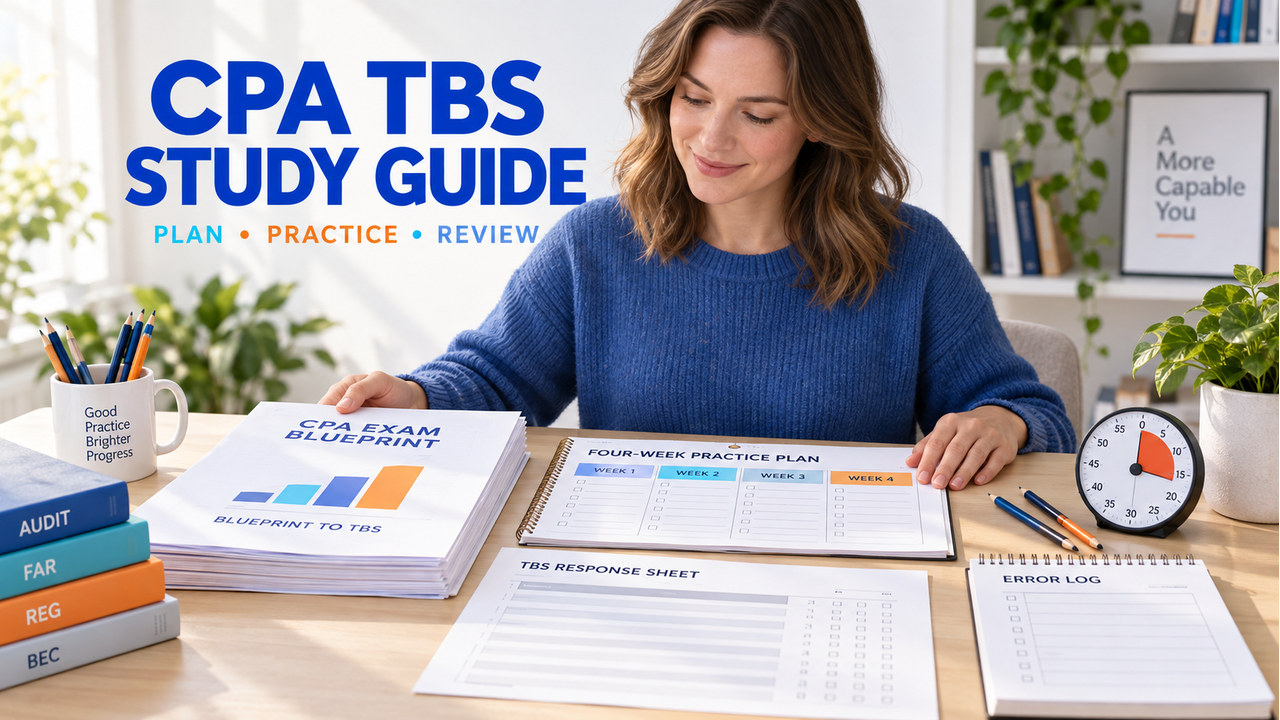

Quick answer: A useful cpa tbs study guide is a four-week loop, not a pile of random simulations. During week one, choose one current Blueprint task and define the skill. Next, in week two, solve an original case without rushing. In week three, add a time boundary and record the evidence path. Finally, in week four, change one fact, retry the linked work, and schedule the next review block from your first error.
That order matters because a long TBS can test several actions at once: reading the deliverable, locating evidence, choosing a unit, calculating, and explaining. Therefore, your study plan should produce a visible artifact after each session. In practice, the goal is not to feel busy; it is to make the next attempt more precise.
Use the current CPA Exam Study Guide for broader planning, and use the live AICPA Blueprint for current section labels and task statements. The case below is original practice. It is not an official question, a memory-based reconstruction, or a readiness score.
What to put in a cpa tbs study guide
A strong guide connects four layers. First, the Blueprint gives you a current topic, task statement, and skill level to investigate. Next, a practice case gives you a defined output and a small exhibit set. Then, your record shows the evidence and work behind the answer. Finally, the retry changes one fact so you can test whether the method transfers.
Start your cpa tbs study guide with one Blueprint task
Open the current AICPA Blueprint for the section you are studying. Next, pick one task statement, copy its action into your study header, and write the unit you expect to produce. For example, “compute ending inventory in whole dollars” creates a better target than “practice FAR TBSs.” Also note the topic and skill level, but do not treat a neighboring section’s label or count as permanent.
Use your cpa tbs study guide to give each exhibit a job
Next, prepare a short evidence map. For example, a purchase record may establish price and units. Similarly, a freight bill may affect the cost assumption. A count sheet may establish what remains. Meanwhile, a sales log may establish units sold and selling price. A storage invoice may be relevant to the case but not to the requested inventory-cost line. Writing each job prevents the longest document from taking over your reasoning.
Keep cpa tbs study guide feedback separate from official scoring
The AICPA explains that its sample test is for format and software familiarity, not a complete section or readiness determination. Likewise, this guide’s record is a diagnostic. Reported CPA Exam scores use a scaled, weighted model and are not simple percentage-correct conversions. Therefore, use your practice result to choose a review block, not to predict a score.
Build a four-week cpa tbs study guide
The path below gives every week one deliverable. Meanwhile, keep the routine flexible for your section, work schedule, and jurisdiction. These numbers are planning recommendations, not official timing rules. For that reason, begin with one focused skill; add breadth only after your error log shows that the first skill is stable.

Week 1 — MAP: set your cpa tbs study guide target
First, choose one section and one current task statement. Next, write the action, topic, assumed output, and two questions you expect the exhibits to answer. Then create a one-page map with four boxes: requested cell, controlling record, decisive fact, and unit. If you cannot fill those boxes, your target is still too broad. Therefore, the week-one output is a scoped practice card, not a completed score.
Week 2 — BUILD: solve an original case untimed
Next, work one bounded case from start to finish without opening the rationale early. First, read the response cell. Then mark dates, quantities, signs, and units. After that, map the records and show the shortest defensible line. Finally, write why the closest distractor fails. An untimed first pass is useful because it separates a knowledge gap from a reading or evidence-control gap.
Week 3 — TIME: add a calm response boundary
Once the evidence path is familiar, add a reasonable time boundary for your study block. Then start the timer after you have read the deliverable, not before. When time ends, stop and label the unfinished line. Also record whether the lost time came from rereading, searching, arithmetic, or explanation. As a result, the diagnosis is more useful than simply writing “too slow.”
Week 4 — RETRY: change one material fact
Finally, change one fact while keeping the rest of the case fixed. Before calculating, predict which output should move. Then compare the new answer with the original and name the controlling record. If only the answer changed but your evidence map did not, your transfer check is incomplete. Therefore, the week-four output is a retry note plus a next-session target.
Original Northline TBS study lab
This is original editorial practice, not an official CPA Exam item. Northline Outdoor Supply buys 100 insulated packs at $40 each. Next, a freight-in bill adds $400. Before the count date, a return memo gives full cost credit for 25 packs. The count sheet shows 45 packs on hand. A sales log shows the remaining packs sold for $85 each. A separate warehouse invoice lists $300 of storage; under this case’s stated assumption, treat storage as a period expense rather than part of the inventory cost.
Use these assumptions only: the freight bill belongs to the 100 purchased packs; the return receives a full cost credit at the same unit cost; the count is reliable; the sales log has no other units; and there are no tax, impairment, obsolescence, or other adjustments. Therefore, 75 packs remain after the return, 30 packs were sold, and 45 remain on hand. Attempt each cell before opening its reveal.

Question 1 — Identify the cost evidence
Tested skill: identify which records support the case’s inventory-cost assumption. Difficulty: foundational evidence selection. Original practice: yes.
Prompt: Which record pair should control the unit-cost calculation under the stated assumptions?
- A. Purchase record and freight-in bill
- B. Count sheet and storage invoice
- C. Sales log and storage invoice
- D. Return memo only
Reveal answer 1 and reasoning
Answer: A. First, the purchase record supplies the $4,000 base and the freight-in bill supplies the $400 addition. Meanwhile, the count sheet controls units remaining, while the storage invoice is deliberately outside inventory cost in this case. Later, the return memo changes the quantity, but it does not establish the original per-unit cost. Next action: write “purchase + freight → cost” in your evidence map.
Question 2 — Compute the unit cost
Tested skill: convert total assumed inventory cost into a per-unit amount. Difficulty: foundational calculation. Original practice: yes.
Prompt: What unit cost should you use for the Northline packs?
- A. $40
- B. $44
- C. $48
- D. $400
Reveal answer 2 and reasoning
Answer: B, $44. First, add the purchase cost and freight: $4,000 + $400 = $4,400. Next, divide by the 100 purchased packs: $4,400 ÷ 100 = $44 per pack. The $40 choice ignores freight, $48 adds the $300 storage invoice, and $400 confuses a total with a unit. Next action: write the unit beside every intermediate result.
Question 3 — Compute ending inventory
Tested skill: connect the return memo and count sheet to the ending quantity. Difficulty: linked calculation. Original practice: yes.
Prompt: What ending inventory amount follows from the reliable count of 45 packs?
- A. $1,800
- B. $1,980
- C. $2,200
- D. $4,400
Reveal answer 3 and reasoning
Answer: B, $1,980. Because the count sheet says 45 packs remain, and the case uses a $44 unit cost, 45 × $44 = $1,980. The $1,800 choice uses the $40 purchase price, $2,200 uses 50 units that are not in the case, and $4,400 is the original total cost. Next action: use the count sheet for quantity and the cost map for unit amount.
Question 4 — Compute COGS and gross profit
Tested skill: link units sold, unit cost, sales price, and gross profit. Difficulty: linked calculation. Original practice: yes.
Prompt: Under the case assumptions, what COGS and gross profit should the sales log produce?
- A. COGS $1,320; gross profit $1,230
- B. COGS $1,980; gross profit $570
- C. COGS $1,200; gross profit $1,350
- D. COGS $2,550; gross profit $0
Reveal answer 4 and reasoning
Answer: A. After 25 returns, 75 packs are available; with 45 on hand, 30 packs were sold. COGS is 30 × $44 = $1,320. Sales are 30 × $85 = $2,550, so gross profit is $2,550 − $1,320 = $1,230. In contrast, choice B uses ending inventory as COGS, while D treats sales dollars as cost. The $300 storage invoice remains a separate case expense. Next action: keep quantity, cost, sales, and storage on separate lines.
Use your cpa tbs study guide error log
After a finished answer, continue the study block. Record the requested output, your first answer, confidence before reveal, controlling record, decisive fact, work line, nearest distractor, and first divergence. Even a correct number supported by the wrong record is a fragile win. Conversely, a wrong number with a correct evidence map may need arithmetic practice rather than a new content chapter.
Classify the first gap
Use scope when you solved a neighboring cell. Next, use evidence when you selected the wrong record or missed the return memo. For a calculation gap, the facts were right but the formula, sign, or unit failed. Use choice when you did not test the closest distractor. Finally, use transfer when the original case felt familiar but one changed fact broke the chain. Choose the smallest review block that repairs the first gap.
For example, if Question 3 was wrong because you used 50 units instead of the count-sheet total, review quantity control and redo that line only. If Question 2 was wrong because storage was added, remap the cost records before doing arithmetic. Therefore, the log should tell you what to open next: a Blueprint task, an evidence drill, a unit drill, or a changed-fact retry.
Change one fact before you repeat the whole case
Run the transfer check now. Change only the return memo from 25 packs to 15 packs. Keep the $44 unit cost, the 45-pack count, the $85 selling price, and the storage assumption fixed. Then predict the direction: fewer returns leave 85 packs available, so 40 packs were sold. The expected results are COGS of $1,760, sales of $3,400, gross profit of $1,640, and ending inventory of $1,980. As a result, the first changed line is sold quantity; unit cost and counted inventory stay fixed.
FAQ for cpa tbs study guide
How many TBSs should I do each week?
In practice, start with one complete, reviewable case and add a second only when you can explain the first error. Quality of the evidence path matters more than a large count. Adjust the number for your available study time and the section task you selected from the current Blueprint.
Should I read the Blueprint before practicing?
Yes. First, use it to choose the task and skill level. Then, use a practice case to apply the action. Do not assume the Blueprint replaces practice; it sets the target, while the case tests whether you can execute it.
Can this cpa tbs study guide predict my score?
No. The Northline case and its record are original practice. The AICPA explains that reported scores are scaled and weighted, not simple percentage-correct conversions. Therefore, use the record to choose your next study block, not to forecast a result.
Where should I check current exam and application details?
Use the live AICPA Blueprints for tested content and the AICPA sample-test resource for software familiarity. Then use NASBA and your state Board for eligibility, scheduling, and licensing details. Reopen those pages when the guidance or your jurisdiction changes.
Sources and refresh note for cpa tbs study guide
Current scope and task statements: AICPA CPA Exam Blueprints. Software familiarity: AICPA sample tests. Score boundary: AICPA scoring and pass rates. Candidate process: NASBA CPA Exam. Checked September 17, 2026. The MAP → BUILD → TIME → RETRY framework, Northline facts, questions, choices, rationales, error log, and retry are original editorial content. Reopen live official pages and refresh the workbook’s Semrush US fields before publication.