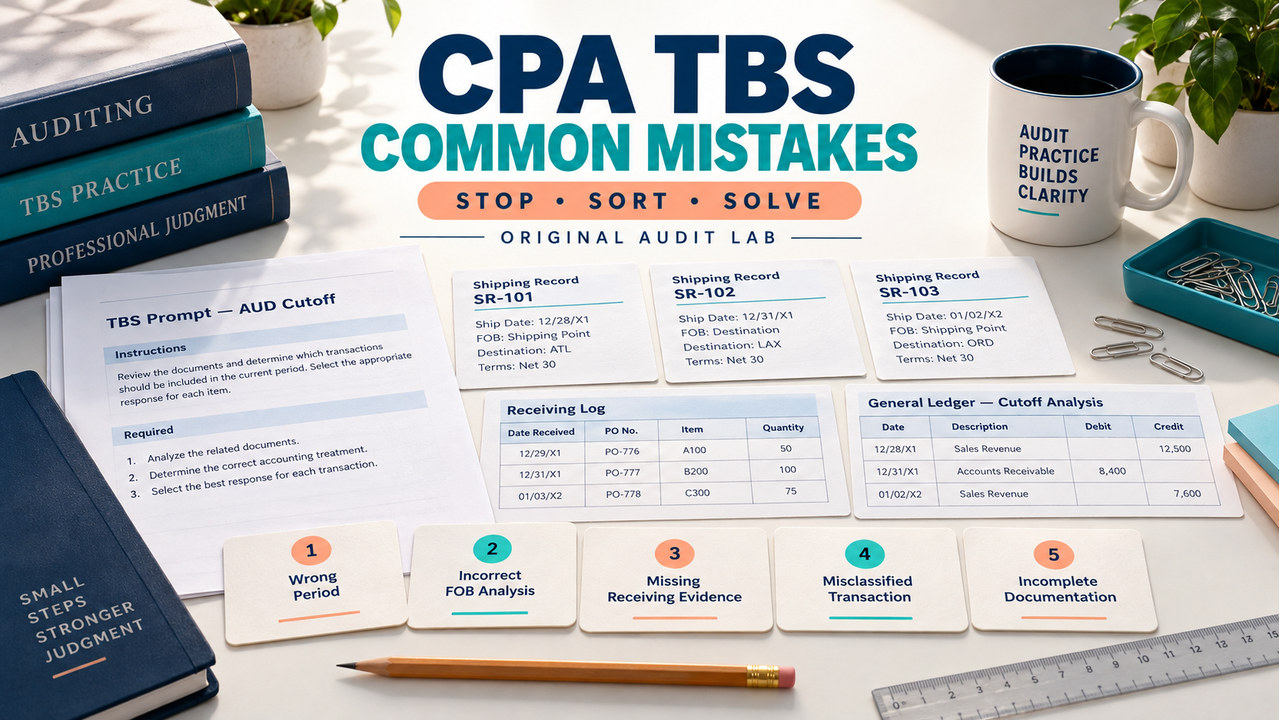

Quick answer: The most useful way to fix cpa tbs common mistakes is to trace the first broken link, not to reread the entire simulation. First, name the requested response cell. Next, tag the exhibit that can prove it. Then, apply the stated unit, term, date, or sign. After that, explain the narrow conclusion and change one fact to test transfer. The original Cedar Ridge AUD cutoff lab below makes each move visible.
The current CPA Exam Study Guide can help with broader scheduling. For current tested topics, task statements, and section terminology, reopen the live AICPA Blueprint. The Cedar Ridge records, questions, answers, and retry are original editorial practice; they are not released, reproduced, or endorsed exam items.
Why cpa tbs common mistakes repeat
Many learners repair the last number they see instead of the first decision that produced it. Suppose a cutoff answer is wrong. More arithmetic will not help if the wrong shipping term controlled the entire path. Likewise, highlighting every exhibit is not evidence mapping if you never identify which record controls the cell.
Read cpa tbs common mistakes before you read every exhibit
Start by rewriting the deliverable in a short phrase: “net ending-inventory adjustment in dollars,” “select the record,” or “explain the direction of the misstatement.” Also capture the cutoff date, sign convention, and whether the response wants a gross or net amount. This step prevents a common mistake: solving a realistic-looking side issue that the cell never asked for.
Separate evidence from detail in cpa tbs common mistakes
Next, give each exhibit one job. In a cutoff case, shipping terms establish the ownership rule under the stated assumptions, dates establish the period, and the ledger shows what the client recorded. Write the chain as cell → record → fact → operation before you calculate.
Set the case rule before solving cpa tbs common mistakes
Some cpa tbs common mistakes come from importing a rule that the prompt intentionally replaced with a supplied assumption. This lab tells you to use the stated shipping terms, dates, and ledger entries; it asks only for cutoff and inventory effects. Do not add tax, valuation, freight, allowance, or subsequent-event analysis. The restriction is part of the skill test because disciplined scope is safer than a technically impressive detour.
Use the STOP SORT SOLVE CHECK RETRY method for cpa tbs common mistakes
The loop diagnoses an attempt and gives your next session a study artifact.
1. READ ASK: define cpa tbs common mistakes by the exact cell
Circle the verb and output: identify, calculate, select, reconcile, or explain. Then add the unit and period. For this lab, the target is a net ending-inventory adjustment at year-end, not a general opinion about the client’s purchasing process. If you cannot say what a correct answer would look like, pause before opening another exhibit.
2. TAG EVIDENCE: map the records behind cpa tbs common mistakes
Label records as rule, date, client entry, or cross-check. Here, terms provide the ownership rule, shipment and receipt dates locate the transaction around year-end, and the ledger date reveals whether the client recorded it in the right period.
3. CHECK TERMS: prevent cpa tbs common mistakes at cutoff
Write the case assumption before you touch a number. In this practice set, FOB shipping point means the goods belong in the buyer’s year-end inventory when the carrier accepts them; FOB destination means they do not belong in the buyer’s year-end inventory until delivery. That rule is supplied for the exercise. Keep it visible beside your worksheet so a familiar but different fact pattern does not replace it.
4. SHOW UNIT: sign cpa tbs common mistakes in dollars
Use one line for each adjustment and keep the sign attached to the reason. An unrecorded year-end purchase is positive inventory; a purchase recorded too early is negative inventory. The unit is dollars of ending inventory, not “number of invoices.” This simple notation catches two frequent cpa tbs common mistakes: reversing a correction and netting unlike measures without stating what the net means.
5. RETRY FACT: transfer cpa tbs common mistakes to one changed fact
Finally, change one material fact and predict the direction before recomputing. If the changed fact is a shipping term, the record remains the same but the ownership conclusion may move. If your retry changes unrelated cells, you are probably memorizing the original answer instead of transferring the method.

Original Cedar Ridge AUD cpa tbs common mistakes lab
This is an original practice packet for the AUD cutoff skill. Before attempting the five cells, write these assumptions in your margin: Cedar Ridge Home Goods has a December 31 year-end; the only question is inventory cutoff; the invoice amounts are complete; ignore freight, discounts, taxes, valuation, and subsequent events; and use the supplied shipping terms as the ownership rule. This case isolates an evidence or cutoff mistake.
Read records for cpa tbs common mistakes before the answer reveals
- Item A: $18,000 invoice; FOB shipping point; carrier accepted the goods on December 29; receipt was January 2; the ledger entry was January 2.
- Item B: $12,500 invoice; FOB destination; shipped December 31; receipt was January 3; the ledger entry was December 31.
- Item C: $9,400 invoice; FOB shipping point; carrier accepted the goods on January 2; receipt was January 4; the ledger entry was January 2.
The request is: identify the items that need a year-end cutoff adjustment and compute the net ending-inventory adjustment. Attempt each cell first. Write the controlling record and the direction beside your answer before opening the explanation.
Cell 1 — Scope the cpa tbs common mistakes lab
Original practice prompt: Which item or items require a year-end cutoff adjustment under the supplied assumptions?
Reveal Cell 1 answer and rationale
Answer: Items A and B require adjustment; Item C does not. The A entry belongs in year-end inventory because the carrier accepted it before year-end, but the ledger did not record it until January 2. For Item B, the ledger was posted before year-end even though FOB destination and the January 3 receipt place ownership after year-end. Item C was both shipped and recorded after year-end, so it is already excluded. The nearest distractor is “all three,” which treats every invoice as a cutoff problem and ignores the ledger date. Next action: if you selected C, review scope and timing before doing any arithmetic.
Cell 2 — Map evidence in cpa tbs common mistakes
Original practice prompt: For Items A and B, name the three evidence fields that must be read together.
Reveal Cell 2 answer and rationale
Answer: Read the shipping term, the shipment or receipt date, and the client ledger date. The term supplies the ownership rule, the dates place ownership around December 31, and the ledger shows the recorded period. A receiving report alone cannot prove FOB destination ownership, while a ledger line alone cannot prove the correct period. The nearest distractor is using the invoice date as the only controller. Next action: build a three-column evidence map—rule, physical timing, client entry—before revisiting the answer.
Cell 3 — What is the net inventory adjustment?
Original practice prompt: Compute the net adjustment to ending inventory in whole dollars. Show the sign for each item that needs correction.
Reveal Cell 3 answer and rationale
Answer: Item A is +$18,000 because owned inventory is missing from the year-end ledger. Item B is −$12,500 because inventory was recorded before ownership. The net ending-inventory adjustment is +$18,000 − $12,500 = +$5,500. Under the case assumptions, the same net direction applies to accounts payable; no COGS effect is requested because the issue is cutoff of purchases and inventory. The distractor +$30,500 loses the signs. Next action: redo the two gross lines with the unit “year-end inventory dollars,” then net them.
Cell 4 — Why does the nearest distractor fail?
Original practice prompt: Explain in one sentence why Item B is reversed even though the ledger shows a December 31 entry.
Reveal Cell 4 answer and rationale
Answer: Item B is reversed because FOB destination and the January 3 receipt mean the buyer did not own the goods at December 31 under the supplied rule; the ledger date is the error, not proof of ownership. The tempting distractor says “December 31 ledger equals year-end inventory,” but that confuses the client’s entry with the evidence that determines the correct period. Next action: when your conclusion relies on the ledger alone, label the gap as evidence mapping and reread the terms.
Cell 5 — Which skill transfers?
Original practice prompt: If one shipping term changes, which response line should move first?
Reveal Cell 5 answer and rationale
Answer: The ownership conclusion for the changed item moves first. Do not rewrite the other records, amounts, or dates. The first changed line is the item-level cutoff adjustment; the net inventory line moves only after that item is recomputed. The nearest distractor is changing all five cells because the packet “looks different.” Next action: identify the changed controller, list the fixed facts, and recompute only linked outputs.

Turn cpa tbs common mistakes into a next review block
After the reveals, do not write only “wrong.” Record the cell, your first answer, confidence before the reveal, controlling record, unit, first divergent step, and next review block. A correct net amount with the wrong evidence path is fragile. Conversely, an incorrect total with correct item-level signs may call for one arithmetic repair rather than a full AUD restart.
Classify cpa tbs common mistakes by the first broken link
Use scope when you answered a different question. Use evidence when you ignored terms, dates, or the ledger role. Choose cutoff when you applied the wrong period rule. Choose calculation when the sign, unit, or netting failed. Finally, choose transfer when the original case made sense but one changed fact caused you to rewrite unrelated lines. This classification is more useful than a total percentage because it names the next action.
For example, a scope error earns a five-minute response-cell drill. An evidence error earns a three-column record map. For a cutoff error, use two contrasting shipping-term examples. For a calculation error, use a signed gross-to-net worksheet. When transferring, retry one fact. Your review block becomes more specific as diagnosis improves.
Retry one fact instead of rereading the entire case
Change only Item B’s shipping term from FOB destination to FOB shipping point. Keep the $12,500 invoice, December 31 shipment, January 3 receipt, and December 31 ledger entry fixed. Under the supplied rule, B is now owned at year-end and its December 31 ledger entry is correct. Item A still needs +$18,000; Item B now needs $0; Item C remains $0. The new net ending-inventory adjustment is therefore +$18,000.
Explain what stayed fixed
The dollar amount, shipment date, receipt date, ledger date, Item A, and Item C did not change. Only the controlling term for Item B changed, so only B’s cutoff conclusion and the net line moved. The common transfer mistake is to change the dates or recalculate Item A because the answer feels new. Instead, write “changed controller: B shipping term” and “fixed inputs: all other records” at the top of the retry.
Schedule the next block from the first gap: review the ownership rule if B stayed reversed, transfer discipline if unrelated cells changed, or signed calculation if the item signs were right but the net was wrong.
FAQ for cpa tbs common mistakes
What is the biggest TBS mistake?
Often, it is answering before defining the requested cell. A learner can know the accounting or auditing rule and still place a correct idea in the wrong response field. Start with the deliverable, period, unit, and sign.
Should I read every exhibit in order?
No. First, read the requirement and assign each exhibit a job. Then scan for the record that controls the cell. This reduces noise without skipping evidence that the question actually needs.
Are this article’s questions official?
No. The Cedar Ridge facts, amounts, records, prompts, answer logic, distractors, and retry are original editorial practice. Use the current AICPA Blueprint and official sample-test resource for current boundaries and software familiarity.
Can my five-cell result predict my CPA score?
No. The AICPA describes reported results as scaled scores rather than percentage-correct conversions. Use this record to choose an evidence, cutoff, calculation, or transfer review block, not to predict readiness.
Where should I verify current exam or application details?
Use current AICPA resources for tested content and software boundaries, then use NASBA, your state Board, and the appropriate testing-center resource for eligibility, scheduling, accommodations, and licensing. Reopen those sources when the guidance changes.
Sources and refresh note for cpa tbs common mistakes
Current scope and task statements: AICPA CPA Exam Blueprints. Software familiarity: AICPA sample tests. Score boundary: AICPA scoring and pass rates. Candidate process: NASBA CPA Exam. Checked September 17, 2026. The STOP → SORT → SOLVE → CHECK → RETRY method, Cedar Ridge records, calculations, questions, rationales, and changed-term retry are original editorial study content. Reopen live official pages and refresh the workbook’s Semrush US fields before publication.