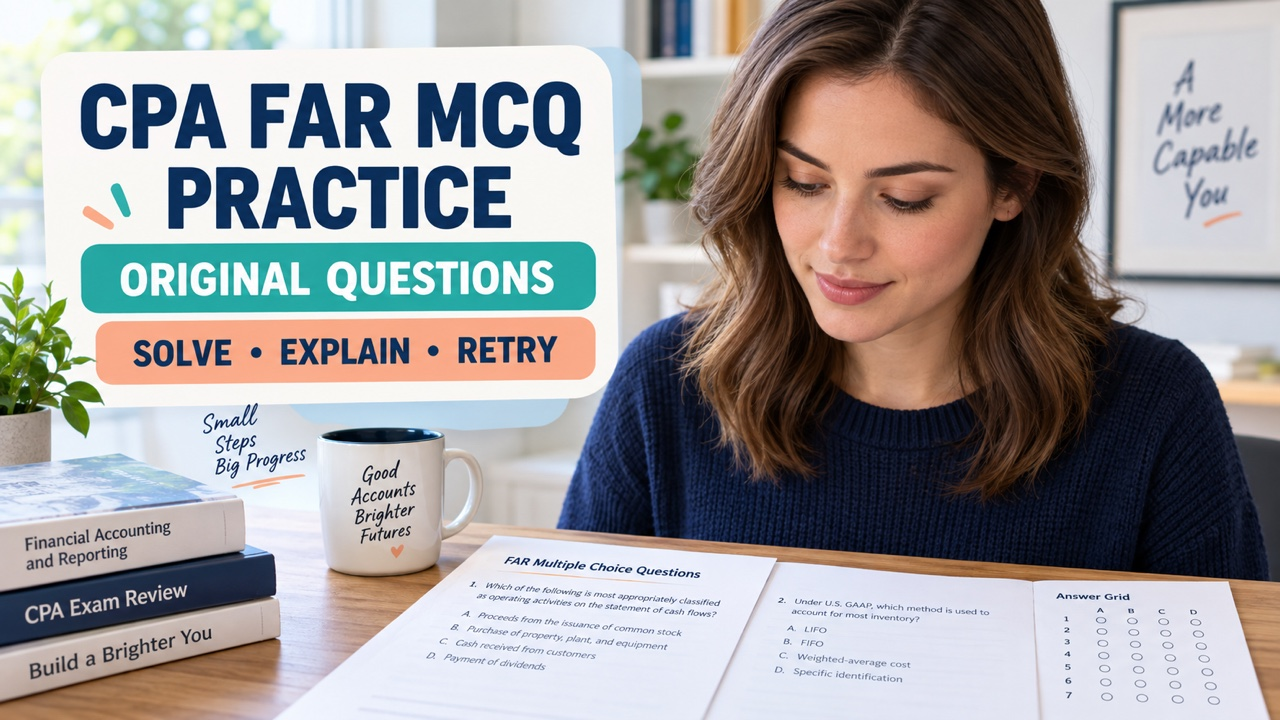

Quick answer: These cpa far multiple choice questions are seven original FAR MCQs with rationales, distractor notes, topic labels, and a changed-fact retry. First, solve before reading the reveals; then use the first broken step to choose what to study next. The set is practice, not live exam content or a score prediction.
Use this page before a question bank. For context, the broader route continues to the site’s FAR review page.
How to use these cpa far multiple choice questions
First, choose one uninterrupted block and answer all seven items before opening a reveal. For each stem, write what the question actually asks, mark the relevant facts, recall the controlling rule, and eliminate the nearest distractor. Next, verify the unit or sign, record the first failed layer, and run the changed-fact retry.

The FAR multiple-choice practice boundary
The AICPA Blueprint organizes exam content by Area, Group, Topic, task statements, skill levels, references, item types, and weighting. Its current FAR description lists two MCQ testlets followed by three TBS testlets. Therefore, use the current Blueprint to orient your topic map and reopen it before a dated plan because eligible content can change.
AICPA’s public sample test is a format and software familiarity tool, not a scored readiness determination. Meanwhile, these questions are independently authored. For technical questions, use the FASB Accounting Standards Codification or another authoritative source.
NASBA states that a section requires a score of 75 or higher, but a reported score is not a percentage correct. Consequently, treat this seven-item result as a descriptive study signal: topic, skill, earliest gap, and next action.
Original cpa far multiple choice questions with answers
Every item was authored for this page. Before opening an explanation, try each answer; then use the distractor note and retry instead of copying the keyed letter into a score tally.
Q1 — Allowance-method write-off
Topic: Receivables and allowance method · Skill: Application
First, a company reports accounts receivable of $40,000 and an allowance for credit losses of $3,500. Then, it writes off an uncollectible $600 account under the allowance method. What happens to net receivables after the write-off?
- A. They increase by $600.
- B. They decrease by $600.
- C. They remain unchanged at $36,500.
- D. They become $40,000 because the allowance is removed first.
Reveal answer 1
Answer: C — First, the entry reduces gross receivables by $600 and reduces the allowance by $600. Therefore, the net carrying amount stays $40,000 − $3,500 = $36,500 immediately after the write-off.
Why the other choices fail: However, A and B treat the write-off as a new expense or a one-sided receivable change. Finally, D ignores the remaining allowance balance and confuses gross receivables with net receivables.
Changed-fact retry: Next, change only the write-off to $900. Then, keep the allowance method and predict whether net receivables move before calculating the new allowance balance.
Q2 — FIFO inventory calculation
Topic: Inventory measurement and FIFO · Skill: Application
Next, beginning inventory is 100 units at $8 each. Then, the company buys 80 units at $11 each and sells 120 units. What are cost of goods sold and ending inventory?
- A. COGS $960; ending inventory $880.
- B. COGS $1,020; ending inventory $660.
- C. COGS $1,320; ending inventory $360.
- D. COGS $1,080; ending inventory $600.
Reveal answer 2
Answer: B — First, FIFO assigns the first 100 units at $8 and the next 20 at $11 to COGS: (100 × $8) + (20 × $11) = $1,020. Then, the remaining 60 units are at $11, so ending inventory is 60 × $11 = $660.
Why the other choices fail: Meanwhile, A uses too few units at the second cost. Next, C treats all 120 sold units as if they were at $11. Finally, D mixes a weighted or reversed layer assignment with the wrong remaining quantity.
Changed-fact retry: For the retry, change the sale to 140 units. Then, write the layer quantities first, and recompute both COGS and the 40-unit ending layer.
Q3 — Disposal of equipment
Topic: Property, plant, and equipment disposal · Skill: Application
Similarly, equipment cost is $90,000 and accumulated depreciation is $54,000. Afterward, the company receives $30,000 cash and has no disposal costs. What should it recognize?
- A. A $6,000 loss.
- B. A $6,000 gain.
- C. A $30,000 loss.
- D. No gain or loss because accumulated depreciation equals the cash proceeds.
Reveal answer 3
Answer: A — First, the carrying amount is $90,000 − $54,000 = $36,000. As a result, comparing proceeds of $30,000 with that carrying amount produces a $6,000 loss.
Why the other choices fail: In contrast, B reverses the direction of the difference. Next, C compares cash with original cost rather than carrying amount. Finally, D treats accumulated depreciation as the asset’s remaining basis.
Changed-fact retry: Next, change proceeds to $39,000 while keeping cost and depreciation fixed. Then, predict the gain or loss direction before computing the $3,000 difference.
Q4 — Cash-flow classification
Topic: Statement of cash flows classification · Skill: Application
However, under the US GAAP assumptions, which classification is the best answer for interest paid and dividends paid?
- A. Interest paid operating; dividends paid financing.
- B. Interest paid investing; dividends paid operating.
- C. Both interest paid and dividends paid investing.
- D. Both interest paid and dividends paid financing.
Reveal answer 4
Answer: A — Under the stated US GAAP convention used here, interest paid is an operating cash flow and dividends paid are financing cash flows. In addition, this item uses the stated convention.
Why the other choices fail: In contrast, B moves both classifications away from the stated convention. Next, C treats recurring financing-related distributions as investing. Finally, D incorrectly moves interest paid into financing for this US GAAP item.
Changed-fact retry: For the retry, change the question to dividends received. Then, identify the cash-flow classification only after stating whether the item is paid or received and which framework applies.
Q5 — Equity-method investment
Topic: Equity method investments · Skill: Application
Meanwhile, an investor owns 30% of an investee and applies the equity method. Next, the investee reports $100,000 of income and pays $20,000 of dividends. What investor income and carrying-amount change follow?
- A. Income $6,000; carrying amount decreases $20,000.
- B. Income $30,000; carrying amount increases $24,000.
- C. Income $100,000; carrying amount increases $100,000.
- D. Income $30,000; carrying amount increases $30,000.
Reveal answer 5
Answer: B — First, the investor recognizes 30% of investee income, or $30,000. Next, the investment increases by that income and decreases for the $6,000 share of dividends received (30% × $20,000), for a net increase of $24,000.
Why the other choices fail: Therefore, A uses the dividend share as income and reverses the investment effect. Next, C uses 100% ownership. Finally, D recognizes income but forgets that the investor’s share of dividends reduces the carrying amount.
Changed-fact retry: For another pass, change ownership to 25% while holding investee income and dividends fixed. Then, recalculate both the income share and the net carrying-amount change.
Q6 — Deferred tax liability
Topic: Deferred tax temporary differences · Skill: Analysis
However, an asset has a book carrying amount of $100,000 and a tax basis of $70,000. Next, assume a 25% enacted tax rate and no valuation allowance. What deferred-tax result follows from the stated difference?
- A. A deductible temporary difference and a $7,500 deferred-tax asset.
- B. A taxable temporary difference and a $7,500 deferred-tax liability.
- C. No temporary difference because book value exceeds tax basis.
- D. A $30,000 deferred-tax liability.
Reveal answer 6
Answer: B — First, book carrying amount exceeds tax basis by $30,000, creating the stated taxable temporary difference. Then, at 25%, the deferred-tax liability is $30,000 × 25% = $7,500 under the simplified assumptions.
Why the other choices fail: In contrast, A reverses the taxable-versus-deductible direction. Next, C ignores the difference. Finally, D records the temporary difference itself as the liability without applying the tax rate.
Changed-fact retry: Next, change the tax basis to $115,000 while keeping carrying amount and rate fixed. First classify the direction, and then calculate the resulting deferred-tax asset.
Q7 — Basic earnings per share
Topic: Basic earnings per share · Skill: Application
Finally, net income is $480,000. Next, weighted-average common shares outstanding are 120,000, with no preferred stock, participating securities, or other adjustments in this simplified item. What is basic EPS?
- A. $0.25.
- B. $2.50.
- C. $4.00.
- D. $40.00.
Reveal answer 7
Answer: C — Finally, basic EPS is net income available to common shareholders divided by weighted-average common shares: $480,000 ÷ 120,000 = $4.00 per share.
Why the other choices fail: However, A reverses the numerator and denominator. Next, B divides by an incorrect share count. Finally, D shifts the decimal by a factor of ten.
Changed-fact retry: For the retry, change weighted-average shares to 160,000 while holding net income fixed. Then, predict that EPS falls, and calculate the new per-share amount.
Blueprint-oriented map for cpa far multiple choice questions
These plain-language labels place a miss; they are not official AICPA task codes. In addition, before your exam window, confirm Area → Group → Topic wording and references in the current Blueprint.
| Item | Study topic label | Skill focus | What to record |
|---|---|---|---|
| Q1 | Receivables and allowance method | Application | Answer, distractor reason, changed-fact retry |
| Q2 | Inventory measurement and FIFO | Application | Answer, distractor reason, changed-fact retry |
| Q3 | Property, plant, and equipment disposal | Application | Answer, distractor reason, changed-fact retry |
| Q4 | Statement of cash flows classification | Application | Answer, distractor reason, changed-fact retry |
| Q5 | Equity method investments | Application | Answer, distractor reason, changed-fact retry |
| Q6 | Deferred tax temporary differences | Analysis | Answer, distractor reason, changed-fact retry |
| Q7 | Basic earnings per share | Application | Answer, distractor reason, changed-fact retry |
How to review missed cpa far multiple choice questions
Do not start with the correct count. Instead, name the earliest failed layer: scope (wrong topic or boundary), reading (missed the requested output or condition), rule (missed the trigger), calculation (input, sign, unit, or operation), distractor (a close choice hid a fact), or transfer (the original fact pattern worked but one changed fact did not).
Then change one fact—amount, ownership, timing, basis, rate, or share count—and predict the direction before recalculating. If the same layer fails twice, choose a focused explanation or topic resource before returning to a mixed set.
Choose the next cpa far multiple choice questions study action
If the topic boundary is unclear, return to the FAR review page and select one topic. If the rule is clear but the evidence handoff breaks, use the site’s TBS practice route. Finally, if several topics need a schedule, use the CPA Exam Study Guide rather than repeating the same mixed set without a plan.
Finally, keep the item, topic, earliest gap, changed-fact result, and next resource in your log.
FAQ for cpa far multiple choice questions
Are these live CPA Exam items?
No. Instead, they are original editorial practice items written for this page, not live exam content or a prediction of results. Use the AICPA Blueprint for current boundaries and the official sample test for software familiarity.
Can a raw practice percentage predict my CPA score?
No. In other words, NASBA explains that the score is not a percentage correct. Record the next topic or skill instead of assigning an official readiness label.
What should I do if I miss most of the set?
Separate scope, reading, rule, calculation, distractor, and transfer errors. Review one layer, retry one changed fact, and choose a focused route on the FAR review page.
Sources and refresh note
Blueprint and FAR testlets: AICPA Blueprints. Format: AICPA sample tests. Scores: NASBA Score Information. Technical boundary: FASB Codification. Checked September 18, 2026. Reopen official pages and refresh Semrush US fields before publication. The questions, choices, rationales, map, and review grid are original.