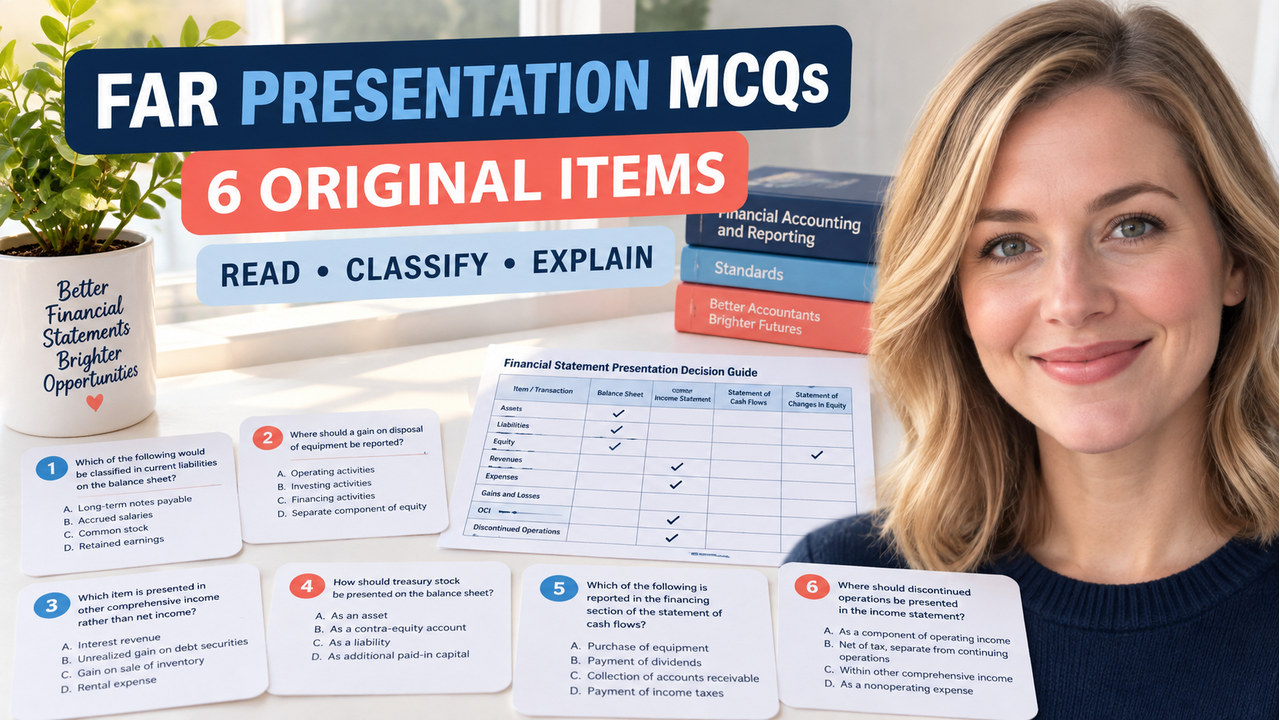

Quick answer: These far financial statement presentation multiple choice questions are most useful when you solve each item as a decision chain: ASK → GATE → OUTPUT → CHECK. First, read exactly what the prompt requests. Next, isolate the fact that controls the answer. Then, place the result in the requested statement or disclosure. Finally, explain why the nearest distractor fails. The items below cover contract-liability timing, discontinued operations, restricted cash, basic EPS, available-for-sale OCI reclassification, and estimate-versus-error presentation.
This is an original FAR practice set, not live exam content or provider-owned material. Attempt every item before opening its reveal. For this set, use simplified U.S. GAAP facts; if a real fact pattern adds scope, tax, impairment, effective-date, or classification details, reopen the current FASB Accounting Standards Codification. For broader navigation, use the FAR review hub and FAR practice questions.
How to use far financial statement presentation multiple choice questions
Tested skill: select the correct presentation outcome when one fact changes the statement, section, line, equity component, or disclosure. More importantly, notice which fact the question made decisive instead of letting a familiar word—such as “current,” “cash,” “gain,” or “error”—do the reasoning for you.
Assumptions: use simplified U.S. GAAP facts and the presentation model named in each item. For Question 2, the prompt states the strategic-shift threshold. For Question 4, it states a public-company context. Finally, the OCI and accounting-change items identify the model or error status so each question tests one gate.
Difficulty: moderate. Allow about two minutes per item. Before revealing an answer, write: ask, gate, output, and distractor. As a result, the practice percentage is a diagnostic for this set, not an official CPA Exam score or readiness label.
For the tested-skill boundary, use the AICPA Blueprint rather than treating it as a promise that a particular item will appear. For software orientation, use the AICPA sample software. Finally, the questions below are independently authored study material and do not reproduce source-question wording.
Build a multiple-choice presentation decision grid
First, start with the output, not with the most memorable rule phrase. If the prompt asks for a balance-sheet classification, look for timing. Next, if it asks about discontinued operations, look for the strategic-shift fact. Likewise, if it asks about cash flows, ask whether cash actually moved before choosing an activity category. For EPS, isolate the denominator. Finally, for OCI and accounting changes, separate the recognition route from the period of correction.
- READ THE ASK: circle the requested statement, line, category, disclosure, or denominator.
- FIND THE GATE: identify the one fact that controls the choice—date, cash, strategic shift, shares, OCI status, or estimate-versus-error status.
- PLACE THE OUTPUT: name the statement section, line, component, comparative period, or disclosure.
- TEST THE DISTRACTOR: explain why the tempting alternative uses the wrong fact, period, or presentation bucket.

Six original far financial statement presentation multiple choice questions
First, attempt the six questions in order. Each prompt is intentionally narrow so you can tell whether a miss came from reading the ask, finding the gate, placing the output, or defending the distractor. In addition, all facts, amounts, choices, rationales, and retries are original editorial practice.
Question 1: Contract liability timing
At December 31, Northstar Learning has collected $48,000 for a service contract. The company will provide $18,000 of service during the next nine months and $30,000 during months 13 through 20. Assume the contract liability is otherwise measured correctly. How should the liability be presented?
- $48,000 current
- $18,000 current and $30,000 noncurrent
- $30,000 current and $18,000 noncurrent
- $48,000 in equity because cash was collected
Reveal Question 1
Answer: B. First, the portion expected to be satisfied within the next nine months is current; the portion tied to service in months 13 through 20 is noncurrent under the stated facts.
Why the distractor fails: However, cash collection does not make the entire contract liability current. The controlling fact is the timing of expected satisfaction. The equity option confuses a liability with an owner transaction.
Retry: For a new pass, change the service schedule so all remaining performance occurs in months 13 through 20. Then reclassify only after rereading the timing gate.
Question 2: Discontinued-operations presentation
On June 30, Summit Foods disposes of a component that represents a major strategic shift away from its former grocery business. The component’s results and disposal gain are measurable, and the stated facts meet the applicable discontinued-operations criteria. What is the best presentation direction?
- Include every amount in ordinary continuing operations with no separate presentation
- Present the discontinued component’s results and disposal effect separately from continuing operations, with tax effects as required
- Move the component’s assets directly to retained earnings
- Report only the disposal cash proceeds in OCI
Reveal Question 2
Answer: B. Because the prompt states that the component meets the discontinued-operations criteria and represents a major strategic shift, its results and disposal effect are presented separately from continuing operations, subject to the applicable tax presentation.
Why the distractor fails: By contrast, the cash proceeds do not decide the income-statement presentation. The controlling gate is the stated discontinued-operations threshold, not whether the transaction generated cash.
Retry: For the retry, change the fact so the disposed product line is not a major strategic shift. Then reassess the gate before choosing separate discontinued-operations presentation.
Question 3: Restricted cash in the cash-flow reconciliation
At the beginning of the year, a company reports $80,000 of cash and cash equivalents and $20,000 of restricted cash. At year-end, it reports $95,000 of cash and cash equivalents and $15,000 of restricted cash. Assume the restrictions are within the applicable cash-flow guidance. Which statement is correct?
- The $5,000 transfer between cash categories is an operating outflow
- The reconciliation begins and ends with only cash and cash equivalents, excluding restricted cash
- The reconciliation includes cash, cash equivalents, restricted cash, and restricted cash equivalents as applicable; an internal transfer is not itself an operating, investing, or financing cash flow
- Restricted cash is always an investing activity
Reveal Question 3
Answer: C. The cash-flow reconciliation is designed to bridge the applicable beginning and ending total of cash, cash equivalents, restricted cash, and restricted cash equivalents. Therefore, moving an amount between categories does not by itself create an operating, investing, or financing cash flow.
Why the distractor fails: In contrast, a change in the label or restriction status is not the same as a third-party cash receipt or payment. The first gate is to distinguish a reconciliation change from a cash-flow activity.
Retry: For the retry, change the fact to a $5,000 cash payment to buy equipment. Then identify the new investing cash flow separately from any reconciliation presentation.
Question 4: Basic EPS denominator
A public company has 1,000,000 common shares outstanding on January 1. It issues 200,000 shares on October 1 and has no other changes. Net income is $600,000, and there are no preferred dividends. What denominator should the simplified basic EPS calculation use?
- 1,000,000 ending shares
- 1,200,000 ending shares plus a full-year weighting
- 1,050,000 weighted-average common shares outstanding
- $600,000 divided by the number of days in the year
Reveal Question 4
Answer: C. The simplified weighted average is 1,000,000 for nine months plus 1,200,000 for three months: 750,000 + 300,000 = 1,050,000 shares. As a result, basic EPS uses the weighted-average common-share denominator rather than the ending balance alone.
Why the distractor fails: The issue occurred on October 1, so the additional shares were not outstanding for the whole year. In other words, a correct net-income numerator cannot repair an incorrect share denominator.
Retry: For the retry, change the issue date to January 1. Then recompute the weighted-average denominator before checking whether the answer changes.
Question 5: Sale of an available-for-sale debt security
Assume a debt security is classified as available for sale. Before sale, its amortized cost is $70,000, its fair value is $76,000, and the $6,000 unrealized gain is in accumulated OCI. The company sells the security for $76,000. Ignoring tax, what is the presentation logic?
- Leave the $6,000 in AOCI permanently and recognize no gain
- Recognize the realized gain in earnings and make the applicable OCI reclassification adjustment so the same gain is not counted twice
- Record the $6,000 as an operating cash inflow only
- Transfer the $6,000 to contributed capital
Reveal Question 5
Answer: B. Once the sale occurs, the gain changes from unrealized to realized. The gain is recognized in earnings, and the related amount is reclassified out of accumulated OCI as required so the same economics are not double-counted.
Why the distractor fails: The cash proceeds are not the entire presentation answer. Instead, the controlling gate is the change from unrealized holding gain to realized sale, which affects both earnings and the accumulated OCI balance.
Retry: For comparison, change the fact to a year-end fair-value measurement with no sale. Then re-run the unrealized-versus-realized gate.
Question 6: Change in estimate versus prior-period error
In 2026, Cedar Works receives new information showing that equipment’s remaining useful life is longer than previously estimated. The 2025 estimate was reasonable when made, and there is no error in the 2025 records. How should the depreciation change be presented?
- Restate 2025 depreciation as a prior-period error
- Record the entire difference in OCI
- Account for the revised estimate prospectively in 2026 and future periods as applicable
- Ignore the information until the equipment is sold
Reveal Question 6
Answer: C. New information that changes a reasonable estimate is accounted for prospectively in the current and future periods affected. Accordingly, it is not a prior-period error merely because the estimate later changes.
Why the distractor fails: The key gate is the nature of the change: new information versus an error in the earlier records. Discovery in 2026 does not automatically create a 2025 restatement.
Retry: For the retry, change the fact so the 2025 useful-life calculation ignored information already available at that time. Then reassess whether the prior-period-error gate now applies.
Record your result and tag the first reasoning gap
Before opening any reveal, record the number attempted, the number correct, and the first question missed. Next, write the four notes: ask, gate, output, and distractor. A percentage can show where to look, but it is not an official score and does not prove readiness.
Repair the first wrong gate before adding more questions
Use the first miss as the next task. For example, a Question 1 miss calls for a timing line. A Question 2 miss calls for a discontinued-operations threshold check. Meanwhile, a Question 3 miss calls for separating reconciliation from cash movement. A Question 4 miss calls for a weighted-share timeline. In addition, a Question 5 miss calls for separating earnings from OCI. Finally, a Question 6 miss calls for writing “new information or prior-period error?” at the top of the page.
Use presentation multiple choice questions in a six-question review route
Do not redo all six mechanically. Instead, choose the tile matching your first error, change one fact, and explain why the output changed or stayed the same. If you cannot defend the nearest distractor in two sentences, the gate is not stable yet.

Presentation multiple choice questions: common traps
Using the instrument label as the answer: “Contract liability” does not tell you whether all of it is current; the satisfaction timing does.
Treating every cash-related fact as a cash flow: Likewise, restricted-cash transfers and noncash exchanges can affect presentation without becoming operating, investing, or financing flows.
Using an ending share count: Basic EPS instead asks for a weighted-average denominator when shares change during the period.
Leaving realized gains in OCI: Once the sale gate changes, earnings recognition and the accumulated OCI presentation must be considered together.
Calling new information an old error: Finally, a reasonable estimate that changes is different from a mistake in the earlier records. Match the correction period to the gate stated in the facts.
FAR financial statement presentation multiple choice questions FAQ
Are these live presentation multiple choice questions?
No. They are original editorial practice items, not live exam content or provider-owned material.
Why are presentation multiple choice questions answers hidden?
Delayed reveals force you to name the controlling fact and defend the nearest distractor before seeing the explanation.
What should I do after a low result?
Do not translate it into an official score. Instead, tag the first wrong gate, retry one changed fact, and add volume only after the explanation is supported.
Next action: complete all six without opening the reveals. Then record the first missed gate and retry that item with one changed fact.
Sources and refresh note
Current tested-skill boundary: AICPA CPA Exam Blueprints. Software orientation: AICPA CPA Exam sample tests. Administration boundary: NASBA CPA Exam FAQ. Technical refresh: FASB Accounting Standards Codification. Checked September 18, 2026. Reopen live official sources before using a dated rule conclusion. The items, answer choices, rationales, and review route are original study guidance.