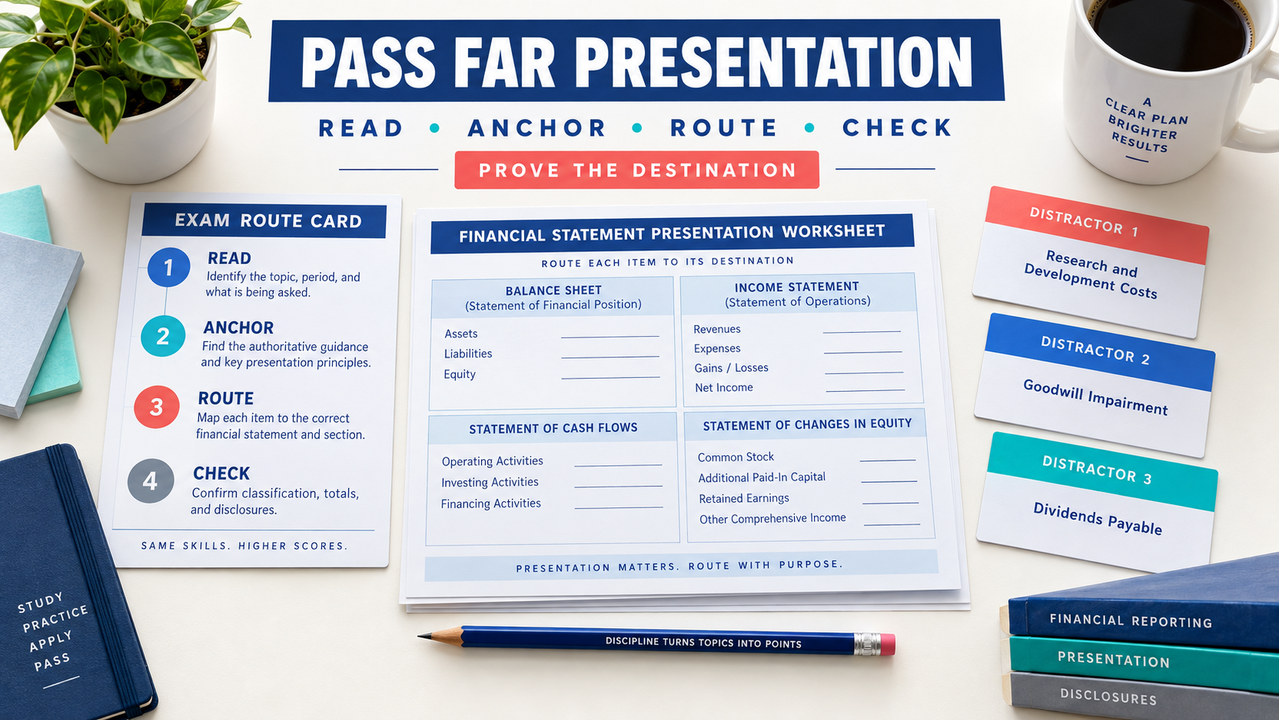

To pass financial statement presentation questions on CPA FAR, do not treat the answer as a number hunt. Treat it as a proof task: identify what the prompt asks, find the fact that controls the result, route that result to the correct statement or note, and explain why the nearest distractor fails. This page uses the route READ → ANCHOR → ROUTE → CHECK.
Quick answer: handle financial statement presentation decisions by preserving the task verb, naming the controlling fact, stating the destination, and testing one changed fact. The three original checks below are editorial practice, not released or provider-owned CPA Exam items. They are designed to expose the first broken step in your reasoning.
Assumptions: examples use simplified U.S. GAAP facts and no unusual tax effects unless stated. Reopen the applicable current Codification topic when a question adds scope, materiality, tax, effective-date, industry, or alternative-presentation complications. “Pass” here means execute a defensible topic decision; it does not mean a guaranteed exam score or readiness prediction.
For a broader preparation path, continue with our CPA Exam Study Guide.
Master how to pass financial statement presentation with a four-step route
What a defensible answer must show
A presentation answer is defensible when another reader can follow the path from fact to destination. Start with the task verb. Then locate the fact that controls timing, amount, classification, or disclosure. Only after those two steps should you choose a statement line or note.
The current AICPA Blueprints provide the boundary for Areas, Groups, Topics, task statements, skill levels, references, item types, and weighting. Use that boundary to name the skill before you begin a question set. A narrow sentence such as “I am practicing how a debt fact changes current-versus-noncurrent presentation” is more useful than “I am doing FAR questions.”
- Read: restate the requested action: classify, present, calculate, correct, or disclose.
- Anchor: underline the one fact that controls the route, such as payment timing, covenant status, cash movement, or disposal.
- Route: name the statement, line, subtotal, section, cash-flow category, OCI component, or note.
- Check: reject the closest distractor by identifying the fact it ignores or changes.
This route keeps a correct amount from becoming an incomplete answer. It also prevents a familiar line item from pulling you toward the wrong destination before you have identified the fact that matters.
Choose a drill to pass financial statement presentation by time
Use the shortest block that produces a written route. A long session filled with unreviewed questions can hide the same destination error. A bounded drill makes the first unsupported step visible.
- 20 minutes — secure the anchor: spend four minutes naming the task verb, eight minutes on one fact pattern, four minutes explaining the nearest distractor, and four minutes changing one fact. Choose this block when you know the chapter but rush past the controlling detail.
- 45 minutes — run and compare: spend seven minutes on the current Blueprint boundary, fifteen minutes on a worked route card, fifteen minutes on three original checks, and eight minutes comparing the old and new destinations. Choose this block when the rule is familiar but transfer is unstable.
- 75 minutes — simulate the handoff: spend ten minutes on scope, twenty-five minutes on two varied facts, twenty-five minutes on a focused set, and fifteen minutes on a no-notes repair. Choose this block when you can state a rule but lose points to timing, classification, or disclosure distractors.
Finish by writing: “The fact I must protect is ___; the destination I must defend is ___; my next retry changes ___.” This sentence gives your next study block a job.
Build a route card to pass financial statement presentation
Use five short fields instead of a page of notes. The card should be small enough to complete under time pressure and specific enough to show where the route broke.

- Task verb: what is the prompt asking you to do?
- Controlling fact: which date, amount, status, cash movement, or obligation changes the conclusion?
- Destination: where does the result appear first?
- Nearest distractor: which answer sounds close, and what fact does it ignore?
- Proof sentence: complete “Because ___, the result belongs in ___ rather than ___.”
Writing the destination before reading every explanation keeps the practice diagnostic honest. If the destination is wrong, rereading a rationale without changing the route will not build transfer.
Work an original drill to pass financial statement presentation
Practice fact pattern: On January 1, Harborline Services obtains equipment with a stated cost of $120,000. It pays $30,000 in cash and signs a $90,000 note due in three years. At year-end, the note has no current portion under the simplified facts, and the company has not breached any covenant. No tax effects or other complications are modeled.
Read: the decision asks how to present the equipment acquisition and the related cash and noncash pieces. Anchor: only $30,000 moved in cash, while $90,000 arose through the note. Route: trace the equipment to its applicable asset presentation, the note to the applicable liability classification, the cash payment to the appropriate investing section, and the noncash portion to the required supplemental explanation.
Check: the tempting $120,000 investing outflow ignores the split consideration. A note is not a cash payment merely because it finances an asset. Now change one fact: suppose the note is due in nine months at year-end. The asset cost and the $30,000 cash movement do not change, but the liability destination must be reconsidered under the current guidance and the stated classification facts.
The point is not to memorize a single line. The point is to preserve the controlling fact, state the destination, and notice exactly which conclusion moved when one fact changed. That is the evidence you need before you expand to a mixed set.
Practice check 1: debt due soon after year-end
Original practice item: A company has a $200,000 note payable due in nine months after the reporting date. Under the simplified facts, management has no unconditional right to defer settlement beyond twelve months and no refinancing fact is provided. Which route should you test first?
- Present the entire note as long-term because it was originally issued for five years.
- Present the note using the applicable current-liability guidance because the reporting-date facts control the classification.
- Present the note in revenue because the borrowing financed operations.
- Omit the note because settlement occurs after the reporting date.
Reveal the answer, distractor, and next action
Answer: B. The controlling fact is the settlement horizon and the rights that exist at the reporting date, not the original five-year label. Under the simplified facts, trace current-versus-noncurrent classification through the applicable current guidance.
Nearest distractor: A preserves the original issuance term while ignoring the reporting-date route. Next action: change the fact so an enforceable right to defer settlement exists and reopen the current literature before changing the classification.
Practice check 2: noncash lease commencement
Original practice item: A company begins a lease and records a right-of-use asset and lease liability. No cash is paid at commencement, and the lease is not a business combination. Which presentation question should you ask first?
- Report the full asset and liability as an operating cash outflow because the lease has a cost.
- Trace the noncash recognition and the required supplemental cash-flow disclosure before classifying later cash payments.
- Record the right-of-use asset as revenue because it creates an economic resource.
- Ignore the transaction because no balance-sheet amount is recognized.
Reveal the answer, distractor, and next action
Answer: B. The anchor is that the asset and liability arose without cash at commencement. The route starts with noncash recognition and the applicable supplemental disclosure; later cash payments require their own classification analysis.
Nearest distractor: A turns an asset and liability entry into a cash event that did not occur. Next action: change the fact so an initial direct payment is made and identify which part of the cash-flow presentation must now be traced separately.
Practice check 3: a disposal-related presentation change
Original practice item: A company sells a component that meets the stated simplified criteria for separate disposal presentation. Which first question best protects the presentation route?
- Put every historical amount into ordinary operating revenue because cash was received.
- Determine whether the component belongs in the applicable discontinued-operation presentation and disclosure path before analyzing the gain.
- Classify the sale proceeds as a financing inflow because the component was funded with debt.
- Move the component to retained earnings with no statement presentation.
Reveal the answer, distractor, and next action
Answer: B. The controlling fact is the stated disposal criterion, so presentation and disclosure scope should be established before the gain or proceeds are routed. Reopen the current literature for the exact definition, measurement, and disclosure details.
Nearest distractor: A treats proceeds as operating revenue and skips the component-level presentation question. Next action: change the fact so the component does not meet the stated criterion and compare which presentation and disclosure path remains.
Control distractors in financial statement presentation questions
Most close distractors do not look absurd. They usually preserve one true number while changing the fact that controls the destination. Use a four-question filter:
- Amount: did the choice use the right number but ignore how it was created?
- Timing: did the choice use an original date instead of the reporting-date facts?
- Destination: did the choice place a balance-sheet or cash-flow item in a familiar but wrong category?
- Disclosure: did the choice stop at the statement line when a noncash, policy, or component explanation is required?
Say the rejection aloud or write it in one sentence: “This distractor fails because it ignores ___.” If you cannot fill the blank, do not call the answer secure yet. A correct letter without a controlling fact is fragile when the next prompt changes one condition.
Repair the first broken FAR financial statement presentation route
Do not label a miss only as “wrong.” Identify the earliest broken step. Misreading the task verb is a read problem. Missing the date, amount, or obligation is an anchor problem. Choosing the wrong statement or category is a route problem. Forgetting a noncash explanation or policy note is a check problem.

Keep every unchanged fact visible during the retry. Change one fact, recompute only the linked conclusion, and compare the old and new destinations. If the destination does not move, explain why. If it does move, name the fact that caused the movement. That comparison is more valuable than opening another random set.
Use a final pass checklist before you expand
- I can restate the task verb without looking back at the choices.
- I can point to the fact that controls amount, timing, classification, or disclosure.
- I can name the statement, line, category, section, or note before writing the rationale.
- I can reject the nearest distractor in one sentence.
- I can change one fact and predict whether the destination moves.
- I know which current source topic I must reopen when the simplified facts no longer apply.
When all six statements are true, expand the next drill by changing the fact pattern, not by adding unrelated volume. If one statement is false, keep the next block narrow and repair that step first.
Refresh official sources before you expand
The AICPA CPA Exam Blueprints page is the scope source for current task statements and exam-format context. The FASB Accounting Standards Codification is the technical source to reopen for the applicable U.S. GAAP topic. The AICPA sample-test resource can help you rehearse the testing interface, while the NASBA CPA Exam FAQ is a separate exam-process reference.
This pass statement presentation method and its examples are original editorial study content. They do not replace current source literature, a full FAR study plan, or jurisdiction-specific advice. Before you move on, save the task verb, controlling fact, destination, distractor rejection, and one changed-fact retry. That is the practical finish line for this topic block.