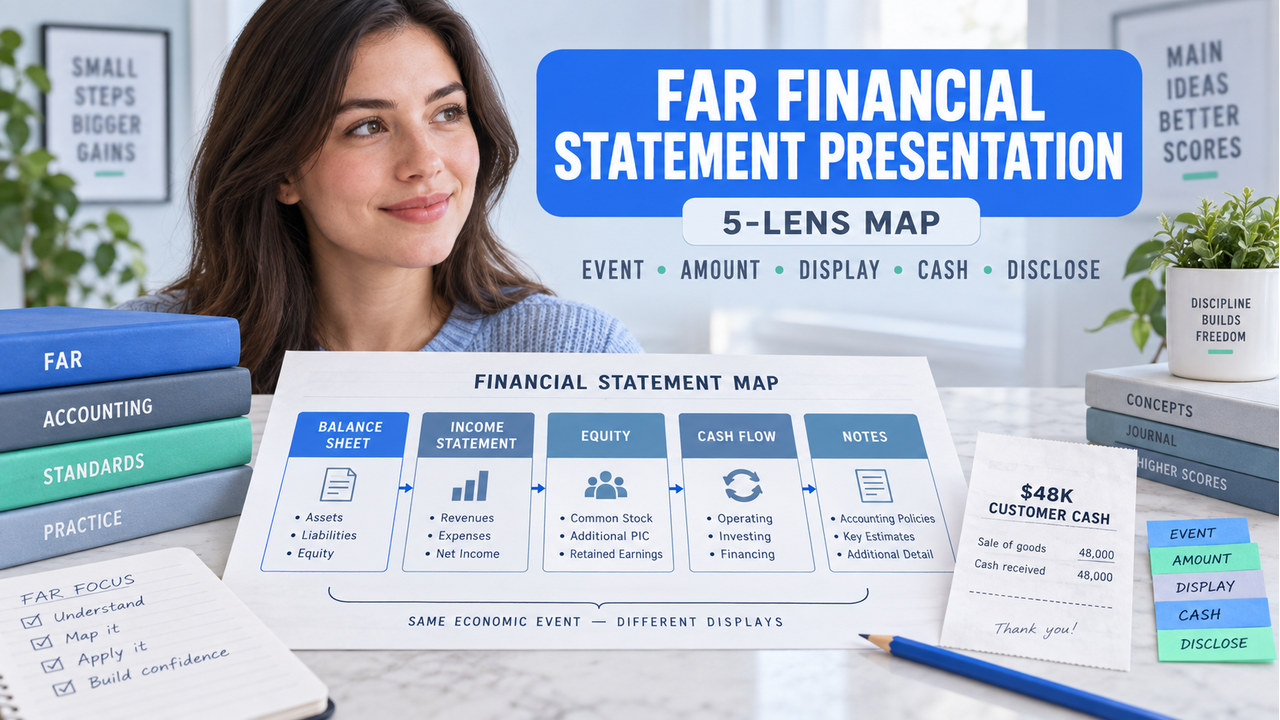

Far financial statement presentation explained starts with one distinction: a transaction can affect more than one reporting output, and each output asks a different question. Recognition asks whether an item belongs in the records. Measurement asks how much belongs there. Presentation asks where the result appears, how cash movement is classified, and what context belongs in a note or equity statement.
Quick answer: name the economic event, identify the requested output, connect the amount to that output, route it to the right statement or line, and then check the cash and disclosure consequences. This article turns that sequence into a five-lens map and three original practice checks. It is a study lesson, not an exam score or a prediction of a particular test form.
For broader preparation, see the CPA FAR review hub. Use this page when the problem is not “Which rule do I memorize?” but “How does one fact move through the financial statements?”
Financial statement presentation explained: what FAR asks you to map
Tested skill: map one defined event to recognition, measurement, display, cash movement, and disclosure without allowing one answer to stand in for all five. Assumptions: the examples use a calendar-year nongovernmental company, simplified U.S. GAAP facts, no unusual tax overlay, and no hidden industry exception. Difficulty: moderate. The arithmetic is short; the challenge is keeping the requested output separate from the other effects.
In practice, “presentation” does not mean styling a finished page. It means deciding how information is communicated to users after the underlying accounting has been considered. A customer receipt may affect cash, revenue, and a contract liability at different amounts. An asset purchase may affect the balance sheet and investing cash flow but not current-period income. A dividend may reduce retained earnings, create a payable, and produce financing cash flow only for the amount actually paid.
That is why a familiar account label can mislead. “Cash received” does not automatically mean revenue. “Asset” does not automatically mean a cash outflow for the full amount. “Expense” does not automatically tell you whether the requested answer belongs on the income statement, in the operating cash-flow reconciliation, or in a note. Read the task verb first.
Use financial statement presentation explained: the five-lens map
Write these five prompts before solving a presentation question. They are a reasoning map, not five invented steps that every standard must follow in the same order.
- Event: What happened economically? State it in plain language without an account label.
- Amount: What amount, sign, timing, or carrying value is linked to the requested output?
- Display: Which statement, line, subtotal, equity component, or balance receives the effect?
- Cash: Did cash actually move in the period? If so, what is the activity’s nature? If not, is a noncash disclosure relevant?
- Disclosure: What explanation, policy, restriction, reconciliation, or source boundary would a user need?
The map prevents a common shortcut: using the correct amount for the wrong output. For example, the amount of a liability is not the same question as the cash received, and the amount of a gain is not the same question as the proceeds from selling an asset. If a prompt asks for one lane, answer that lane first and then use the other lenses as a consistency check.
Keep the financial statement presentation explained sequence beside the fact pattern: event first, amount second, display and cash next, then disclosure.

Worked example: customer cash received before service
Suppose Brightline Services receives $48,000 from a customer on December 1 for four months of support. By December 31, one month of support has been delivered. Assume the contract facts support straight-line recognition for this simplified exercise and that no refund or collection issue changes the result.
Event: Brightline received cash for a service arrangement and has performed one month. Amount: one month is $12,000, leaving $36,000 for the remaining three months. Display: record $12,000 of revenue for the delivered service and a $36,000 contract liability for the remaining obligation. Cash: the full $48,000 receipt is an operating cash inflow because it came from a customer transaction. Disclosure: the company still applies its current revenue and contract-liability guidance, including any policy or disaggregation information required by the facts.
The nearest distractors each answer only part of the question. Calling the full receipt revenue ignores the remaining performance obligation. Calling the full $48,000 a liability ignores the service already delivered. Showing $12,000 as the cash inflow confuses earned revenue with cash movement. A strong presentation answer keeps the three amounts visible: $12,000 revenue, $36,000 liability, and $48,000 operating cash receipt.
This is the central lesson of the phrase financial statement presentation explained: one event can have several valid outputs, but each output has its own amount and destination. When the facts become more complex, return to the current applicable literature instead of extending this simplified example by analogy.

Complete three original presentation checks before revealing the answers
These are original practice items for the exact skill in this article. Do not treat them as a source of current exam content. For each item, write four short answers: event, amount, destination, and nearest rejected distractor. Then open the answer reveal.
Check 1: equipment bought with cash and a note
On December 29, Cedar Works acquires equipment for $75,000. It pays $15,000 immediately and signs a $60,000 note. No other fact changes. What is recognized, what cash moved, and what presentation issue must remain visible?
Check 2: dividend declared and partly paid
On December 20, Harbor Lane declares a $10,000 cash dividend. It pays $6,000 before year-end and will pay the remaining $4,000 in January. Identify the equity effect, the year-end liability, and the cash-flow amount. Do not answer with the declared amount alone.
Check 3: prepaid insurance at year-end
On October 1, Maple Ridge pays $24,000 for twelve months of insurance coverage. Three months have elapsed by December 31. Identify the expense, the remaining asset, the cash-flow timing, and the statement destination of the unexpired portion.
Reveal the three statement maps
For each original fact pattern, write the recognized item, the primary statement or line, the cash classification, and the closest rejected distractor before opening the answer.
Reveal the answer
Answer: The equipment purchase recognizes a $75,000 asset with a $15,000 investing cash outflow and a $60,000 noncash financing disclosure; the dividend creates a $10,000 equity reduction and $4,000 payable after a $6,000 payment; the prepaid insurance leaves an $18,000 current asset after $6,000 expense and a $24,000 operating cash outflow.
Each answer keeps recognition, measurement, display, cash movement, and disclosure in separate lanes. A familiar label is not a substitute for the requested output.
Review financial statement presentation explained distractors
A distractor is useful because it shows which lens the learner skipped. If you choose $75,000 as the cash outflow in Check 1, the amount may be correct for the asset but not for the cash movement. Treating the full $10,000 dividend as paid cash in Check 2 collapses declaration and settlement. If you expense the full $24,000 insurance payment in Check 3, you have ignored the reporting date and the unexpired benefit.
Use a short rejection sentence. “The equipment is recognized at $75,000, but only $15,000 of cash moved; the $60,000 note is a noncash financing fact that needs the applicable disclosure treatment.” “The dividend reduces equity by $10,000, but only $6,000 is a current-period cash payment and $4,000 remains payable.” “The three months used produce $6,000 of expense, while $18,000 remains a current asset; the cash payment happened on October 1.”
These sentences do more than explain an answer. They prove that the event, amount, display, and cash lenses are connected without being identical. When the current literature imposes a different scope or disclosure requirement, the source check controls the conclusion.
Use financial statement presentation explained to choose your next FAR review action
Record your three-check result as a diagnostic, not a readiness score. Give yourself one mark for each complete map that names the event, amount, destination, cash treatment, and rejected distractor. Then label the first incomplete lens: event, amount, display, cash, or disclosure. The label determines the next study action.
- Event miss: rewrite the transaction in plain language without account names.
- Amount miss: show the arithmetic, reporting date, and sign before looking at answer choices.
- Display miss: write the exact statement, line, equity component, or balance that receives the effect.
- Cash miss: state whether cash moved and why the activity is operating, investing, financing, or noncash.
- Disclosure miss: reopen the applicable current Topic and write the fact that would change the note or supplemental presentation.
Run a ten-minute retry with the same structure and one changed fact. Change $15,000 cash paid to $30,000, or change the insurance payment date, but hold the other facts fixed. A focused changed-fact retry tells you whether the reasoning transferred. A new mixed question set can hide the original weakness.
For scope and exam terminology, use the AICPA CPA Exam Blueprints resource. For software and format rehearsal, use the AICPA sample test; it is not a scored readiness determination. The public retired FAR task-based simulation can help you recognize a multi-step format, but it does not make the original practice here current or official.
FAR financial statement presentation explained FAQ
Is presentation the same as recognition?
No. Recognition asks whether an item enters the accounting records. Presentation asks how the recognized result is shown, classified, grouped, reconciled, or explained. A question may ask for one of those outputs while giving facts that affect the others.
Are these practice checks official CPA Exam questions?
No. They are original editorial exercises. Use the AICPA resources for current exam scope and software boundaries, and use the current FASB Codification for technical conclusions when the facts require more than a simplified study assumption.
When should I reopen the accounting guidance?
Reopen it when the entity type, reporting date, materiality, transaction scope, tax treatment, disclosure threshold, or effective date changes. FASB’s Accounting Standards Codification is the research entry point, and its Codification overview explains the topical structure and the need to use current content.