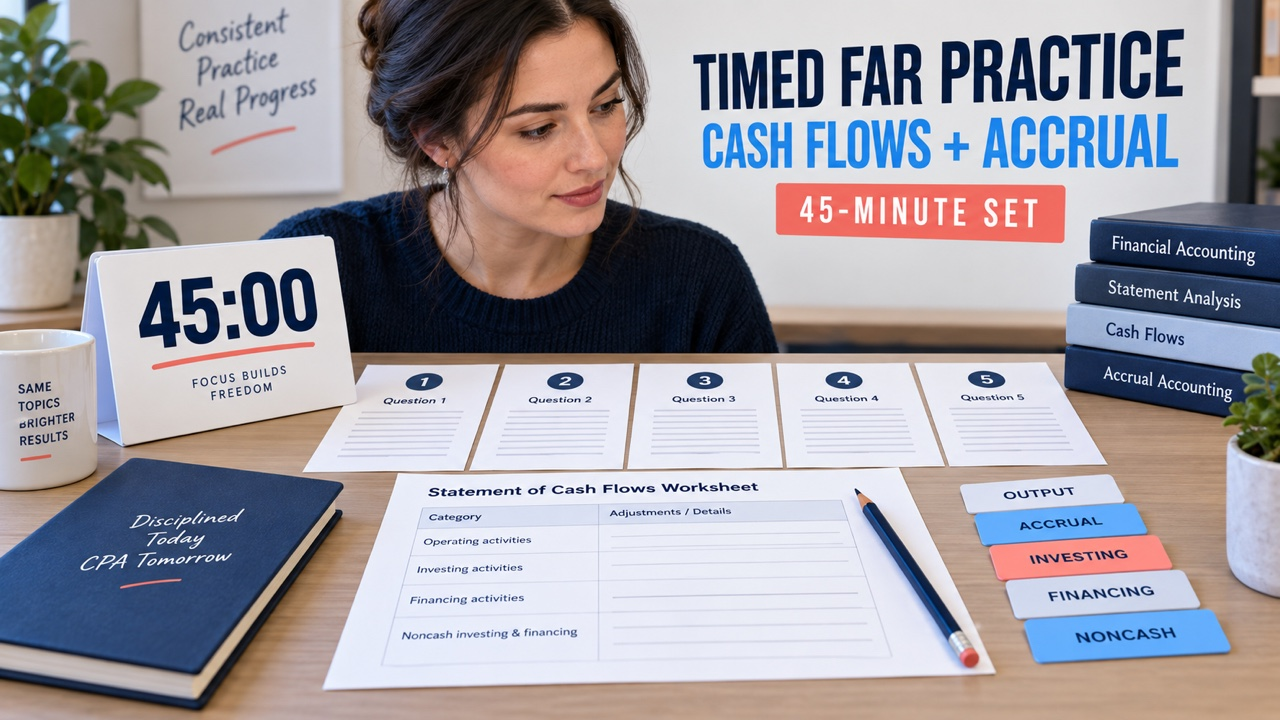

timed far cash flows practice works best when the clock measures a repeatable process, not just how fast you can type. In this original set, name the requested output, isolate the controlling accrual fact, place the activity lane, and explain the noncash boundary before you worry about speed. Use this timed far cash flows practice loop as a local diagnostic method, not an official CPA Exam score or a promise that you will pass.
Quick answer: For this timed far cash flows practice, use five minutes to name the output, ten minutes to build an accrual bridge, ten minutes to place the activity lane, ten minutes to check noncash treatment, and ten minutes to explain the first broken field. Then complete five original prompts under one timer. Review the reasoning only after the attempt, and schedule one changed-fact retry instead of rereading every FAR chapter.
Timed FAR cash flows practice: what the clock should test
Tested skill: move from a mixed cash-flow and accrual fact pattern to the exact answer the prompt requests. That may be cash from operations, a cash payment, a financing movement, an adjustment to an indirect-method bridge, or a noncash disclosure boundary. The timer should reveal which field breaks first; it should not turn a local practice result into a readiness claim.
Assumptions: the original prompts use simplified calendar-year nongovernmental entities, short calculations, and no unusual tax, industry, method, presentation, or effective-date exception. Therefore, reopen current guidance when a real question changes those facts. The current AICPA CPA Exam Blueprint resource sets the scope boundary, while the AICPA sample tests support format rehearsal rather than a local score.
Difficulty: moderate. The arithmetic is short, but the same fact can touch net income, a working-capital adjustment, an activity classification, and a noncash conclusion. For example, a correct $31,000 amount is still a wrong answer if the prompt asks for the investing lane and you label it operating. Track the first broken field, not only the final total.
Set up the timed FAR cash flows practice
Use one blank page with four headings: OUTPUT, CONTROLLING FACT, LANE, and NEXT RETRY. Set a 45-minute timer and keep one short calculator or scratch-paper rule: write the route before computing the total. If you finish early, spend the remaining time explaining one distractor rather than opening another random question.
Minute 0-5: name the output for timed FAR cash flows practice
First, underline the prompt verb. “Cash provided” points to a cash bridge. “Cash paid” points to a payment and its activity lane. “Net financing” points to borrowing and principal repayment. “Treatment” may signal that no cash moved. Write the requested output in one line before you copy any amount from the fact pattern.
Minute 6-15: build the accrual bridge
Next, start with the stated profit measure when the exercise uses an indirect-method bridge. Add back noncash expense, then adjust operating working-capital changes in the direction supported by the fact. An increase in receivables usually consumes cash in a simplified bridge; an increase in an operating payable usually supplies cash. Mark any accrued amount that is recognized but not paid.
Minute 16-25: place the activity lane
Now sort the movement before you chase a total. Operating facts belong in the operating bridge under the stated exercise. Cash paid for long-lived assets is an investing candidate. Borrowing, principal repayment, equity cash, and distributions are financing candidates. A lane label is evidence; it is not decoration added after the arithmetic.
Minute 26-35: check noncash in timed FAR cash flows practice
Then ask whether cash moved at all. An asset acquired by issuing shares directly may need noncash treatment even though the fair value is easy to calculate. An accrued expense can change an indirect bridge without a same-day cash payment. Write “cash moved” or “no cash moved” beside the controlling fact so the final answer does not silently cross that boundary.
Minute 36-45: explain and mark the timed FAR cash flows practice retry
Finally, explain the nearest distractor in one sentence. When the number is right but the output is wrong, mark output. If the sign or accrual direction is wrong, mark adjustment. When the cash movement lands in the wrong statement lane, mark activity. For a no-cash exchange treated as a cash flow, mark noncash. Stop the review when you can name the first broken field and the one changed fact you will retry.

Checkpoint: the timer is doing useful work when you can show a requested output, one controlling fact, a lane or noncash boundary, and a next retry for every missed item. A faster blank answer is not better evidence than a slower answer with a traceable route.
Original timed FAR cash flows practice prompts
These five prompts are original CPA Exam Prep editorial exercises and are not copied from a test provider. Set the 45-minute timer, complete every prompt, and write your four fields before opening the answer. Use the same assumptions stated above unless a prompt says otherwise.
Prompt 1: Harbor Ledger operating bridge
Harbor Ledger reports net income of $68,000. Depreciation is $7,500, accounts receivable increases by $4,000, and accounts payable decreases by $1,500. Under a simplified indirect-method presentation, what is cash provided by operating activities?
Prompt 2: Northstar accrued utilities
Northstar Fabrication records a $3,200 utilities expense that remains unpaid at period-end. Under the same simplified indirect-method presentation, what is the effect of the accrued utility amount on cash from operations, and what fact controls the direction?
Prompt 3: Cedar Ridge equipment
Cedar Ridge pays $31,000 cash for testing equipment. Which amount and activity lane describe the purchase-date cash effect? Ignore later depreciation.
Prompt 4: Blue Harbor debt movement
Blue Harbor borrows $55,000 in cash and repays $20,000 of principal during the same period. Ignore interest. What is the net financing cash flow?
Prompt 5: Pine Grove share-for-land exchange
Pine Grove acquires land with a fair value of $18,000 by issuing shares directly to the seller. No cash is paid at signing. What treatment fits the stated facts?
Reveal the timed practice answers
Set a 45-minute timer, complete all five prompts, and write the requested output, controlling fact, lane, and one distractor before opening the answers.
Reveal the answer
Answer: Harbor Ledger CFO is $70,000; Northstar's accrued utilities increase the indirect-method CFO by $3,200; Cedar Ridge is a $31,000 investing outflow; Blue Harbor is a $35,000 financing inflow; Pine Grove is a noncash share-for-land exchange.
Compare your process with the reasoning shown above.
Review the timed FAR cash flows practice without chasing a score
After the timer ends, compare your route with the reasoning below. In timed far cash flows practice, Harbor Ledger is $70,000 of operating cash: $68,000 + $7,500 – $4,000 – $1,500. The receivables increase consumes cash, while the payable decrease also reduces the bridge. Northstar’s unpaid $3,200 expense is an accrued operating liability: in this simplified indirect exercise, the amount is added to operating cash because it reduced the stated expense-based profit without a cash payment.
Cedar Ridge is a $31,000 investing outflow because the prompt asks for cash paid for a long-lived asset. Blue Harbor is a $35,000 financing inflow because $55,000 borrowed less $20,000 repaid equals $35,000. Pine Grove is a noncash share-for-land exchange at the acquisition date because no cash moved, even though the land has an $18,000 fair value.
The most useful review question is not “What percentage did I get?” It is “Where did the route first break?” A wrong total after a correct output and lane points to an adjustment review. A correct total in the wrong lane points to an activity review. A fair value treated as cash points to a noncash review. Record one ignored fact, one correction, and one changed-fact retry.

Output errors: reread the verb
If you answered a different question than the prompt asked, run a five-minute scan of the verbs “provided,” “paid,” “net financing,” and “treatment.” Complete one short fact pattern without calculating until the requested output is written at the top.
Adjustment errors: isolate the accrual direction
If the bridge sign is wrong, run a 10-minute drill with one receivable, one payable, and one accrued expense. For each line, write whether the balance change supplied or consumed cash in the stated indirect-method exercise. Change one direction only on the retry.
Activity errors: sort before totaling
If the amount is right but the statement lane is wrong, run a 10-minute sort for operating, investing, and financing movements. Keep the amount hidden until every movement has a lane label. Then explain why the nearest lane was tempting.
Noncash errors: separate value from cash
If you treated the share-for-land exchange as a cash payment, rewrite the fact as two fields: fair value and cash paid. Run one changed-fact retry where the seller receives cash, then state exactly what changed in the treatment.
Run a second timed FAR cash flows practice round with one changed fact
Do not immediately start another mixed set. For a timed far cash flows practice retry, change one controlling fact from the item that broke first. Harbor Ledger is a useful variant: change the receivables increase to a decrease and explain why the bridge moves by $8,000 relative to the original fact. Next, change Northstar’s utilities amount from unpaid to paid and explain why the accrued-liability adjustment disappears. Finally, change Pine Grove’s share issuance to a cash payment and explain why the noncash boundary changes.
With 20 minutes, do one output scan, one bridge, one lane sort, and one changed-fact explanation. At 45 minutes, repeat the full five-stage route with three new facts. With 75 minutes, complete a second round plus a 15-minute source-refresh note for any fact that depends on entity type, method, reporting date, disclosure scope, or effective date.
Keep this local record separate from official scoring. The FASB Accounting Standards Codification is the current research entry point when the simplified assumptions no longer control. The CPA FAR review hub can provide broader study context, but this page stays focused on timed cash-flow and accrual practice.
Timed FAR cash flows practice FAQ
Is my timed percentage an official CPA Exam score?
No. A local percentage can help you choose a repair, but it is not an AICPA score, a readiness measure, or a pass probability. Save the first broken field beside the percentage so the next block changes something concrete.
Should I use a calculator during timed practice?
Use the same permitted setup you intend to rehearse, but do not let a calculator replace the route. Write the requested output, controlling fact, and lane before pressing through a total.
What if I run out of time before the explanation?
Record the last completed field and the missing field. If you named the output and lane but did not explain the distractor, the next block should protect explanation time rather than add more random questions.
When should I check official accounting guidance again?
Check the current Blueprint when scope or skill language changes. Check current FASB guidance when entity type, reporting date, method, presentation, disclosure scope, or effective-date facts change.