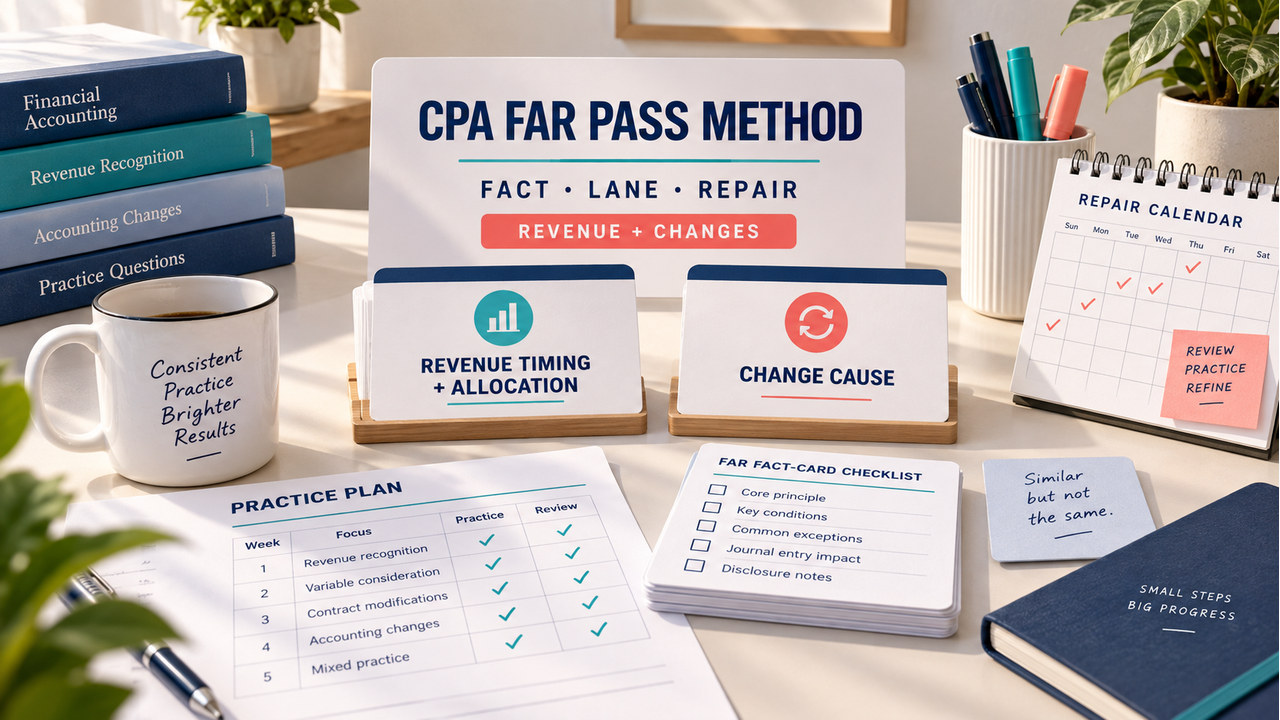

Direct answer: To pass revenue recognition and accounting changes on CPA FAR, use a fact-first loop: define the output, route the lane, practice one controlling fact, and let each miss choose the next review block. This method makes no outcome promise.
These simplified cases use the current AICPA Blueprint as a scope check and current FASB guidance as the technical boundary. The questions, calculations, answer choices, and prompts are original editorial practice content. For the wider section route, visit the FAR review hub.
Editorial review note: Written by the CPA Exam Prep study-content team and checked for terminology, arithmetic, internal consistency, and learner usefulness. Reopen the current Blueprint and Codification when an effective date, transition rule, contract fact, or entity-specific issue changes.
Pass revenue recognition by defining the work
A pass goal becomes useful when it changes the next study block. Do not begin with “finish revenue.” Begin with an observable decision such as “identify the promise,” “separate payment from performance,” “allocate the transaction price,” or “classify the cause of a changed amount.” The verb gives you evidence before you look at a score.
Pass revenue recognition: name the required output
Before reading every date in a long stem, underline the output: earned revenue, a remaining contract liability, an allocated amount, a depreciation amount, a classification, a correction, or a transition step. A stem can contain several numbers that are true but irrelevant to the requested output. Writing the output first reduces the chance that you calculate a correct number for the wrong question.
Revenue recognition: use a process target instead of a result promise
A useful target is “complete two original timing cases and explain the controlling fact without notes.” A weak target is “be ready to pass tomorrow.” That creates evidence, not pressure. Keep the distinction visible in your notes, because neither a local percentage nor a practice streak is an official exam score or readiness forecast.
Build a two-lane map for revenue and changes
Revenue-recognition questions and accounting-change questions can appear in the same FAR study session, but they do not use the same first decision. The revenue lane asks when a promise is satisfied and how a transaction price is assigned. The change lane asks why a reported amount or method changed. Start with the lane before choosing a rule.
Revenue recognition lane: timing and allocation
Put payment date, performance or transfer date, standalone selling prices, and the pattern of delivery on the first side of your page. Payment is not automatically performance. A printed invoice is not automatically the amount earned. If several promises exist, allocate first and then apply each promise’s transfer pattern. Keep the facts simple enough that the mistake comes from the lane, not arithmetic noise.
Revenue recognition lane: estimate, principle, and error
Put new evidence, an acceptable method switch, and an available omitted fact on the second side. New information may point toward an estimate question. A move between acceptable principles may need principle-change research. A fact already available but omitted may require error analysis. These are study-routing labels, not universal treatments; research materiality, disclosure, effective date, and transition requirements when a live fact pattern requires them.

Use a weekly pass plan with visible evidence
A short cycle is easier to audit than an oversized promise. Use four blocks across a week, then repeat the cycle with the weak lane receiving the most time. Each block can be 30 to 45 minutes; if time is tight, reduce examples but keep the target, controlling fact, rationale, and next action.
Pass revenue recognition: scope and output identification
Start by checking the current AICPA Blueprint boundary for the FAR area, group, topic, task statement, skill, and item type that frame your work. Then complete three short stems in which you write only the requested output. Do not begin by rereading every definition. The goal is to learn what the question is asking before you spend effort on the calculation.
Pass revenue recognition: revenue timing and allocation
Work one service-period case and one bundle case. For the service case, write the delivery period before multiplying. For the bundle, write standalone prices and an allocation basis before recognizing any transferred promise. Explain the nearest distractor in one sentence. That explanation is more useful than copying the answer letter.
Pass revenue recognition: change-cause classification
Sort three short cases into new evidence, acceptable method change, and available omitted fact. For each case, write the next source question rather than a memorized conclusion. For example: “Which transition guidance applies?” or “Was the information available before issuance?” The question you ask next is the control that keeps a study shortcut from becoming a technical error.
Pass revenue recognition: mixed and repair work
Complete one timing item and one change-cause item under a modest time limit. Mark the first decision that broke: output, lane, controlling fact, calculation, or presentation research. Then change only that fact in a new mini-case. A repair case should be different enough to test transfer, not a copy of the original wording.

Practice revenue with one controlling fact
Short calculations are valuable when they force a decision about which fact controls the answer. Keep a simple fact card with payment date, transfer or performance date, standalone prices, and the delivery pattern. Then state the fact that makes your answer different from the nearest distractor.
Revenue recognition case one: separate payment from performance
Harbor receives $84,000 on January 1 for twelve months of even stand-ready support. Seven months are delivered by July 31. Under the simplified facts, $84,000 ÷ 12 × 7 = $49,000 earned, and $35,000 remains for undelivered service. The controlling fact is the delivered service period, not the cash date. If you selected $84,000, your next block is two prepayment cases with different delivery months.
Revenue recognition case two: allocate before timing
Summit sells equipment and four months of training for $260,000. Standalone prices are $200,000 for equipment and $80,000 for training. Equipment transfers immediately, and one month of training is delivered. First assign the stated amounts to the two promises. Then recognize one month of training: $80,000 ÷ 4 = $20,000. A full-invoice answer skips allocation and the training pattern. If you chose it, schedule one bundle case with different standalone prices before another timing case.
Classify accounting changes by cause
When an amount or method changes, ask “What caused the change?” before asking “How do I present it?” The following cases are original routing practice. They are intentionally simplified so that you can inspect the first decision, then reopen authoritative guidance for a real conclusion.
New evidence: update the estimate lane
A machine has a $96,000 carrying amount and no residual value at the beginning of Year 4. New production evidence changes the remaining useful life to six years. Under the simplified facts, the next-period depreciation is $96,000 ÷ 6 = $16,000. The controlling fact is new evidence about the remaining estimate. Your next study verb is estimate, followed by a source check on the applicable treatment.
Acceptable method switch: research the principle lane
Suppose an entity changes from one acceptable inventory-costing method to another under the stated facts. Start with classify; do not jump directly to a universal prospective or retrospective answer. Check the relevant guidance, effective date, permitted alternatives, transition rule, and disclosure requirements. If your answer was based only on the label “method change,” your repair case should change the available methods while holding the reporting period constant.
Available fact: investigate the error lane
Suppose a vendor invoice was in the accounting team’s records before the financial statements were issued but was omitted from the prior-period file. The availability date points first toward correct and error analysis, not automatically toward a new estimate. Research materiality, correction, comparative-period, and disclosure effects. Your next case should change only when the information became available.
Run a timed mixed set with distractor review
Timing work is not just answering faster; it is preserving decision order when the stem is dense. Use three passes: orient, solve, and review. Keep the timer modest enough to explain the miss afterward.
Revenue recognition pass one: orient to the output and lane
Read the final question first and name the output. Next, mark whether the controlling lane is timing/allocation or change-cause classification. Circle one fact that could change the answer. Ignore decorative dates until you know why they matter. This takes only a few seconds but prevents a long stem from setting your route for you.
Revenue recognition pass two: solve and label the distractor
Write the equation, allocation basis, or classification trigger before selecting an answer. Then write why the nearest distractor fails. A distractor may use the cash date, the full invoice, a new-estimate label, or an automatic transition rule. Naming the trap makes the next practice set specific.
Revenue recognition pass three: repair the first broken decision
Do not restart the entire chapter after one miss. Record the first broken decision and schedule a changed-fact retry within the next two study sessions. If the calculation was correct but the lane was wrong, repeat the lane split. If the lane was correct but the source boundary was uncertain, repeat the case with a research question attached.
Use original checkpoints before the explanation
Attempt each check before opening the reasoning. These are original editorial practice questions, not official exam items. Write the controlling fact beside your answer.
Checkpoint 1: what amount is earned?
Orchid receives $72,000 for twelve months of even support. Five months are delivered. What simplified amount is earned?
- $72,000
- $30,000
- $42,000
- $6,000
Reveal Checkpoint 1 reasoning
Correct answer: B. $72,000 ÷ 12 × 5 = $30,000. The next action is two delivery-period drills if you selected A or C.
Checkpoint 2: what comes before timing?
Maple sells equipment and training for $300,000. Standalone prices are $210,000 and $90,000; two of six training months are delivered. What should you do first?
- Recognize the full invoice when the equipment transfers
- Allocate the transaction price, then apply each promise’s transfer pattern
- Wait until all training is complete
- Use the printed invoice lines without checking standalone prices
Reveal Checkpoint 2 reasoning
Correct answer: B. Allocation comes before the timing analysis for each promise. The next action is one bundle case with a changed standalone price.
Checkpoint 3: which change lane comes first?
An invoice was available before issuance but omitted from prior-year records. Which lane should you investigate first?
- New estimate
- Acceptable principle switch
- Prior-period error analysis
- Future revenue timing
Reveal Checkpoint 3 reasoning
Correct answer: C. The information-availability date is the controlling fact. The next action is to compare one available-fact case with one genuinely new-evidence case.
Record a score that changes the next block
A percentage is useful only when it routes the next study action. Record the number completed, correct without notes, lane, controlling fact, nearest distractor, and repair verb. Then choose one next block; do not turn the record into an official score claim.
Turn the first miss into a specific retry
For each miss, record the item number, confidence before the reveal, fact ignored, distractor chosen, repair verb, and scheduled follow-up. Change one fact only. Then explain the new answer without copying the first case. The purpose is transfer: you want to know whether the controlling fact moved with the case.
Pass revenue recognition: FAQ and refresh note
Should revenue recognition and accounting changes be studied together?
Keep them in one weekly plan so you practice switching, but keep the trigger drills separate until you can name the controlling fact. Mixed work belongs after the lane-specific practice, not before it.
Revenue recognition: how much time should one study block take?
Use 30 to 45 minutes as a starting point. If your time is shorter, keep the output target, one fact, a brief rationale, and a next action while reducing the number of examples. The method stays diagnostic even when the block is small.
Revenue recognition: when should I check current guidance?
Reopen the current AICPA Blueprint and FASB Codification when a question turns on an effective date, transition, contract detail, variable consideration, entity-specific presentation, materiality, disclosure, or a method that may have changed. This article organizes practice; it does not replace authoritative guidance.
Pass revenue recognition: sources
Current tested-content boundary: AICPA CPA Exam Blueprints. Revenue framework background: FASB Revenue Recognition project summary. Technical refresh: FASB Accounting Standards Codification. Candidate-process routing: NASBA CPA Exam FAQ. The team checked these pages September 23, 2026. Reopen current guidance when the contract, entity, reporting date, accounting method, or transition fact changes. The examples, calculations, answer choices, rationales, and review prompts are original editorial study content.