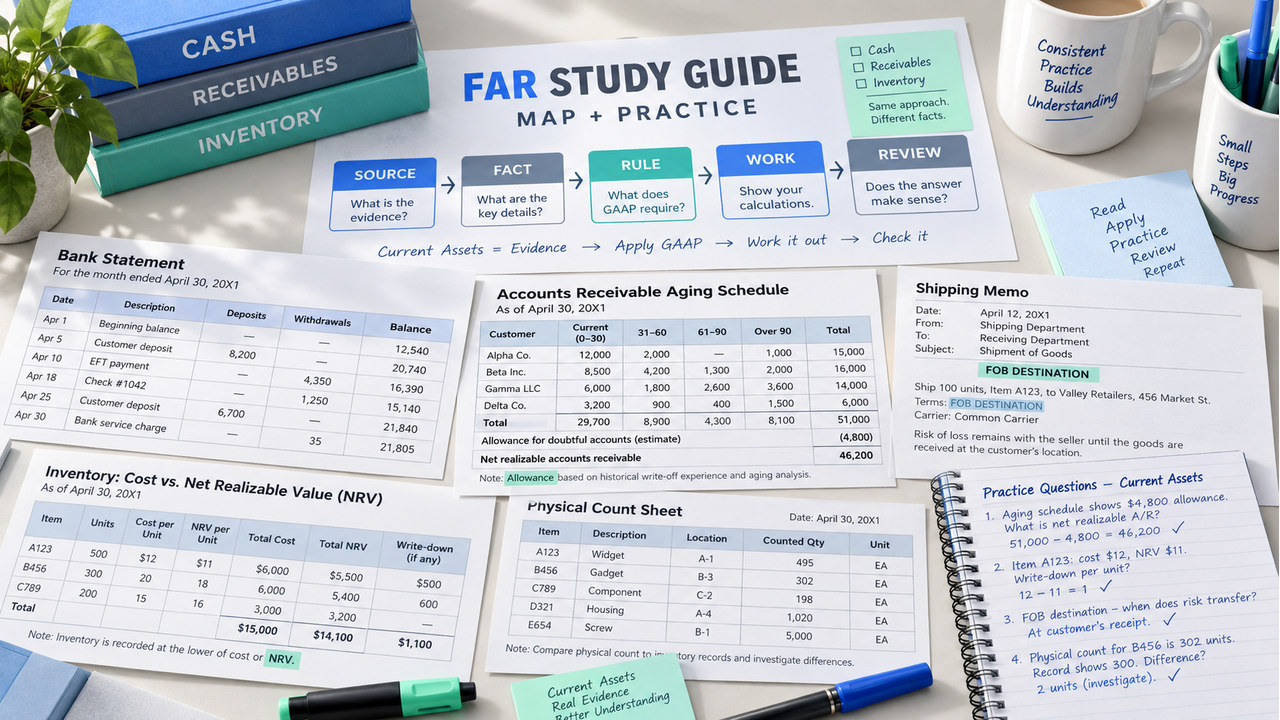

Direct answer: Use this cash receivables inventory study guide in four passes: identify the record that carries the fact, name the rule trigger, show the small calculation or classification, and schedule the next review block. The guide then tests the method with five original current-asset cases.
Editorial boundary: This is original study material, not live provider material, provider-owned questions, an exam score, or a pass prediction. The cases, amounts, rationales, visual boards, score route, and retry are written for practice.
Current-asset questions feel connected because they all use dates, balances, and supporting records, but the controlling lane changes quickly. A bank statement tests timing, an aging schedule tests an allowance target, a shipping term tests ownership, an NRV comparison tests measurement direction, and a count sheet tests quantity. For broader navigation, visit the FAR review hub; for current scope, reopen the Blueprint and Codification named at the end of this guide.
How to use the cash receivables inventory study guide
Start with a blank page divided into five columns: source, fact, rule, work, and review. The source is the document or record that owns the fact. The fact is the date, amount, term, or count. The rule is the decision trigger. The work is the arithmetic or classification. The review column names what you will do when the item is wrong.
Use the same sequence for all three topic groups. In cash, write bank statement and book activity before adjusting either side. In receivables, write the existing allowance balance and required ending balance before calculating expense. In inventory, write the ownership term, measurement input, or count evidence before choosing a number. This prevents a familiar formula from replacing the actual fact pattern.
- Source: circle the record that controls the assertion.
- Fact: underline the date, term, balance, or measurement input that changes the answer.
- Rule: state the decision in a short verb such as reconcile, target, include, compare, or investigate.
- Work: show one line of arithmetic or classification before looking at a rationale.
- Review: name the first broken field and assign one short repair block.
Do not mark an item secure because the final amount looks familiar. A correct amount with the wrong source lane is fragile; a changed date, shipping term, or opening balance can expose it immediately. The aim of this guide is transfer: the method should survive a new number.

Build a current-asset evidence lane
Cash: reconcile two records without mixing adjustments
Keep bank-side timing items separate from book-side recording items. Deposits in transit and outstanding checks explain why the bank statement differs from the books; service charges and interest change the books. Reconcile each side independently, then compare the adjusted totals. The common error is to put a bank timing item into book cash or to subtract a check from the wrong side.
Receivables: move the allowance to its target
An allowance question is usually a movement question. Write the required ending credit balance, identify the existing balance and its direction, and calculate only the movement needed to reach the target. Net receivables use gross receivables minus the required ending allowance, not gross receivables minus the expense movement.
Inventory: separate ownership, value, and quantity
Ownership asks who includes goods at the reporting date. Valuation asks whether the stated measurement comparison requires a write-down. Quantity asks why the record and physical count differ. These lanes can appear in the same chapter, but they are not interchangeable. Label the lane before you calculate.
Original FAR cash receivables inventory study guide practice set
How to use the set: Attempt all five cases before opening the rationales. For each answer, write the source record, the rule verb, and the nearest distractor. The assumptions are intentionally narrow so one skill stays visible; reopen current guidance when a real fact pattern adds a complication.

Case A — Reconcile bank timing and book activity
Question: The December 31 bank statement shows $84,200. A deposit of $2,750 is in transit and outstanding checks total $1,180. Book cash is $86,010 before a $315 service charge and $75 of bank interest are recorded. What adjusted cash balance should both sides show?
Answer A and rationale
Answer: $85,770. The bank side is $84,200 + $2,750 − $1,180 = $85,770. The book side is $86,010 − $315 + $75 = $85,770. The nearest distractor records the deposit in transit on the books or treats the outstanding checks as a book deduction. The source lane is bank-versus-book timing, and the repair verb is reconcile.
Case B — Move an allowance to its target
Question: Gross accounts receivable are $214,000. The allowance currently has a $3,400 credit balance, and the required ending credit balance is $10,600. What bad-debt expense and net receivables follow under the stated facts?
Answer B and rationale
Answer: $7,200 expense and $203,400 net receivables. Expense is the movement from the existing credit to the required credit: $10,600 − $3,400 = $7,200. Net receivables are $214,000 − $10,600 = $203,400. The nearest distractor records the full $10,600 as expense and ignores the opening credit. The broken field is the opening balance, so the repair verb is target.
Case C — Apply FOB destination to ownership
Question: Goods costing $12,400 were shipped to a buyer on December 29 under FOB destination and arrived January 3. Under the stated simplified facts, should the buyer include the goods in December 31 inventory?
Answer C and rationale
Answer: No, exclude $12,400 from the buyer’s December 31 inventory. Under the stated term, the buyer does not take the relevant ownership position until destination, so the arrival date matters here. The nearest distractor applies FOB shipping point automatically because the goods left the seller before year-end. The broken field is ownership, so the repair verb is classify.
Case D — Compare cost with NRV
Question: Under the simplified measurement rule supplied for this guide, an inventory group has recorded cost of $48,200 and NRV of $46,900 at year-end. No other complication is supplied. What write-down and ending amount follow?
Answer D and rationale
Answer: $1,300 write-down and $46,900 ending inventory. The stated comparison is $48,200 − $46,900 = $1,300. The nearest distractor leaves cost unchanged because the count did not change. The broken field is measurement direction, so the repair verb is compare. Reopen current guidance if the inventory category or measurement rule changes.
Case E — Explain a physical-count overage
Question: The perpetual inventory record supports $39,760 at cost, while the verified physical count supports $40,120. The prompt supplies no ownership or valuation issue. What amount should the learner investigate?
Answer E and rationale
Answer: Investigate a $360 quantity overage. The difference is $40,120 − $39,760 = $360. Under the stated facts, verify count accuracy, cutoff, receiving records, and shortage or overage treatment before making a conclusion. Do not turn a quantity difference into a valuation answer. The broken field is quantity, so the repair verb is verify.
Score the cash receivables inventory study guide
Give one point only when both the answer and the evidence lane are correct. A 0–2 result means rebuild the five-column map with one case at a time. A 3–4 result means target the first broken field and repeat that lane with a changed amount. A 5 means the sequence is working; keep it and test transfer with one changed fact.
Important: this is a local study signal, not an official CPA score or pass prediction. Its value is the review decision it creates.
Review study-guide errors by evidence field
When an answer is wrong, do not rewrite the entire chapter. Record the case, source record, fact, rule trigger, work line, answer chosen, nearest distractor, first broken field, and next ten-minute review block. Case A points to bank-versus-book timing. B points to the allowance opening balance. C points to the shipping term and ownership date. D points to measurement direction. E points to quantity and cutoff.
If the letter is correct but the explanation is missing, keep the case open. A durable answer can name the source record, state the rule verb, and explain why the nearest distractor loses. That standard is more useful than a percentage that hides the broken field.
Retry one fact after the study guide
Change only Case B’s existing allowance balance from a $3,400 credit to a $2,100 credit. Keep gross receivables and the required ending credit balance unchanged.
The target remains $10,600, so net receivables remain $203,400. The expense movement becomes $10,600 − $2,100 = $8,500, which is $1,300 higher than the original $7,200. If your answer changes net receivables instead of the expense movement, return to the allowance lane and label the opening balance before calculating.
What to write when a study session ends
If time runs out, preserve the map rather than guessing. Write the source record and rule verb for the unfinished case. For example, “shipping memo—destination—classify ownership” is a useful handoff to the next session. Then reveal the rationale and compare your missing field with the answer path.
If you finish early, change one fact and recalculate only the affected lane. Do not change the date, term, amount, and measurement rule at once. A controlled change shows whether the reasoning transfers or whether the learner memorized the original number.
Cash receivables inventory study guide FAQ
Should I study all three topics in one sitting?
Use one sitting to build the map, but separate the repair blocks. Cash timing, allowance movement, ownership, valuation, and quantity are different evidence lanes even when they appear in the same FAR section.
What if I remember the formula but not the source record?
Pause before calculating and name the record first. The source record often determines which side changes, which balance is a target, or whether the question is about ownership, value, or quantity.
How often should I refresh this guide?
Recheck the current Blueprint and Codification when the exam scope, reporting guidance, shipping term, allowance model, cost-flow method, or measurement rule changes. Keep the study method, but update any fact-specific conclusion that depends on current guidance.
Sources and refresh note for the study guide
Use the AICPA CPA Exam Blueprints for current scope and item-type boundaries, the FASB Accounting Standards Codification for current accounting guidance, and the NASBA exam FAQ for current exam-administration questions. These references were checked September 23, 2026. Recheck them before reusing a fact-specific example after a Blueprint or guidance change.
Next action: Draw the five-column evidence map, attempt the five cases without notes, record the first broken field, and complete the controlled allowance retry. Keep the sequence visible: source, fact, rule, work, review.
Sources and update log
- AICPA CPA Exam Blueprints
- AICPA CPA Exam sample tests
- FASB Accounting Standards Codification
- NASBA CPA Exam FAQ
Refresh trigger: Recheck the live Blueprint or Codification when scope, reporting date, shipping term, allowance method, cost-flow method, or measurement rule changes.