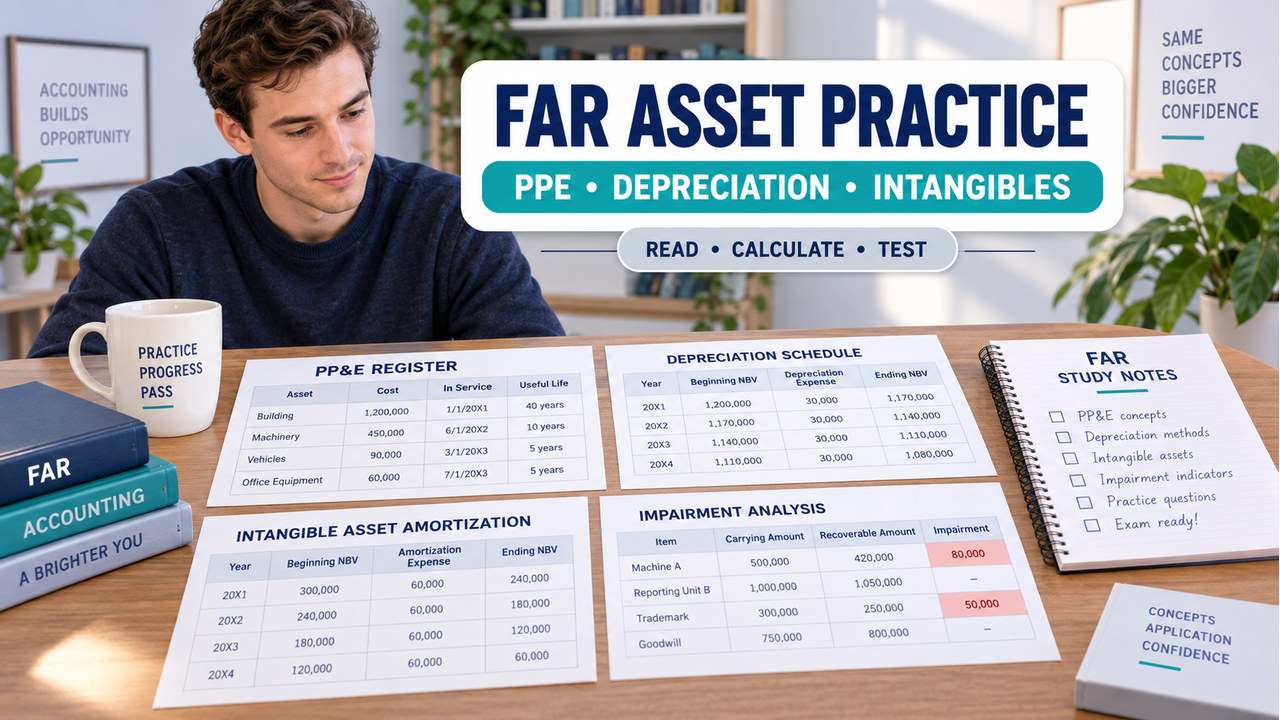

Direct answer: First, the safest way to use impairment practice questions on FAR assets is to identify the asset lane before doing the math: build the PPE cost basis, mark the placed-in-service date, calculate depreciation or amortization, then test the correct impairment trigger. A familiar formula cannot rescue an answer built on the wrong asset class or the wrong clock.
Editorial review note: This page was checked by the CPA Exam Prep study-content team for terminology, arithmetic, internal consistency, source boundaries, and learner usefulness. The cases, amounts, prompts, answers, distractors, and retry are original editorial practice, not official or copied exam content.
These FAR PPE, depreciation, intangible, and impairment examples use simplified assumptions so the controlling fact stays visible. In practice, the current AICPA CPA Exam Blueprint and current FASB Accounting Standards Codification define the live boundary. For broader routing, visit the FAR review hub, and reopen current guidance when a real fact pattern adds an asset group, disposal classification, tax effect, or other assumption not stated here.
Impairment practice questions: map the asset before the math
First, before attempting a question, write five labels in the margin: ASSET, BASIS, CLOCK, TRIGGER, and OUTPUT. This short map prevents a depreciation calculation from being used where the question is really asking for an impairment test.
- Name the asset: Decide whether the fact describes tangible PPE, a finite-lived intangible, an indefinite-lived intangible, or a held-and-used asset group.
- Set the basis: Separate costs that get the asset ready for intended use from training, repairs, or other items the prompt says to expense.
- Mark the clock: Circle the placed-in-service date, acquisition date, useful life, residual value, or reporting date.
- Choose the trigger: Ask whether the task is periodic depreciation, amortization, a finite-life impairment review, an indefinite-life test, or the recoverability screen for a long-lived asset.
- State the output: Finish with the expense, carrying amount, impairment loss, or next evidence check the question actually requests.
Use this order even when the numbers look easy. For example, the nearest distractor is often a correct formula applied to a cost that includes an excluded item, a full-year charge applied to a partial year, or a fair-value comparison made before the recoverability gate.

Separate PPE depreciation from intangible amortization and impairment
Property, plant, and equipment is tangible and normally depreciated over its useful life after it is ready for intended use. By contrast, a finite-lived intangible is amortized over its useful life under the stated assumptions. At the same time, an indefinite-lived intangible is not amortized while its life remains indefinite, but it still requires the applicable impairment analysis. The labels are not interchangeable, so identify the asset before selecting the equation.
Use the cost basis and service date for PPE
For a simplified straight-line question, the annual depreciation formula is (depreciable basis − salvage value) ÷ useful life. In addition, the depreciable basis is the amount needed to acquire the asset and make it ready for its intended use. For example, freight, installation, and site preparation may belong in the basis when the prompt supports them. Training, start-up waste, or routine repairs may be excluded when the stated assumptions say so.
Next, use the placed-in-service date to determine the period charge. An asset purchased on January 1 is not the same as an asset ready for use on April 1. If the question says the entity records depreciation for nine months, calculate the annual amount first and then apply 9/12. As a result, do not let the invoice date silently replace the service date.
Use useful life for a finite-lived intangible
A patent or license with a stated finite life generally follows an amortization path in a simplified practice question. Likewise, subtract any stated residual value, divide by the useful life, and use the acquisition or availability date that the question gives. Then compare the ending carrying amount with the amount requested. For that reason, if the prompt changes the useful life because of new information, keep the remaining carrying amount and remaining period visible instead of restating earlier years by reflex.
Use impairment practice questions to test the right gate
For a held-and-used long-lived asset, the simplified US GAAP path is a recoverability screen using undiscounted cash flows followed by measurement at fair value when the carrying amount is not recoverable. For an indefinite-lived intangible, the question may move directly to a carrying-amount-versus-fair-value comparison under the applicable guidance. In other words, these are different lanes. Do not use a finite-life amortization formula to answer either impairment question.
However, real accounting research may require asset-group definition, allocation, qualitative assessment, disposal classification, disclosures, and current Codification details. The cases below deliberately hold those facts constant so the tested skill remains visible.
Original FAR PPE, depreciation, intangibles, and impairment practice questions
Attempt each case before opening the reveal. For every prompt, write the five labels, show one line of work, and name the nearest distractor. These are original practice items; they are not official CPA Exam questions and are not copied from any exam source.
Case 1 — Build the PPE cost basis before depreciating
Question: A company buys manufacturing equipment for $590,000, pays $12,000 for freight, and pays $18,000 for installation. Employee training costs $9,000 and is expensed under the stated facts. The equipment has a $20,000 salvage value and a ten-year straight-line life. What is annual depreciation?
Reveal Case 1 answer and reasoning
Answer: $60,000. First, the equipment basis is $590,000 + $12,000 + $18,000 = $620,000. Next, subtract the $20,000 salvage value and divide $600,000 by ten years. The training amount is the distractor: it is not part of the basis under the stated assumption. If you included it, you would calculate the wrong depreciable amount even though the formula itself is familiar.
Case 2 — Apply the placed-in-service clock
Question: A machine has a $450,000 basis, no salvage value, and a ten-year straight-line life. It is placed in service on April 1, Year 1, and the entity records depreciation for the period in service. What is Year 1 depreciation?
Reveal Case 2 answer and reasoning
Answer: $33,750. First, the annual amount is $450,000 ÷ 10 = $45,000. Then, the machine is in service for nine months, so $45,000 × 9/12 = $33,750. The distractor is the full $45,000 annual amount. The clock begins with the stated in-service assumption, not with an automatic full-year charge.
Case 3 — Amortize a finite-lived patent
Question: A company acquires a patent on January 1, Year 1, for $300,000. The patent has a five-year finite useful life and no residual value under the simplified facts. What is Year 1 amortization and the ending carrying amount?
Reveal Case 3 answer and reasoning
Answer: $60,000 of amortization and a $240,000 ending carrying amount. Divide $300,000 by five years to get $60,000. Then subtract one year of amortization from the $300,000 opening amount. As a result, the ending carrying amount is $240,000. The distractor is to treat the patent as an indefinite-lived asset merely because it is intangible. The stated finite life controls the calculation.
Case 4 — Test an indefinite-lived trademark separately
Question: A trademark has an indefinite useful life and a carrying amount of $410,000 at the reporting date. The applicable impairment evidence gives a fair value of $360,000. Under the simplified facts, what impairment loss follows?
Reveal Case 4 answer and reasoning
Answer: $50,000. Here, subtract fair value from carrying amount: $410,000 − $360,000 = $50,000. The question is a fair-value comparison for an indefinite-lived intangible; it is not a periodic amortization question. In other words, the nearest distractor is to record no expense because no amortization was recorded. “Indefinite-lived” removes amortization under the stated facts; it does not remove impairment testing.
Case 5 — Solve impairment practice questions through the recoverability gate
Question: A held-and-used asset group has a carrying amount of $1.05 million. Its undiscounted cash flows are estimated at $0.98 million, and its fair value is $0.90 million. Under the simplified two-step facts, what impairment loss is recognized?
Reveal Case 5 answer and reasoning
Answer: $150,000. First, the $0.98 million undiscounted cash flows are below the $1.05 million carrying amount, so the group fails the recoverability screen. Next, measure the loss as carrying amount less fair value: $1.05 million − $0.90 million = $0.15 million. The distractor is to use the $70,000 difference from the cash-flow screen as the loss. That amount is evidence that the asset is not recoverable, not the final fair-value measurement.
Review impairment practice questions by the first broken lane
After the reveals, score the reasoning path rather than only the number. In particular, mark each miss as basis, clock, life, trigger, or measurement. For example, a correct number with the wrong trigger still needs repair. The label should change your next ten-minute review block.
Retry impairment practice questions after one changed fact
Change only Case 1’s salvage value from $20,000 to $30,000. Keep the invoice, freight, installation, training treatment, and ten-year life fixed. The equipment basis remains $620,000. The new annual depreciation is ($620,000 − $30,000) ÷ 10 = $59,000.
This controlled retry tests whether you understand the variable or merely memorized $100,000. If more than one fact changes, the retry stops diagnosing the original error. In other words, preserve every fixed fact and write one new correction sentence.
Turn an asset-question miss into a specific review block
Use the table as a routing tool after the five cases. It is not a score prediction. As a result, a correct number with an unexplained lane remains provisional because one changed fact could break the method.
| First broken label | What it usually means | Next ten-minute block |
|---|---|---|
| Basis | Included a readiness cost or excluded an expense item incorrectly. | Rebuild one asset register with included/excluded columns. |
| Clock | Used a full year or purchase date without reading the service assumption. | Solve three partial-year depreciation prompts. |
| Life | Confused finite amortization with indefinite-lived testing. | Classify five assets before calculating any expense. |
| Trigger | Skipped the recoverability screen or tested the wrong condition. | Write the screen/evidence/measurement order from memory. |
| Measurement | Used the screen difference instead of the fair-value difference. | Complete two carrying-amount-versus-fair-value calculations. |

Research and refresh note
Use the current AICPA CPA Exam Blueprints to orient the tested FAR scope and the AICPA sample tests for software and format orientation. For current administration questions, consult the NASBA CPA Exam FAQ. For a live accounting conclusion, consult the FASB Accounting Standards Codification, including the applicable Topic 350 and Topic 360 guidance. The high-level FASB long-lived-asset summary and FASB Topic 350 release are orientation sources, not a substitute for the current Codification.
Also, the examples hold cost flow, tax effects, asset-group boundaries, and disposal status constant. Even so, reopen the live sources before reusing a fact-specific answer after a scope or guidance change.
Next action: Finally, attempt Case 1 and Case 5 again without notes. For each, write the asset class, the controlling clock or trigger, and the one fact that would change your answer before opening the reveal.
FAR PPE, depreciation, intangibles, and impairment FAQ
When does PPE depreciation begin in these practice questions?
Use the placed-in-service date supplied by the question. For example, if the asset is ready for intended use on April 1, calculate the annual amount first and apply the stated nine-month period rather than charging a full year automatically.
Are finite-lived intangibles amortized?
Under the simplified facts here, yes. Divide the depreciable or amortizable amount by the stated finite useful life and apply the acquisition or availability date. A real fact pattern may require current guidance and additional assumptions.
Does indefinite-lived mean no impairment test?
No. Indefinite-lived means no amortization while the life remains indefinite under the stated facts. The applicable impairment analysis still matters, and the prompt may ask for a carrying-amount-versus-fair-value comparison.
Why do impairment practice questions separate the recoverability screen from the loss?
For the simplified held-and-used case, undiscounted cash flows answer whether the carrying amount is recoverable. Once the screen fails, fair value supplies the measurement. Therefore, the screen difference and the recognized loss can be different amounts.