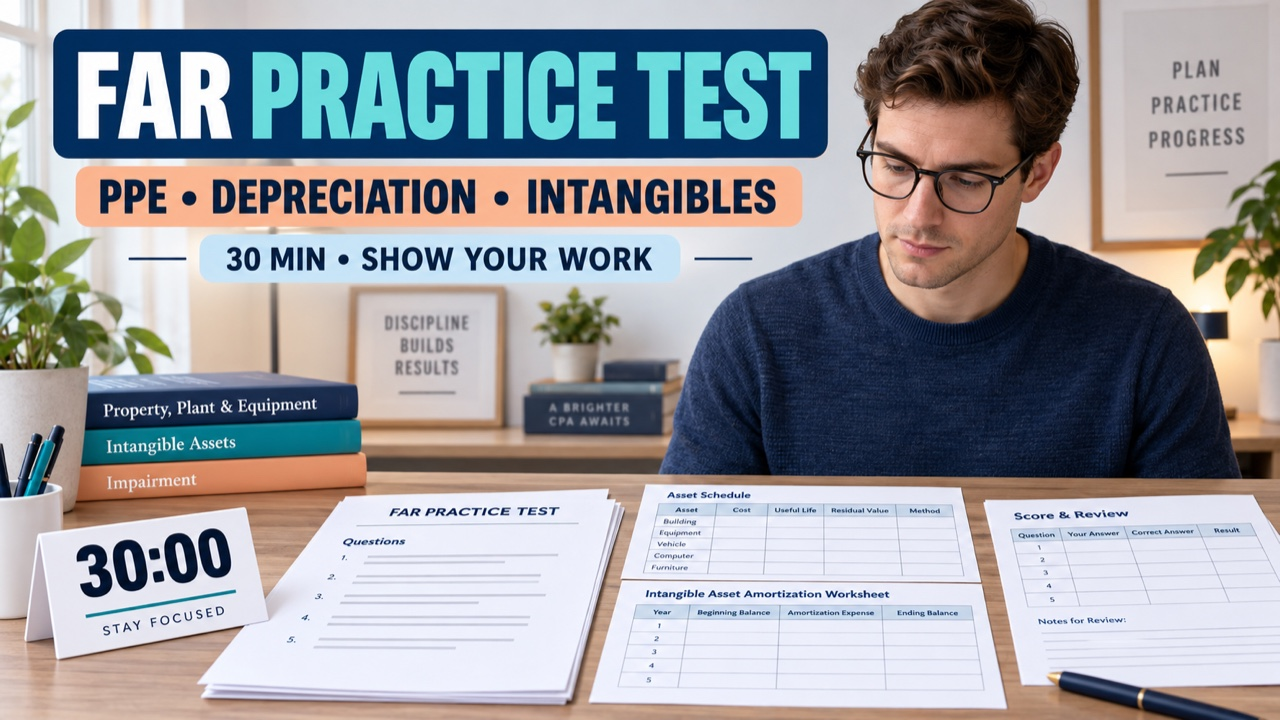

Quick answer: Use this far ppe depreciation intangibles impairment practice test as a 30-minute original drill. First, work without notes and write the controlling fact before calculating. Then, open each answer only after you commit to a choice. The useful result is not a pretend exam score; it is knowing whether your first broken lane was basis, clock, estimate, life, test, or output.
Editorial review note: Every stem, amount, answer choice, rationale, distractor, visual, and retry below is original practice content. However, it is not a provider-issued item and it is not a prediction of a live score.
For current scope, use the AICPA CPA Exam Blueprint. In addition, reopen the FASB Accounting Standards Codification before applying a real entity-specific conclusion. The FAR review hub can hold your broader study route, while the NASBA CPA Exam FAQ is the separate place to check administration questions.
Practice test setup
This practice test is built for a timed first pass: commit to the controlling fact, calculate once, and review the nearest distractor only after you choose. Next, keep the practice test focused on the decision lane rather than chasing a memorized formula.
How to use this PPE depreciation intangibles impairment practice test
First, set a 30-minute timer. Spend about four minutes on each question and keep the final six minutes for review. For example, do not search for a formula before you label the asset and the requested output. If a question feels familiar, still write the fact that makes the answer different.
- Read: underline the asset, date available for use, life, residual value, carrying amount, cash-flow gate, or wording that asks for a loss.
- Classify: decide whether the item is PPE, a finite-lived intangible, an indefinite-lived intangible, or a held-and-used asset group.
- Calculate: show the basis, months, remaining life, or impairment comparison before looking at the options again.
- Record: write the answer letter, confidence, and nearest distractor. A lucky letter still needs a reason.
In this drill, the questions are simplified so one controlling skill stays visible. For that reason, the arithmetic is not a substitute for the current Codification when a real fact pattern adds tax effects, disposal classification, component accounting, or another impairment model.

Test map and timing
Next, use the map to budget attention, not to skip the fact pattern. First, Questions 1 and 2 test PPE decisions from different angles. Then, Questions 3 and 6 test finite-life amortization and timing. Finally, Questions 4 and 5 separate indefinite-life testing from the held-and-used recoverability gate.
| Question | Skill lane | Target time | Show before answer |
|---|---|---|---|
| 1 | PPE basis + clock | 4 min | capitalized cost and in-service months |
| 2 | change in estimate | 5 min | new carrying amount and remaining life |
| 3 | finite-life patent | 4 min | available date and annual amortization |
| 4 | indefinite-life impairment | 4 min | carrying amount versus fair value |
| 5 | held-and-used gate | 5 min | undiscounted cash flows before fair value |
| 6 | finite-life customer list | 4 min | available-for-use months |
Original FAR practice test questions
Before you begin, note that all six items are original and simplified. Commit to a letter before opening a reveal. Then write the nearest distractor and the first field that broke. As a result, the final note turns a timed test into a study tool.
Question 1: PPE basis and first-year depreciation
Difficulty: moderate. For example, a machine invoice is $360,000. Freight is $8,000, installation is $12,000, and testing before intended use is $5,000. Employee training is $9,000 and is expensed under the stated facts. The machine has a $15,000 salvage value, a four-year life, and is placed in service on April 1. What is first-year straight-line depreciation?
- $69,375
- $92,500
- $66,375
- $85,000
Reveal the answer to Question 1
The correct choice is A, $69,375. Therefore, the ready-for-use basis is $360,000 + $8,000 + $12,000 + $5,000 = $385,000; training stays outside the basis. Depreciable cost is $385,000 − $15,000 = $370,000. Annual depreciation is $370,000 ÷ 4 = $92,500, and April through December is nine months: $92,500 × 9/12 = $69,375. Choice B is a full-year answer, C removes the testing cost, and D uses an unsupported timing assumption. The broken lanes are BASIS and CLOCK.
Question 2: PPE change in estimate
Difficulty: challenging. Next, a machine originally cost $520,000, had a $20,000 residual value, and was depreciated straight-line over eight years. After three full years, its residual value is revised to $8,000 and its remaining useful life is revised to five years. What is depreciation for year four?
- $62,400
- $64,900
- $65,000
- $66,400
Reveal the answer to Question 2
The correct choice is B, $64,900. Next, calculate original annual depreciation as ($520,000 − $20,000) ÷ 8 = $62,500. After three years, carrying amount is $520,000 − $187,500 = $332,500. Apply the revised estimate prospectively: ($332,500 − $8,000) ÷ 5 = $64,900. Choice A uses the old residual value, C rounds the result, and D depreciates the original basis again. The control is ESTIMATE, not a retrospective rewrite.
Question 3: finite-lived patent available during the year
Difficulty: moderate. In this case, a patent costs $168,000. Direct registration costs of $12,000 are included in the stated basis. The patent has a six-year useful life, no residual value, and is available for use on July 1. Under the simplified facts, what is first-year amortization?
- $15,000
- $20,000
- $30,000
- $10,000
Reveal the answer to Question 3
The correct choice is A, $15,000. In this case, basis is $168,000 + $12,000 = $180,000. Annual amortization is $180,000 ÷ 6 = $30,000. July through December is six months, so $30,000 × 6/12 = $15,000. Choice D is a three-month distractor, B uses eight months, and C is the full-year amount. The controlling lane is LIFE + CLOCK.
Question 4: indefinite-lived brand impairment
Difficulty: foundational classification. Likewise, a brand remains indefinite-lived under the simplified facts. Its carrying amount is $410,000 and fair value is $372,000 at the annual test date. What is recorded?
- $38,000 impairment and no routine amortization while the life remains indefinite
- $372,000 impairment because fair value replaces carrying amount
- $38,000 amortization and no impairment
- No change because indefinite-lived assets are not tested
Reveal the answer to Question 4
The correct choice is A. In contrast, under the stated simplified facts, the loss is $410,000 − $372,000 = $38,000. Indefinite-lived means no routine amortization while that classification remains; it does not mean the asset escapes applicable impairment testing. Choice B records fair value rather than the loss, C confuses amortization with impairment, and D treats the classification as an exemption. The broken lane is LIFE.
Question 5: held-and-used recoverability gate
Difficulty: challenging. However, a held-and-used asset group has a $760,000 carrying amount. Its stated undiscounted cash flows are $740,000 and fair value is $690,000. Under the simplified two-step facts, what impairment loss is recorded?
- $20,000
- $50,000
- $70,000
- $0
Reveal the answer to Question 5
The correct choice is C, $70,000. First, the $760,000 carrying amount exceeds the $740,000 undiscounted cash flows, so the recoverability gate fails. Only then is fair value used for the simplified loss measurement: $760,000 − $690,000 = $70,000. Choice A subtracts cash flows from carrying amount, B subtracts fair value from cash flows, and D assumes a passing gate. The control is TEST before measurement.
Question 6: finite-lived customer relationship
Difficulty: moderate timing transfer. Finally, an acquired customer relationship has a $144,000 basis, a six-year useful life, and no residual value. It is available for use on March 1. What is first-year amortization under the simplified monthly convention?
- $20,000
- $24,000
- $16,000
- $10,000
Reveal the answer to Question 6
The correct choice is A, $20,000. Finally, annual amortization is $144,000 ÷ 6 = $24,000. March through December is ten months, so $24,000 × 10/12 = $20,000. Choice B is a full-year amount, C uses eight months, and D uses five months. The broken lane is CLOCK; the asset is finite-lived, so amortization starts when available for use under the stated convention.
Score the test and choose the next block
When you finish, give yourself one point for each correct letter, but do not treat the total as an official exam score. Meanwhile, a correct answer chosen for the wrong reason belongs in the review log. More importantly, record whether the miss came from basis, estimate, life, clock, test, or output. After this practice test, review the first broken lane before adding more question volume.
| Score | What it suggests | Next study block |
|---|---|---|
| 5–6 | Rules are usable; verify the first broken lane in any lucky answer. | Mixed FAR set with a shorter timer. |
| 3–4 | One or two lanes are unstable. | Ten minutes on the most repeated broken lane, then retry its item. |
| 0–2 | Slow down before adding more question volume. | Rebuild the five-field map, then redo Questions 1, 4, and 5 without notes. |
Review the first broken answer lane
As a result, the closest distractor is often more useful than the percentage. If your answer was wrong, write the number you used, the number the stem supplied, and the field that should have controlled the choice. Likewise, keep a lucky answer in the review log when the controlling fact was unclear.

Retry one fact before your next session
Change only Question 5’s undiscounted cash flows from $740,000 to $780,000. Keep the $760,000 carrying amount and $690,000 fair value fixed. The gate now passes because cash flows exceed carrying amount, so the simplified impairment loss changes to $0. Therefore, this is a test of sequencing, not a new formula.
Finally, return to the current Codification whenever a live problem adds a disposal classification, tax effect, component asset, goodwill, a different impairment model, or an entity-specific measurement question. In short, the practice set is a diagnostic tool, not a substitute for current guidance.
FAR practice test questions
Is this an official CPA exam practice test?
No. Instead, it is an original editorial drill with simplified facts, and it does not reproduce provider-issued or score-predictive content.
What should I write before calculating PPE depreciation?
First, write the ready-for-use basis, residual value, useful life, and months in service. Keep stated training or other expenses outside the basis when the stem directs it.
Why does the held-and-used question compare cash flows before fair value?
Therefore, the simplified sequence uses undiscounted cash flows as the recoverability gate; fair value measures a loss only after the gate fails.
How should I use a lucky correct answer?
Finally, log the nearest distractor and the first broken lane anyway, then spend the next review block on that lane instead of moving on blindly.