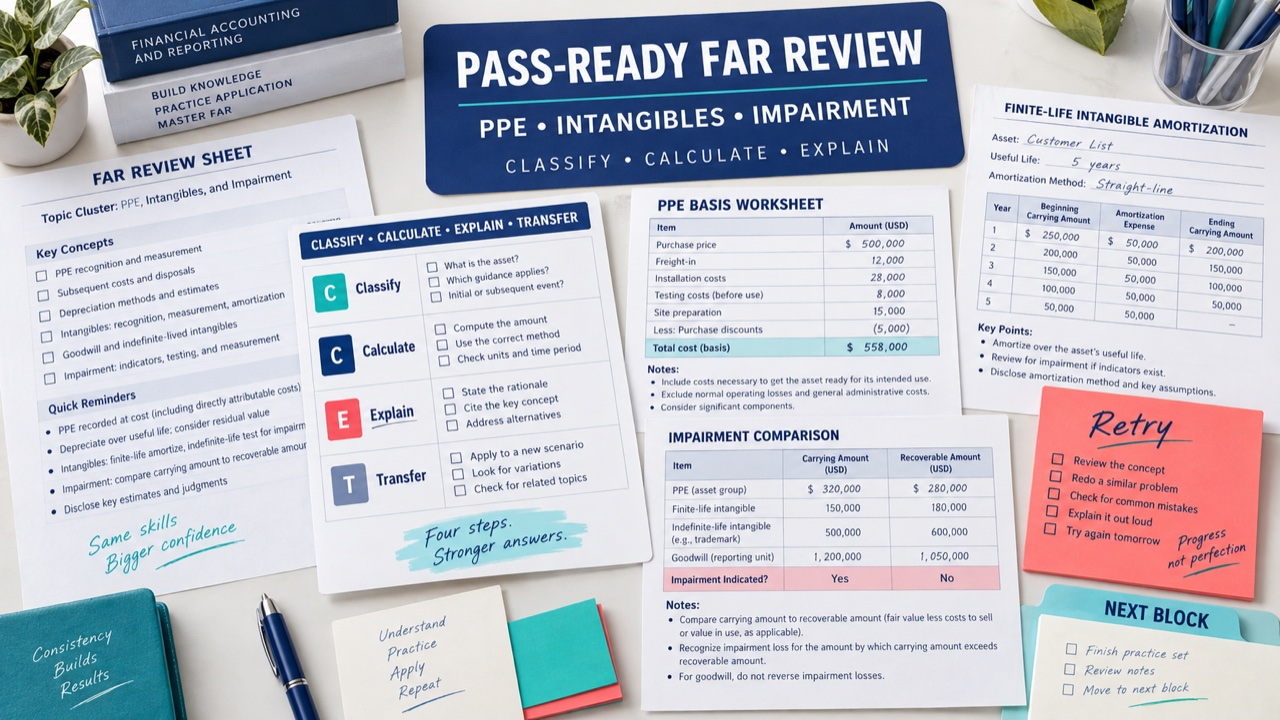

Quick answer: To pass PPE depreciation, intangibles, and impairment on CPA FAR, do not turn the topic into a promise or a pile of formulas. Use four gates: classify the asset and controlling date, calculate the requested output, explain the nearest distractor, and transfer the method to one changed fact. A 20-minute block can repair one gate; a 40- or 60-minute block can compare lanes and schedule the next repair.
Editorial review: Written by the CPA Exam Prep editorial team and technically checked against the current AICPA Blueprint and linked FASB boundaries on September 24, 2026. This page is original educational study material, not official exam content, an exam-outcome promise, a licensed accounting opinion, or a score prediction.
For exam scope, reopen the AICPA CPA Exam Blueprint. For live US GAAP conclusions, reopen the FASB Accounting Standards Codification. The FAR review hub is the broader navigation route; the NASBA CPA Exam FAQ is the separate checkpoint for administration questions.
What a pass PPE depreciation review must prove
In practice, a pass goal becomes useful only when it changes what you do on paper. Before you count correct answers, prove four smaller decisions. First, you can classify the lane. Next, you can show the number flow. Then, you can reject the nearest distractor. Finally, you can survive one changed fact. For that reason, the sequence does not guarantee a score; it gives you evidence about what to review next.
| Gate | Question to ask | Evidence to write | If it breaks |
|---|---|---|---|
| 1. Classify | Which asset lane and date control? | PPE, finite, indefinite, or held-and-used + the date | Review the decision rule before another calculation |
| 2. Calculate | What is the requested output? | Basis, carrying amount, time fraction, or comparison | Redo one number flow without looking at choices |
| 3. Explain | Why is the nearest distractor wrong? | One broken fact or wrong shortcut | Write the error label and retry one changed fact |
| 4. Transfer | Can the method survive one changed input? | New result + next review lane | Shrink the case and repeat the same lane |
Assumptions: The original cases below use simplified straight-line depreciation or amortization, no tax effects, and clear fact patterns. They are method-training examples rather than provider-issued or reproduced questions. For a live accounting conclusion, reopen the current Codification instead of treating a study shortcut as universal.
Use a pass PPE depreciation decision order
When a question feels crowded, write the lane before the formula. PPE usually asks about included cost, salvage, useful life, and the ready-for-use clock. Meanwhile, a finite-lived intangible adds the available-for-use date. By contrast, an indefinite-lived asset moves you toward an impairment comparison. Likewise, a held-and-used group requires the recoverability screen before measurement. Accordingly, the first line of your work should name the decision lane, not the answer letter.

- Classify. Write PPE, finite-lived intangible, indefinite-lived intangible, or held-and-used group.
- Mark the controlling fact. Circle included cost, salvage, ready-for-use date, available-for-use date, carrying amount, cash-flow screen, or fair value.
- Calculate. Show one number flow before reading the choices again. Keep basis, time fraction, and comparison separate.
- Explain. Name the nearest distractor and the shortcut it represents: omitted cost, wrong clock, wrong lane, or wrong sequence.
- Transfer. Change one input and solve again. If the method does not transfer, that lane is the next review block.
For example, a correct dollar amount with an incorrect gate order is not stable evidence. Likewise, a wrong answer caused by a single date mistake is not a reason to reread every impairment rule. The four-gate route keeps the next action proportional to the first broken decision.
Build a 20-, 40-, or 60-minute pass PPE depreciation block
Time is a constraint, not a score. First, a short block should target one lane. Next, a medium block should compare two different lanes. Finally, a longer block should reserve time for transfer instead of adding endless new questions.
| Available time | Route | Pass-ready evidence |
|---|---|---|
| 20 minutes | One case: classify, calculate, explain, retry | One corrected number flow + one error label |
| 40 minutes | Two different lanes with a side-by-side contrast | Two explanations + one chosen weak area |
| 60 minutes | Three cases plus a final transfer retry | Three explanations + a named next block |
In a 20-minute block, use five minutes for classification, ten for the calculation, and five for the distractor and retry. In a 40-minute block, use two contrasting cases so that you must explain why the lanes differ. For a 60-minute block, work three cases but protect the final ten minutes for the next-block note. As a result, the method turns a pass goal into a repeatable review loop rather than a motivational slogan.
Original FAR practice set for pass PPE depreciation
Before each reveal, pause at the prompt. Write the lane, the controlling fact, and the requested output. In addition, every case is original and simplified. If an option set does not match the number flow, do not force a choice; record the mismatch as a quality-control error.
Original practice 1: PPE basis and partial-year depreciation
Pause before the reveal: A machine invoice is $360,000. Freight is $8,000, installation is $12,000, testing is $5,000, and expected salvage is $15,000. The machine is ready for use on April 1 and has a five-year straight-line life. Under these simplified facts, what are depreciable basis and first-year depreciation?
Choices: A. $370,000 and $55,500. B. $385,000 and $57,750. C. $370,000 and $74,000. D. $355,000 and $53,250.
Reveal answer and reasoning
Answer: A. First, included cost is $360,000 + $8,000 + $12,000 + $5,000 = $385,000. Then, subtract $15,000 salvage for a $370,000 depreciable basis. Annual depreciation is $74,000; finally, nine months in service produces $55,500.
Nearest distractor: By contrast, B keeps salvage in the depreciable base; moreover, C forgets the April 1 timing; D removes salvage twice.
Changed-fact retry: Next, move the ready-for-use date to July 1. Keep basis and life fixed, then recompute only the six-month time fraction.
Original practice 2: Prospective change in residual value
Pause before the reveal: An asset costs $260,000, has a $20,000 residual value, and a five-year life. After two full years, the residual value changes to $8,000 and three years remain. What is the new annual depreciation under the simplified facts?
Choices: A. $48,000. B. $52,000. C. $50,400. D. $84,000.
Reveal answer and reasoning
Answer: B. First, the old annual amount is ($260,000 − $20,000) ÷ 5 = $48,000. After two years, carrying amount is $164,000. Therefore, the prospective amount is ($164,000 − $8,000) ÷ 3 = $52,000.
Nearest distractor: By contrast, A keeps the old estimate; meanwhile, C uses the new residual against original cost; D changes prior periods instead of applying the new estimate prospectively.
Changed-fact retry: Next, keep the $164,000 carrying amount but set remaining life to four years. Then, recompute prospectively without rewriting the first two years.
Original practice 3: Finite-lived patent timing
Pause before the reveal: A patent costs $168,000 and direct registration costs are $12,000. It becomes available for use on July 1 and has a five-year life with no residual value. What is first-year amortization under the simplified facts?
Choices: A. $18,000. B. $30,000. C. $36,000. D. $180,000.
Reveal answer and reasoning
Answer: A. First, the amortizable amount is $180,000. Annual amortization is $36,000; consequently, six months available for use produces $18,000.
Nearest distractor: B uses a full-year amount; C ignores the July 1 fraction; D reports basis instead of period expense. The $18,000 choice is supported only after the six-month time fraction is shown.
Changed-fact retry: Change the availability date to October 1 and add an $18,000 option. Then, apply three months to the $36,000 annual amount and choose $9,000.
Original practice 4: Indefinite-lived impairment comparison
Pause before the reveal: A brand is classified as indefinite-lived under the simplified facts. Its carrying amount is $410,000 and the comparison produces fair value of $372,000. What shortfall should the study note record?
Choices: A. $0. B. $38,000. C. $372,000. D. $782,000.
Reveal answer and reasoning
Answer: B. Here, subtract fair value from carrying amount: $410,000 − $372,000 = $38,000. The classification also matters; do not move an indefinite-lived brand into a routine finite-life amortization schedule.
Nearest distractor: By contrast, A assumes no loss; moreover, C records fair value itself; finally, D adds the two balances.
Changed-fact retry: Next, raise fair value to $425,000. Decide whether a shortfall remains before writing an amount, and keep the classification step visible.
Original practice 5: Held-and-used recoverability gate
Pause before the reveal: A held-and-used asset group has a carrying amount of $760,000, undiscounted cash flows of $740,000, and fair value of $690,000. Under the simplified study example, what loss is indicated after the screen?
Choices: A. $0. B. $20,000. C. $70,000. D. $1,450,000.
Reveal answer and reasoning
Answer: C. First, $740,000 is below the $760,000 carrying amount, so the recoverability gate fails. Then, the simplified measured loss is $760,000 − $690,000 = $70,000. Therefore, record the gate result before the measured loss.
Nearest distractor: By contrast, B confuses the gate shortfall with the measured loss; meanwhile, A ignores the failed gate; D has no meaning for the requested output.
Changed-fact retry: Finally, change undiscounted cash flows to $800,000 while keeping fair value at $690,000. The gate passes under the simplified facts, so the indicated loss becomes $0.
Route the first broken fact after a pass PPE depreciation block
After the five cases, do not average the result into a broad confidence label. Instead, classify the first broken fact. For that reason, basis and clock errors belong together; estimate changes require prospective thinking; finite-life errors usually live in the availability date; indefinite-life errors are often classification errors; and recoverability errors are sequencing errors. As a result, the router should name one narrow lane rather than a general feeling about FAR.

Use the router in order: write the first break, retry the same case with one changed input, and book a narrow next review. If the retry works, add one contrasting case tomorrow. Conversely, if it fails again, stay in the same lane and reduce the numbers until the decision order is explainable without notes.
What to study next after a pass PPE depreciation review
If basis or timing broke first, schedule a 20-minute PPE block with one included-cost variation and one date variation. Likewise, if the estimate changed, schedule a prospective-change block and keep prior periods untouched in the explanation. Similarly, if finite and indefinite were mixed, compare one patent case with one brand case. Finally, if the recoverability gate broke, repeat the $740,000-to-$800,000 retry and explain why fair value comes later under these simplified facts. Therefore, the next block should be chosen from the first broken gate, not from the most familiar chapter.
Before treating the page as a live study plan or technical conclusion, return to the current Blueprint and Codification. The useful output of this pass PPE depreciation method is not a promise; it is one named lane, one corrected number flow, one explained distractor, and one scheduled retry.
FAQ: pass PPE depreciation and FAR review
Will this method guarantee a CPA FAR result?
No. A study method cannot guarantee an exam outcome. It can make the review more controlled by separating classification, calculation, explanation, and transfer, then directing the next block to the first broken gate.
What should I study first for PPE depreciation?
Start with included cost, salvage, the ready-for-use date, and useful life. Then show the basis and time fraction before you look at the answer choices. In addition, write why the nearest distractor fails.
How do finite and indefinite-lived intangibles differ in this review?
Finite-lived rights use an amortization clock after becoming available for use; however, indefinite-lived assets use an impairment-focused lane rather than routine amortization in these simplified cases.
What if my answer is right but my reasoning is wrong?
Treat it as a review signal. First label the broken fact, then retry one changed input. If the transfer fails, stay in that lane for the next block instead of averaging the result into a broad confidence score.