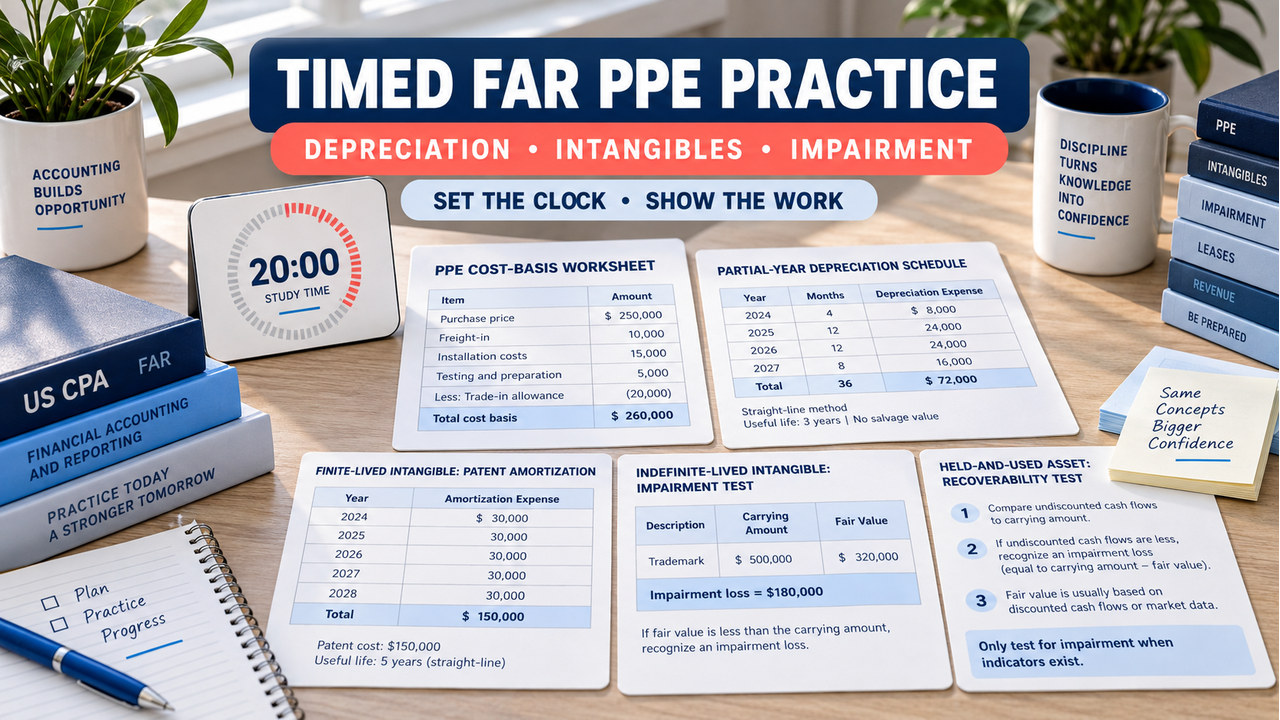

Direct answer: Use a timed FAR PPE practice block to test the decision order, not just how quickly you can copy a formula. Then set the clock, classify the asset, mark the controlling date or trigger, show one number flow, explain the nearest distractor, and retry one changed fact. The timer matters because the first broken label should choose the next review block.
Editorial review: Written by the CPA Exam Prep editorial team and checked against the current AICPA Blueprint and linked FASB boundaries on September 24, 2026. The questions, amounts, explanations, and review tools are original simplified study material, not official exam content, a licensed accounting opinion, or a score prediction.
For scope, reopen the AICPA CPA Exam Blueprint. For live US GAAP conclusions, reopen the FASB Accounting Standards Codification. In addition, the FAR review hub is the broader navigation route, while the NASBA CPA Exam FAQ is the separate checkpoint for administration questions.
Timed FAR PPE practice: set the clock before the formula
First, a timed set becomes useful when each minute has a job. Before reading the choices, write five labels: ASSET, BASIS, CLOCK, TRIGGER, and OUTPUT. This keeps a depreciation calculation from silently becoming an impairment answer, and it keeps a full-year assumption from replacing the stated service date.
- Route the asset. Decide whether the fact describes PPE, a finite-lived intangible, an indefinite-lived intangible, or a held-and-used group.
- Mark the controlling fact. Circle included cost, salvage, ready-for-use date, available-for-use date, useful life, undiscounted cash flows, carrying amount, or fair value.
- State the output. Write whether the prompt wants expense, carrying amount, a shortfall, a loss, or a pass/fail gate.
- Show one number flow. Put the calculation or comparison on paper before selecting an answer.
- Explain the nearest distractor. Name the wrong clock, wrong lane, omitted cost, or wrong measurement step.

Time-box the attempt: 20, 40, or 60 minutes
Next, choose the time box before opening the first question. Twenty minutes is a focused diagnostic, forty minutes is a contrast between lanes, and sixty minutes adds a review pass. None of the three is an official readiness score. The value is the evidence you can write down before the session ends.
| Time box | Route | Evidence before stopping |
|---|---|---|
| 20 minutes | Attempt two focused cases, show the controlling fact, and retry one input. | Two answer paths plus one first-error label. |
| 40 minutes | Attempt four cases from at least two asset lanes and compare the distractors. | Four routes plus one named weak area. |
| 60 minutes | Attempt the full set, review every reveal, and schedule tomorrow’s repair. | A complete error map and one next ten-minute block. |
Finally, use the last two minutes to write the first broken label. However, if the number is wrong because basis was wrong, another mixed set is not the best next step. If the number is right but the trigger was unexplained, treat that as provisional evidence and retry the same lane with one changed fact.
Original timed FAR PPE practice questions
In practice, these six cases are original and simplified. Pause before each reveal. Write the asset lane, controlling fact, requested output, and nearest distractor first. The assumptions remove tax effects and entity-specific complications so the accounting decision remains visible; for live conclusions, return to the current Codification.
Case 1: timed FAR PPE basis and a partial-year clock
Prompt: For example, equipment costs $480,000. Freight is $10,000, installation is $15,000, and employee training is $8,000. The equipment has $25,000 expected salvage, a five-year straight-line life, and is ready for use on April 1. Under the simplified facts, what are the depreciable basis and first-year depreciation?
Choices: A. $480,000 and $72,000. B. $488,000 and $73,200. C. $505,000 and $75,750. D. $480,000 and $96,000.
Reveal Case 1 answer and reasoning
Answer: A. First, cost ready for use is $480,000 + $10,000 + $15,000 = $505,000. Subtract $25,000 salvage to get a $480,000 depreciable basis. Annual depreciation is $96,000, and nine months in service produces $72,000. The nearest distractor is D, which forgets the April 1 clock; B includes training and C leaves salvage in the basis.
Retry: Then, change only the service date to October 1. Keep the basis and life fixed, and use three months of the $96,000 annual amount.
Case 2: Prospective residual-value change
Prompt: Similarly, an asset costs $300,000, has a $30,000 residual value, and a six-year life. After two full years, the residual value changes to $18,000 and four years remain. What is the new annual depreciation under the simplified facts?
Choices: A. $45,000. B. $48,000. C. $50,000. D. $70,500.
Reveal Case 2 answer and reasoning
Answer: B. First, the old annual amount was ($300,000 − $30,000) ÷ 6 = $45,000. After two years, carrying amount is $210,000. Apply the new estimate prospectively: ($210,000 − $18,000) ÷ 4 = $48,000. A keeps the old estimate, C uses the new residual against original cost, and D changes prior periods instead of using the current carrying amount.
Retry: Next, keep the $210,000 carrying amount but change the remaining life to three years. Recalculate prospectively without rewriting the first two years.
Case 3: Finite-lived patent timing
Prompt: For instance, a patent and directly related registration costs total $250,000. It becomes available for use on July 1 and has a five-year finite life with no residual value. What is first-year amortization under the simplified facts?
Choices: A. $20,833. B. $25,000. C. $50,000. D. $250,000.
Reveal Case 3 answer and reasoning
Answer: B. Similarly, annual amortization is $250,000 ÷ 5 = $50,000. Six months available for use produces $25,000. C is a full-year amount; A applies an incorrect five-month fraction; D reports basis rather than period expense. The available-for-use date is the controlling clock.
Retry: Afterward, change the availability date to October 1. Keep basis and life fixed, and apply three months to the $50,000 annual amount.
Case 4: Indefinite-lived trademark comparison
Prompt: In this case, a trademark remains indefinite-lived under the simplified facts. Its carrying amount is $620,000 and the applicable comparison gives fair value of $575,000. What shortfall should the study note record?
Choices: A. $0. B. $45,000. C. $575,000. D. $1,195,000.
Reveal Case 4 answer and reasoning
Answer: B. In contrast, subtract fair value from carrying amount: $620,000 − $575,000 = $45,000. The classification matters because an indefinite-lived asset is not placed into a routine finite-life amortization schedule under these assumptions; it still requires the applicable impairment analysis. C records fair value itself, while D adds the two balances.
Retry: Then, raise fair value to $640,000. Decide whether a shortfall remains before writing an amount.
Case 5: timed FAR PPE recoverability gate
Prompt: Next, a held-and-used asset group has a carrying amount of $900,000, undiscounted cash flows of $860,000, and fair value of $800,000. Under the simplified two-step facts, what loss is indicated after the screen?
Choices: A. $0. B. $40,000. C. $100,000. D. $1,700,000.
Reveal Case 5 answer and reasoning
Answer: C. As a result, the $860,000 undiscounted cash flows are below the $900,000 carrying amount, so the recoverability screen fails. Then measure the simplified loss using fair value: $900,000 − $800,000 = $100,000. B is only the screen difference; it is not the measured loss. A ignores the failed gate and D has no requested accounting meaning.
Retry: Finally, change only undiscounted cash flows to $950,000. If the screen passes, record no loss under these simplified facts even though fair value is $800,000.
Case 6: A passing recoverability screen
Prompt: Finally, a held-and-used asset group has a carrying amount of $900,000, undiscounted cash flows of $950,000, and fair value of $800,000. Under the same simplified screen-first facts, what loss is indicated?
Choices: A. $0. B. $50,000. C. $100,000. D. $150,000.
Reveal Case 6 answer and reasoning
Answer: A. Therefore, the undiscounted cash flows exceed the $900,000 carrying amount, so the recoverability screen passes. Under the stated simplified facts, the process stops before a measured impairment loss. D incorrectly subtracts fair value without passing the gate; C repeats Case 5 after the controlling fact changed.
Retry: In turn, reduce undiscounted cash flows to $880,000 while keeping fair value fixed. Then write the screen result before calculating any loss.
Route the first error after timed FAR PPE practice
After the reveals, do not average six cases into a broad confidence label. Instead, classify the first broken field. A basis error means the cost build was wrong. A clock error means the service or availability date was replaced by a full-year assumption. A finite-life error means the amortization lane was not separated from the indefinite-life lane. An indefinite-life error means the classification or fair-value comparison was unclear. In contrast, a recoverability error means the screen and measurement were reversed. Finally, a measurement error means the screen difference was mistaken for the loss.

Therefore, use the first label to choose tomorrow’s work. Do not add more difficulty just because the timer ended. As a result, the next block should repair the smallest decision that failed: rebuild one cost schedule, solve three partial-year prompts, classify five intangible facts, write the screen-before-loss sequence, or complete two carrying-amount-versus-fair-value comparisons.
Turn a missed question into the next ten-minute block
However, the timer is finished when the next action is specific. Use this route to keep a miss useful:
| First broken label | Repair action | Proof to keep |
|---|---|---|
| Basis | Rebuild one included-cost schedule. | Included and excluded facts in two columns. |
| Clock | Solve three partial-year or availability-date cases. | Annual amount and time fraction shown separately. |
| Life | Classify five assets before calculating. | Finite, indefinite, or held-and-used label. |
| Recoverability | Write the screen before the measurement. | Undiscounted cash flows compared first. |
| Measurement | Complete two fair-value comparisons. | Carrying amount less fair value only after the gate. |
Research and refresh note
For live conclusions, use the current AICPA CPA Exam Blueprints to orient tested scope, and use the current FASB Accounting Standards Codification for a technical conclusion. In addition, the FASB long-lived-asset impairment summary and Topic 350 reference are saved as checkpoints, not substitutes for current research. This page uses clear simplified facts so the timed method can be audited; it does not cover every asset-group, disclosure, tax, disposal, or jurisdiction-specific issue.
Also, before publication, refresh any time-sensitive source and recheck the article’s arithmetic. Do not interpret a raw practice result as an official score, pass probability, or readiness determination.
Timed FAR PPE practice FAQ
What should I write before starting the timer?
Before you start, write the asset lane, basis, controlling clock or trigger, requested output, and nearest distractor. This takes less than a minute and prevents a familiar formula from controlling the wrong question.
Is a 20-minute practice result an official CPA score?
No. However, it is a local study diagnostic. Use the first broken label and the explanation quality to choose the next review action; do not convert the result into an official score or pass prediction.
Why is a recoverability screen different from a loss measurement?
In other words, the screen asks whether the carrying amount is recoverable under the simplified facts. Only after the screen fails does the worked example use fair value to illustrate a measured difference.
What if I get the number right but cannot explain the lane?
Therefore, keep the result provisional, label the broken field, and retry one changed fact. If the transfer fails, repeat the same lane in the next ten-minute block.