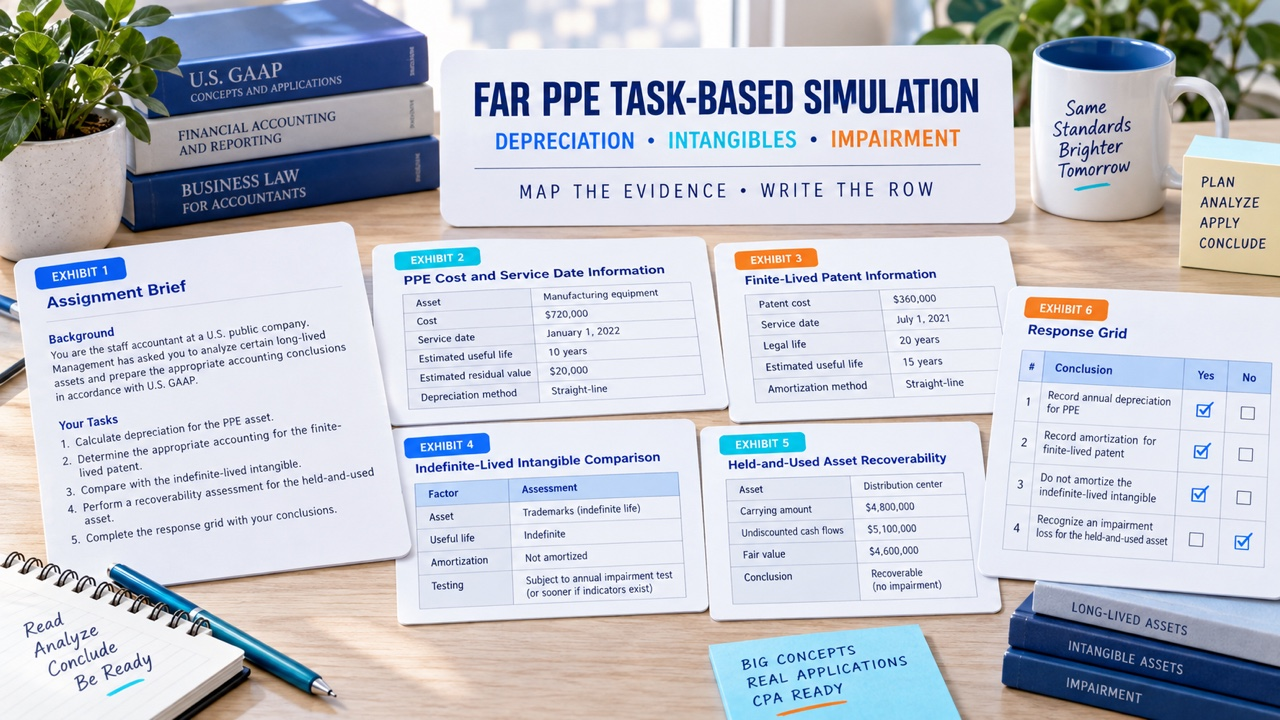

Direct answer: A useful FAR PPE depreciation simulation is an evidence-to-response exercise, not a collection of disconnected calculations. Read the assignment, map each exhibit to a requested row, classify the asset lane, show only the controlling formula or gate, and finish with a concise response that another reviewer could trace.
Editorial review: Written by the CPA Exam Prep editorial team and checked against the current AICPA Blueprint and linked FASB boundaries on September 24, 2026. The exhibits, amounts, explanations, and review tools are original simplified study material, not official exam content, a licensed accounting opinion, or a score prediction.
For scope, reopen the AICPA CPA Exam Blueprint. For current US GAAP conclusions, reopen the FASB Accounting Standards Codification. In addition, the FAR review hub is a broader navigation route, while the NASBA CPA Exam FAQ is a separate checkpoint for administration questions.
FAR PPE depreciation simulation: read the assignment before the formula
First, treat the task request as the control document. A simulation may give you cost, dates, useful life, fair value, cash flows, and several distractors, but the answer row still asks for a defined output. Before calculating, write four labels: EVIDENCE, LANE, GATE, and OUTPUT. This prevents a correct formula from being attached to the wrong exhibit.
- Read the request. Circle whether the row wants basis, period expense, a shortfall, a recoverability result, or a measured loss.
- Map the exhibit. Note which document supplies the cost, date, classification, carrying amount, cash flow, or fair value.
- Apply the lane. Use PPE, finite-lived intangible, indefinite-lived intangible, or held-and-used group as the working classification.
- Show the gate. If a recoverability screen or available-for-use date controls the answer, write that step before the final number.
- Write the response row. Give the result, the short reason, and the exhibit or trigger that supports it.

Set up the FAR PPE simulation workpaper
Next, use a compact workpaper rather than copying every fact into a paragraph. The four-row map below keeps the task auditable and makes a later error review specific.
| Workpaper row | What to capture | Proof before moving on |
|---|---|---|
| Evidence | Exhibit name, amount, date, and classification clue. | A reader can point to the source fact. |
| Formula or gate | Cost build, time fraction, amortization, or recoverability screen. | The controlling step is written before the result. |
| Output | Basis, expense, shortfall, pass/fail, or loss requested by the task. | The answer uses the requested unit and period. |
| Reason | One sentence naming the nearest distractor. | The wrong lane or skipped gate is explicit. |
Original FAR PPE task-based simulation
In practice, the following packet is original and simplified. Assume no tax effects, no disposal complications, no entity-specific elections, and no facts outside the exhibits. Attempt each task before opening its reveal. The point of this FAR PPE depreciation simulation is to connect evidence, classification, calculation, and response wording.
Task 1: PPE cost, service date, and first-year depreciation
Exhibit A — purchase memo: Equipment invoice $600,000; freight $12,000; installation $20,000; employee training $9,000. The equipment is ready for use on April 1. Expected salvage is $32,000 and useful life is five years. The task asks for depreciable basis and first-year straight-line depreciation.
Prompt: Which amount belongs in basis, and what first-year depreciation should the response row report under these simplified facts?
Reveal Task 1 answer and reasoning
Answer: Basis is $632,000: $600,000 + $12,000 freight + $20,000 installation. Training is excluded from this simplified cost build. Annual depreciation is ($632,000 − $32,000) ÷ 5 = $120,000. Nine months from April 1 produces $90,000 of first-year depreciation. The nearest distractor includes training or uses a full year.
Evidence path: Cite Exhibit A, circle the April 1 service date, and show the basis, annual amount, and nine-month fraction on separate lines.
Task 2: finite-lived intangible and available-for-use date
Exhibit B — patent file: Patent purchase $165,000 and directly related registration cost $15,000. The patent is available for use on July 1 and has a ten-year finite life with no residual value. The task asks for first-year amortization and the controlling date.
Prompt: Which costs form the simplified basis, and what amount belongs in the first-year expense row?
Reveal Task 2 answer and reasoning
Answer: The simplified basis is $180,000. Annual amortization is $18,000, and six months from July 1 produces $9,000. The available-for-use date controls the first-year fraction. The nearest distractor reports $18,000 for a full year or uses only the invoice amount.
Evidence path: Cite Exhibit B, label the registration cost as directly related, and write “available for use: July 1” beside the six-month fraction.
Task 3: indefinite-lived intangible comparison
Exhibit C — brand review: A trademark remains indefinite-lived under the simplified facts. Carrying amount is $1,240,000 and the applicable comparison gives fair value of $730,000. The task asks for the shortfall to carry into the response row.
Prompt: What amount should the workpaper report, and why is a routine amortization formula not the first step?
Reveal Task 3 answer and reasoning
Answer: The simplified shortfall is $510,000: $1,240,000 − $730,000. Because the asset is treated as indefinite-lived, the task first points to the applicable impairment comparison rather than a routine finite-life amortization schedule. The nearest distractor records fair value itself or adds the two balances.
Evidence path: Cite Exhibit C, label the asset “indefinite-lived,” and show carrying amount less fair value only after writing the comparison step.
Task 4: held-and-used recoverability gate and measured loss
Exhibit D — asset-group forecast: Carrying amount is $920,000, undiscounted cash flows are $870,000, and fair value is $140,000. The task asks whether the screen passes and, if it fails, what simplified loss belongs in the response row.
Prompt: What must the learner write before using fair value, and what loss follows under the simplified two-step facts?
Reveal Task 4 answer and reasoning
Answer: The recoverability screen fails because $870,000 of undiscounted cash flows is below the $920,000 carrying amount. Then measure the simplified loss using fair value: $920,000 − $140,000 = $780,000. The nearest distractor records the $50,000 screen difference or jumps to fair value without documenting the gate.
Evidence path: Cite Exhibit D, write “screen fails” first, and only then show carrying amount less fair value as the measured loss.
Review the first broken task row
After the reveals, do not average the four answers into one confidence label. Instead, name the first row that failed. An evidence error means the wrong exhibit or amount was selected. A basis error means included and excluded costs were mixed. A timing error means the service or available-for-use date was replaced with a full year. A classification error means finite, indefinite, and held-and-used lanes were blurred. A gate error means the recoverability screen was skipped or reversed. Finally, a response error means the calculation was right but the requested output was not stated.

Therefore, use the first broken row to choose tomorrow’s work. Do not add a harder simulation just because one answer was wrong. Instead, rebuild one evidence map, solve two cost-and-date drills, classify five asset descriptions, or write three screen-before-loss responses. The purpose of this FAR PPE simulation is transfer, not a decorative score.
Turn the simulation result into a ten-minute review
However, a task-based result is useful only when it changes the next block. Use the route below after you finish the original packet.
| First broken row | Next ten-minute action | Proof to keep |
|---|---|---|
| Evidence | Map five facts to five exhibit labels. | Each number has a source row. |
| Basis | Rebuild two included-cost schedules. | Included and excluded costs are separated. |
| Timing | Solve three service-date or availability-date fractions. | Annual amount and fraction are shown separately. |
| Classification | Label five facts as PPE, finite, indefinite, or held-and-used. | The lane is written before the formula. |
| Gate | Write three screen-before-loss responses. | Recoverability is documented before fair value. |
| Response | Rewrite two answers in requested units and periods. | Result, reason, and exhibit appear together. |
Research and refresh note
For live conclusions, use the current AICPA CPA Exam Blueprints to orient tested scope and use the current FASB Accounting Standards Codification for a technical conclusion. In addition, the FASB long-lived-asset impairment summary and Topic 350 reference are saved as checkpoints, not substitutes for current research. This page uses clear simplified facts so the evidence path can be audited; it does not cover every asset-group, disclosure, tax, disposal, or jurisdiction-specific issue.
Also, before publication, refresh any time-sensitive source and recheck the arithmetic. Do not interpret a raw simulation result as an official score, pass probability, or readiness determination.
FAR PPE simulation FAQ
What should I write before opening an exhibit?
Before you start, write the requested output, likely asset lane, controlling date or gate, and exhibit name. This keeps the evidence map ahead of the formula.
Are these task-based questions from the CPA Exam?
No. However, they are original simplified study exercises. Use the official sources for scope and current technical research; this page is an independent practice aid.
Why does the recoverability gate come before fair value?
In other words, the simplified held-and-used task asks whether the carrying amount passes the screen before the example illustrates a measured loss.
What if my calculation is right but my response row is wrong?
Therefore, label it a response error, rewrite the result in the requested unit and period, and retry one changed fact before adding difficulty.