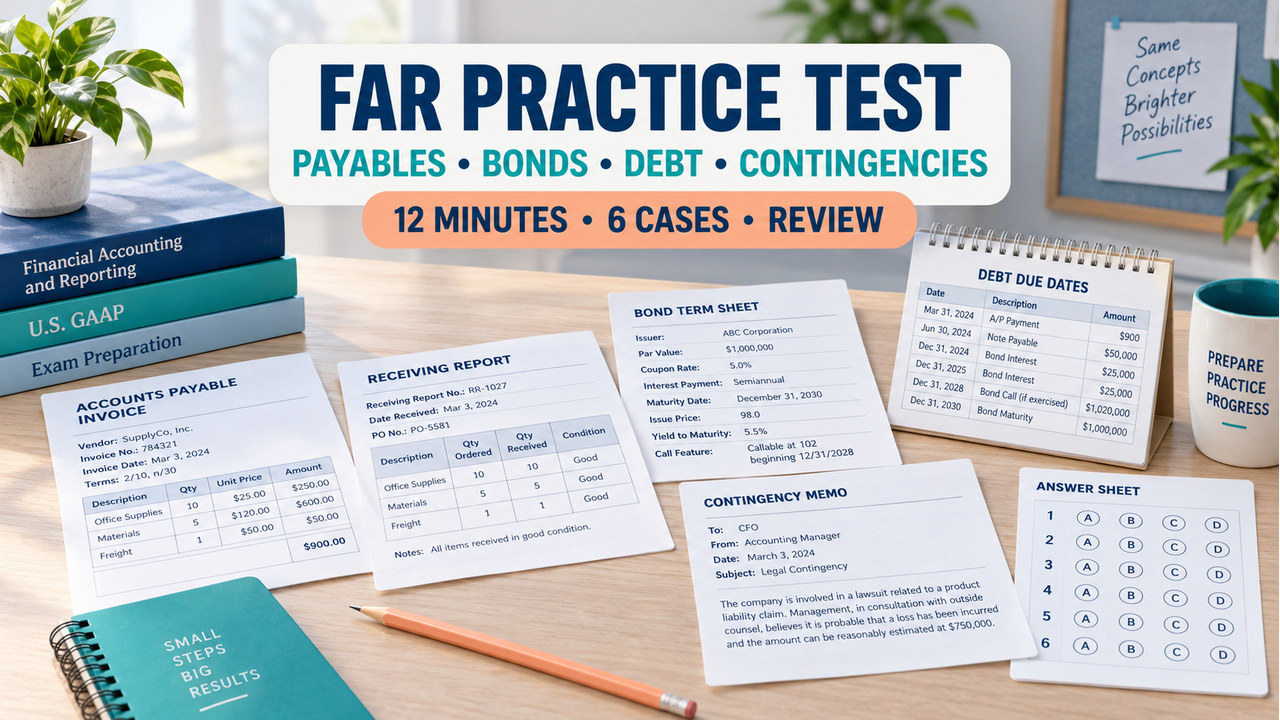

Direct answer: Use this payables bonds debt and contingencies practice test as a 12-minute diagnostic, not as an exam source or readiness prediction. Before each answer, name the controlling source, the reporting date or elapsed period, the accounting lane, and the response unit. The six original cases below mix cutoff, bond measurement, debt classification, contingencies, and accrued interest so that the nearest distractor exposes the field you missed. In short, attempt every item before opening a reveal.
Editorial review: The CPA Exam Prep editorial team checked the topic scope against the current AICPA Blueprint and saved the FASB research boundary on September 24, 2026. The cases, options, amounts, rationales, visuals, and review actions are original simplified study material, not provider-owned question content or a score prediction. Moreover, each result points to a focused study action rather than an exam forecast.
For scope, reopen the AICPA CPA Exam Blueprint. For technical conclusions, use the current FASB Accounting Standards Codification. Meanwhile, the NASBA CPA Exam FAQ remains a separate administration checkpoint.
How to use the payables bonds debt and contingencies practice test
First, set a 12-minute timer and keep a blank sheet beside the questions. Next, give yourself one point for each best answer, but do not treat the total as a license, pass probability, or readiness score. The useful result is the first broken field: source, date, lane, test, or response. Therefore, a six-out-of-six result still deserves a rationale check, while a lower result tells you where to retry.
- Source: identify the invoice, receiving report, bond terms, note, waiver, or counsel memo that controls.
- Date: mark the reporting date, due date, receipt date, payment date, or elapsed period.
- Lane: label payable, interest expense, current portion, contingency, or accrued interest.
- Response: state the amount, classification, recognition, disclosure, or explanation the question requests.
As a result, the practice test rewards a visible handoff rather than fast arithmetic alone. If two options look close, write the requested unit first. Similarly, if the number looks easy, ask which fact changes its timing or measurement basis. This pause is short, but it prevents a familiar coupon, invoice total, or cash date from taking over the answer.
Run the payables bonds debt and contingencies practice test
Use the sequence below for every item. Read the entire fact pattern, underline the controlling fact, select one option, and then record the rejected distractor. Only after all six attempts should you open the answer reveals. In addition, the page uses simplified assumptions so the reasoning can be inspected; a changed fact pattern may require current research.
What document or statement supplies the fact?
Which cutoff or elapsed period applies?
Which liability or expense field is requested?
What amount, class, or explanation must be returned?

Original payables bonds debt and contingencies practice test cases
First, each case below is original, simplified, and designed to isolate a different field. Assume a calendar year-end, no tax effects, no unusual elections, and only the stated facts. In addition, the answer reveals explain the nearest distractor so the result can transfer to a new question.
1. Receiving cutoff and accounts payable
Tested skill: identify the liability from the receiving evidence. Assumptions: goods were accepted before year-end and the vendor’s invoice was entered later. Difficulty: foundational cutoff. For example, Northline received and accepted $84,000 of inventory on December 29. The invoice was entered on January 3 and paid on January 20. No payable was recorded at December 31.
Question: Next, what amount should be included in the simplified year-end payable?
- A. $0 because the invoice was entered after year-end
- B. $84,000 because the goods were received and accepted before year-end
- C. $20,000 because that is the payment date
- D. $104,000 because invoice entry and payment are added
Reveal Case 1 answer and reasoning
Answer: B. Therefore, the receiving evidence places the accepted obligation in the year-end period, so the simplified payable is $84,000. Option A follows the invoice-entry date rather than the receipt. Option C treats the cash date as the liability date, and option D invents an addition. Next action: draw receipt, invoice entry, and payment on one line and circle the first event that creates the accepted obligation.
2. Effective interest on a bond premium
Tested skill: apply the effective yield to the carrying amount. Assumptions: interest is paid semiannually and the supplied yield remains constant for the period. Difficulty: measurement. Similarly, a $1,000,000 bond has a $1,040,000 carrying amount at the start of six months, a 6% annual coupon, and a 5% annual effective yield.
Next, what is the simplified six-month interest expense?
- A. $15,000
- B. $26,000
- C. $30,000
- D. $52,000
Reveal Case 2 answer and reasoning
Answer: B. Consequently, use carrying amount and market yield for the expense: $1,040,000 × 5% × 6/12 = $26,000. Option A uses a different rate or period, option C is the six-month cash coupon based on face amount, and option D uses a full-year amount. Next action: write face, carrying amount, coupon, yield, and period on separate lines.
3. Current portion at the reporting date
Tested skill: present principal due within the next twelve months. Assumptions: the question asks for principal only at December 31. Difficulty: classification. Meanwhile, a $720,000 installment note has $180,000 of principal due during the next twelve months and $540,000 due later. Interest is not part of the requested amount.
Then, what current portion should be presented?
- A. $0
- B. $180,000
- C. $540,000
- D. $720,000
Reveal Case 3 answer and reasoning
Answer: B. As a result, the current portion is the principal scheduled within the next twelve months: $180,000. Option A ignores the maturity schedule, option C selects the later amount, and option D leaves the note unsplit. Next action: put the reporting date in the center of the maturity schedule before labeling current and noncurrent.
4. Probable and reasonably estimable claim
Tested skill: separate probability from measurement. Assumptions: use the simplified recognition exercise and do not invent a range. Difficulty: judgment. In contrast, counsel says a claim loss is probable and the best estimate at year-end is $96,000. No reimbursement or insurance recovery is stated.
After that, what response follows from the stated fields?
- A. Recognize a $96,000 loss and liability
- B. Disclose only because the claim is not paid
- C. Recognize the claimant’s opening demand automatically
- D. Ignore the claim because the estimate is not cash
Reveal Case 4 answer and reasoning
Answer: A. Therefore, under the simplified exercise, probable plus reasonably estimable supports recognition of the $96,000 loss and liability. Option B confuses cash timing with recognition. Option C substitutes a demand for the stated estimate, and option D treats noncash measurement as irrelevant. Next action: write probability and estimate on separate lines, then combine them only at the final response step.
5. Bond premium and cash interest
Tested skill: distinguish cash interest from effective interest. Assumptions: the question asks for six-month cash interest, not expense. Difficulty: requested-unit control. Specifically, a $1,000,000 bond has a 6% annual coupon and pays interest semiannually. Its carrying amount and market yield are supplied elsewhere but are not needed for this question.
Next, what cash interest is paid for six months?
- A. $15,000
- B. $30,000
- C. $50,000
- D. $60,000
Reveal Case 5 answer and reasoning
Answer: B. In this case, cash interest uses face amount, coupon rate, and the six-month period: $1,000,000 × 6% × 6/12 = $30,000. Option A uses one quarter, option C uses a five-percent rate, and option D uses a full year. Next action: write the requested word—cash or expense—above the formula before choosing inputs.
6. Accrued interest by elapsed days
Tested skill: accrue interest for the elapsed reporting period. Assumptions: use a 360-day year and simple daily accrual. Difficulty: time-apportioned calculation. Finally, a $800,000 note carries a 7.5% annual rate. Sixty days have elapsed since the last payment, and no accrued interest has been recorded.
Finally, what accrued interest should be recorded?
- A. $1,000
- B. $5,000
- C. $10,000
- D. $60,000
Reveal Case 6 answer and reasoning
Answer: C. As a result, annual interest is $800,000 × 7.5% = $60,000. Apply 60/360: $60,000 × 60/360 = $10,000. Option A uses too little time, option B uses one month, and option D records a full year. Next action: write annual interest, elapsed days, and the day-count denominator before calculating.
Review payables bonds debt and contingencies practice test errors
Now classify the first broken field. The source field breaks when you use an invoice-entry date, demand letter, or cash date instead of the document that controls. A date error means you skipped the reporting date or elapsed period. For the lane field, check whether you answered current portion, cash interest, or liability when the prompt asked for a different unit. Finally, a test error means you used coupon, face value, probability, or a full-year amount when the stated rule required another input. Overall, the label matters because it keeps the retry narrow.
For this reason, do not respond to a wrong answer by rereading every liability chapter. For Cases 1 or 6, rebuild a timeline. After Case 2 or Case 5, label face, carrying amount, coupon, yield, cash, and expense. Then, after Case 3, split principal at the reporting date. Finally, after Case 4, separate probability from estimate. As a result, the first broken field determines the next ten-minute block. In practice, this narrow repair protects the rest of your review time.

Turn the payables bonds debt and contingencies practice test into a retry
In practice, use the score only to choose the next action. With zero or one miss, explain every selected answer in one sentence and redo the item whose distractor felt most tempting. At two or three misses, run a source-and-date drill with three new timelines. Four or more misses call for two blocks: measurement and classification first, then contingencies and accruals. Consequently, the score changes the route without pretending to predict an exam outcome.
| First broken field | Retry block | Proof to keep |
|---|---|---|
| Source | Place receipt, invoice, memo, and cash dates in order. | The controlling document is named. |
| Date | Mark reporting date, maturity, and elapsed days. | The time fraction is visible. |
| Lane | Label payable, expense, current portion, contingency, or interest. | The requested unit appears before the formula. |
| Test | Separate face, carrying amount, coupon, yield, probability, and estimate. | Each input has a named role. |
Research and refresh payables bonds debt and contingencies practice test
For live conclusions, use the current AICPA CPA Exam Blueprints for scope and the current FASB Accounting Standards Codification for technical debt, interest, payable, and contingency guidance. The AICPA sample test can help with exam software and format, but it is not a readiness determination. In other words, this page uses simplified facts and does not replace current research for a complete reporting conclusion.
Before reuse, refresh time-sensitive scope pages and recheck every arithmetic row. In addition, use the result as a study signal, not a pass probability, licensing conclusion, or readiness score. Likewise, keep the assumptions visible when you compare a later attempt.
Payables bonds debt and contingencies practice test FAQ
How long should the practice test take?
For example, use a 12-minute timer for six original cases, then spend more time on the first broken field rather than repeating the whole test.
What should I record besides the answer letter?
Additionally, record the source, date or elapsed period, accounting lane, requested response, and nearest distractor.
Why separate cash interest from interest expense?
Meanwhile, cash interest uses the coupon and face amount, while effective interest uses the carrying amount and market yield in the simplified bond cases.
Does the result predict my CPA score?
In contrast, these are original study questions. Use the first broken field to choose a narrow retry instead of treating the result as a prediction.