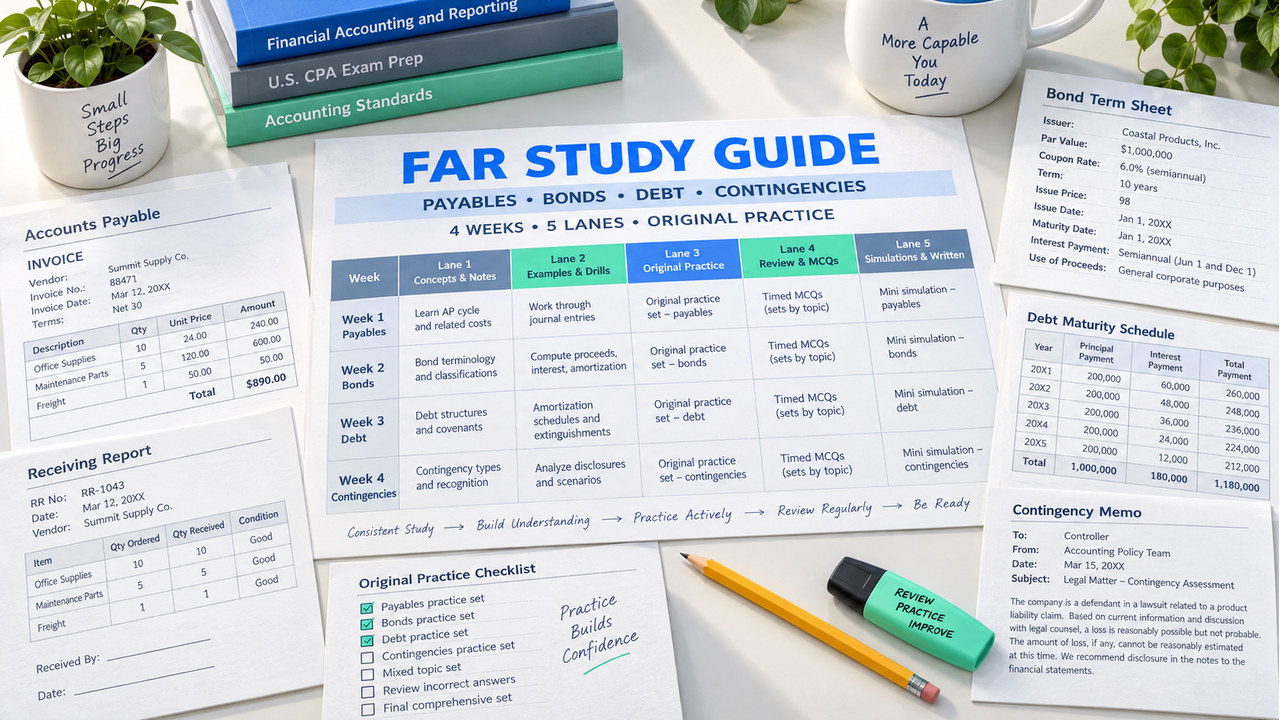

Direct answer: First, use this far payables bonds debt and contingencies study guide as a four-week route from blueprint scope to focused practice. Start with the document and date that control the facts, then separate measurement, classification, judgment, and elapsed-period work. Keep one proof per lane, solve an original checkpoint, and let the first broken field choose the next block.
Editorial review: Meanwhile, the CPA Exam Prep editorial team checked the AICPA Blueprint scope and recorded the FASB checkpoint on September 24, 2026. The route and cases are original, not official questions. Therefore, each week ends with visible proof.
For technical conclusions, use the current FASB Accounting Standards Codification. In addition, the NASBA FAQ covers administration, while the sample test covers format.
What this payables bonds debt and contingencies study guide covers
First, anchor the guide to five lanes. The source lane asks which invoice, receiving report, term sheet, maturity schedule, or counsel memo supplies the fact. Next, the measurement lane separates face amount, carrying amount, coupon, effective yield, and elapsed period. Classification places principal due within twelve months in the right bucket; judgment separates probable from estimable; accrual turns a rate and elapsed period into the requested amount.
- Source: name the document that controls the obligation or estimate.
- Date: mark receipt, reporting, payment, maturity, or elapsed days.
- Measurement: label face, carrying amount, coupon, yield, and period before calculating.
- Classification: split current and noncurrent principal at the reporting date.
- Judgment and accrual: test probability and estimation separately, then calculate only the elapsed period requested.
As a result, a study session should leave a short trail: source, date, lane, formula or recognition test, and next problem. In short, the trail should show what controls the answer. If it is missing, rebuild the skipped field instead of rereading everything.
Build a four-week debt and contingencies study guide route
Use one week for each cluster and keep one rhythm: read bounded notes, solve original problems before the reveal, and explain the nearest distractor. Consequently, keep the proof small: a filled checklist, corrected formula, dated maturity split, or probability-and-estimate note is more useful than an unclassified score.
Receipt, invoice, accrual, cutoff, and related estimates. Proof: one dated source timeline.
Face, carrying amount, coupon, yield, premium, discount, and interest. Proof: one labeled formula.
Maturity schedules, current portion, long-term presentation, and note terms. Proof: one dated split.
Probability, estimation, recognition, disclosure, and mixed review. Proof: one decision note.

Week 1: Payables and cutoff evidence
First, begin with the receiving report, invoice date, payment date, and reporting date. However, the study question is not “When was cash paid?” but “When did the accepted obligation enter the reporting period?” For example, a $72,000 shipment received and accepted on December 28 belongs in the year-end timeline even if the invoice arrives in January. As a result, write the dates in order, name the controlling evidence, and then solve three new cutoff variations. Then, keep that timeline beside the new variations.
Week 2: Bonds and interest measurement
Next, put face amount, carrying amount, coupon rate, effective yield, and period on separate lines. However, a bond premium or discount means the cash coupon and effective interest expense may differ. Therefore, a clean formula is a study proof: the inputs show why the answer uses face or carrying amount, and the period shows why a full-year rate is prorated. In other words, label the requested output before choosing an input.
Week 3: Debt classification and presentation
Then, place the reporting date in the center of the maturity schedule. In practice, mark principal due within the next twelve months as current in the simplified exercises and leave the later principal in the long-term lane. For this reason, rework a new schedule after you finish the original example so that the classification rule is not tied to one set of numbers. As a result, the reporting date remains visible when the amounts change.
Week 4: Debt and contingencies review
Finally, separate probability from measurement. Because of this distinction, a probable loss with a reasonable estimate leads to a different response from a probable loss that cannot yet be reasonably estimated in the simplified checkpoint below. Meanwhile, pair that judgment with one elapsed-interest calculation, then complete a mixed set using the same source-date-measurement-classification trail. For this reason, record the judgment and the calculation as separate proofs.
Worked example: bond measurement and study proof
Use this original worked example before the checkpoints. For example, a $1,000,000 bond has a $960,000 carrying amount, a 6.5% annual effective yield, and a 5% annual coupon. The requested unit is six-month interest expense, not cash interest. Calculate $960,000 × 6.5% × 6/12 = $31,200. The $25,000 coupon uses face amount and coupon.
Study proof: write “expense,” “carrying amount,” “effective yield,” and “six months” beside the formula. Consequently, an answer using $1,000,000 or 5% signals a measurement error. In other words, label inputs before arithmetic. Rebuild the labels, solve a second bond, and explain the cash-interest distractor.
Debt and contingencies study guide checkpoints: six original cases
These six checkpoints are original simplified practice, not official questions. First, read the skill, assumptions, and difficulty, attempt each item, then record the first broken field: source, date, measurement, classification, judgment, or elapsed period. Before you reveal an answer, write the requested output in one line.
1. Accepted goods and the reporting cutoff
Tested skill: identify the source that creates the payable. Assumptions: goods were accepted before year-end; no return is stated. Difficulty: foundational. Northline received and accepted $72,000 of inventory on December 28. The invoice was entered on January 4 and paid on January 22.
Question: Which amount belongs in the simplified December 31 payable?
- A. $0 because the invoice was entered in January
- B. $72,000 because accepted goods were received before year-end
- C. $22,000 because payment occurred in January
- D. $94,000 because invoice entry and payment are combined
Reveal Checkpoint 1 answer and reasoning
Answer: B. Thus, receipt and acceptance create the controlling year-end obligation in this simplified exercise. Option A follows the entry date, option C follows cash, and option D invents an addition. Therefore: draw a four-date timeline and solve two variations where the receipt occurs after year-end.
2. Effective interest on a bond carrying amount
Tested skill: select the measurement basis and period. Assumptions: the supplied yield is annual and the requested period is six months. Difficulty: measurement. A bond has a $960,000 carrying amount at the start of six months and a 6.5% annual effective yield.
Question: What simplified interest expense should the study calculation produce?
- A. $24,000
- B. $25,000
- C. $31,200
- D. $62,400
Reveal Checkpoint 2 answer and reasoning
Answer: C. Therefore, use carrying amount and effective yield: $960,000 × 6.5% × 6/12 = $31,200. Option B uses a 5% coupon on face amount from a different fact, and option D skips the six-month fraction. Therefore: rewrite the formula with the requested unit above it before changing any numbers.
3. Current portion of a note
Tested skill: classify principal at the reporting date. Assumptions: only principal is requested; the note has no stated refinancing exception. Difficulty: classification. A $900,000 installment note has $150,000 of principal due over the next twelve months and $750,000 due later.
Question: What current portion should be presented in the simplified schedule?
- A. $0
- B. $150,000
- C. $750,000
- D. $900,000
Reveal Checkpoint 3 answer and reasoning
Answer: B. Thus, the current portion is principal due within the next twelve months. Option A ignores the schedule, option C selects the later balance, and option D leaves current and long-term amounts unsplit. Therefore: make a dated two-column maturity schedule and label the split before calculating interest.
4. Probable but not reasonably estimable loss
Tested skill: separate probability from measurement. Assumptions: the claim is probable, but counsel cannot yet make a reasonable estimate. Difficulty: judgment. No reimbursement is stated, and the question asks for the simplified reporting response.
Question: Which response best follows the stated fields?
- A. Recognize any amount the claimant requested
- B. Disclose the contingency without recognizing an invented amount
- C. Ignore the matter because no cash was paid
- D. Recognize a zero-dollar liability and stop reviewing
Reveal Checkpoint 4 answer and reasoning
Answer: B. However, probability alone does not supply a reliable measured amount in this simplified exercise, so the study response is disclosure without an invented recognition amount. Option A substitutes a demand for an estimate, option C confuses cash with reporting, and option D treats zero as a conclusion. Therefore: write probability and estimability on separate lines and change only the estimate field in a retry.
5. Accrued interest for elapsed days
Tested skill: prorate interest for the elapsed period. Assumptions: use a 360-day year and simple daily accrual. Difficulty: accrual. A $600,000 note carries an 8% annual rate, and 45 days have elapsed since the last payment.
Question: What accrued interest should the simplified calculation record?
- A. $2,000
- B. $4,800
- C. $6,000
- D. $48,000
Reveal Checkpoint 5 answer and reasoning
Answer: C. Thus, annual interest is $600,000 × 8% = $48,000. Apply 45/360: $48,000 × 45/360 = $6,000. Option B uses one month, option D records a full year, and option A uses too little time. Therefore: write annual amount, elapsed days, and denominator before entering the rate.
6. Cash interest versus effective expense
Tested skill: return the requested output rather than a nearby bond amount. Assumptions: interest is paid semiannually and the question asks for cash interest. Difficulty: requested-unit control. A $1,200,000 bond has a 5.5% annual coupon and pays interest every six months.
Question: What six-month cash interest is paid?
- A. $16,500
- B. $33,000
- C. $66,000
- D. The carrying amount multiplied by the effective yield
Reveal Checkpoint 6 answer and reasoning
Answer: B. Thus, cash interest uses face amount and coupon: $1,200,000 × 5.5% × 6/12 = $33,000. Option A uses one quarter, option C uses a full year, and option D answers expense rather than cash. Therefore: write “cash” or “expense” above the formula before selecting inputs.
Review errors from the debt and contingencies study guide
Next, classify the first error instead of rereading all four weeks. For example, a source error means the controlling document was missed. Next, a date error loses the reporting or elapsed period. Similarly, a measurement error mixes face, carrying amount, coupon, or yield. In contrast, a classification error leaves current and long-term principal unsplit. Finally, a judgment error combines probability and estimability.
For example, after Checkpoint 1, place receipt and invoice dates on a timeline. After 2 or 6, write the requested output and formula inputs; after 3, redo a maturity schedule; after 4, change only the estimate field. In contrast, rereading every rule hides the first broken field. The narrowest repair gives you a better next block.

Turn the debt and contingencies study guide into a repeatable loop
In practice, close each week with three proofs: one corrected workpaper, one distractor explanation, and one new problem solved without notes. Therefore, if one breaks, keep the lane and change one fact; however, a percentage is not proof of transfer. Thus, change one fact rather than restart the topic.
| First broken field | Proof to keep | Next block |
|---|---|---|
| Source or date | Dated document timeline | Three cutoff variations |
| Measurement | Labeled formula and units | Two bond calculations |
| Classification | Dated current/noncurrent split | Two maturity schedules |
| Judgment or accrual | Probability note or time fraction | One changed-fact retry |
Research and refresh the study guide
For live conclusions, use the current AICPA CPA Exam Blueprints for scope and the current FASB Accounting Standards Codification for technical debt, interest, payable, and contingency guidance. Meanwhile, the AICPA sample test can help with software and format, but it is not a readiness determination. In other words, this guide uses simplified facts and does not replace current research for a complete reporting conclusion.
Finally, before reuse, refresh the scope pages, check the Blueprint effective date, and recheck every arithmetic row. In addition, keep assumptions visible when comparing attempts, and leave Semrush US volume and KD open until the row-level refresh is complete.
Payables bonds debt and contingencies study guide FAQ
How should I start this study guide?
First, read the Blueprint boundary, choose the current week, and write the proof you will keep before solving a new problem.
Should I study bonds before payables?
Usually, start with payables and source-date control, then move to bond measurement because the same evidence habit supports later formulas.
What should I do after a wrong answer?
Identify the first broken field, change one fact, solve a similar original problem, and explain the nearest distractor.
Does this guide predict a CPA score?
No. It is original study material. Use the proof and next block to guide learning, not to estimate a score or readiness.