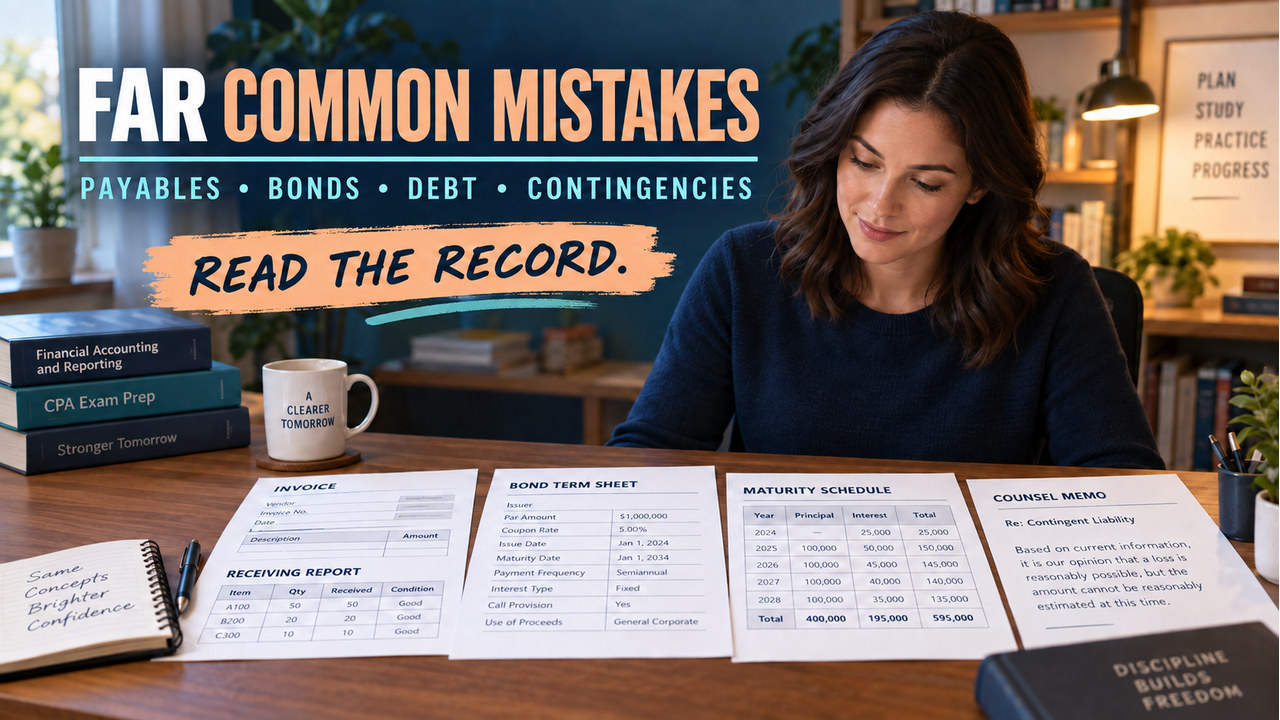

Direct answer: Most payables bonds debt contingencies mistakes begin before the calculation. The learner chooses a plausible number before identifying the controlling record, reporting date, measurement basis, classification trigger, or disclosure question. Use this original FAR practice guide to stop that sequence: read the record, mark the date, name the accounting lane, compute only the requested unit, and route the first broken field to one next drill. These questions are original study material, not official or recalled CPA Exam content.
Scope note: The CPA Exam Blueprints effective January 1, 2026 describe eligible content and sample task statements. The AICPA and NASBA resources explain the exam format and task-based simulations. For technical conclusions, reopen the current FASB Accounting Standards Codification and the complete facts. This page is a study aid, not a reporting conclusion.
Use the AICPA CPA Exam Blueprint resource for tested-skill scope and the FASB Accounting Standards Codification for current technical guidance. The NASBA CPA Exam FAQ explains that candidates encounter both multiple-choice questions and task-based simulations. Those sources help define the study boundary; they do not turn the drills below into official questions.
For a broader preparation path, continue with our CPA Exam Study Guide.
What these payables bonds debt contingencies mistakes actually test
These topics look separate, yet the error pattern is similar. A packet contains several documents and several dates. One number feels familiar, so the learner calculates immediately. The better move is to build a five-field record before touching the answer choices.
- Source: Which document or fact controls the question?
- Date: Which transaction, reporting, maturity, or elapsed-interest date matters?
- Measure: Is the question asking for face amount, carrying amount, interest expense, cash interest, probability, or an estimate?
- Classify: Does the result belong in payable, debt, current portion, contingency, or disclosure?
- Disclose: What explanation or judgment remains even after a number is recorded?
A correct formula cannot repair the wrong field. Therefore, write the requested unit in the margin before calculating. If the prompt asks for an ending liability, do not answer with cash paid. If it asks about a possible loss, do not jump from a worrying memo to a recorded amount without testing probability and estimability.
Use a mistake filter before choosing a number
Start with the source record. An invoice may show a date and amount, but a receiving report may show when goods were accepted. A bond term sheet may show face value and coupon, while the market yield controls effective-interest measurement. A maturity schedule may reveal the current portion, and a counsel memo may describe a loss contingency without resolving recognition by itself. When the packet combines these lanes, name the bonds debt mistake before you calculate.
Next, mark the reporting date and the fact that changed. Then name the requested output. The following short filter keeps a familiar number from taking over the question:
- Underline the trigger: acceptance, issuance, maturity, settlement, elapsed months, or legal assessment.
- Circle the unit: payable, carrying value, interest expense, cash interest, current debt, loss, or disclosure.
- Cross out distractor numbers: face value is not automatically carrying value; a coupon is not automatically effective interest; an estimate is not automatically a recognized liability.
- Write one support sentence: state the fact that makes the selected answer fit.
The checkpoint is simple: if you cannot name the source and date in one sentence, pause before computing. That short pause is the bonds debt check that keeps a familiar number from controlling the answer.

Separate the six error lanes
1. Recording an obligation from the invoice alone
A common payable mistake is to treat the invoice date as the complete recognition story. In a simplified drill, the receiving report may show acceptance after the reporting date, or it may show that the goods were already received before year-end even though the invoice arrived later. The mistake is not arithmetic; it is using the wrong event.
Ask what the packet says about delivery, acceptance, and the reporting date. Then choose the amount that belongs to the obligation existing at that date. If the fact pattern is incomplete, state the missing assumption instead of inventing one. The learner should leave the question with a source trail: receiving report controls the acceptance date; invoice confirms the billed amount.
2. Treating bond face value as the carrying amount
Face value is the amount due at maturity. The carrying amount can differ when the issue price reflects a discount or premium. The coupon rate drives contractual cash interest, while the market or effective rate drives interest expense in an effective-interest pattern. A response that uses the coupon rate for every purpose may look neat but answer a different question.
Before calculating, label each rate and each amount. Write face, cash coupon, effective yield, and carrying amount beside the inputs. Then test whether the requested output is the next-period interest expense, cash payment, or ending carrying value. This small labeling step prevents the most common bond shortcut.
3. Ignoring the current portion of long-term debt
A maturity schedule may show that a payment due within the next operating cycle must be presented separately from the remaining long-term balance. The total debt does not disappear, but classification changes. Learners often carry the entire balance into long-term debt because the original borrowing was long term.
Read the reporting date first. Identify principal due in the relevant near-term window, then separate that amount from the remaining balance. Do not confuse a refinancing fact, a covenant issue, or a payment schedule with a new measurement rule. The question may ask only for current classification, not the total liability or a journal entry.
4. Recording a contingency because the memo sounds serious
Legal language can be alarming without proving that recognition criteria are met. A contingency analysis requires attention to the likelihood of an unfavorable outcome and whether the amount can be reasonably estimated under the applicable guidance. A memo that says a loss is possible does not automatically equal a recorded loss.
Mark the probability wording, the estimate range, and the reporting date. If the question asks for disclosure, answer the disclosure question. If it asks for recognition, explain why the probability and estimate facts do or do not support a recorded amount. Never convert tone into a number.
5. Mixing accrued interest with cash interest
Accrued interest measures the amount earned or incurred through an elapsed date. Cash interest measures the payment made under the contract. A six-month payment does not necessarily equal the interest expense for a year-end question, and an unpaid amount can still be part of the liability.
Draw a short timeline. Put issuance, last payment, reporting date, and next payment on it. Count the elapsed period requested by the prompt. Then decide whether the output is interest expense, accrued interest payable, or cash paid. The timeline is often more valuable than another memorized formula.
6. Carrying a prior answer into a changed fact pattern
Practice sets often alter one fact: the receiving date moves, the yield changes, the maturity crosses the reporting date, or the counsel estimate becomes unavailable. A learner may remember the earlier answer and adjust the wrong line. The safer method is to preserve the original work, circle the changed fact, and restart only the affected field.
This is why a mistake log should name the first broken field rather than record only a score. “Measurement: used coupon instead of effective yield” leads to a useful retry. “Missed question 4” does not.
Complete the original mistake drills
Attempt each question before opening the answer. Assume a simplified fact pattern, use only the information shown, and write the requested unit. These are original practice questions, not official, recalled, or leaked CPA Exam items.
Drill 1 — Which source controls the payable date?
A company receives goods on December 30 and accepts them on January 2. The vendor invoice is dated December 29. The reporting date is December 31. Which fact should control the first review of the payable question?
- A. Invoice date only
- B. Receiving and acceptance records
- C. Vendor payment date
- D. The next month’s bank statement
Drill 2 — Which rate answers the interest-expense question?
A bond has a $100,000 face amount, a 5% coupon, and a 6% effective yield. The prompt asks for the period’s interest expense. Which input should lead the calculation?
- A. Face amount only
- B. Coupon cash payment only
- C. Carrying amount and effective yield
- D. Maturity date only
Drill 3 — Which amount is current?
A $240,000 note is due in installments. The maturity schedule shows $40,000 due within the next operating cycle and $200,000 afterward. The prompt asks for the current portion.
- A. $40,000
- B. $200,000
- C. $240,000
- D. Zero because the note began as long-term debt
Drill 4 — What must the contingency review identify first?
Counsel describes an unfavorable outcome as reasonably possible, but the amount cannot be estimated. What should the learner identify before choosing a recognition answer?
- A. The probability wording and estimate availability
- B. The invoice number
- C. The bond coupon
- D. The cash balance
Drill 5 — What does a six-month cash payment prove?
A company pays six months of contractual interest on July 1. The question asks for interest accrued at December 31. Which step is necessary?
- A. Treat the July payment as the full-year expense
- B. Draw the timeline and measure the elapsed period through December 31
- C. Use the bond face amount as accrued interest
- D. Ignore the reporting date
Drill 6 — What changes when one fact changes?
Your original answer used a 5% effective yield. A revised task gives a 6% yield but leaves the coupon unchanged. What is the best first action?
- A. Copy the old answer and change the label
- B. Restart every topic in the chapter
- C. Circle the changed yield and recompute the affected measurement field
- D. Replace the yield with the coupon
Reveal the reason, not only the letter
After attempting the six drills, reveal the correct answer and identify the first broken field: source, timing, measurement, classification, or disclosure.
Reveal the answer
Answer: Review the worked explanation in the article.
Compare your process with the reasoning shown above.
Route the first broken field to the next drill
After checking the answers, do not label the result only as right or wrong. Use the first broken field to choose the next action:
- Source error: reread the invoice, receiving report, term sheet, or counsel memo and write the controlling fact.
- Timing error: draw the reporting-date or elapsed-interest timeline.
- Measurement error: label face, coupon, yield, estimate, cash, and carrying amount before recomputing.
- Classification error: separate current, long-term, payable, debt, contingency, and disclosure outputs.
- Disclosure error: write the probability, estimate, and judgment in one support sentence.
For example, a learner who chose the coupon rate for an interest-expense question should not repeat the same bond chapter blindly. The next drill should change one yield or carrying amount fact, require the same labels, and ask for a short support sentence. Meanwhile, a learner who treated a serious-sounding legal memo as a recorded loss should retry a case in which probability changes but the estimate remains unavailable.

Common mistakes FAQ
What is the most common mistake across these topics?
Choosing a number before naming the controlling record, date, and measurement basis. Start with those three fields, then classify the requested output.
Should every plausible obligation become a payable?
No. Use the complete reporting-date facts and the applicable recognition guidance. An invoice, memo, or estimate can be evidence without being the final recognition answer.
How should I use a missed question?
Classify the first broken field, reopen the relevant source or rule, and retry one changed fact pattern. A score without a repair action is weak feedback.
Are these official CPA Exam questions?
No. These are original study drills. They are designed to practice the reasoning path and do not reproduce or predict any live exam item.
Sources
For scope and current exam terminology, review the AICPA CPA Exam Blueprint resource and the NASBA CPA Exam FAQ. For technical accounting research, use the current FASB Accounting Standards Codification and monitor the FASB debt-exchange project history. The AICPA sample-test resource can help you understand the practice environment, but these drills remain independently authored.