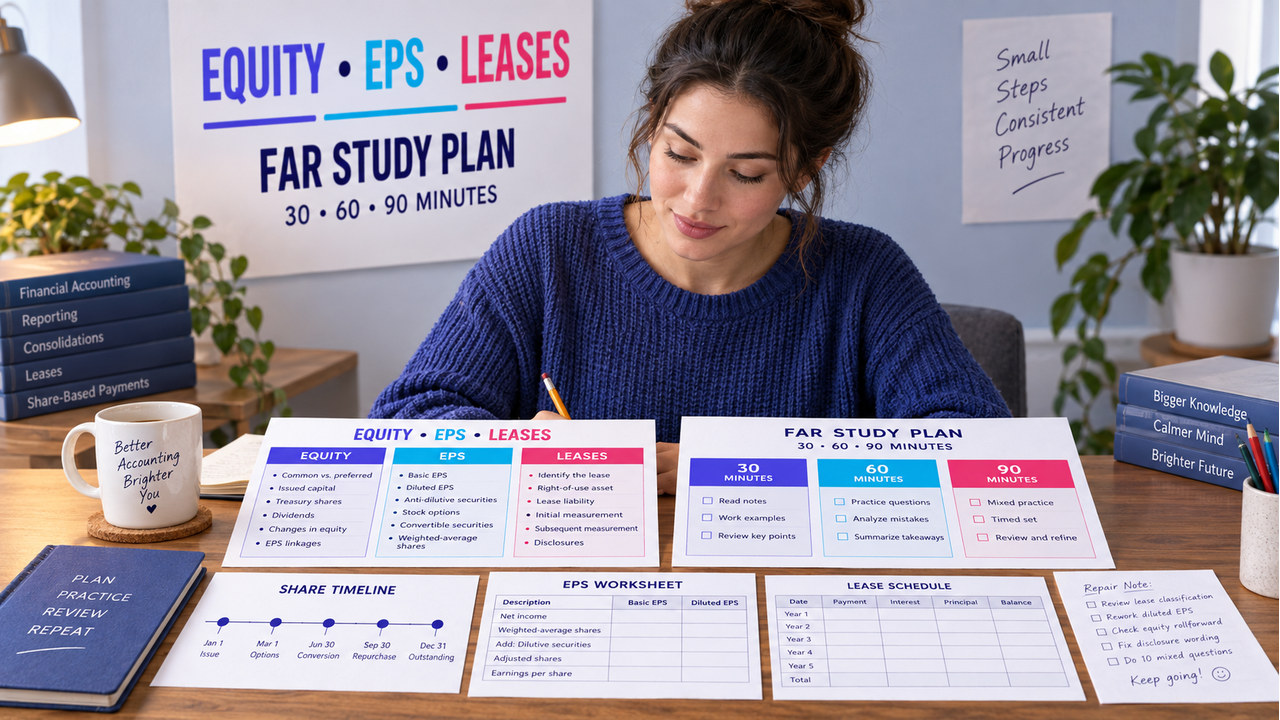

Short answer: To study equity EPS lease accounting for FAR, match the routine to your available time and the first broken skill. Use 30 minutes for one narrow lane and a repair note, 60 minutes for one lane plus retrieval, and 90 minutes for two lanes plus a mixed check. Finish every session by changing one fact and retrying the same method.
This approach keeps a short study window useful without pretending that more minutes automatically create better results. The AICPA Blueprint supplies a scope boundary, while the FASB Codification supplies the technical research route. The examples below are original and simplified. They are not official, recalled, leaked, or score-predictive CPA Exam questions.
Build the plan around the first broken skill
A good plan does not begin with “cover everything.” It begins with evidence. When a question goes wrong, record the topic lane, requested unit, first broken field, and the shortcut that pulled you off course. Equity errors often involve share timing, treasury stock, or preferred-dividend presentation. EPS errors often involve the numerator, weighted-average shares, or dilution. Lease errors often involve payment timing, present value, right-of-use adjustments, or renewal evidence.
Then give the error one next action. Start a share-timing repair with a timeline. Use an income-to-common bridge for a numerator miss. Isolate dilution with a separate incremental-share calculation. Build a payment schedule for a lease-measurement miss. For a term miss, write a sentence explaining the evidence for reasonable certainty. Therefore, the plan should follow the error field, not the order of a textbook chapter. That record keeps the study equity EPS lease accounting plan tied to an observable repair rather than a page count.
Choose the routine that fits your time
Use the shortest complete routine you can repeat. A complete routine has four parts: setup, one focused lane, retrieval without notes, and a repair note. The longer versions add a second lane or a mixed check; they do not simply stretch the same rereading block.
30-minute routine: one lane and one repair
Spend three minutes naming the lane and requested output. Use fifteen minutes on two or three original cases in that lane. Next, close the notes and write the method in four lines. Reserve the final seven minutes for one changed-fact retry and a repair note. This routine suits a learner who knows the broad topic but keeps repeating one narrow mistake.
60-minute routine: focused work plus retrieval
Use five minutes to review the error log, thirty minutes for one lane, ten minutes for retrieval without notes, and fifteen minutes for a changed-fact check. For example, an EPS session can separate the numerator bridge from dilution rather than mixing both immediately. If the retrieval step exposes a different failure, carry only that field into the next session.
90-minute routine: two lanes and a mixed check
Use ten minutes for the plan, thirty minutes for the primary weak lane, twenty-five minutes for a second lane, fifteen minutes for a mixed case, and ten minutes for the repair note. Keep the second lane smaller. The purpose is to test whether you can identify the topic before reaching for a method, not to race through every possible subtopic.

Route each lane to the right study work
For equity, start with a dated share timeline. Mark opening shares, issues, repurchases, and preferred-dividend facts before writing an equation. Then check whether the requested output is weighted-average shares, a treasury-stock presentation, or income available to common shareholders. A final retry should change one date or one transaction, not the entire fact pattern.
For EPS, keep the numerator and denominator on separate lines. Basic EPS may require a bridge from net income to income available to common shareholders. Diluted EPS may require potential shares, after-tax adjustments, and a test of whether the instrument is actually dilutive. If a learner selects every potential share automatically, the next block should isolate the dilution decision.
For leases, label payment timing first. Then calculate the liability from the stated payments and discount information. After that, adjust the right-of-use asset for the facts supplied at commencement, and treat the lease term as an evidence question when a renewal option appears. A lease session should produce a labeled schedule, not only a final number.
Use a weekly rotation without losing the weak area
A weekly plan can rotate the three lanes while preserving the first broken field. Day one is for diagnosis and mapping. Reserve day two for equity. Use day three for EPS. Put leases on day four. By day five, mix two lanes. Day six is for retrying the most persistent error with a changed fact. Finally, use day seven to explain one case and choose the next cycle.
Do not let rotation hide a repeated weakness. If leases fail on three consecutive checks, keep the rotation but give leases the primary block and make the other lane a short retrieval exercise. Likewise, if equity is stable but EPS dilution remains weak, do not spend the full session on share-count definitions. A plan is working when it changes the allocation in response to evidence.
Run five original planning checks
These cases ask what the next study move should be. Attempt them before revealing the rationale. Record the available time, the weak lane, and the output you intend to produce.
Check 1 — Short window, timing error
You have 30 minutes and missed a weighted-average-share question because you used the year-end balance for every month. What should the next session produce?
- A. A full reread of all equity topics
- B. One dated share timeline and a changed-issue-date retry
- C. A lease present-value schedule
- D. A mixed set with no notes
Reveal the rationale
Best answer: B. The evidence points to timing, so a timeline and one changed date make the repair observable. A broad reread uses the window without isolating the field. Next, move the issue from July to October and recompute.
Check 2 — EPS numerator and dilution
You have 60 minutes. Your last two EPS misses came from subtracting preferred dividends incorrectly and adding all options as dilutive. What should lead the block?
- A. Two separate bridges: income available to common, then incremental shares
- B. Lease term classification
- C. Memorizing every EPS formula in one list
- D. A score comparison with another learner
Reveal the rationale
Best answer: A. The two errors belong to related but distinct fields. Use one bridge for the numerator and one treasury-stock case for dilution, then retrieve both without notes. Change the preferred dividend or market price on the retry.
Check 3 — Long window, lease measurement
You have 90 minutes and repeatedly confuse total lease payments with the initial present-value liability. Which sequence is most useful?
- A. Read three unrelated FAR chapters
- B. Calculate a labeled payment schedule, explain discounting, then change payment timing
- C. Memorize the right-of-use abbreviation only
- D. Start with a mixed quiz and skip the schedule
Reveal the rationale
Best answer: B. The weak field is measurement. A schedule makes payment timing, discount factors, and liability output visible; a changed timing fact tests transfer. Reserve the final minutes for the repair note.
Check 4 — Mixed errors
Your mixed set contains one equity timing miss, one EPS numerator miss, and one correct lease calculation. What should the next session do?
- A. Repeat the entire mixed set without recording errors
- B. Use a primary block for equity and a short EPS bridge; keep lease in maintenance
- C. Drop equity and EPS because the lease item was correct
- D. Study only the answer letters
Reveal the rationale
Best answer: B. Two lanes need repair, while lease can remain a short retrieval item. This allocation respects the evidence without restarting the whole section. Change one equity date and one EPS numerator fact.
Check 5 — Noisy week
You can study for 20 minutes on four separate days, but one day will be lost. Which plan is most defensible?
- A. Wait for one perfect four-hour block
- B. Use three 20-minute lane blocks and one changed-fact review, with the weakest lane twice
- C. Spend every block copying definitions
- D. Mix all topics every day without an error log
Reveal the rationale
Best answer: B. Short repeatable blocks create evidence and protect the weak lane from disappearing. Schedule the second pass after the first error log, then change one fact instead of copying the old answer.
End every session with a changed fact
A session is incomplete when you only know whether an answer was right. Write four lines: “I used ___; the prompt required ___; I will change ___; my next output is ___.” The output might be a share timeline, an EPS numerator bridge, an incremental-share schedule, a lease payment table, or a lease-term evidence sentence.
Keep the retry narrow. If you change three facts at once, a correct result does not show which repair worked. Instead, preserve the lane, change one input, and explain why the answer changes or stays the same. This is especially useful when a lease payment moves from period-end to commencement or when an option’s market price falls below its exercise price.
Route the session to the weak area
Use a simple router after every block. An EQUITY timing error sends the next session to a timeline drill. For EPS numerator errors, send the next block to a bridge from net income to common shareholders. When dilution fails, send it to a potential-share test. A LEASE measurement error sends the next block to a payment schedule. For a LEASE term error, use an evidence comparison. The label should appear in the error log before you choose the next topic.

How to study equity EPS lease accounting when time changes
Use the study equity EPS lease accounting method as a flexible frame, not a fixed calendar. On a short day, choose one lane and one retry. Add retrieval when the day is longer. On a long day, add a second lane and a mixed check. If the same field fails again, promote it to the primary block; if it holds after a changed fact, move it to maintenance.
For the broader section route, use the site’s FAR review hub. Use the official AICPA and FASB resources below for scope and technical research. Keep this local planning method separate from any official question or result claim.
FAQ about a FAR study plan
Should I always use the longest study routine?
No. Use the longest routine you can complete consistently. A focused 30-minute block with a changed-fact retry is more informative than a 90-minute session of passive rereading.
Which lane should come first?
Use the first broken field from your error log. If evidence is mixed, choose the lane that failed more than once and keep the stable lane in short retrieval.
How often should I mix equity, EPS, and leases?
Mix them after you can complete each lane separately. A weekly rotation can add mixed work on Day 5 while keeping the weakest lane primary.
Does this plan predict my CPA Exam result?
No. It organizes study time and practice feedback. It does not reproduce official questions, assign official weighting, or predict a score.
Sources and scope boundary
Use the AICPA CPA Exam Blueprints to confirm the current FAR boundary, task statements, skill levels, and references. Use the FASB Standards page and the current Topic 260 and Topic 842 Codification routes for technical research. Use the NASBA CPA Exam FAQ for administration questions.
Before reuse, reopen the official sources, verify the applicable facts and dates, and recheck every simplified calculation. This is a study method with original cases, not an official exam simulation.