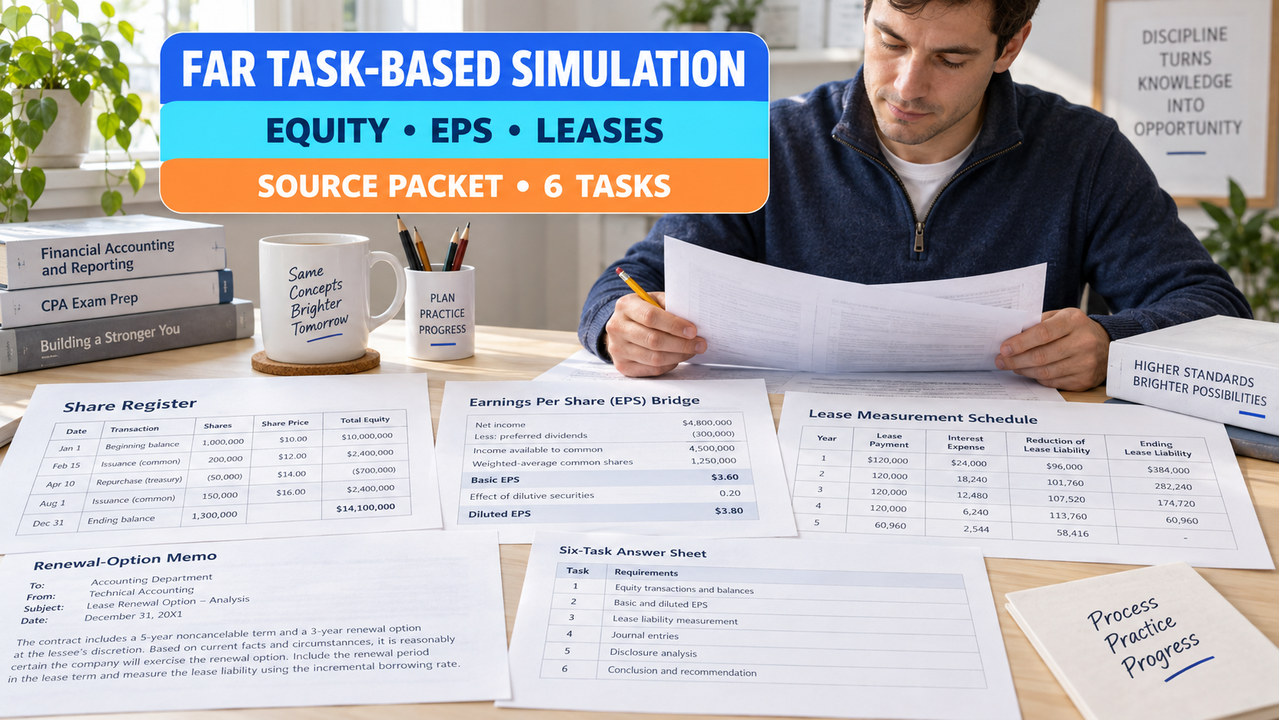

Direct answer: Use this FAR equity EPS lease simulation as an evidence handoff. Read the exhibit, identify the rule trigger, return the requested unit, write one support sentence, and log the first broken field. The six tasks below are original study material, not official, recalled, leaked, or score-predictive questions. Set a 20-minute limit and open each answer only after choosing an option.
Scope note: The CPA Exam Prep editorial team checked the scope boundary against the current AICPA Blueprint and saved an EPS and lease research checkpoint on September 30, 2026. Amounts, documents, options, rationales, visual labels, and study actions are independently authored. A real reporting conclusion still requires current research and complete facts.
For scope, reopen the AICPA CPA Exam Blueprint. For technical accounting research, use the current FASB Accounting Standards Codification, including the Topic 260 and Topic 842 routes when the fact pattern points to EPS or leases. The NASBA CPA Exam FAQ covers administration separately.
What this FAR equity EPS lease simulation tests
This FAR equity EPS lease simulation tests whether you can keep five fields separate when a packet contains several plausible numbers. First, identify the controlling exhibit: a share register, income statement, potential-share schedule, lease payment schedule, or renewal memo. Next, mark the reporting date or elapsed period. Then, name the lane—share timing, EPS numerator, EPS dilution, lease measurement, or lease term. After that, return the unit requested by the prompt. Finally, support the answer in one sentence.
Do not treat the number correct as a score, readiness estimate, or pass probability. Instead, use the visible evidence trail. A correct answer without a source or period is fragile; a missed answer with a named broken field is repairable. Keep the first attempt intact and postpone reveals until every task has an option selected.
Which exhibit controls?
Which period applies?
Which accounting field?
What must you return?
Why does it follow?
Build the FAR equity EPS lease simulation packet
Before calculating, sort the packet into six evidence tabs. Pair the share register with issuance and repurchase dates. Put net income, preferred dividends, and weighted-average shares on the EPS bridge. Keep potential common shares in a separate dilution note. Place lease payments and the present value in the measurement schedule. Finally, place the renewal option and specialized-improvement facts beside the lease-term conclusion.
For each tab, write the requested output in plain language: weighted-average shares, basic EPS, diluted EPS, initial lease liability, lease term, or the next review action. A number that does not answer that unit is a distractor. Therefore, label the formula before selecting inputs.

Run the FAR equity EPS lease simulation
First, use the same five-step routine for all six original tasks: read the exhibit, research the trigger, decide, support, and review the first broken field. Assume a calendar year, no tax effects, no unusual elections, and only the stated facts. A changed real-world fact can change the conclusion.
1. Weighted-average share timing
For Task 1, tested skill: weight common shares by time. Assumptions: ignore stock splits and preferred dividends, and use a simplified annual calculation. Difficulty: foundational. The share register shows 100,000 common shares on January 1, an issuance of 20,000 on April 1, and a repurchase of 10,000 on October 1.
Question: What weighted-average share count should the simplified answer use?
- A. 100,000
- B. 105,000
- C. 112,500
- D. 120,000
Reveal Task 1 answer and reasoning
Answer: C. The company has 100,000 shares for three months, 120,000 for six months, and 110,000 for three months. Therefore, the weighted amount is 25,000 + 60,000 + 27,500 = 112,500. Option A ignores the issuance, option B understates the middle period, and option D ignores the repurchase. Next action: draw the date line before touching the answer choices.
2. Basic EPS numerator
Next, Task 2 tested skill: separate income available to common shareholders from reported net income. Assumptions: preferred dividends are cumulative for this simplified exercise, and no other adjustments apply. Difficulty: calculation setup. Net income is $480,000, preferred dividends are $30,000, and weighted-average common shares are 225,000.
Question: Which basic EPS amount is closest?
- A. $1.87
- B. $2.00
- C. $2.13
- D. $2.27
Reveal Task 2 answer and reasoning
Answer: B. Income available to common shareholders is $480,000 − $30,000 = $450,000. Accordingly, $450,000 ÷ 225,000 = $2.00. Option A divides net income by the share count without subtracting preferred dividends. Next action: keep a numerator bridge visible whenever the prompt gives both net income and preferred dividends.
3. Diluted EPS denominator
Then, Task 3 tested skill: test the effect of potential common shares. Assumptions: the instrument is dilutive and creates no numerator adjustment. Difficulty: denominator control. Basic income available to common shareholders is $450,000, basic weighted-average shares are 225,000, and a potential common-share instrument adds 25,000 shares.
Question: Which diluted EPS amount is closest?
- A. $1.80
- B. $2.00
- C. $2.22
- D. $2.50
Reveal Task 3 answer and reasoning
Answer: A. The diluted denominator is 225,000 + 25,000 = 250,000 shares. As a result, $450,000 ÷ 250,000 = $1.80. Option B keeps the basic denominator, while the other options use a denominator that does not match the exhibit. Next action: write numerator, basic denominator, and incremental shares on separate lines.
4. Initial lease measurement
Meanwhile, Task 4 tested skill: identify the initial lease liability from the payment schedule. Assumptions: four annual payments of $100,000 occur at each year-end, the stated present value is the only adjustment, and the question asks for the liability at commencement. Difficulty: measurement. The schedule gives a present value of $354,600.
Question: Which amount best describes the initial lease liability?
- A. $100,000
- B. $300,000
- C. $354,600
- D. $400,000
Reveal Task 4 answer and reasoning
Answer: C. The initial liability is based on the present value of the lease payments, not the first payment or the undiscounted total. In particular, the schedule should show the liability declining as payments are made and interest is recognized. Next action: build the payment schedule before comparing the present value with the total cash payments.
5. Renewal-option evidence
Afterward, Task 5 tested skill: connect lease-term evidence to the measurement period. Assumptions: the option is evaluated at commencement and the specialized improvements cannot be moved economically. Difficulty: judgment. A lease has a five-year base term and a two-year renewal option. Management is reasonably certain to renew because the replacement site would cost much more and the improvements are specialized.
Question: What is the best review action before completing the lease schedule?
- A. Ignore the renewal because no cash has been paid yet
- B. Include the option period automatically without reviewing evidence
- C. Write the evidence for reasonable certainty and test one changed fact
- D. Replace the lease question with another EPS calculation
Reveal Task 5 answer and reasoning
Answer: C. The useful response is to connect the term conclusion to the evidence, then change one fact and test whether the conclusion moves. Therefore, removing the specialized improvements is a meaningful retry. Option B skips the judgment step, while A and D do not answer the lease-term task. Next action: keep the renewal evidence memo beside the term schedule.
6. Mixed output and first broken field
Finally, Task 6 tested skill: select the requested output when several topic lanes appear together. Assumptions: the prompt asks for the next review action, not a new accounting number. Difficulty: transfer. The learner chose the correct EPS numerator in Task 2 but used the undiscounted lease total in Task 4 and skipped the evidence note in Task 5.
Question: Which next action is most useful?
- A. Repeat all six tasks without notes
- B. Memorize the final answers again
- C. Build a present-value schedule, then test the renewal conclusion with one changed fact
- D. Increase the number of questions before repairing the broken field
Reveal Task 6 answer and reasoning
Answer: C. The first broken field is lease measurement and term evidence, not the EPS numerator. Consequently, a narrow schedule plus one changed-fact lease retry is more useful than a larger question count. Next action: state the first broken field before selecting the next study block.
Support each simulation answer with a research trail
After the first attempt, do not merely copy the answer letter. Instead, write a compact support sentence that names the source exhibit, trigger, requested unit, and nearest distractor. The table below is a study scaffold, not a substitute for the current Codification when a real case changes an assumption.
| Task lane | Evidence to name | Proof to keep |
|---|---|---|
| Share timing | Share register and transaction dates | 112,500 weighted shares |
| Basic EPS | Net income, preferred dividends, common shares | $450,000 numerator and $2.00 EPS |
| Diluted EPS | Incremental potential shares | 250,000 diluted denominator |
| Lease measurement | Payment schedule and present value | $354,600 initial liability |
| Lease term | Renewal evidence and changed fact | Reasonable-certainty conclusion |
For a current conclusion, reopen the authoritative source. In particular, use the AICPA Blueprint for scope and the Codification for technical accounting. This simulation forces the handoff to be explicit; it is not authority by itself.
Route a FAR equity EPS lease simulation result to a next drill
In practice, score only after writing a support sentence for every task. Additionally, count a point only when the answer, source exhibit, period, requested unit, and rejected distractor are visible. If the option is right for the wrong reason, mark it for repair.

For a 0–2 result, rebuild: sort the exhibits, label the five fields, and redo Tasks 1, 2, and 4. Next, for 3–4, target the first weak lane with two changed facts. Finally, for 5–6, transfer one task by changing one fact and explaining why the distractor still fails. None predicts a CPA result.
Log the first break in the FAR equity EPS lease simulation
First, classify the earliest broken field, not the last arithmetic mistake. A source break means you used the wrong exhibit. Next, a date break means you skipped an issuance, repurchase, reporting period, payment timing, or renewal point. Then, a measurement break means you mixed net income with income available to common shareholders or cash payments with present value. After that, a denominator break means you ignored incremental shares. Finally, a unit break means you answered with a number when the prompt asked for a review action.
Next, write the first break as “I used ___, but the task asked for ___.” However, change one fact only: move the share issuance to July 1, change preferred dividends to $20,000, remove the potential shares, change the lease payment timing, remove the specialized improvements, or make the renewal decision uncertain. As a result, a controlled change tests transfer.
Retry one changed fact before leaving the simulation
Use Task 5 as the judgment retry. Keep the base lease term, but remove the specialized improvements and ask whether reasonable certainty still supports the renewal period. Do not reuse the old term answer automatically. Instead, separate the evidence field from the measurement field and explain why the changed fact does or does not move the conclusion.
Next, choose the lane with the weakest support sentence. If you calculated $2.00 but could not show the preferred-dividend bridge, do a numerator drill. When 112,500 was correct but the dates were not labeled, redo the share timeline. When $354,600 was correct without a payment schedule, rebuild the measurement exhibit.
Refresh the FAR equity EPS lease simulation before reuse
Before reusing this FAR equity EPS lease simulation, reopen the AICPA CPA Exam Blueprints for scope and the FASB Codification for the technical boundary. Use Topic 260 for EPS research and Topic 842 for lease research. These links set boundaries; they do not change the original cases.
Finally, recheck every number, date, assumption, image label, and answer reveal. In addition, keep the simulation clearly labeled as original study material. If a real prompt supplies a different standard, jurisdiction, reporting date, or contractual term, stop the shortcut and research the current source.
FAR equity EPS lease simulation FAQ
Is this a provider-issued task-based simulation?
No. It is original simplified study material for evidence selection, rule triggers, requested units, and review actions.
What should I do before opening the answers?
Read all six tasks, select an option, name the exhibit and period, and write the rejected distractor.
How should I use a low result?
Use the first broken field to choose a narrow rebuild or target drill.
Why separate basic and diluted EPS?
Basic EPS establishes income available to common shareholders and the basic denominator; diluted EPS adds only the tested incremental effect.