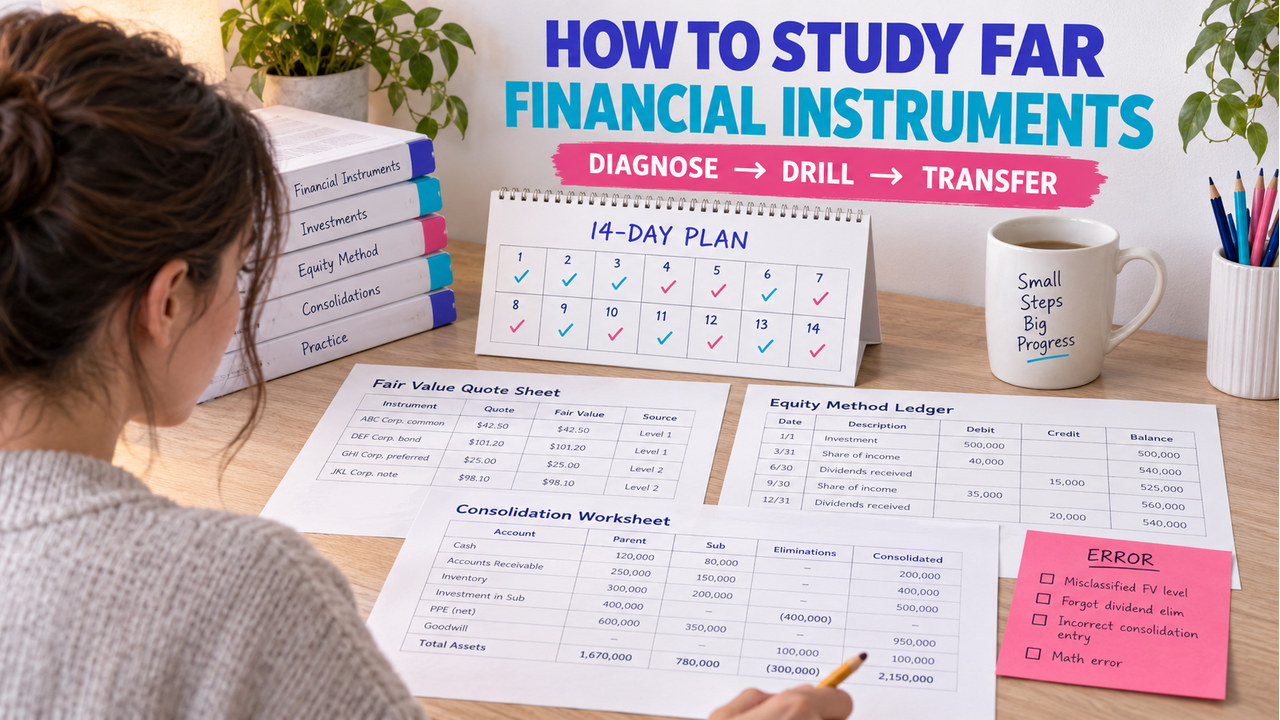

Direct answer: If you need to know how to study financial instruments for CPA FAR, use an adaptive 14-day loop. Start with five original checks, tag the first miss as MEASURE, RELATE, or ELIMINATE, spend each block on one weak lane, and change one fact before you add more questions. This page teaches a study method, not an official exam schedule or a score forecast.
Editorial scope note: This method serves US CPA candidates and uses the current AICPA Blueprint as its October 2, 2026 scope checkpoint. The calendar, examples, options, explanations, visual labels, and review rules come from this editorial packet. A live accounting conclusion still requires complete facts and current research.
For scope, reopen the AICPA CPA Exam Blueprint. For technical research, use the current FASB Accounting Standards Codification and its routes for Topic 321, Topic 323, Topic 810, and Topic 820. The NASBA CPA Exam FAQ covers administration. The FAR review hub can hold the wider section sequence.
How to study financial instruments for CPA FAR
Use the same four-step loop every time: diagnose, drill, transfer, and record. Diagnose with a small baseline before you reread. Drill the narrow field that caused the first miss. Transfer the method by changing one fact. Record the result in a review card so tomorrow’s block starts with evidence.
Three tags keep the loop practical. Start with MEASURE for units, prices, market evidence, and carrying-amount bridges. Then use RELATE for significant influence, control, voting power, and the method-selection trigger. Reserve ELIMINATE for the group boundary, internal counterparties, and unrealized internal profit. That tag gives a study action more precision than a broad label such as “FAR weak area.”
Keep every block inside a time budget. With 15 minutes, repair one bridge. At 25 minutes, add a second changed fact. With 45 minutes, combine a short explanation, two original cases, and a written error log. Instead of passive rereading, make the last five minutes produce a visible next action.
Use a 14-day financial-instruments study cycle
Begin the first two days by creating a baseline, not by chasing a percentage. Next, attempt five original checks without opening the rationales. Afterward, mark the first place where you hesitated. Days 3–5 isolate measurement. On Days 6–8, isolate relationships. For Days 9–11, isolate group eliminations. By Days 12–14, mix the lanes and change one fact in the first weak case.

- Days 1–2 — Baseline: attempt five cases, state the requested output, and tag the first broken field.
- Days 3–5 — Measure: complete units-times-price cases and carrying-amount bridges. Write the input, movement, and ending output separately.
- Days 6–8 — Relate: classify influence or control before you choose a method. Change the ownership fact once and explain the new route.
- Days 9–11 — Eliminate: draw the parent, subsidiary, and counterparty. Remove only the internal effect named by the case.
- Days 12–14 — Transfer: solve a mixed set, change one fact, explain the new answer, and schedule the next narrow retry.
Use a review card at the end of every block. Write the lane, controlling fact, requested output, nearest shortcut, and next action. This record lets you restart quickly after a busy day. It also shows whether the problem came from a method choice or from arithmetic.
Match the block to the weak area
Available time changes the size of the block, not the study method. First, choose the time card. Next, choose the first-miss tag. Then, complete the smallest task that can prove a repair. For example, a 15-minute MEASURE block needs two quote drills, while a 45-minute ELIMINATE block can include a group worksheet and a changed-fact retry.

| Time | First miss | Smallest useful block | Proof of repair |
|---|---|---|---|
| 15 minutes | MEASURE | Two quote or bridge drills | One written input-to-output line |
| 25 minutes | RELATE | One ownership bridge and a changed fact | Method choice plus reason |
| 45 minutes | ELIMINATE | Group worksheet, explanation, retry | Counterparty and effect both named |
Therefore, when a block ends early, stop after the proof of repair. More volume can wait until the method survives a changed fact. Likewise, when a block runs long, keep the error card and shorten the next set. The goal is repeatable evidence, not a crowded calendar.
Attempt five original transfer checks
Attempt each question before opening its rationale. These original simplified cases target the three tags in the plan. State the skill, the assumption, and the requested output first. Then explain why the nearest distractor fails. Use the next retry to change only one fact.
Check 1 — Measure the quoted units
Facts: 320 identical units have a supported measurement-date quote of $27 per unit. Skill: fair-value unit setup. Difficulty: foundation. Question: What amount should the simplified bridge produce?
- A. $27
- B. $293
- C. $8,640
- D. $8,667
Reveal the reasoning
Best answer: C, $8,640. Multiply 320 by $27. A is one-unit data. B subtracts unlike values. D adds the quote to the total. Next action: change units while keeping the quote constant.
Check 2 — Separate equity-method movements
Facts: significant influence exists. Opening investment is $275,000, the investor’s share of income is $18,000, and cash distributions are $4,000. Skill: carrying-amount bridge. Difficulty: foundation. Question: Which ending balance fits?
- A. $253,000
- B. $289,000
- C. $297,000
- D. $279,000
Reveal the reasoning
Best answer: B, $289,000. Use $275,000 + $18,000 − $4,000. A subtracts both movements, C adds the distribution, and D ignores the distribution. Next action: change only the income share and write the bridge again.
Check 3 — Eliminate the internal amount
Facts: a parent controls a subsidiary. The parent recorded a $14,000 profit on inventory sold to the subsidiary, and the goods remain inside the group at period end. Skill: group-boundary reasoning. Difficulty: intermediate. Question: What should the simplified group response do?
- A. Add the $14,000 to group profit
- B. Eliminate the unrealized internal profit
- C. Treat the sale as external because cash moved
- D. Increase ending inventory by $14,000
Reveal the reasoning
Best answer: B. The inventory remains inside the controlled group, so the internal profit has not reached an outside customer. A and D inflate the group result. C confuses cash movement with an external sale. Next action: change the fact so an outside customer buys the goods.
Check 4 — Name observable evidence
Facts: the case supplies a closing quote for the identical instrument in an active market. Skill: evidence classification. Difficulty: foundation. Question: Which description fits the supplied evidence?
- A. Observable quoted price for the identical instrument
- B. Unsupported entity forecast
- C. Prior carrying amount used as today’s quote
- D. Management estimate used despite the quote
Reveal the reasoning
Best answer: A. The active-market quote for the same instrument supplies observable evidence. B and D describe estimates. C confuses a prior balance with current market evidence. Next action: replace the quote with a different input and mark the research question.
Check 5 — Start with the control route
Facts: an investor owns 58% of voting shares and appoints a majority of the governing body. No contrary arrangement appears. Skill: relationship classification. Difficulty: intermediate. Question: Which route should you test first?
- A. Consolidation because the facts indicate control
- B. Equity method because ownership is below 100%
- C. Fair value because ownership never matters
- D. No accounting because the subsidiary is separate
Reveal the reasoning
Best answer: A. The stated voting power and appointment facts point to control in this simplified case. B confuses non-100% ownership with influence. C ignores the relationship. D confuses legal separateness with group reporting. Next action: change the voting facts and state which fact now controls the route.
Record the first miss and choose the next block
Classify the first miss before you open more questions. A MEASURE miss means the learner used the wrong unit, quote, or carrying-amount movement. A RELATE miss means the learner chose a method before reading influence or control. An ELIMINATE miss means the learner ignored the group boundary or internal counterparty.
- Name the lane: MEASURE, RELATE, or ELIMINATE.
- Name the controlling fact: units, market evidence, influence, voting power, control, counterparty, or outside sale.
- Write the shortcut: for example, “I added the distribution” or “I treated cash as an outside sale.”
- Choose the smallest block: 15, 25, or 45 minutes.
- Change one fact and retry: keep the same method, then record whether the explanation still works.
For example, one MEASURE miss needs two quote or bridge drills. A RELATE miss needs one ownership case and one changed voting fact. An ELIMINATE miss needs one parent-subsidiary worksheet with the counterparty circled. After the retry, add volume only when the method survives the fact change.
Keep the study loop current before reuse
Before reusing this how to study financial instruments method, reopen the AICPA CPA Exam Blueprint for scope and the FASB Codification for the technical boundary. Use Topics 321, 323, 810, or 820 as research routes after checking complete current facts. The calendar and tags are original study aids; they do not assign official weights or predict an exam result.
Finally, recheck each amount, option, assumption, image label, and review instruction. If the live fact changes the instrument, reporting date, market evidence, voting arrangement, or internal transaction, pause the old shortcut and research the current source.
How to study financial instruments FAQ
How many days should I use?
Use the 14-day loop as a repeatable template, then adjust the block size to your available time.
What if I have only 15 minutes?
Choose one first-miss tag and complete two narrow drills plus one written proof of repair.
Should I mix all three lanes immediately?
Start with a baseline, isolate the first weak lane, and mix only after a changed-fact retry.
Is this an official exam schedule?
No. It is an original study method bounded by official scope and research sources.